Minnesota Questionnaire For Mediators
About this form
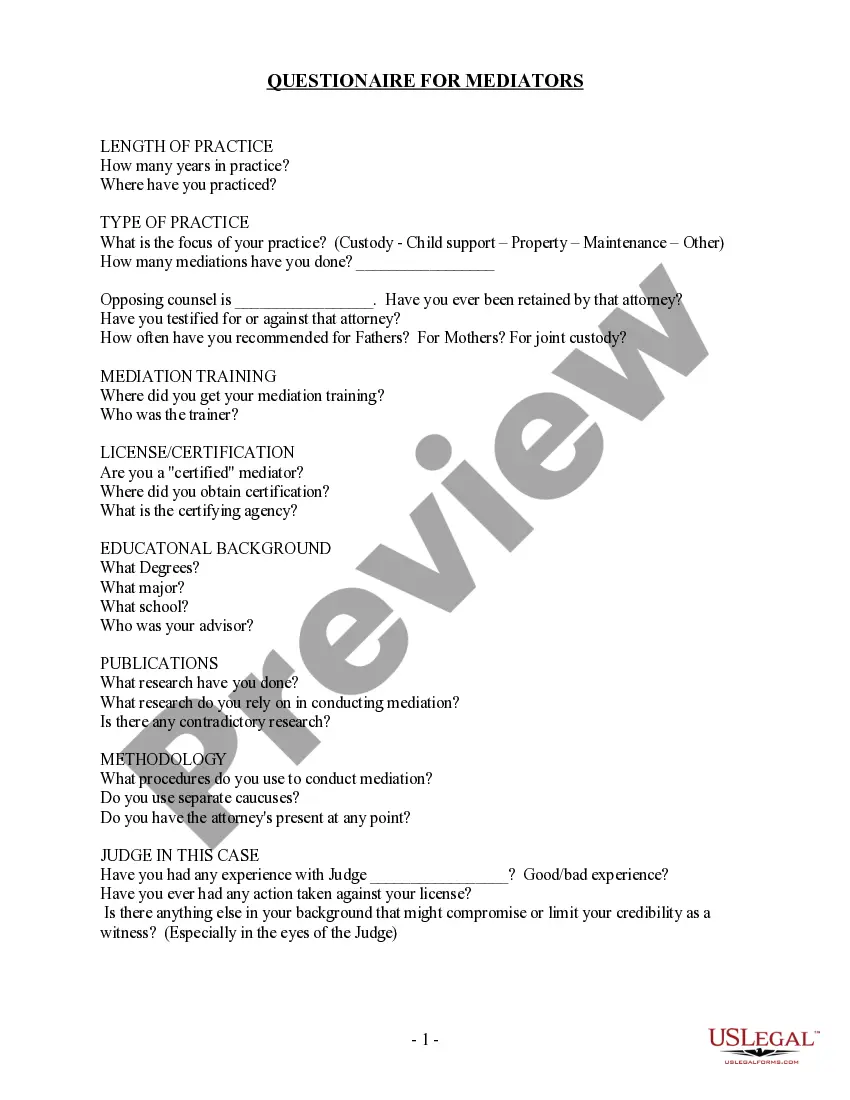
The Questionnaire for Mediators is a specialized form designed to assist attorneys in assessing potential mediators for their cases. By using this form, attorneys can obtain vital information about a mediator's experience, training, and methodologies, helping them to make informed decisions. This form stands out from general mediation forms by focusing specifically on the background and qualifications of mediators, ensuring they align with the needs of the case at hand.
Key parts of this document
- Length of practice: Years of experience and locations of practice.
- Type of practice: Areas of focus such as custody, property, or maintenance.
- Mediation training: Details of training programs and trainers.
- Licensure and certification: Information on mediator certification and certifying agencies.
- Educational background: Degrees obtained and expertise areas.
- Publications: Significant research related to mediation practices.
- Methodology: Procedures utilized during mediation sessions.
- Experience with judges: Any relevant past interactions with judges.


When to use this document
This form is ideal for attorneys seeking to identify suitable mediators for their cases. It can be used in various scenarios, including family law disputes, custody arrangements, and property settlements. The Questionnaire for Mediators helps attorneys ensure the mediator's qualifications match the specific needs of their clients and can provide the best pathway to resolution.
Who this form is for
- Attorneys looking to evaluate mediators for their legal cases.
- Legal professionals involved in family law, custody, or property disputes.
- Individuals seeking to hire a mediator and wanting to vet their qualifications.
Steps to complete this form
- Gather basic information about the mediator, including their years in practice and areas of focus.
- Document the mediator's training background and any relevant certifications.
- Note the number of mediations completed and any associations with opposing counsel.
- Investigate the mediator's methodology and any publications they have authored.
- Seek information regarding past experiences with judges relevant to ongoing cases.
Does this form need to be notarized?
Notarization is generally not required for this form. However, certain states or situations might demand it. You can complete notarization online through US Legal Forms, powered by Notarize, using a verified video call available anytime.
Get your form ready online
Our built-in tools help you complete, sign, share, and store your documents in one place.
Make edits, fill in missing information, and update formatting in US Legal Forms—just like you would in MS Word.
Download a copy, print it, send it by email, or mail it via USPS—whatever works best for your next step.
Sign and collect signatures with our SignNow integration. Send to multiple recipients, set reminders, and more. Go Premium to unlock E-Sign.
If this form requires notarization, complete it online through a secure video call—no need to meet a notary in person or wait for an appointment.
We protect your documents and personal data by following strict security and privacy standards.

Make edits, fill in missing information, and update formatting in US Legal Forms—just like you would in MS Word.

Download a copy, print it, send it by email, or mail it via USPS—whatever works best for your next step.

Sign and collect signatures with our SignNow integration. Send to multiple recipients, set reminders, and more. Go Premium to unlock E-Sign.

If this form requires notarization, complete it online through a secure video call—no need to meet a notary in person or wait for an appointment.

We protect your documents and personal data by following strict security and privacy standards.
Common mistakes
- Failing to ask about specific mediation experiences relevant to the case.
- Overlooking the importance of a mediator's training and certification.
- Not documenting past relationships with opposing counsel adequately.
- Neglecting to verify any potential conflicts of interest.
Why use this form online
- Convenient access to a structured format that guides information gathering easily.
- Editability allows attorneys to customize questions based on their unique needs.
- Reliability, with templates drafted by licensed attorneys ensuring legal soundness.
Legal use & context
- This form facilitates transparent communication between attorneys and mediators.
- Helps establish the credibility of a mediator as a witness if court involvement is necessary.
- Ensures that all parties are adequately prepared for mediation proceedings.
Summary of main points
- The Questionnaire for Mediators is essential for vetting mediators effectively.
- Clear understanding of a mediatorâs qualifications can enhance case outcomes.
- Thorough documentation can prevent conflicts and establish professional trust.
Looking for another form?
Form popularity
FAQ
To request mediation in Minnesota, begin by completing the Minnesota Questionnaire For Mediators. This document helps outline the issues you wish to address and provides essential information about your situation. Once you have filled out the questionnaire, submit it to the appropriate mediation program or mediator. Remember, using the Minnesota Questionnaire For Mediators simplifies the process and ensures that you are prepared for your mediation session.
At mediation, it's important to avoid accusatory or inflammatory language, as it can escalate tensions. Statements that dismiss the other party's feelings or concerns should also be avoided. The Minnesota Questionnaire For Mediators can help participants prepare by highlighting constructive language and approaches that foster a positive dialogue.
Mediators typically ask questions that encourage reflection and clarity, such as, 'What do you hope to achieve?' or 'What are your main concerns?' These questions aim to uncover the real issues at stake. Utilizing the Minnesota Questionnaire For Mediators can assist in identifying these key questions, making the mediation process more effective.
Mediators ask open-ended questions to help parties express their concerns and explore potential solutions. These questions often focus on the underlying interests and needs of each party. The Minnesota Questionnaire For Mediators serves as a valuable tool in this context, guiding mediators in formulating questions that promote dialogue and understanding.
The golden rule of mediation is to treat others as you would like to be treated. This principle promotes respect and understanding, which are critical for effective mediation. By using the Minnesota Questionnaire For Mediators, participants can ensure they approach discussions with empathy, leading to more productive outcomes.
The 4 C's of mediation are communication, collaboration, creativity, and compromise. These principles guide the mediation process, encouraging parties to express their needs and work together towards a solution. Utilizing the Minnesota Questionnaire For Mediators can enhance these aspects by prompting thoughtful discussion and fostering an environment of cooperation.
Rule 114 of the Minnesota General Rules of Practice establishes the process for alternative dispute resolution, specifically mediation. This rule emphasizes the importance of mediation in resolving disputes outside of court, offering a less adversarial approach. The Minnesota Questionnaire For Mediators is often utilized to streamline this process, helping parties identify issues and facilitating discussions.
Online dispute resolution (ODR) offers several advantages over traditional court proceedings. ODR can be more convenient, allowing participants to engage from their homes, and it often resolves issues faster than the court system. The Minnesota Questionnaire For Mediators can facilitate this process, ensuring all relevant information is considered. Ultimately, ODR can provide a more flexible and less adversarial environment for resolving disputes.
Alternative dispute resolution (ADR) in Minnesota encompasses various methods, including mediation, arbitration, and negotiation, to resolve disputes outside of court. ADR provides parties an opportunity to collaborate and find mutually beneficial solutions, often using tools like the Minnesota Questionnaire For Mediators to streamline the process. This approach can lead to quicker and less expensive outcomes compared to traditional litigation. Resources such as USLegalForms can guide you in understanding and accessing these ADR options.
A Rule 114 neutral refers to a trained mediator who facilitates discussions between parties in a dispute, aiming for a fair resolution. These neutrals are essential in Minnesota's alternative dispute resolution process. They guide participants through the Minnesota Questionnaire For Mediators, helping them clarify their issues and objectives. Utilizing a Rule 114 neutral can lead to more amicable settlements, saving time and reducing stress.