Delegation Checklist
Understanding this form
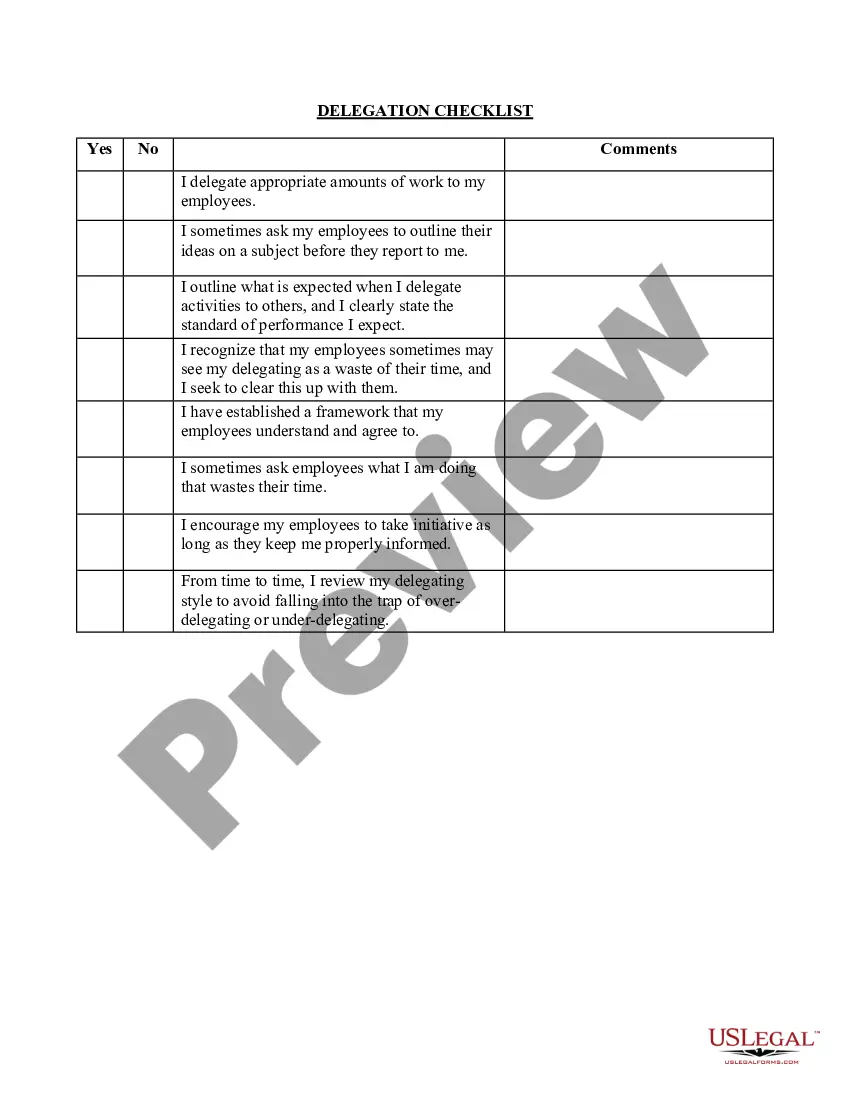
The Delegation Checklist is a management tool designed to help evaluate the proper delegation of tasks within an organization. This checklist allows managers to assess and ensure that responsibilities are assigned effectively among team members. Unlike other forms that may simply outline tasks or assignments, this checklist provides a systematic way to guarantee that all aspects of delegation are considered and addressed.
Main sections of this form
- Evaluation criteria for task delegation
- Priority ranking of tasks
- Section for identifying team members
- Checklist for ensuring clarity in responsibilities
- Notes section for additional comments

Situations where this form applies
This form is particularly useful when management is planning a project that requires distributing tasks among team members. It can also serve as a helpful reference during performance reviews, team restructuring, or when implementing new workflows. Use this checklist to ensure that all relevant matters are considered when delegating responsibilities, thereby enhancing productivity and accountability within the team.
Who can use this document
- Managers seeking to improve delegation practices
- Team leaders assigning tasks for specific projects
- Supervisors conducting employee performance evaluations
- Human resources professionals involved in organizational development
How to complete this form
- Identify the tasks that need to be delegated.
- Evaluate each task using the provided criteria.
- Rank the priority of each task to ensure critical ones are handled first.
- Assign tasks to team members based on their strengths and availability.
- Add any notes or comments that may help clarify expectations.
Does this document require notarization?
This form does not typically require notarization to be legally valid. However, some jurisdictions or document types may still require it. US Legal Forms provides secure online notarization powered by Notarize, available 24/7 for added convenience.
Get your form ready online
Our built-in tools help you complete, sign, share, and store your documents in one place.
Make edits, fill in missing information, and update formatting in US Legal Forms—just like you would in MS Word.
Download a copy, print it, send it by email, or mail it via USPS—whatever works best for your next step.
Sign and collect signatures with our SignNow integration. Send to multiple recipients, set reminders, and more. Go Premium to unlock E-Sign.
If this form requires notarization, complete it online through a secure video call—no need to meet a notary in person or wait for an appointment.
We protect your documents and personal data by following strict security and privacy standards.

Make edits, fill in missing information, and update formatting in US Legal Forms—just like you would in MS Word.

Download a copy, print it, send it by email, or mail it via USPS—whatever works best for your next step.

Sign and collect signatures with our SignNow integration. Send to multiple recipients, set reminders, and more. Go Premium to unlock E-Sign.

If this form requires notarization, complete it online through a secure video call—no need to meet a notary in person or wait for an appointment.

We protect your documents and personal data by following strict security and privacy standards.
Mistakes to watch out for
- Failing to involve team members in the delegation process.
- Overloading individuals with too many responsibilities.
- Neglecting to clarify task details and expectations.
- Not reviewing the delegation effectiveness after completion.
Benefits of using this form online
- Convenient access from any device at any time.
- Easy to edit and customize for specific projects.
- Secure storage of completed forms online for future reference.
- Reduces paperwork and helps maintain an organized system of delegation.
Main things to remember
- The Delegation Checklist helps improve task delegation.
- It ensures clarity and accountability among team members.
- This form is applicable for various management scenarios.
Looking for another form?

Form popularity
FAQ
Determine goals: Clarify responsibility and authority: Motivate subordinates: Provide training: Establish adequate control: Require completed work: Two-Way communication: Adherence to the principle of delegation:
Elements of Delegation Responsibility, Authority and Accountability (With Features and Differences) There are three elements of delegation, i.e., Responsibility, Authority and Accountability.
Gives you the time and ability to focus on higher-level tasks. Gives others the ability to learn and develop new skills. Develops trust between workers and improves communication. Improves efficiency, productivity, and time management.
Every time you delegate work to a teammate, three inescapable core elements of delegation are in play. Authority, responsibility, and accountability form an integrated process and must be applied by you as a unified whole.
Utilize the five rights of delegation (e.g., right task, right circumstances, right person, right direction or communication, right supervision or feedback)
Company's History: The history of the company influences the degree of delegation. Availability of Capable Persons: Importance and Costliness of Decisions: Size of the Enterprise: Available Controls: Types of Enterprise: Environmental Factors:
Identify the tasks you are going to delegate, and what the outputs are. Determine who you will delegate the tasks to. Create a management plan for the person assigned to these tasks. Schedule regular status meetings with the employee(s) you have delegated tasks to.
Wanting to do Things Personally: Insecurity: Retention of Power: Lack of Confidence in Subordinates: Unwillingness to Set Standards of Control: Lack of Confidence: Fear of Making Mistakes: Lack of Incentives:
Determine what you will delegate. Effective delegation begins with defining your responsibilities. Choose the right person to delegate the task to. Clarify the desired results. Clearly define the employee's responsibility and authority as it relates to the delegated task. Establish a follow up meeting or touch points.