Company Property Checklist
Understanding this form
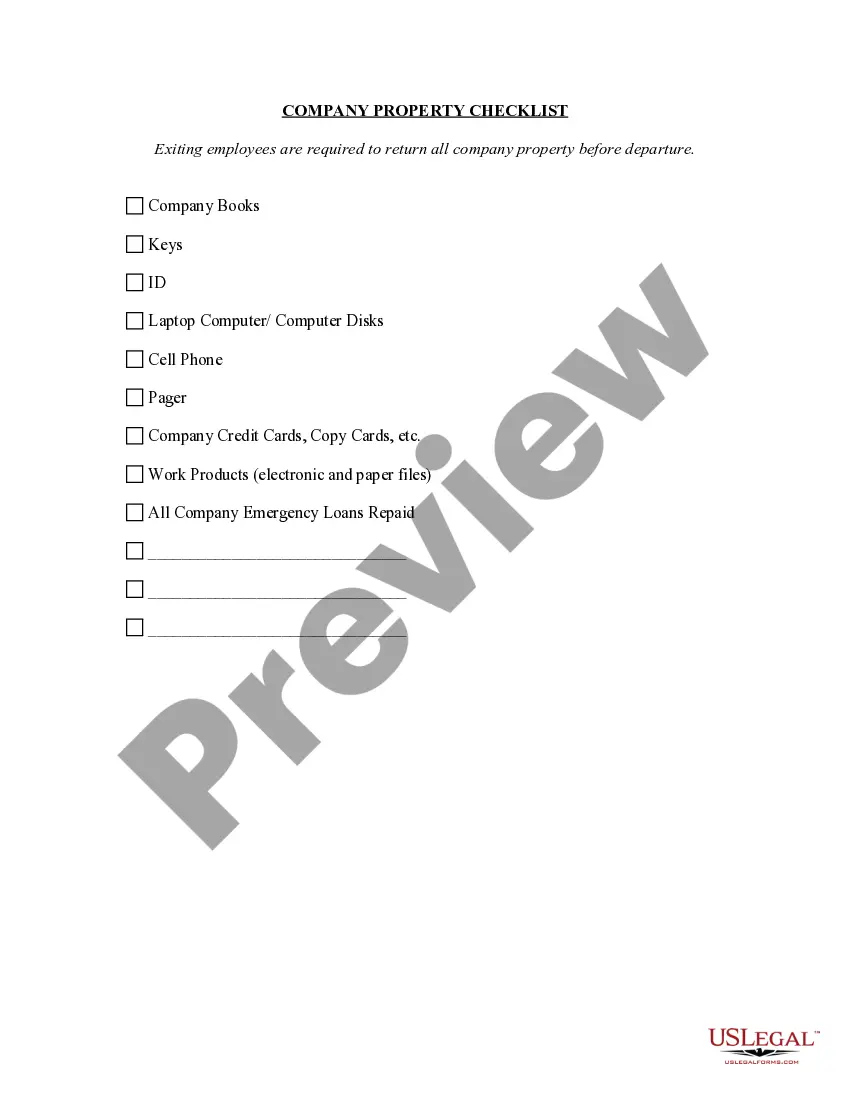
The Company Property Checklist is a vital document designed for employers to ensure that exiting employees return all company property before their departure. This form helps safeguard the organization's assets and can prevent potential disputes related to unreturned items. It is specifically tailored to meet the needs of employers of all sizes, and effectively differs from general employment termination forms by focusing specifically on property return obligations.
Key components of this form
- Company books and materials
- Keys and access cards
- Identification badges
- Laptop computers and computer disks
- Mobile devices, including cell phones and pagers
- Company credit cards and other financial instruments
- Work products, both electronic and paper files
- Documentation of company emergency loans and their repayment
When to use this document
This form should be used when an employee is exiting the organization, whether through resignation, termination, or retirement. It serves as a checklist to ensure that all company property is accounted for and returned, thus avoiding misunderstandings and ensuring compliance with company policies regarding property management.
Who can use this document
- Employers of all sizes from small businesses to large corporations
- Human resources professionals handling employee exits
- Managers overseeing the return of company property
- Administrators responsible for maintaining inventory of company assets
Steps to complete this form
- List all company property issued to the employee.
- Ensure each item is checked off as it is returned.
- Gather any additional items the employee may need to return (e.g., company credit cards).
- Document any outstanding obligations, such as unrepaid emergency loans.
- Have the employee sign the completed checklist to confirm the return of all items.
Does this form need to be notarized?
This form does not typically require notarization unless specified by local law. Organizations may wish to retain this checklist for their records, but notarization is generally not necessary for its validity.
Get your form ready online
Our built-in tools help you complete, sign, share, and store your documents in one place.
Make edits, fill in missing information, and update formatting in US Legal Forms—just like you would in MS Word.
Download a copy, print it, send it by email, or mail it via USPS—whatever works best for your next step.
Sign and collect signatures with our SignNow integration. Send to multiple recipients, set reminders, and more. Go Premium to unlock E-Sign.
If this form requires notarization, complete it online through a secure video call—no need to meet a notary in person or wait for an appointment.
We protect your documents and personal data by following strict security and privacy standards.

Make edits, fill in missing information, and update formatting in US Legal Forms—just like you would in MS Word.

Download a copy, print it, send it by email, or mail it via USPS—whatever works best for your next step.

Sign and collect signatures with our SignNow integration. Send to multiple recipients, set reminders, and more. Go Premium to unlock E-Sign.

If this form requires notarization, complete it online through a secure video call—no need to meet a notary in person or wait for an appointment.

We protect your documents and personal data by following strict security and privacy standards.
Mistakes to watch out for
- Failing to include all items issued to the employee.
- Not having the employee sign the checklist upon return of items.
- Overlooking the need to document any financial obligations.
- Assuming verbal confirmation of item return is sufficient.
Why complete this form online
- Immediate access to a professionally drafted form.
- Customizable to fit specific company needs.
- Easy to download and print for immediate use.
- Saves time compared to drafting a checklist from scratch.
Summary of main points
- The Company Property Checklist helps ensure that all assets are returned upon employee exit.
- Using this form prevents potential loss of company property and enhances accountability.
- It is a straightforward tool that can be easily adapted for various business needs.
Looking for another form?
Form popularity
FAQ
Go somewhere private and then lead with the punch line, says Glickman. She suggests you begin by saying, I have some bad news for you. Today is your last day here. Then state the reason for termination in one simple sentence. Be transparent, she says.
The file should have an employee termination checklist form to be followed and basic details of the employee such as name, department, position as well as important details such as the reason for termination, last day of work and the name of the person handling their file.
Termination letter due to layoffs/downsizing. Termination letter for cause (misconduct/performance/attendance, etc.) Termination of business contract.
Identify and Document the Issues. Coach Employees to Rectify the Issue. Create a Performance Improvement Plan. Terminate the Employee. Have HR Conduct an Exit Interview.
Immediately develop a hiring plan to replace the employee. Frame the resignation as an opportunity for remaining team members to take on new responsibilities and learn new things. Publicly acknowledge the employee's departure and his contributions to the team.
You can start this off by saying: "Per company policy, employees must return all property back to the organization in insert number of days after a termination/layoff/etc."
The employer must provide the employee with his or her final paycheck during the termination meeting.In addition, make sure to provide the employee with all documentation regarding applicable benefits (including retirement benefits and insurance/COBRA information, if applicable) and unemployment benefits.
Depending on the value of the property at issue, an employer may be able to file a small claims action against a former employee who won't return its property. Also, in some circumstances you may be able to put an employee on an unpaid suspension pending the return of property.