Minnesota Discovery - Request for Admissions in a Paternity Action
What this document covers
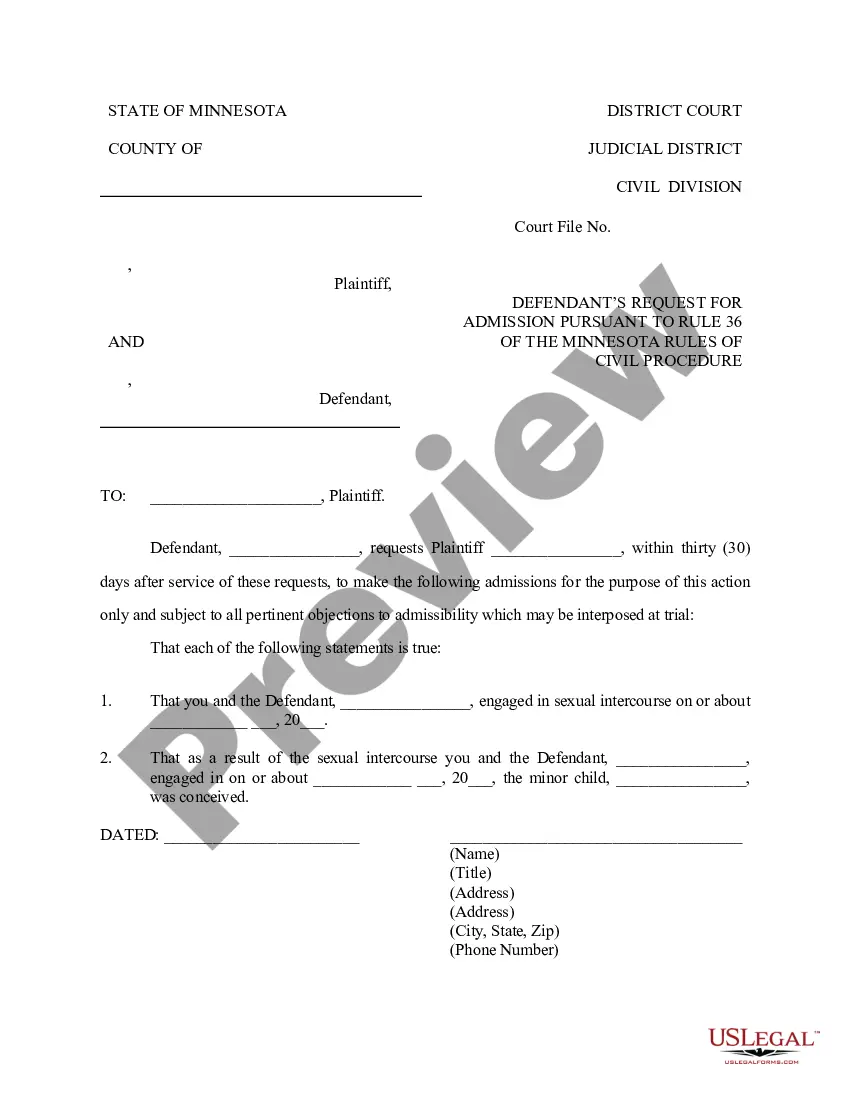
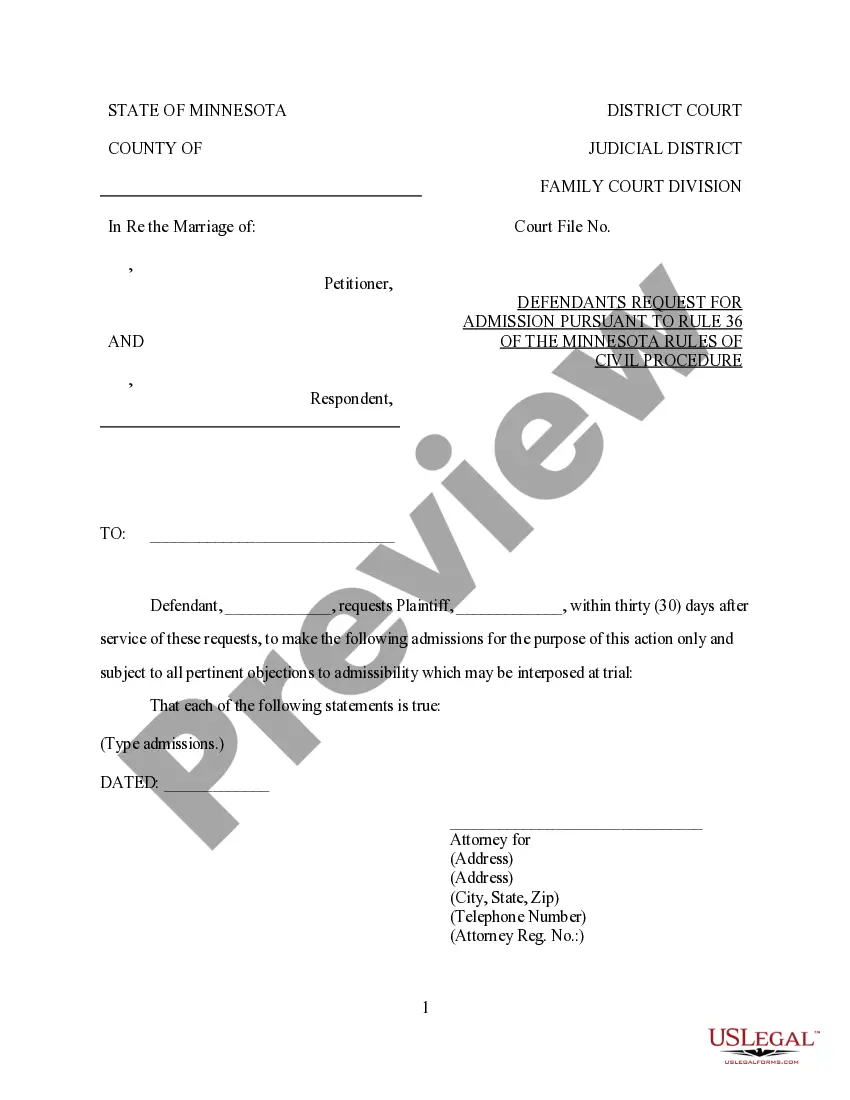
The Discovery - Request for Admissions in a Paternity Action is a legal document used in paternity cases where the defendant requests the plaintiff to admit specific facts. This form helps clarify details that may be undisputed, enabling both parties to focus on the contested issues in the case. It is important to note that this form is specifically tailored for paternity actions and differs from other discovery forms, such as interrogatories or requests for production of documents.
Form components explained
- Request for admissions directed to the plaintiff.
- Specific statements regarding the sexual relationship and the conception of the child.
- Time frame for the plaintiff to respond (thirty days after service).
- Signature block for the defendant including name and contact details.
When to use this document
This form should be used when a defendant in a paternity action needs to clarify certain facts regarding the relationship and the conception of the child involved. It is particularly useful when both parties may agree on some of the facts, which can streamline the legal process and reduce the overall time and cost of litigation. Common scenarios include cases where paternity is in dispute, or when establishing legal rights and responsibilities regarding the child.
Who this form is for
This form is intended for the following individuals:
- Defendants in a paternity action who want to secure admissions from the plaintiff.
- Individuals seeking to resolve factual disputes regarding the conception and relationship.
- Legal representatives assisting clients in paternity cases.
How to prepare this document
- Identify the parties involved in the paternity action (plaintiff and defendant).
- Fill in the date when the sexual intercourse occurred.
- State the name of the minor child conceived as a result of the relationship.
- Sign and date the form, including your contact information for service.
- Ensure the form is served to the plaintiff within the required timeframe.
Does this document require notarization?
Notarization is generally not required for this form. However, certain states or situations might demand it. You can complete notarization online through US Legal Forms, powered by Notarize, using a verified video call available anytime.
Get your form ready online
Our built-in tools help you complete, sign, share, and store your documents in one place.
Make edits, fill in missing information, and update formatting in US Legal Forms—just like you would in MS Word.
Download a copy, print it, send it by email, or mail it via USPS—whatever works best for your next step.
Sign and collect signatures with our SignNow integration. Send to multiple recipients, set reminders, and more. Go Premium to unlock E-Sign.
If this form requires notarization, complete it online through a secure video call—no need to meet a notary in person or wait for an appointment.
We protect your documents and personal data by following strict security and privacy standards.

Make edits, fill in missing information, and update formatting in US Legal Forms—just like you would in MS Word.

Download a copy, print it, send it by email, or mail it via USPS—whatever works best for your next step.

Sign and collect signatures with our SignNow integration. Send to multiple recipients, set reminders, and more. Go Premium to unlock E-Sign.

If this form requires notarization, complete it online through a secure video call—no need to meet a notary in person or wait for an appointment.

We protect your documents and personal data by following strict security and privacy standards.
Typical mistakes to avoid
- Failing to serve the form within the thirty-day period.
- Not including complete information about the parties and the child.
- Neglecting to sign the form before serving it to the plaintiff.
Why complete this form online
- Convenience of accessing and downloading the form at any time.
- Editability allows users to tailor the form to their specific situation.
- Reliability, as the form is drafted by licensed attorneys to meet legal standards.
Legal use & context
- This form is legally recognized in paternity actions to clarify disputed issues.
- The admissions requested can simplify legal proceedings by establishing agreed-upon facts.
- Failure to respond to the request can lead to automatic admissions of the statements made.
Summary of main points
- This form is essential for requesting admissions in paternity actions.
- Serves to clarify undisputed facts to streamline the legal process.
- It's important to complete and serve the form accurately and within the specified timeframe.
Looking for another form?

Form popularity
FAQ
An Acknowledgement of Paternity in Minnesota is a legal document that establishes a father's rights and responsibilities toward his child. This acknowledgment can be signed voluntarily by both parents and is crucial for determining legal parentage. If you require assistance with the process, utilizing platforms like US Legal Forms can make it easier, particularly if you are navigating a Minnesota Discovery - Request for Admissions in a Paternity Action.
Unmarried fathers in Minnesota have certain rights, including the ability to seek custody, visitation, and child support. However, these rights may not be automatically granted unless paternity is established legally. Engaging in a Minnesota Discovery - Request for Admissions in a Paternity Action can help you assert your rights and responsibilities more clearly, ensuring a fair process.
To file a declaration of paternity in Minnesota, you need to complete the necessary forms and submit them to the appropriate court or agency. This declaration serves as legal proof of paternity and can impact custody and support issues. For assistance with the process, consider using resources like US Legal Forms, which provide comprehensive guidance and templates, especially when preparing for a Minnesota Discovery - Request for Admissions in a Paternity Action.
In Minnesota, a father can establish paternity at any time before the child turns 18. It's important to act swiftly, especially if there are legal matters pending. Utilizing tools like the Minnesota Discovery - Request for Admissions in a Paternity Action can help facilitate the process and clarify your rights regarding paternity.
In Minnesota, if a father is listed on the birth certificate, he has legal rights regarding custody, visitation, and child support. This designation establishes him as the legal parent, which means he can seek to be involved in decisions about the child's upbringing. However, these rights can be affected by ongoing legal actions, such as a Minnesota Discovery - Request for Admissions in a Paternity Action, which may clarify paternity issues further.
Rule 33 of the Minnesota Rules of Civil Procedure enables parties to submit written questions to each other, promoting transparency and clarity in legal proceedings. This rule can significantly impact the outcome of a case by ensuring that all relevant facts are disclosed. When engaging in Minnesota Discovery - Request for Admissions in a Paternity Action, understanding Rule 33 can enhance your legal approach.
The Rule 33 in the Minnesota Rules of Civil Procedure deals specifically with interrogatories, allowing parties to gather information relevant to their case. This rule enhances communication and clarity between parties, ultimately benefiting the court process. Utilizing this rule effectively can be a key part of your strategy in Minnesota Discovery - Request for Admissions in a Paternity Action.
Order 33 of the Civil Procedure Code typically refers to the guidelines surrounding interrogatories in legal proceedings. It establishes how parties can request information from each other, which is crucial in cases like paternity actions. By following Order 33, you can ensure compliance in your Minnesota Discovery - Request for Admissions in a Paternity Action.
Rule 33 of Civil Procedure governs the use of interrogatories, which are written questions one party sends to another. The responding party must answer these questions under oath, providing essential information for the case. Utilizing Rule 33 can be beneficial in the context of Minnesota Discovery - Request for Admissions in a Paternity Action, as it clarifies positions and evidence.
Rule 36.01 in Minnesota outlines the process for requests for admissions, allowing one party to request another to admit or deny the truth of specific matters related to the case. This rule helps streamline the litigation process by narrowing down the issues that need to be resolved. By effectively using Rule 36.01, you can enhance your strategy for Minnesota Discovery - Request for Admissions in a Paternity Action.