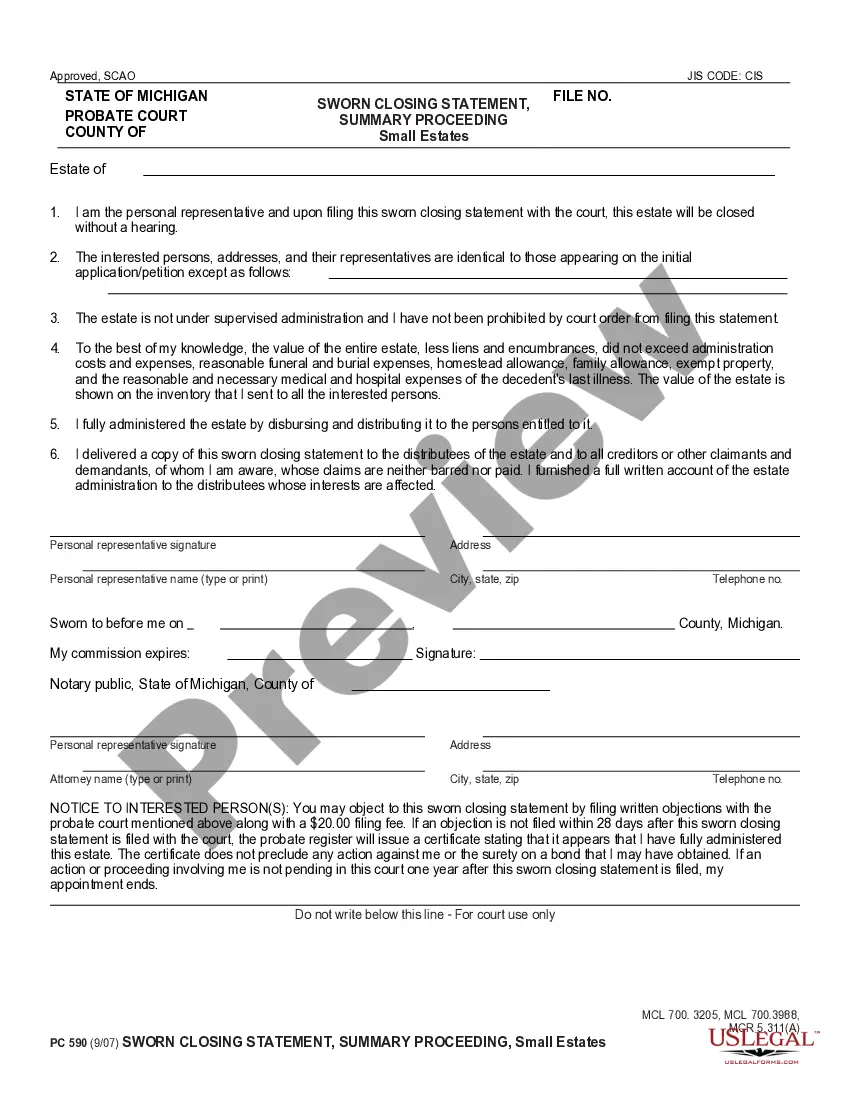
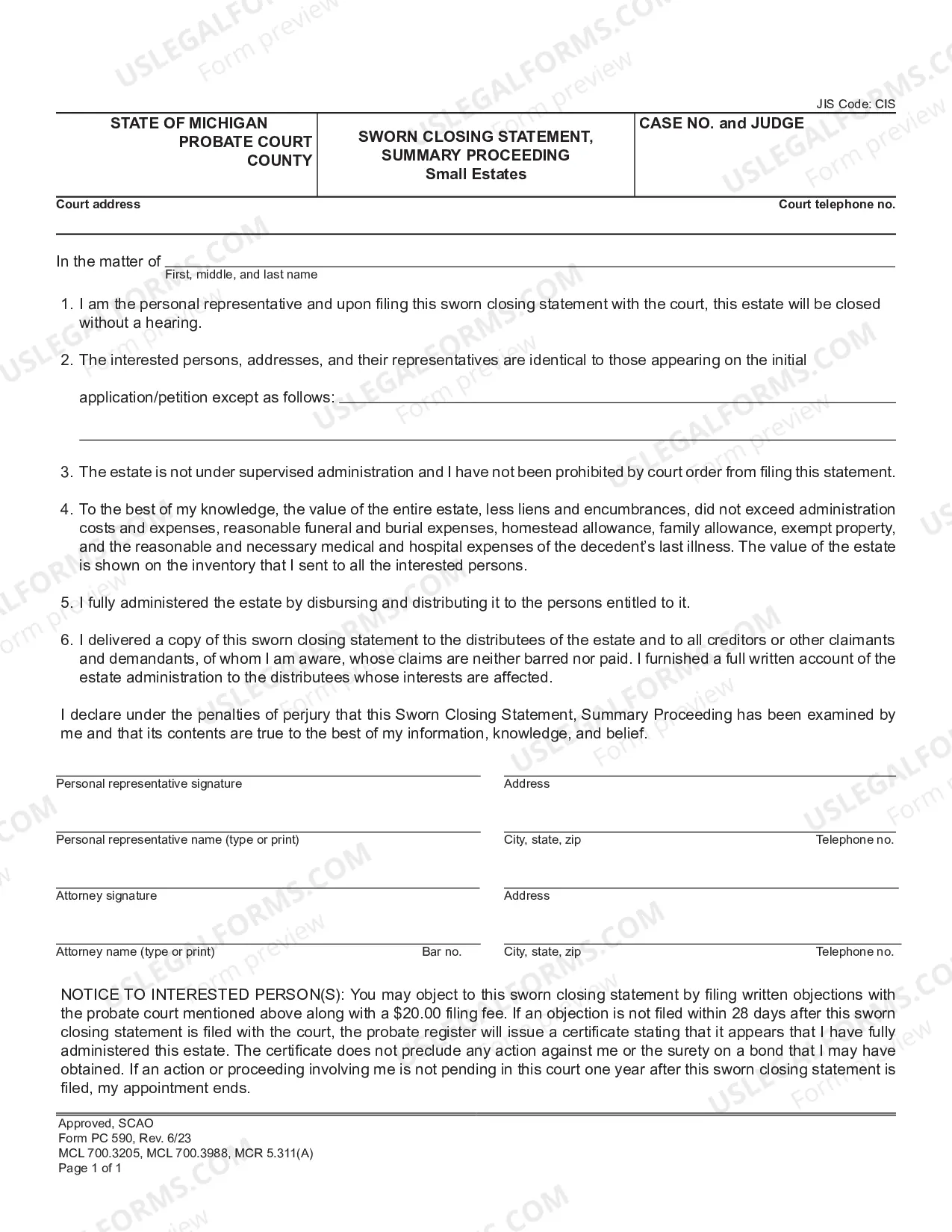
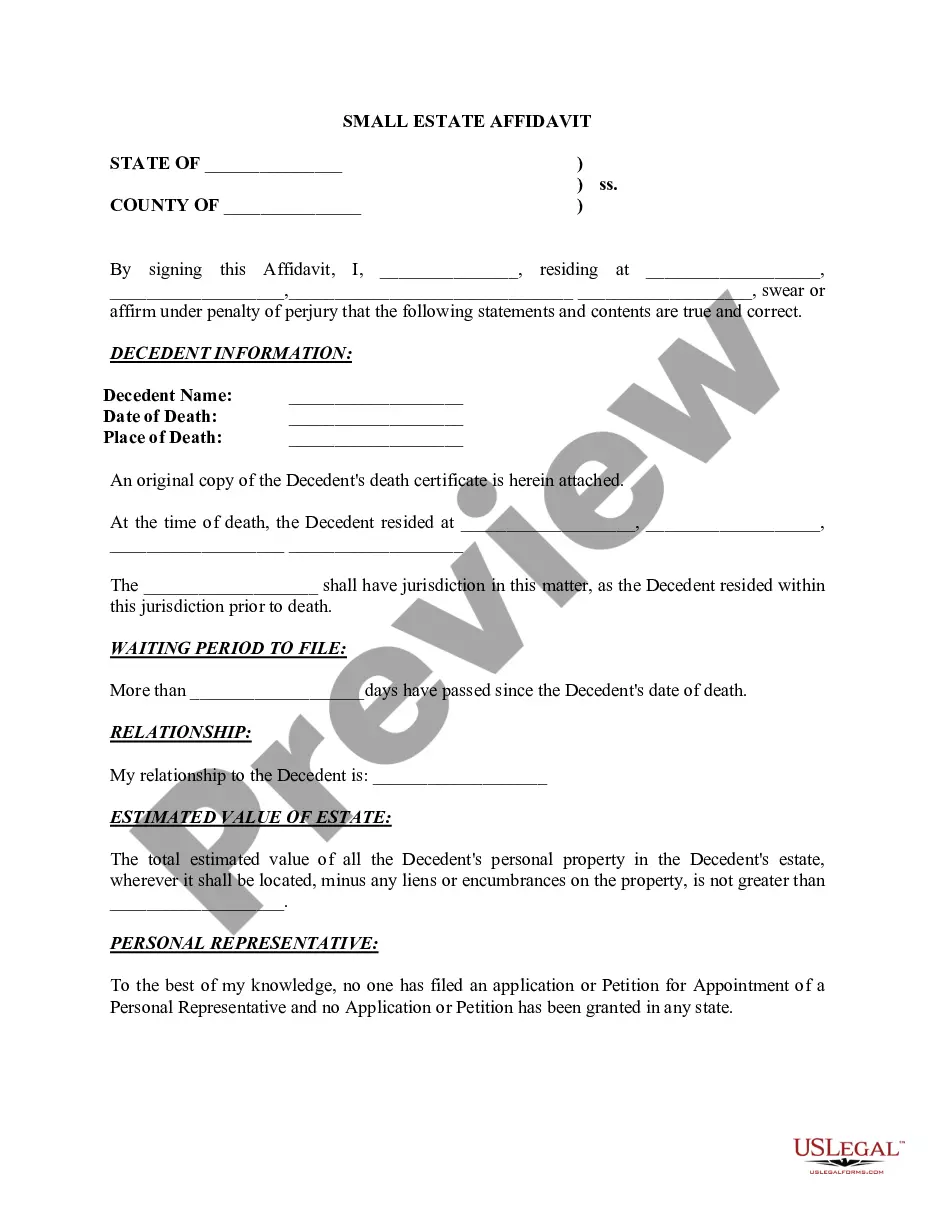
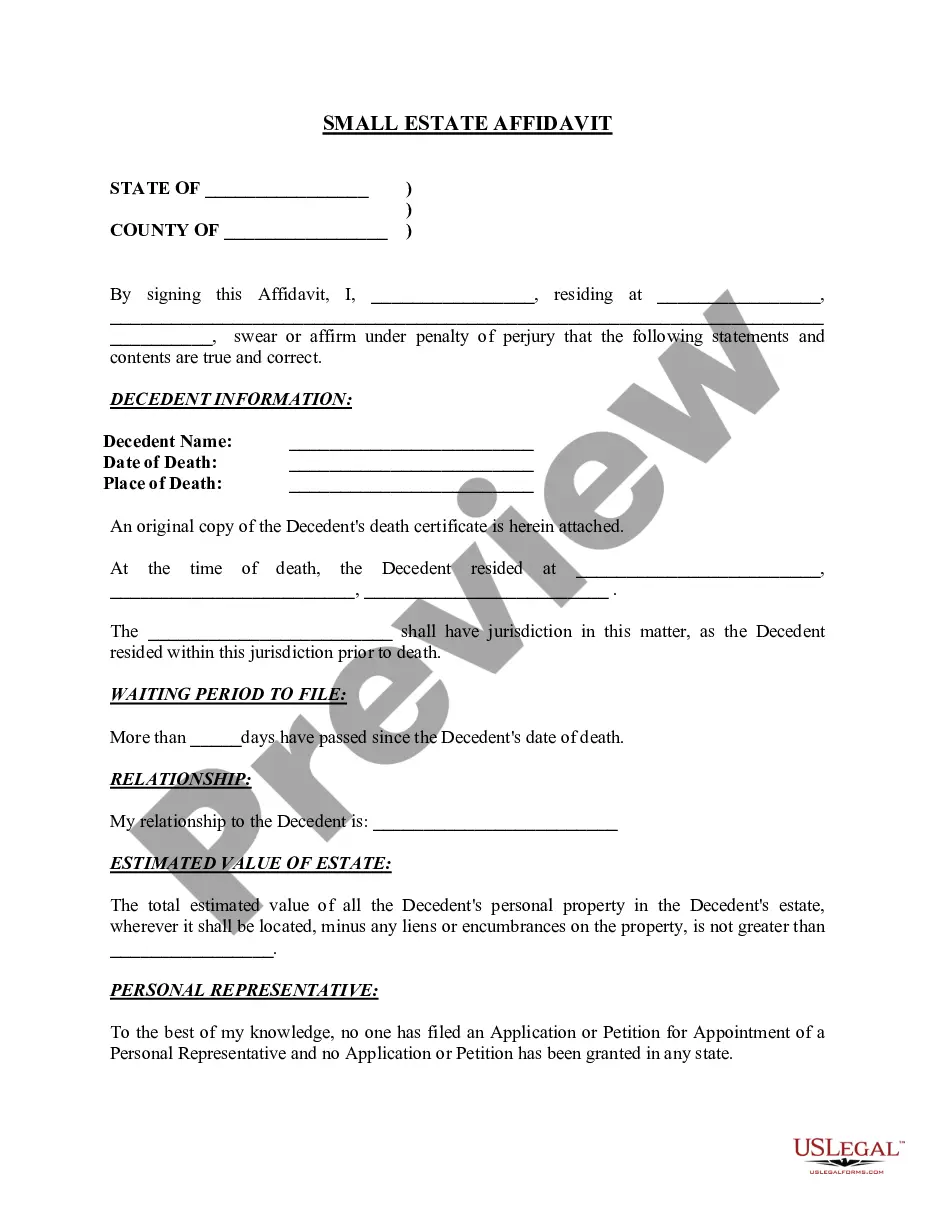
Michigan Sworn Closing Statement, Summary Proceeding, Small Estates
Description

Get your form ready online
Our built-in tools help you complete, sign, share, and store your documents in one place.
Make edits, fill in missing information, and update formatting in US Legal Forms—just like you would in MS Word.
Download a copy, print it, send it by email, or mail it via USPS—whatever works best for your next step.
Sign and collect signatures with our SignNow integration. Send to multiple recipients, set reminders, and more. Go Premium to unlock E-Sign.
If this form requires notarization, complete it online through a secure video call—no need to meet a notary in person or wait for an appointment.
We protect your documents and personal data by following strict security and privacy standards.

Make edits, fill in missing information, and update formatting in US Legal Forms—just like you would in MS Word.

Download a copy, print it, send it by email, or mail it via USPS—whatever works best for your next step.

Sign and collect signatures with our SignNow integration. Send to multiple recipients, set reminders, and more. Go Premium to unlock E-Sign.

If this form requires notarization, complete it online through a secure video call—no need to meet a notary in person or wait for an appointment.

We protect your documents and personal data by following strict security and privacy standards.
Looking for another form?
How to fill out Michigan Sworn Closing Statement, Summary Proceeding, Small Estates?
Access any template from 85,000 legal documents including Michigan Sworn Closing Statement, Summary Proceeding, Small Estates online with US Legal Forms. Each template is prepared and refreshed by state-certified attorneys.
If you possess a subscription, Log In. Upon reaching the form’s page, click on the Download button and navigate to My documents to retrieve it.
If you haven’t subscribed yet, follow the guidelines below.
With US Legal Forms, you will consistently have instant access to the relevant downloadable template. The platform provides access to documents and categorizes them to enhance your search experience. Use US Legal Forms to acquire your Michigan Sworn Closing Statement, Summary Proceeding, Small Estates quickly and efficiently.
- Review the state-specific criteria for the Michigan Sworn Closing Statement, Summary Proceeding, Small Estates you wish to utilize.
- Examine the description and preview the sample.
- Once you are certain the template meets your requirements, click Buy Now.
- Choose a subscription plan that truly fits your budget.
- Establish a personal account.
- Make a payment using one of two suitable methods: by credit card or through PayPal.
- Select a format to download the document in; two options are available (PDF or Word).
- Download the document to the My documents section.
- After your reusable template is downloaded, print it or save it to your device.
Form popularity
FAQ
Typically, a small estate affidavit does not need to be filed with the court in Michigan unless there are complications or disputes. However, submitting it could help clarify the process and expedite the Summary Proceeding. Always check local regulations, as requirements may vary slightly by jurisdiction. Using USLegalForms can help you stay informed about the necessary steps in this process.
Writing a small estate affidavit involves detailing the assets and liabilities of the deceased, along with personal information about the heirs. You should clearly state your relationship to the deceased and how the estate will be distributed. It's advisable to follow a template or format provided by credible sources, like USLegalForms, to ensure compliance with Michigan laws and regulations regarding Small Estates.
In Michigan, affidavits generally do require notarization for them to be considered valid. This requirement ensures that the information you provide is verified and trustworthy. When submitting your Michigan Sworn Closing Statement, having it notarized adds an extra layer of authenticity to your Summary Proceeding. Using a reliable service can help guide you through this step.
Yes, anyone who meets the legal requirements can fill out a small estate affidavit in Michigan. Generally, individuals eligible to file a Michigan Sworn Closing Statement include heirs, beneficiaries, or personal representatives of the deceased. It's important for you to accurately list all assets and debts of the estate. Utilizing platforms like USLegalForms can simplify this process.
To file a small estate affidavit in Michigan, you must prepare the affidavit according to state guidelines. Make sure to include details about the deceased’s assets and heirs. After completing the form, submit it to the probate court along with any supporting documents. Utilize uslegalforms for easy access to forms and instructions tailored to Michigan's small estates process.
Closing an estate in Michigan typically involves submitting a Michigan sworn closing statement to the court. First, you need to ensure all debts, taxes, and expenses are settled. After that, file the necessary documents, including any required affidavits, with the probate court. Online resources, including uslegalforms, can provide guidance and templates to make this process smoother.
Filling out a small estate affidavit form can be straightforward. Begin by gathering all necessary information, such as the deceased's assets, debts, and details of the heirs. You can find templates online, including options from uslegalforms, which helps simplify this process. Ensure that you understand Michigan’s laws regarding sworn closing statements in summary proceedings to avoid common pitfalls.
Form PC 598 is a vital document used in Michigan's probate process, particularly for small estate proceedings. This form assists in disbursing the decedent's assets without a formal probate court procedure, thus simplifying the process for small estates. By utilizing the PC 598 form, individuals directly manage the estate's affairs, saving time and legal costs. Accessing this form through the US Legal Forms platform can provide you with a streamlined experience.
To obtain a small estate affidavit in Michigan, you should meet specific eligibility criteria, such as the estate's total value not exceeding a certain limit. You can create the affidavit using forms available on the US Legal Forms platform, which simplifies the process ensuring compliance with Michigan laws. Once completed, you will file the affidavit in the appropriate probate court, facilitating a smoother transition for small estates. This can expedite the distribution of assets without the need for the full probate process.
A closing statement for an estate outlines the financial details involved in settling the estate. It serves as a summary of all the assets and liabilities, ensuring a transparent process in Michigan's sworn closing statement. This document is crucial in summary proceedings and small estates, making it easier for executors to close the estate efficiently. Understanding this statement helps all parties stay informed throughout the process.