Michigan Complaint to Determine Paternity, Custody
About this form
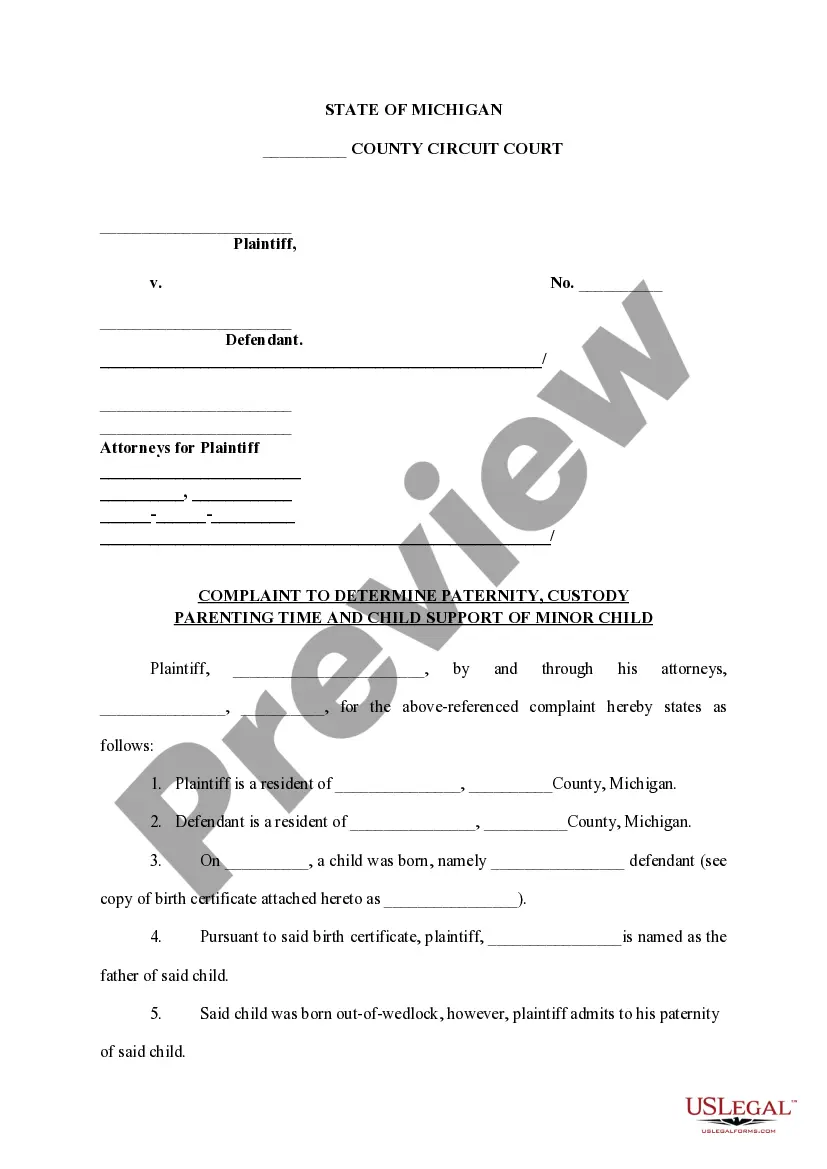
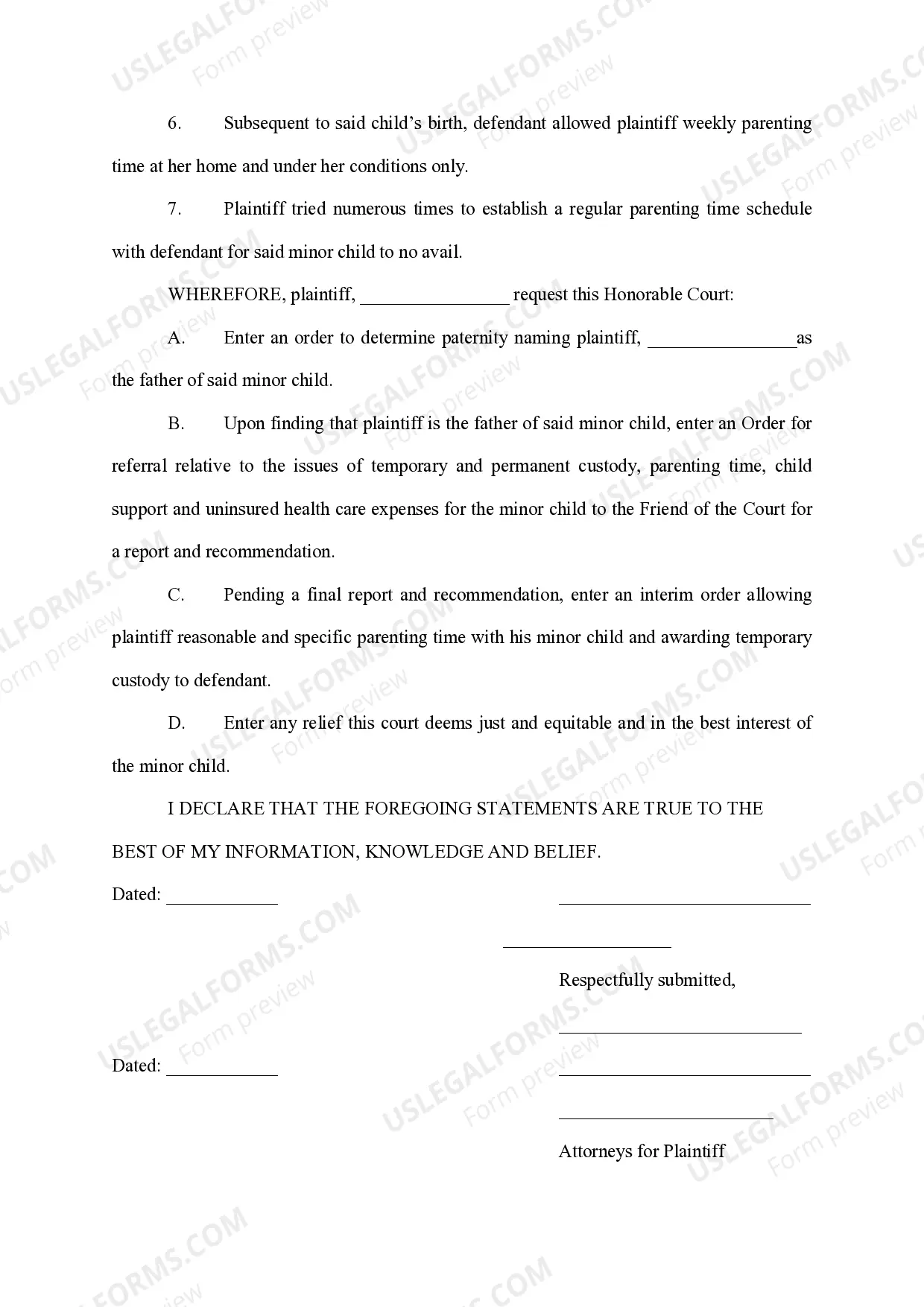
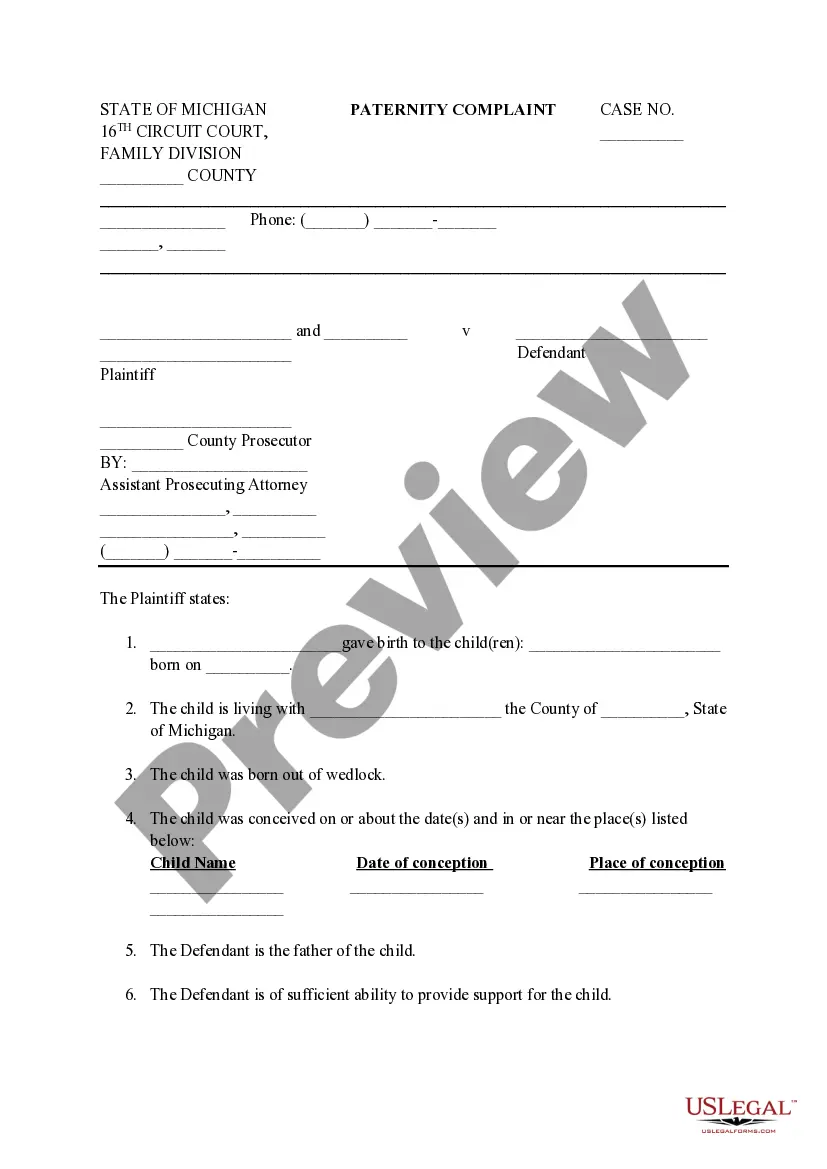
The Complaint to Determine Paternity, Custody form is a legal document used to initiate a paternity action in family court. This form serves to establish paternity for a child born out of wedlock and seeks court orders related to custody, parenting time, and child support. By filing this complaint, a parent can clarify their legal rights and responsibilities regarding a minor child, distinguishing it from other family law forms related to custody or visitation alone.
What’s included in this form
- Identification of parties: Names and addresses of both the plaintiff and defendant.
- Details of the child: Information regarding the child born out of wedlock, including the birth date and the attached birth certificate.
- Admission of paternity: A statement where the plaintiff acknowledges their paternity of the child.
- Request for relief: Specific requests for the courtâs determination regarding paternity, custody, and parenting time.
- Signature and declaration: The plaintiff's declaration attesting to the accuracy of the information provided.
When this form is needed
This form is typically used when a father wants to establish legal paternity for a child born out of wedlock. It can be especially important in cases where the father seeks custody rights or wishes to secure child support. Use this form if you are facing challenges in accessing parenting time or need formal determination of custody arrangements with the childâs mother.
Who can use this document
- Fathers seeking to establish legal paternity of their child born out of wedlock.
- Parents who need a court order for custody and parenting time arrangements.
- Individuals looking to address child support responsibilities and rights.
Instructions for completing this form
- Identify the parties involved by entering the names and addresses of the plaintiff and defendant.
- Provide details about the child including their name and date of birth, along with an attached birth certificate.
- Clearly state the plaintiffâs admission of paternity regarding the child.
- Outline the specifics of your request, including any parenting time and custody arrangements you seek from the court.
- Sign and date the form after filling in all relevant information.
Does this form need to be notarized?
In most cases, this form does not require notarization. However, some jurisdictions or signing circumstances might. US Legal Forms offers online notarization powered by Notarize, accessible 24/7 for a quick, remote process.
Get your form ready online
Our built-in tools help you complete, sign, share, and store your documents in one place.
Make edits, fill in missing information, and update formatting in US Legal Forms—just like you would in MS Word.
Download a copy, print it, send it by email, or mail it via USPS—whatever works best for your next step.
Sign and collect signatures with our SignNow integration. Send to multiple recipients, set reminders, and more. Go Premium to unlock E-Sign.
If this form requires notarization, complete it online through a secure video call—no need to meet a notary in person or wait for an appointment.
We protect your documents and personal data by following strict security and privacy standards.

Make edits, fill in missing information, and update formatting in US Legal Forms—just like you would in MS Word.

Download a copy, print it, send it by email, or mail it via USPS—whatever works best for your next step.

Sign and collect signatures with our SignNow integration. Send to multiple recipients, set reminders, and more. Go Premium to unlock E-Sign.

If this form requires notarization, complete it online through a secure video call—no need to meet a notary in person or wait for an appointment.

We protect your documents and personal data by following strict security and privacy standards.
Mistakes to watch out for
- Failing to provide accurate addresses for all parties involved.
- Not attaching the required birth certificate or other necessary documents.
- Leaving out significant information, such as the child's birth date or the plaintiff's acknowledgment of paternity.
- Neglecting to sign and date the form before submission.
Advantages of online completion
- Convenience of accessing and completing the form from home at your own pace.
- Editability allows for adjustments to be made easily if needed.
- Reliable templates that ensure compliance with state-specific legal requirements.
Legal use & context
- This form is legally recognized in Michigan for establishing paternity and determining custody issues.
- It provides a structured approach to addressing important family law matters.
- Failure to properly complete the form may result in delays or dismissals in court proceedings.
Looking for another form?
Form popularity
FAQ
In Michigan, child custody decisions rely on the best interests of the child, which the court evaluates through a variety of factors. These include the emotional ties between the child and each parent, the ability of each parent to provide a stable home, and the child's reasonable preference if they are of sufficient age. Additionally, the court considers any history of domestic violence and the overall physical and mental health of both parents. To navigate these complexities, utilizing a Michigan Complaint to Determine Paternity, Custody can help ensure that your case is presented effectively.
Yes, lying about paternity can have serious consequences, including potential criminal charges. If a person knowingly provides false information about paternity, it may be considered fraud, especially in legal matters such as a Michigan Complaint to Determine Paternity, Custody. The court takes these allegations seriously, and if proven, the individual could face penalties, including jail time. It is vital to be truthful in paternity matters to avoid legal repercussions and ensure the best outcome for all parties involved.
The Paternity Act in Michigan is designed to establish legal paternity for children born out of wedlock. This law allows mothers and fathers to seek court judgments declaring paternity, which can lead to decisions regarding child support, custody, and visitation. A Michigan Complaint to Determine Paternity, Custody plays a crucial role in this process, enabling parents to formalize their rights and obligations. For assistance with this procedure, USLegalForms provides valuable templates and guidance.
A father in Michigan can establish paternity until the child turns 18 years old, but it's advisable to act sooner. Filing a Michigan Complaint to Determine Paternity, Custody helps clarify rights and responsibilities regarding the child. It’s beneficial to consult legal resources to ensure you meet all deadlines and procedures required by Michigan law.
In Michigan, child custody decisions focus on the child's best interests, considering various factors such as the child’s emotional ties to each parent, the parents’ ability to provide care, and the child’s own wishes if they are mature enough. When filing a Michigan Complaint to Determine Paternity, Custody, you can present evidence supporting your case for custody. Consulting with legal resources or platforms like USLegalForms can help you navigate the complexities of custody determination.
To file a paternity case in Michigan, you need to submit a Michigan Complaint to Determine Paternity, Custody with the appropriate circuit court. Usually, you'll provide necessary information about the child and the alleged father. You can complete this process more easily using platforms like USLegalForms, which offers templates and guidance for these legal documents. Once filed, the court will schedule a hearing to establish paternity.