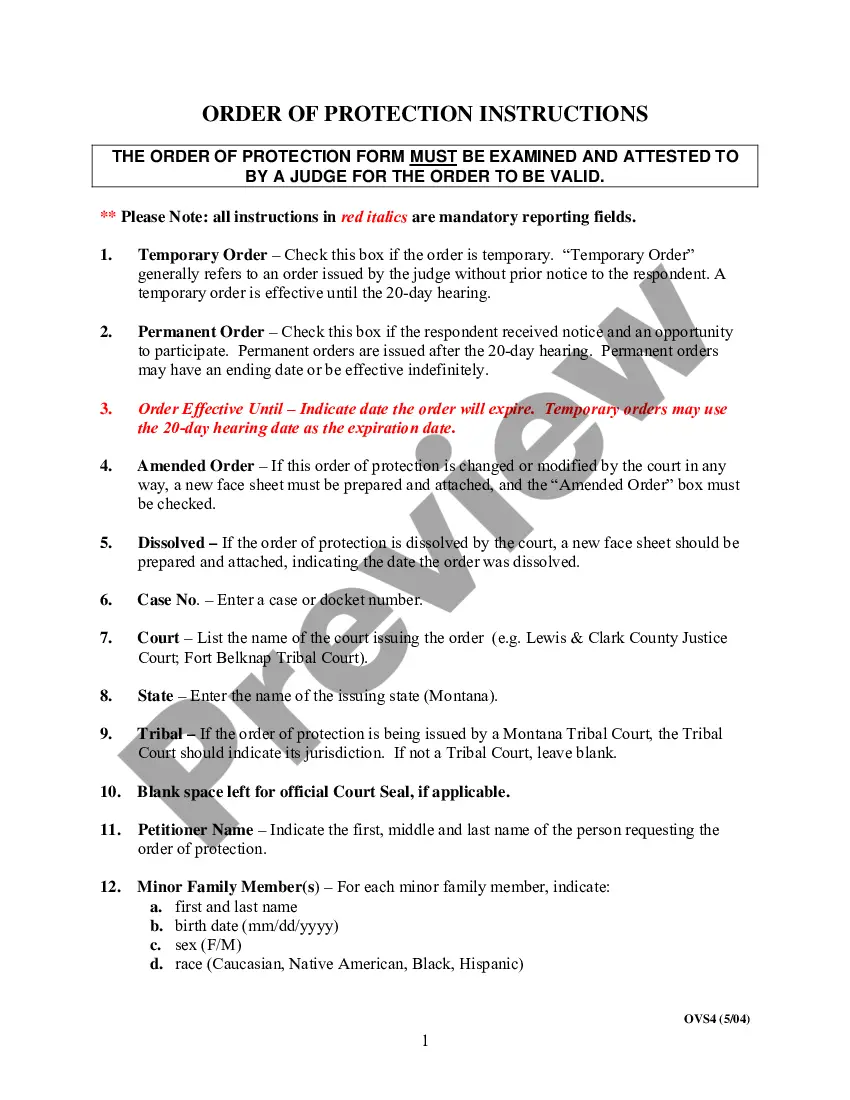
Complaint regarding Legal Malpractice in adoption case
What is this form?
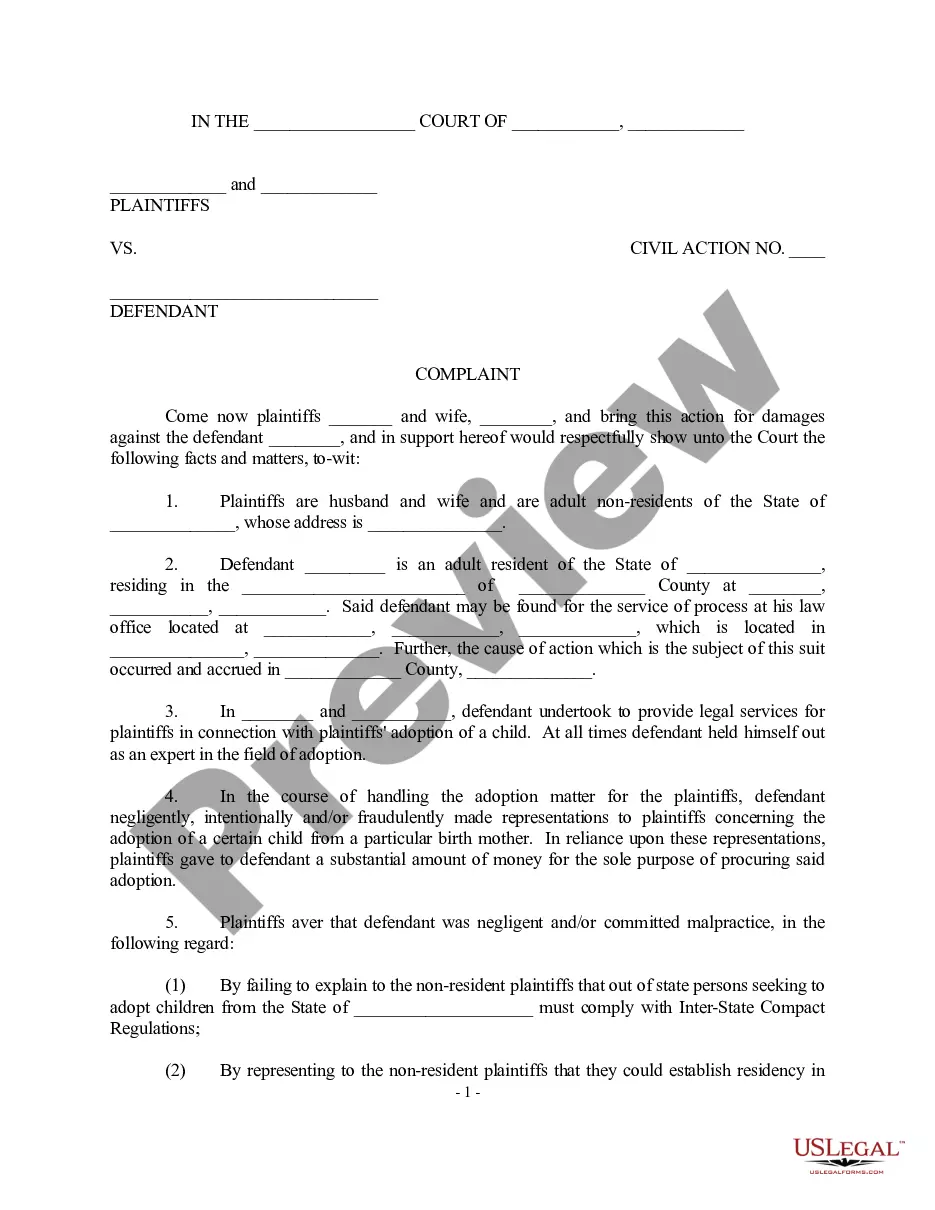
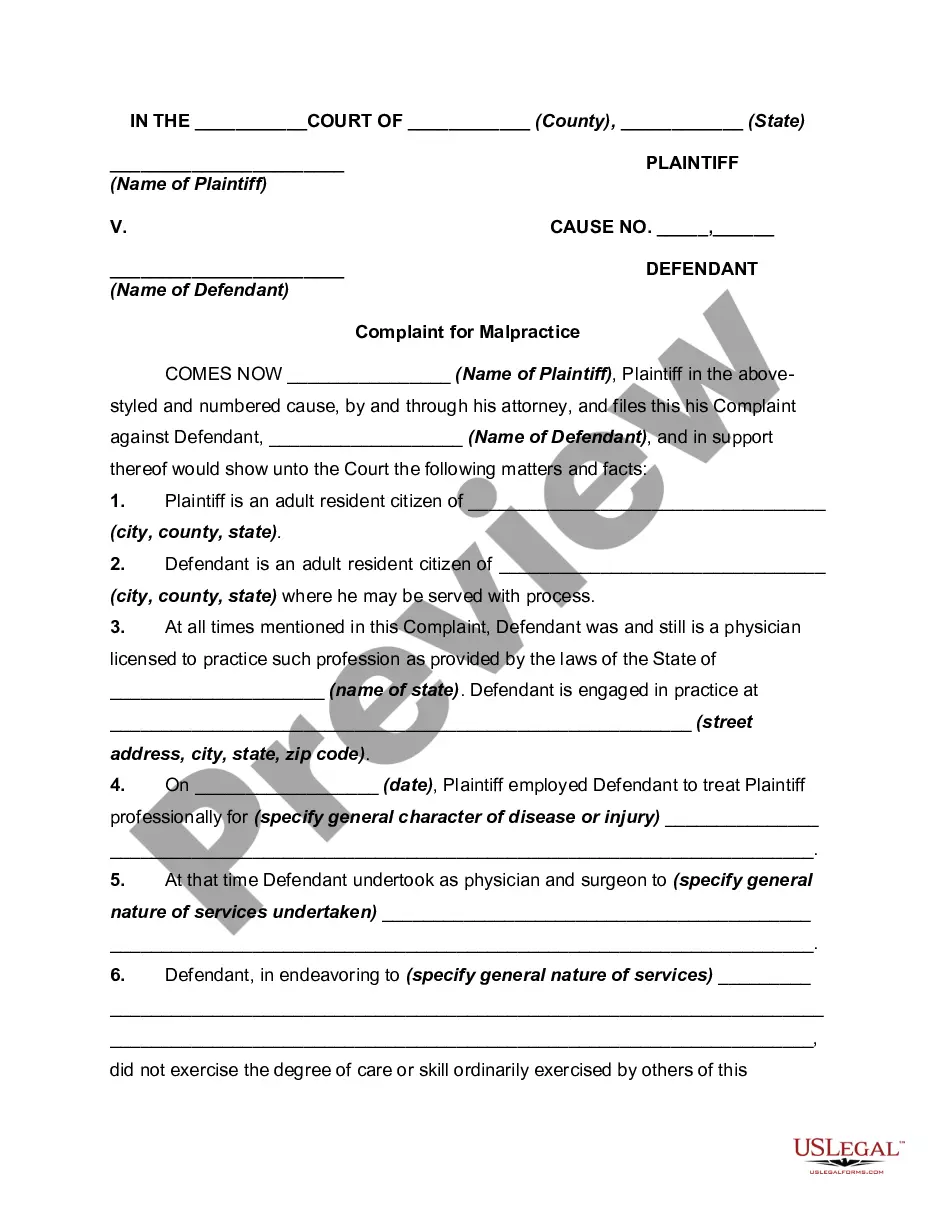
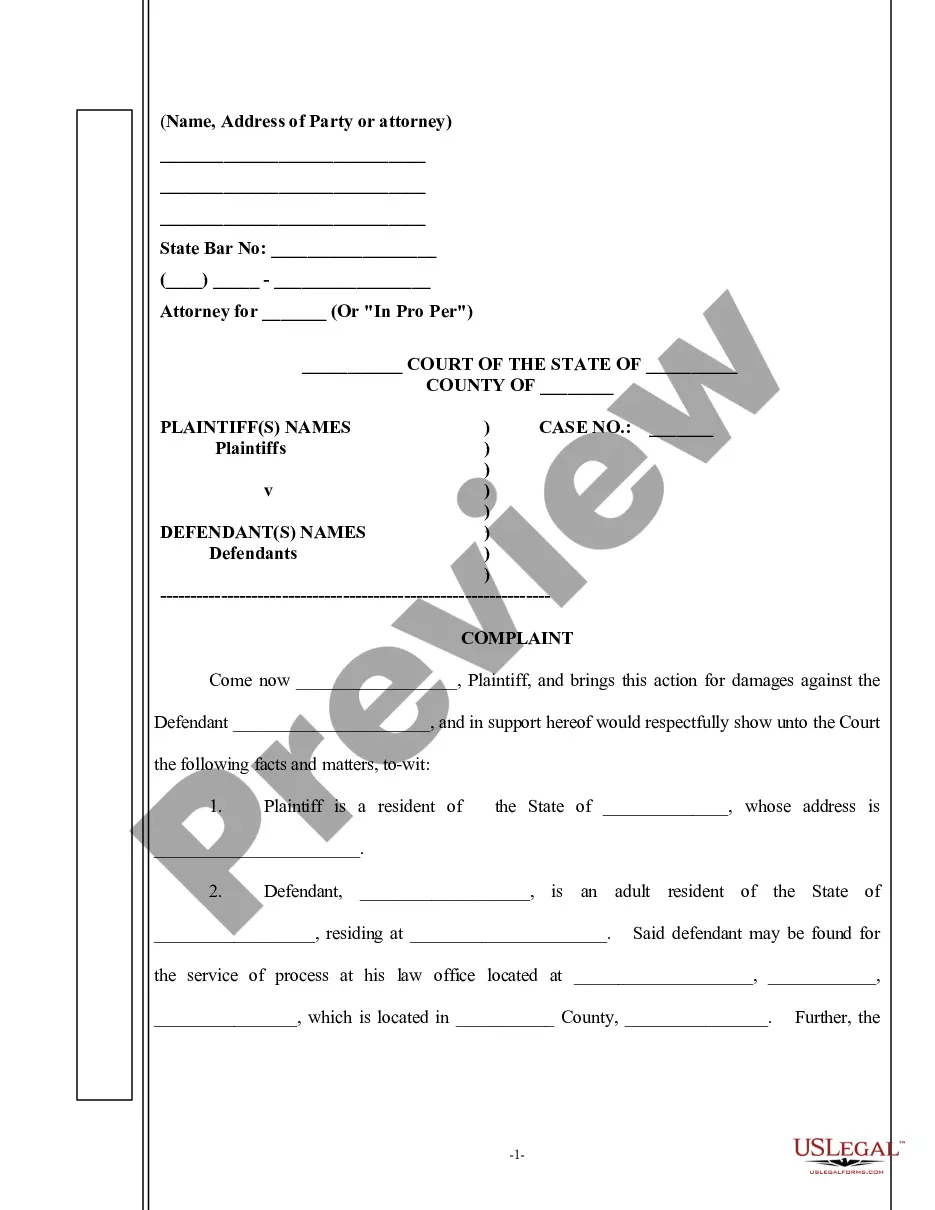
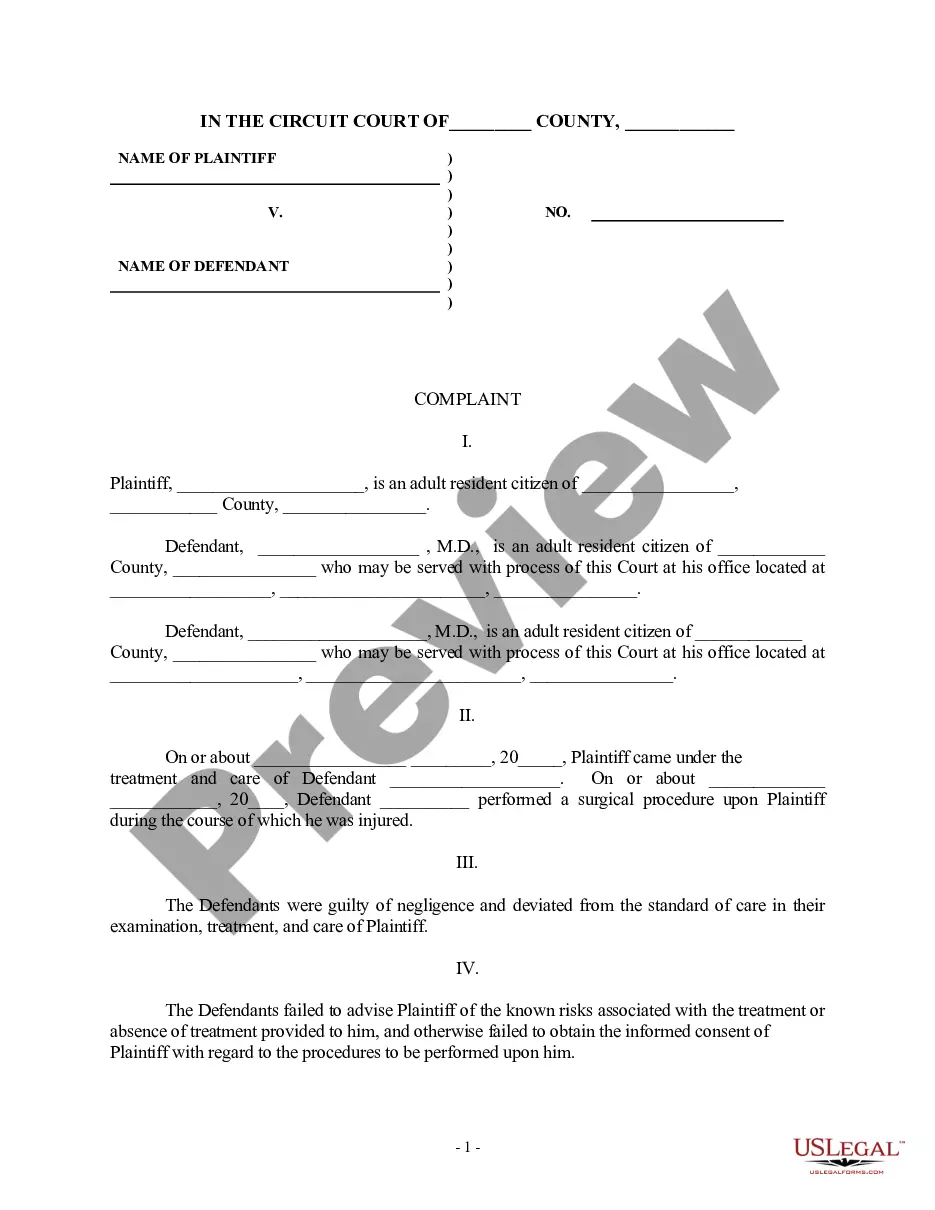
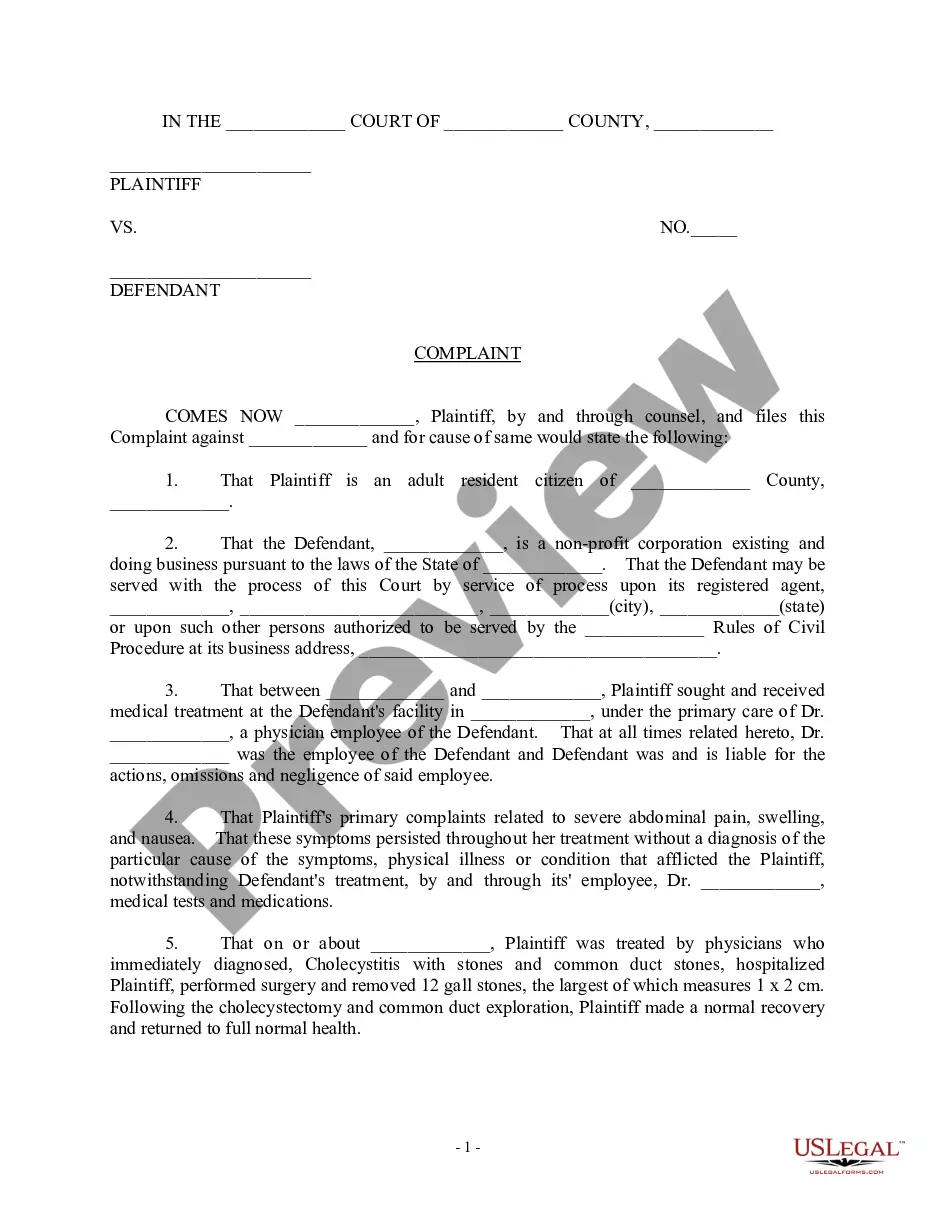
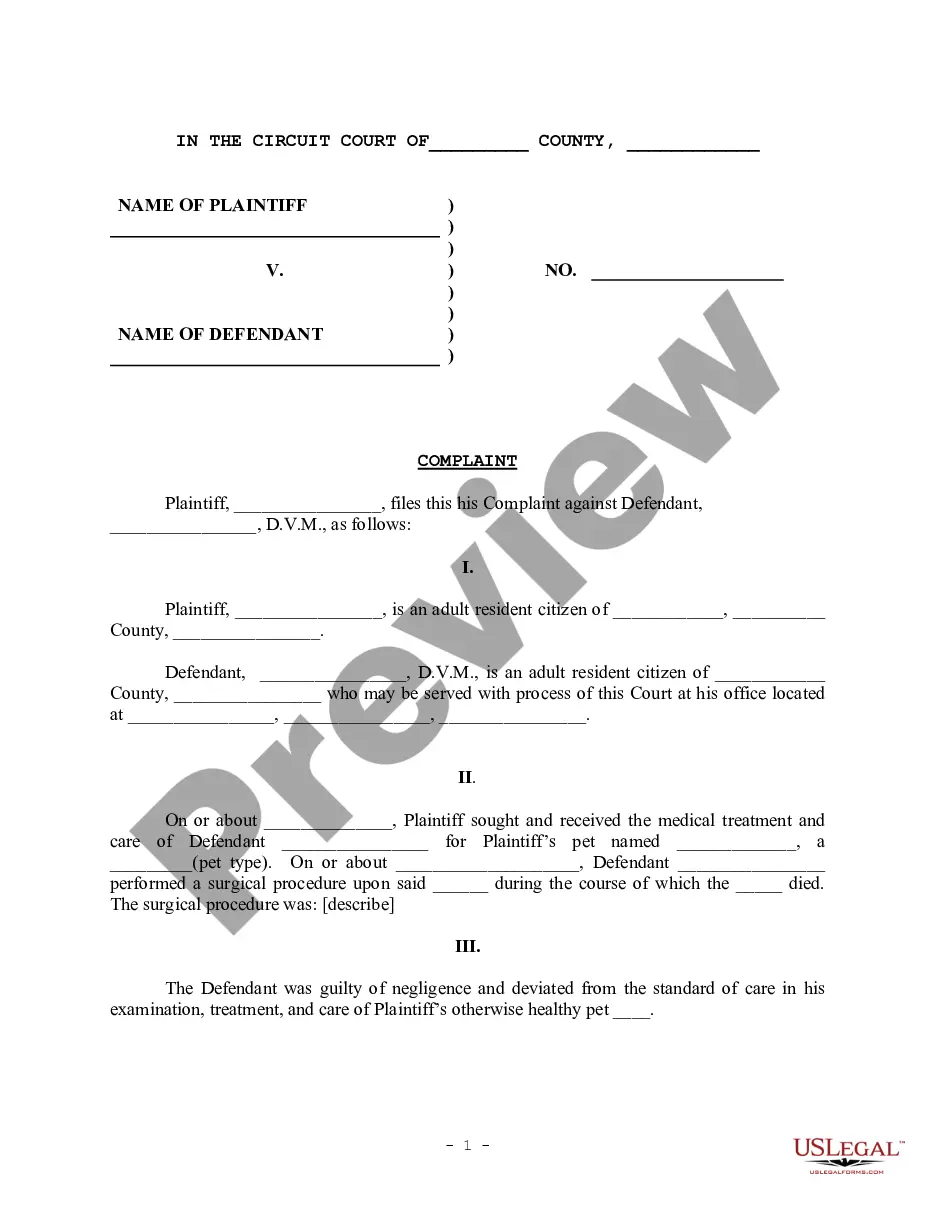
The Complaint regarding Legal Malpractice in adoption case is a formal legal document filed by plaintiffs against an attorney for malpractice during the adoption process. This complaint is essential for individuals seeking redress for negligent or fraudulent actions by their attorney in a failed adoption case. It sets forth the claims of legal malpractice, emotional distress, and requests for damages resulting from the attorney's misconduct, distinguishing it from other legal complaint forms by its focus on adoption-specific issues.
Main sections of this form
- Identification of plaintiffs and defendant, including their residency details.
- Description of the legal services allegedly provided by the defendant.
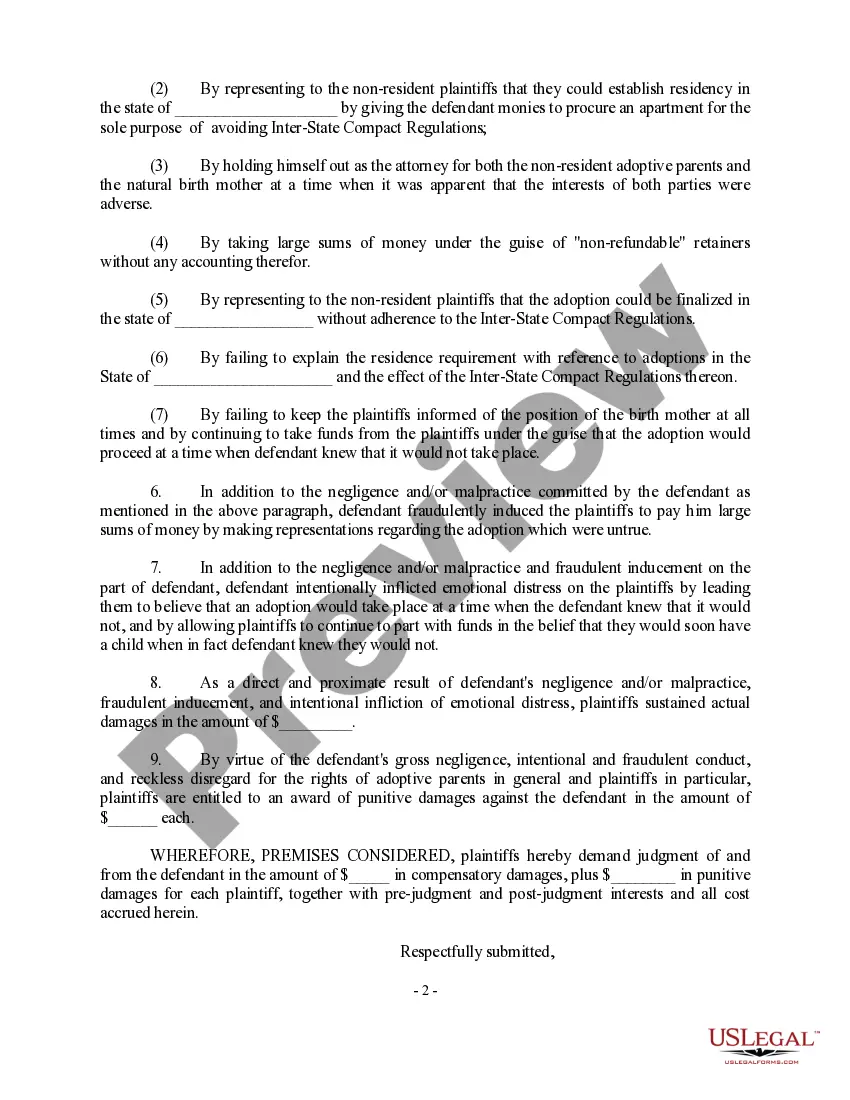
- Allegations of attorney malpractice, including specific failures and misrepresentations.
- Claims for damages, detailed assessment of financial loss, and emotional distress.
- Request for punitive damages based on the defendant's conduct.
Common use cases
This form is used when adoptive parents believe their attorney has committed malpractice during the legal process of adoption. It is applicable when an attorney has failed to provide proper guidance, made false representations, or engaged in unethical conduct that has directly impacted the adoption outcome and caused emotional or financial harm to the plaintiffs.
Who needs this form
- Individuals or couples who have attempted to adopt a child but have experienced legal malpractice from an attorney.
- Adoptive parents who have suffered financial losses due to negligent legal representation.
- Clients who wish to hold their attorney accountable for emotional distress resulting from mishandled adoption cases.
Instructions for completing this form
- Enter the names of the plaintiffs and defendant, including their respective addresses.
- Detail the nature of the legal services provided by the attorney in relation to the adoption.
- List all allegations of neglect, fraud, and emotional distress associated with the attorney's actions.
- Specify the actual damages sustained by the plaintiffs and any requested punitive damages.
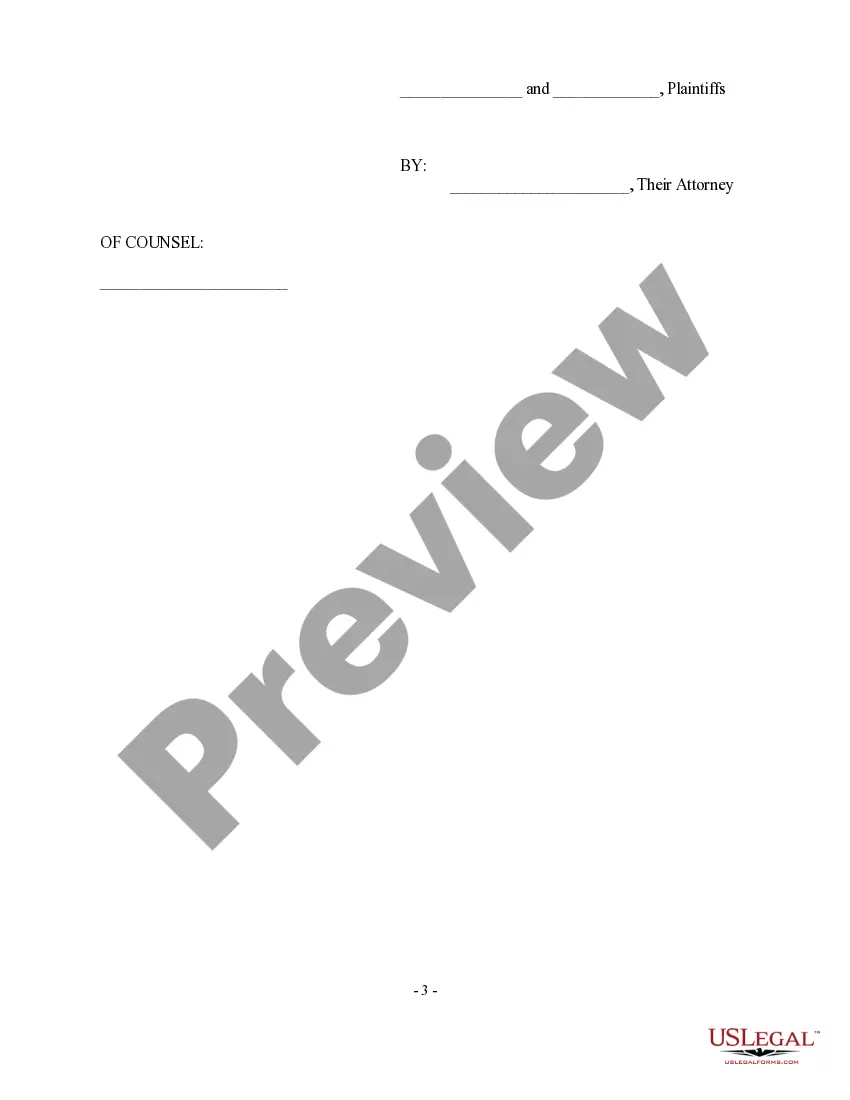
- Sign the form and ensure all required documentation is included for filing with the court.
Does this form need to be notarized?
This form does not typically require notarization unless specified by local law. Be sure to check any specific rules pertaining to your jurisdiction regarding the necessity of notarization for legal complaints.
Get your form ready online
Our built-in tools help you complete, sign, share, and store your documents in one place.
Make edits, fill in missing information, and update formatting in US Legal Forms—just like you would in MS Word.
Download a copy, print it, send it by email, or mail it via USPS—whatever works best for your next step.
Sign and collect signatures with our SignNow integration. Send to multiple recipients, set reminders, and more. Go Premium to unlock E-Sign.
If this form requires notarization, complete it online through a secure video call—no need to meet a notary in person or wait for an appointment.
We protect your documents and personal data by following strict security and privacy standards.

Make edits, fill in missing information, and update formatting in US Legal Forms—just like you would in MS Word.

Download a copy, print it, send it by email, or mail it via USPS—whatever works best for your next step.

Sign and collect signatures with our SignNow integration. Send to multiple recipients, set reminders, and more. Go Premium to unlock E-Sign.

If this form requires notarization, complete it online through a secure video call—no need to meet a notary in person or wait for an appointment.

We protect your documents and personal data by following strict security and privacy standards.
Typical mistakes to avoid
- Failing to provide complete and accurate information about the plaintiffs and defendant.
- Neglecting to specify all allegations of malpractice and emotional distress.
- Forgetting to state the exact amount of damages being claimed.
- Omitting signatures or required documentation when submitting the form.
Benefits of using this form online
- Access to professionally drafted legal templates specific to your needs.
- Convenience of filling out and downloading your complaint form from home.
- Easy customization options to ensure your complaint accurately reflects your situation.
- Peace of mind knowing the template complies with relevant legal requirements.
What to keep in mind
- The Complaint regarding Legal Malpractice in adoption case allows for legal recourse against negligent attorneys.
- It's vital to provide detailed allegations and specify damages to improve the chances of a successful claim.
- This form can be used by any adoptive parent who has suffered due to malpractice in the adoption process.
Looking for another form?

Form popularity
FAQ
To prevail in a legal malpractice lawsuit in most jurisdictions, you will need to prove an attorney-client relationship between you and the lawyer, a breach of the duty to provide skillful and competent representation (negligence), causation, and a financial loss.
Although the general rule in California bars the assignment of a cause of action for legal malpractice, a narrow exception is appropriate on the particular facts here because White Mountains did not simply buy a malpractice claim, like buying a fraud claim without buying the money or property obtained by the fraud.
Duty -- that the attorney owed you a duty to act properly. breach -- that the attorney breached the duty: she was negligent, she made a mistake, or she did not do what she agreed to do. causation -- that this conduct hurt you financially, and.
Most medical malpractice attorneys charge at least a 40% contingency fee to handle medical malpractice cases. A contingency fee means that the lawyer does not get paid unless a recovery is made. In other words, the lawyer's fee is contingent upon getting a recovery.
Medical Malpractice Case Outcomes: Facts & Statistics According to their findings, physicians win 80% to 90% of jury trials with weak evidence of medical negligence, approximately 70% of borderline cases, and 50% of cases with strong evidence of medical negligence.
To prove legal malpractice you must establish the following four elements: (1) duty, (2) breach, (3) causation, and (4) harm. These are the basic elements for most torts in California.
The average out of court settlement for a medical malpractice lawsuit is just over $425,000, while the average jury award is now over $1 Million.
To prove legal malpractice you must establish the following four elements: (1) duty, (2) breach, (3) causation, and (4) harm. These are the basic elements for most torts in California. Duty. A plaintiff must show the existence of an agreement, either express or implied, that creates an attorney-client relationship.
To prove legal malpractice you must establish the following four elements: (1) duty, (2) breach, (3) causation, and (4) harm. These are the basic elements for most torts in California. Duty. A plaintiff must show the existence of an agreement, either express or implied, that creates an attorney-client relationship.