Michigan Complaint for Divorce for People with Adult Children
Overview of this form
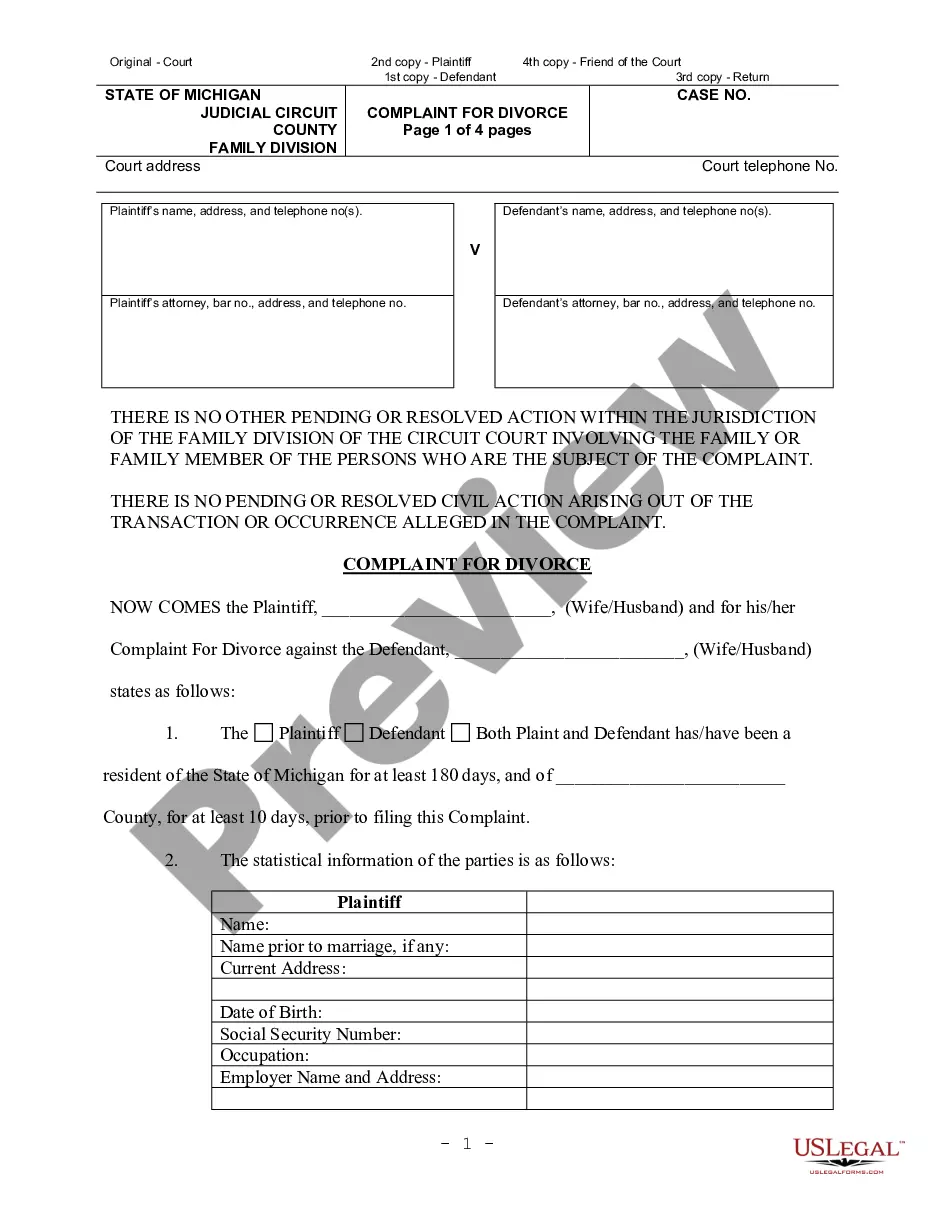
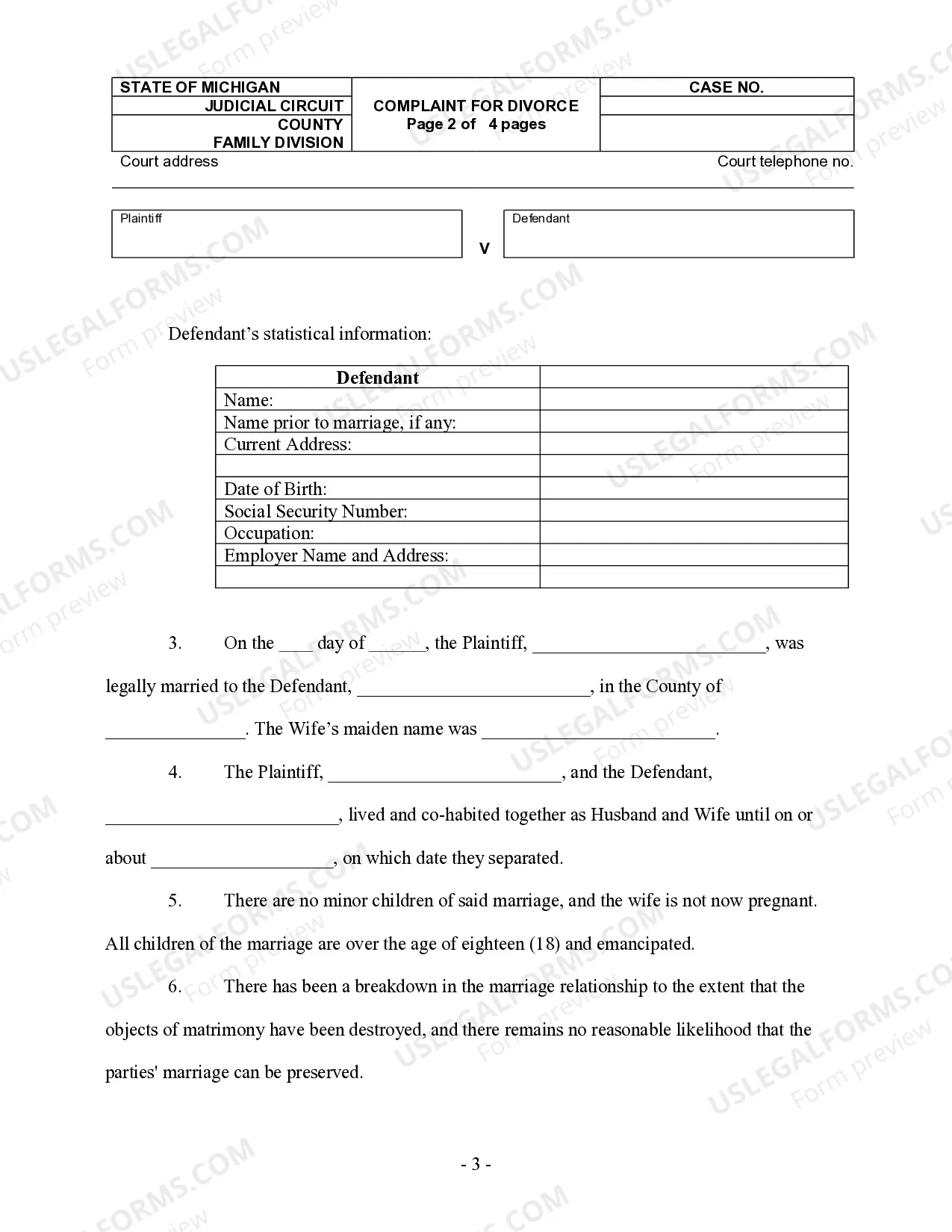
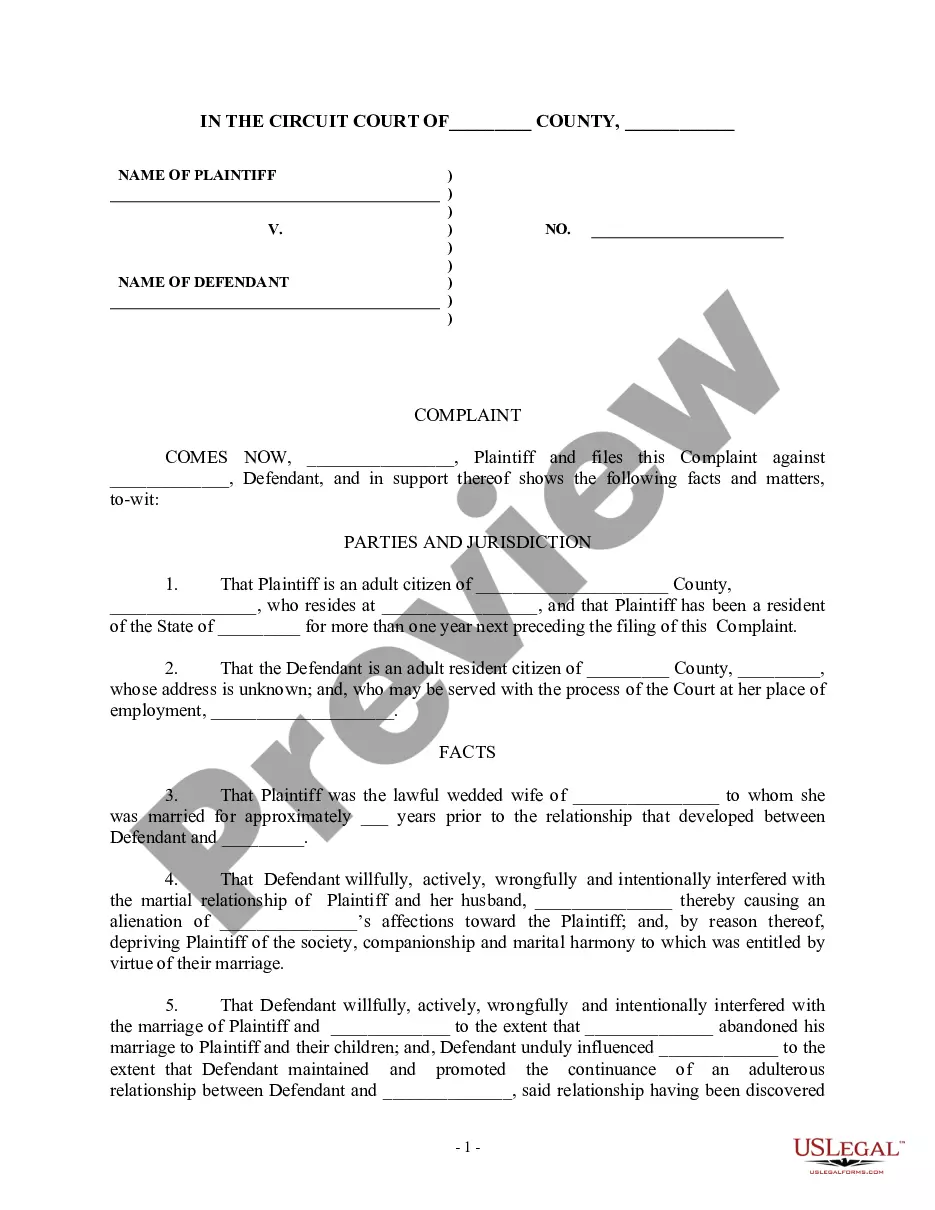
The Complaint for Divorce for People with Adult Children is a legal document that requests the court to grant a divorce when both parties have adult children. Unlike other divorce forms that may involve minor children, this form acknowledges that all children are emancipated. The document states that irreconcilable differences exist, and it asserts that the marriage cannot be saved.
Key components of this form
- Identification of the Plaintiff and Defendant, specifying their roles (Wife/Husband).
- Details of the marriage, including the date of separation and confirmation that there are no minor children.
- A declaration that irreconcilable differences exist and that the marriage cannot be preserved.
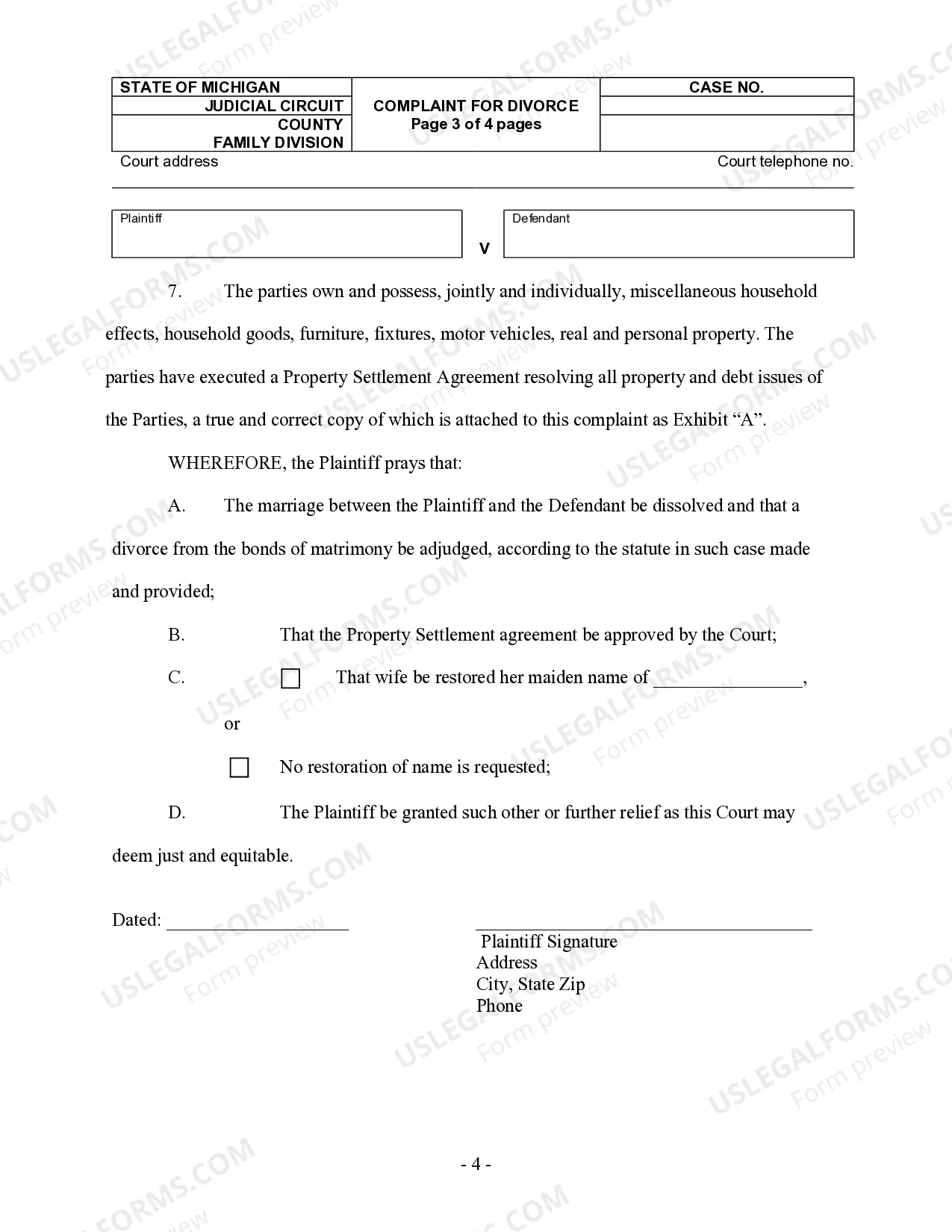
- Signature lines for both parties to validate the document.

When to use this form
This form should be used when spouses, who have adult children, decide to file for divorce. It is appropriate in situations where both parties have reached an agreement on the irreconcilable differences that led to the breakdown of the marriage and can proceed without considerations for minor children.
Who should use this form
- Individuals seeking a divorce who have adult children and no minor dependents.
- Spouses who have mutually agreed that their marriage has irreconcilable differences.
- People looking to manage their divorce process without the involvement of minor children in the proceedings.
Steps to complete this form
- Identify the Plaintiff and Defendant by filling in their names and roles (Wife/Husband).
- Specify the date of separation and confirm the absence of minor children.
- State the reasons for the divorce, mentioning the irreconcilable differences that have led to the breakdown of the marriage.
- Sign and date the form to validate the complaint.
Does this document require notarization?
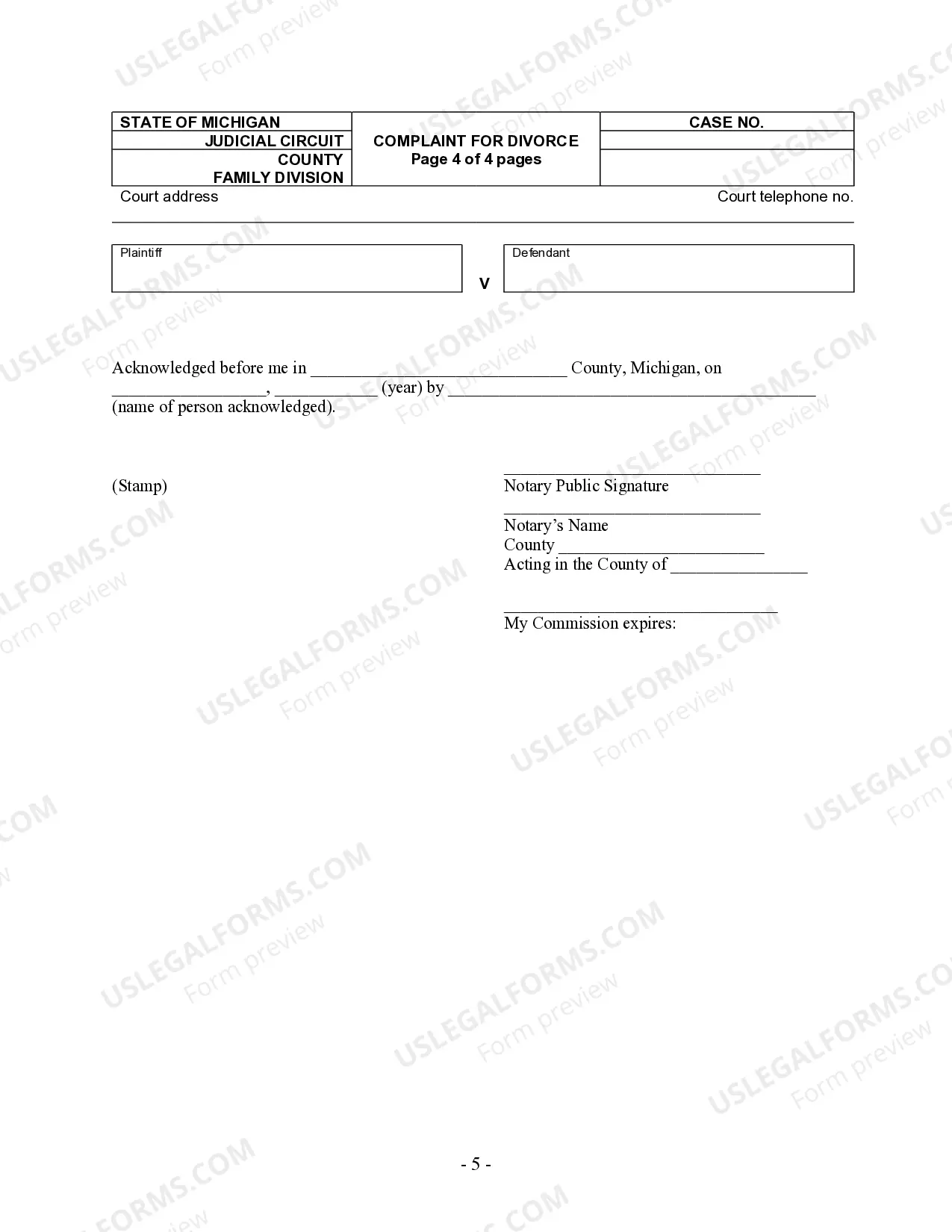
This form does not typically require notarization unless specified by local law.
Get your form ready online
Our built-in tools help you complete, sign, share, and store your documents in one place.
Make edits, fill in missing information, and update formatting in US Legal Forms—just like you would in MS Word.
Download a copy, print it, send it by email, or mail it via USPS—whatever works best for your next step.
Sign and collect signatures with our SignNow integration. Send to multiple recipients, set reminders, and more. Go Premium to unlock E-Sign.
If this form requires notarization, complete it online through a secure video call—no need to meet a notary in person or wait for an appointment.
We protect your documents and personal data by following strict security and privacy standards.

Make edits, fill in missing information, and update formatting in US Legal Forms—just like you would in MS Word.

Download a copy, print it, send it by email, or mail it via USPS—whatever works best for your next step.

Sign and collect signatures with our SignNow integration. Send to multiple recipients, set reminders, and more. Go Premium to unlock E-Sign.

If this form requires notarization, complete it online through a secure video call—no need to meet a notary in person or wait for an appointment.

We protect your documents and personal data by following strict security and privacy standards.
Avoid these common issues
- Failing to correctly identify both parties involved in the divorce.
- Omitting the date of separation.
- Not stating the absence of minor children explicitly.
- Forgetting to sign and date the form before submission.
Why complete this form online
- Convenience of downloading the form anytime, saving time and effort.
- Editability allows users to customize the document to their specific situation.
- Access to forms drafted by licensed attorneys, ensuring legal reliability.
Looking for another form?
Form popularity
FAQ
From a legal perspective, it generally does not matter who files for divorce first.Filing first creates an opportunity to present the court with various orders before your spouse is notified of the Michigan divorce proceedings. The orders are called Ex Parte, which means literally, on one side only.
1 attorney answer Although a child's wishes are one factor among many the court must consider in determining the child's best interests, a minor child never gets to "decide" which parent to live with.
The legal definition of an unfit parent is when the parent through their conduct fails to provide proper guidance, care, or support. Also, if there is abuse, neglect, or substance abuse issues, that parent will be deemed unfit.
One of the main legal advantages that a person gains by filing the divorce petition before his or her spouse does is that the filer can request a Standing Order from the court when filing the petition.If the matter should go to a hearing, the person who files the petition usually presents his or her case first.
Under Michigan law, courts already can award joint physical custody, or shared physical custody.This means that the court would begin from the premise that parents always will share physical custody 50-50 unless there is a reason not to do so (namely, domestic violence).
Contrary to popular belief, there is no age in Michigan when the child can unilaterally decide which parent to live with other than after age 18. The preference of the child, however, is one of the many considerations that the judge will consider when making decisions regarding child custody or parenting time.
Although courts may consider the reasonable preference of the child in custody cases, the caveat is that the child must be deemed to be of sufficient age to participate. What does this mean in the state of Michigan? For starters, any child age 17 or older can choose the parent he/she prefers to live with.
Michigan - like most other states - has several different ways to recognize a child's parentage.This form is legally binding and puts the world on notice that both the mother and father recognize that the man is the biological father of the child in question.
It is up to the judge to decide whether a child is old enough to state a preference. The judge will give more weight to this factor with children who are older or more mature. There is no age at which a child can decide where he or she wants to live.