Massachusetts Assignment to Living Trust
What this document covers
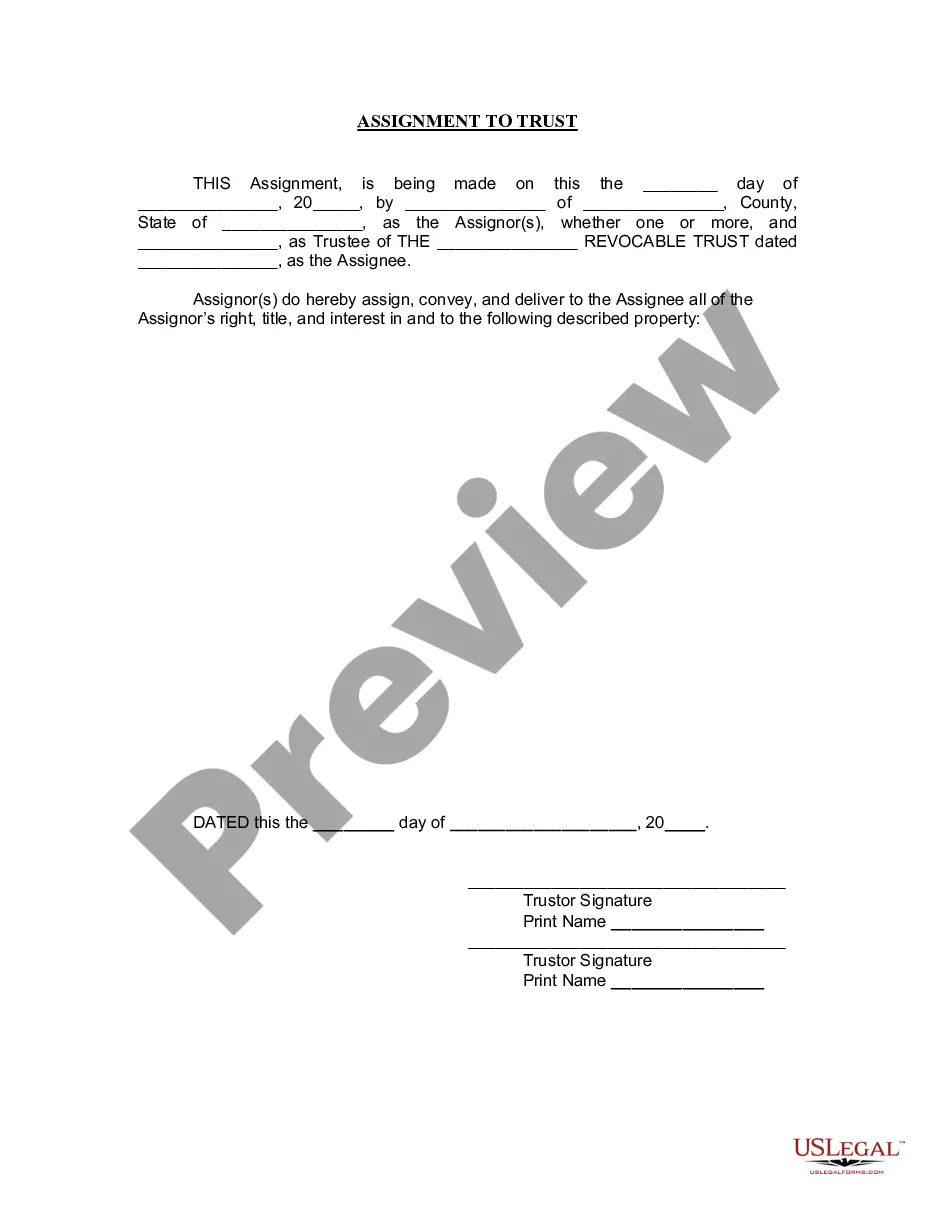
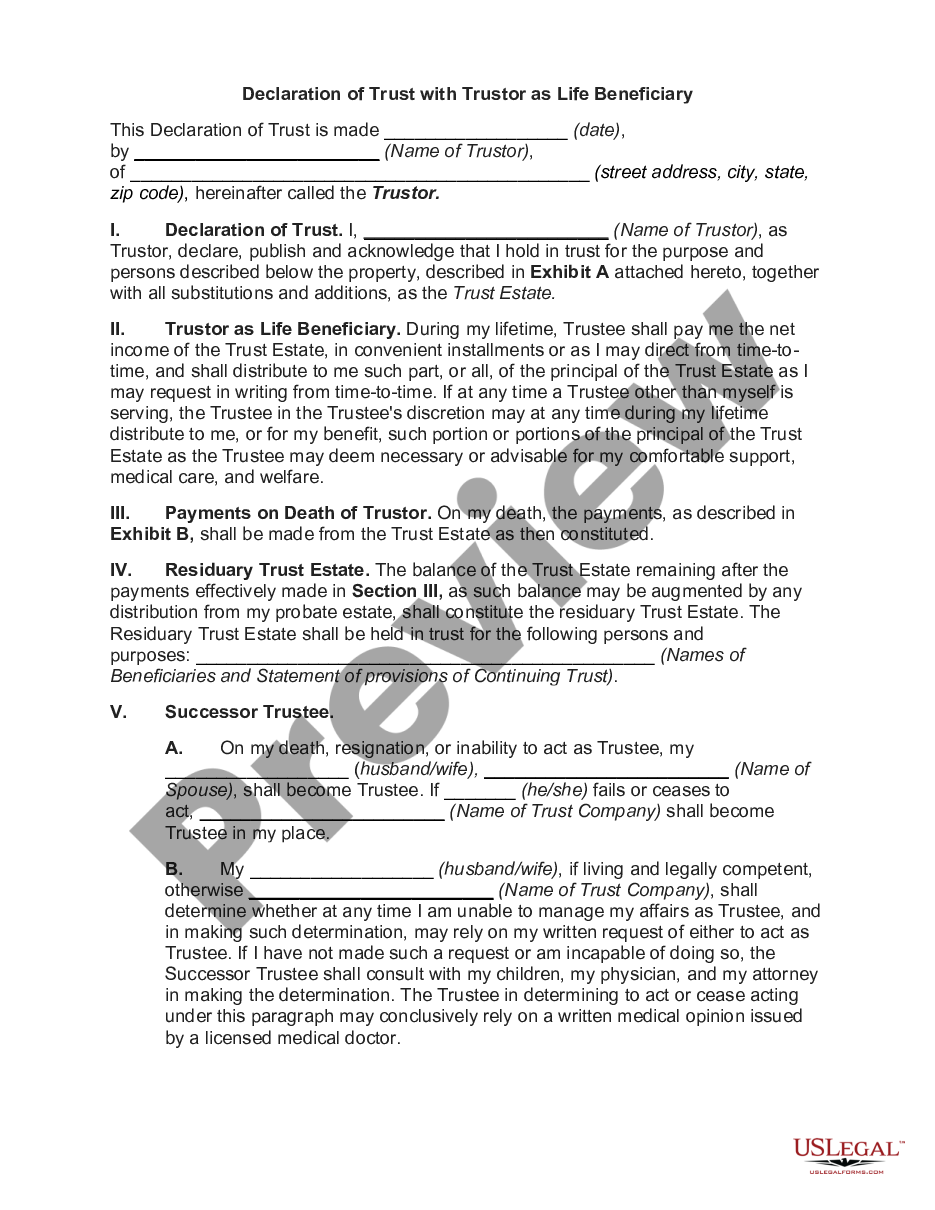
The Assignment to Living Trust form is a legal document used to transfer ownership of specific property into a living trust during the lifetime of the trustor. This process helps in effective estate planning by ensuring that assets are managed according to the trustor's wishes after their passing. This form is distinct from other types of property transfers as it specifically involves assigning rights and interests in property to a living trust, which is created for asset management and distribution purposes.
What’s included in this form
- Date of the assignment
- Names and addresses of the Assignor(s)
- Name of the Trustee and trust details
- Description of the property being assigned
- Signature block for the Assignor(s)
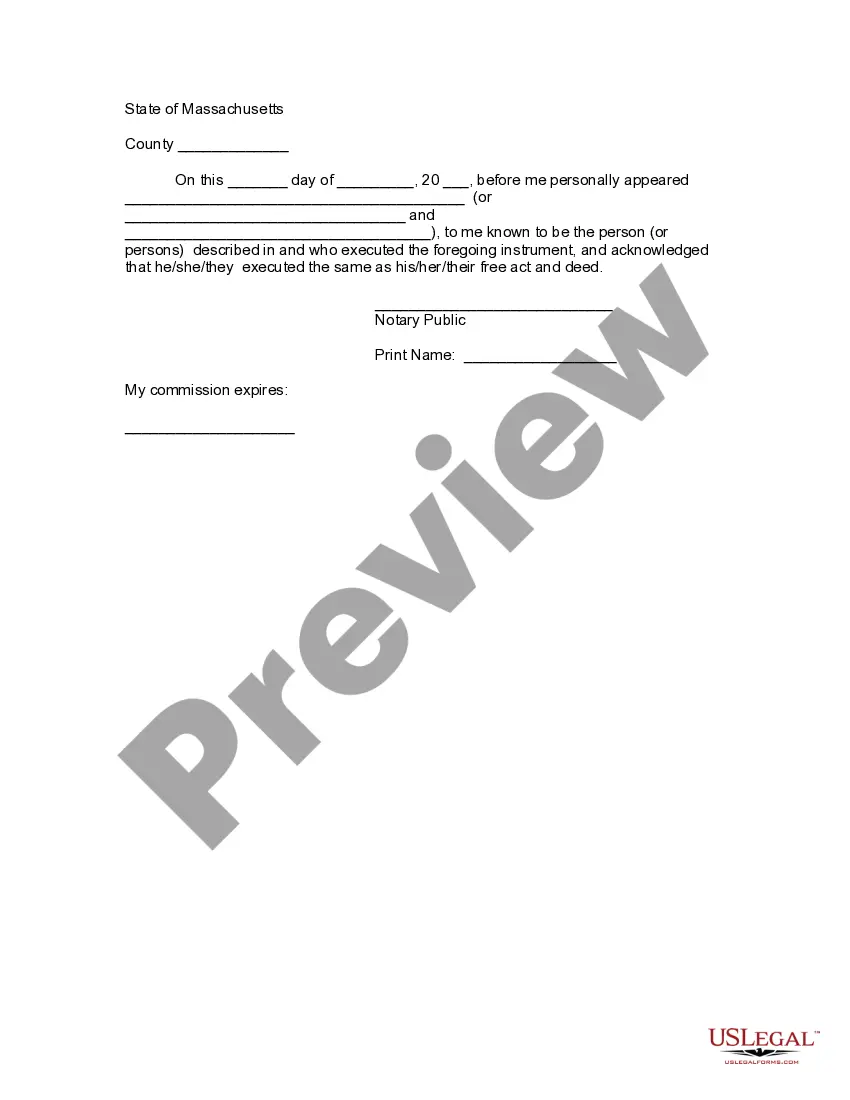
- Notary acknowledgment section
Situations where this form applies
This form should be used when an individual wishes to assign property to a living trust. Common scenarios include estate planning for minimizing probate issues, managing assets during one's lifetime, or ensuring proper distribution of assets to beneficiaries. It's particularly useful when the trustor wants to maintain control over their assets while preparing for potential future incapacity or death.
Who should use this form
- Individuals creating a living trust as part of their estate planning process
- Trustees managing a living trust
- Benefactors wanting to ensure their property is transferred effectively
- Anyone looking to avoid probate issues with their assets
Completing this form step by step
- Identify the parties involved (Assignor(s) and Trustee).
- Clearly specify the property being assigned to the trust.
- Fill in the date of the assignment.
- Obtain the signatures of the Assignor(s) along with printed names.
- Complete the notary acknowledgment section with the notary public's information.
Does this form need to be notarized?
Yes, this form must be notarized to be legally valid. The presence of a notary public ensures the authenticity of the signatures and gives legal weight to the document. US Legal Forms offers integrated online notarization, providing secure video calls and legal equivalence, eliminating the need for travel.
Get your form ready online
Our built-in tools help you complete, sign, share, and store your documents in one place.
Make edits, fill in missing information, and update formatting in US Legal Forms—just like you would in MS Word.
Download a copy, print it, send it by email, or mail it via USPS—whatever works best for your next step.
Sign and collect signatures with our SignNow integration. Send to multiple recipients, set reminders, and more. Go Premium to unlock E-Sign.
If this form requires notarization, complete it online through a secure video call—no need to meet a notary in person or wait for an appointment.
We protect your documents and personal data by following strict security and privacy standards.

Make edits, fill in missing information, and update formatting in US Legal Forms—just like you would in MS Word.

Download a copy, print it, send it by email, or mail it via USPS—whatever works best for your next step.

Sign and collect signatures with our SignNow integration. Send to multiple recipients, set reminders, and more. Go Premium to unlock E-Sign.

If this form requires notarization, complete it online through a secure video call—no need to meet a notary in person or wait for an appointment.

We protect your documents and personal data by following strict security and privacy standards.
Mistakes to watch out for
- Failing to accurately describe the property in the assignment.
- Not obtaining the proper signatures from all Assignors.
- Omitting notary public acknowledgment which may invalidate the form.
- Forgetting to fill in the date of the assignment.
Benefits of using this form online
- Convenient access to professionally drafted templates.
- Easy editing to customize the form according to specific needs.
- Reliable and secure formats that comply with legal standards.
- Immediate download available for quicker use.
What to keep in mind
- The Assignment to Living Trust form is essential for transferring property into a living trust.
- It is important to have the form notarized to validate the assignment.
- Carefully complete all sections to avoid common mistakes and ensure the document's effectiveness.
Looking for another form?
Form popularity
FAQ
In order to create a general petition for the creation of a trust, the filing fee is $375 with a surcharge of $15. Once the trust has been created, there will be a great deal of paperwork involved, since every asset that is added to the trust will need to be signed for.
Assuming you decide you want a revocable living trust, how much should you expect to pay? If you are willing to do it yourself, it will cost you about $30 for a book, or $70 for living trust software. If you hire a lawyer to do the job for you, get ready to pay between $1,200 and $2,000.
A living trust in Massachusetts is created by the grantor, the person putting things into trust. As the grantor you must choose a trustee who is charged with managing the trust for your benefit while you are alive and distributing your assets to your beneficiaries after your death.
No, you don't need a lawyer to set up a trust, but it might be a good idea to seek legal advice to ensure the trust is set up correctly and that you have considered all long-term financial and estate planning aspects of the trust.Some living trusts are revocable, which means the trust can be changed at any time.
Locate your current deed. Use the proper deed. Check with your title insurance company and lender. Prepare a new deed. Sign in the presence of a notary. Record the deed in the county clerk's office. Locate the deed that's in trust. Use the proper deed.
Transferring Real Property to a Trust You can transfer your home (or any real property) to the trust with a deed, a document that transfers ownership to the trust. A quitclaim deed is the most common and simplest method (and one you can do yourself).
Prior to enacting G.L.c. 184, §35, Massachusetts was among the few states requiring the full trust document for trusts containing real property to be recorded.The trustee's certificate is recorded either immediately upon the trust's acquisition of real property, or when the trustee acts upon the title 1.
Determine the Current Title and Vesting to Your Property. Prepare a Deed. Be Aware of Your Lender and Title Insurance. Prepare a Preliminary Change of Ownership Report. Execute Your Deed. Record Your Deed. Wait for the Deed to be Returned. Keep the Property in the Trust.
Decide between a single or joint trust. A single is obviously a good match for those that are unmarried. Review your property. Pick a trustee. Get your trust documents together. Sign your living trust. Fund your trust with your assets and property.