Transfer Under The Massachusetts Uniform Transfers to Minors Act
About this form
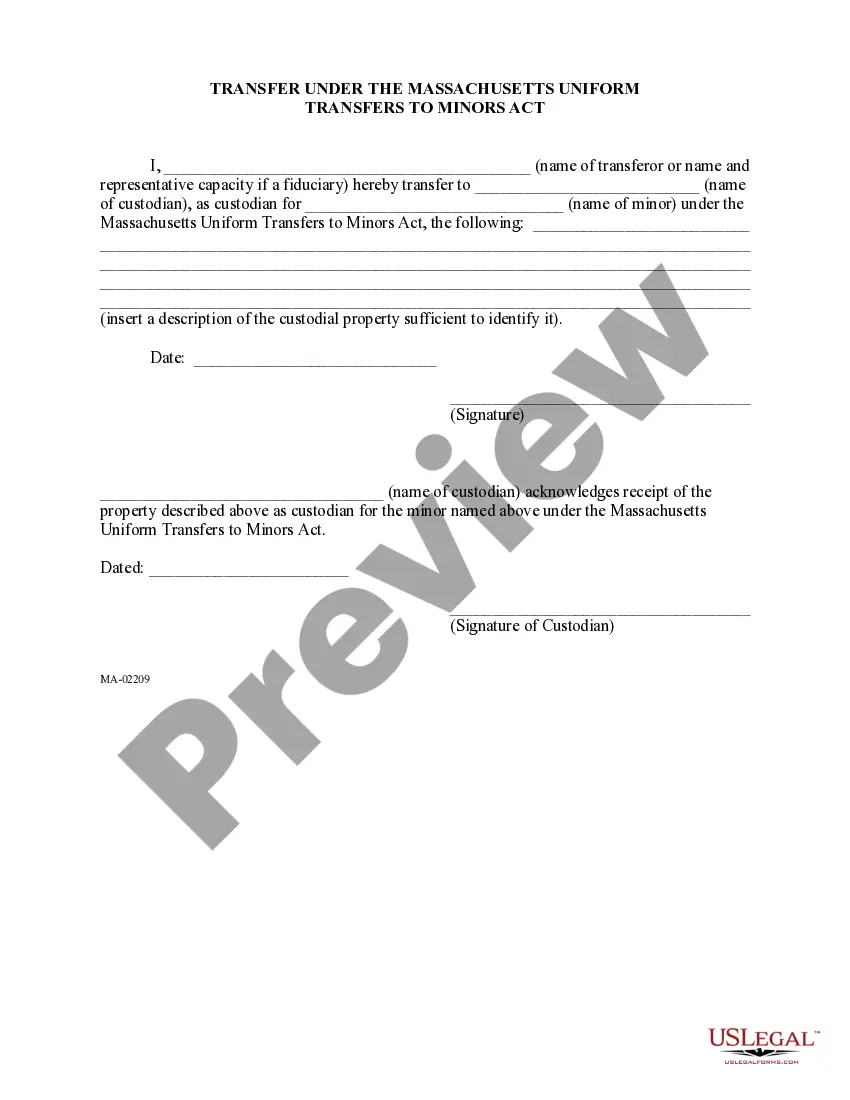
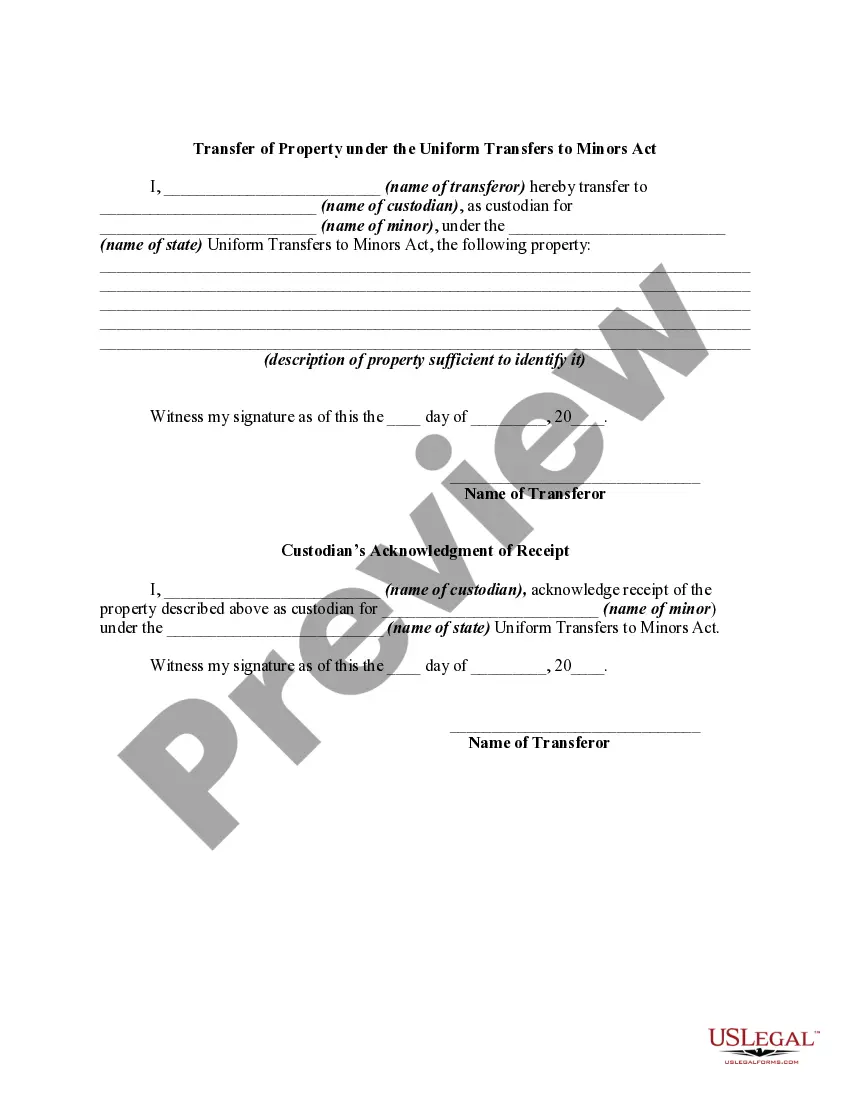
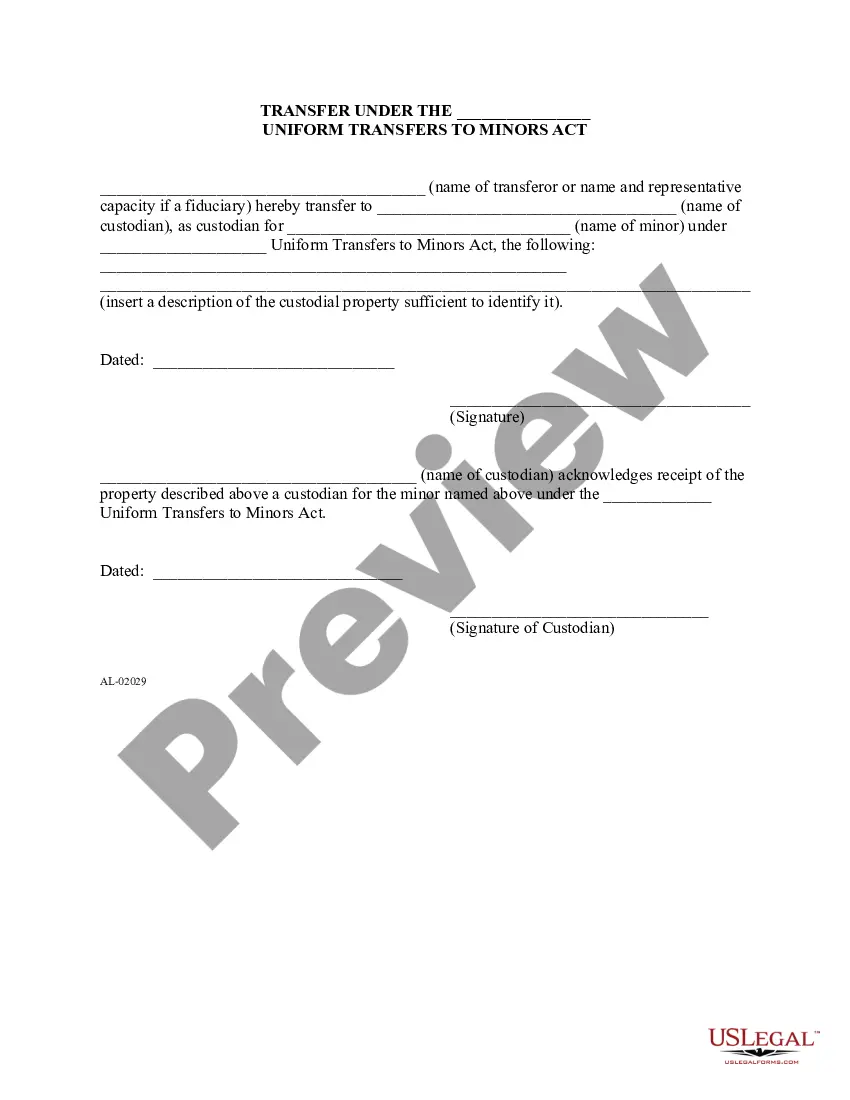
The Transfer Under The Massachusetts Uniform Transfers to Minors Act is a legal document that facilitates the transfer of property, such as land or other assets, to a minor. This form designates a custodian who will manage the property until the minor reaches the age of majority. This document ensures that the minor's interests are protected and managed in accordance with state law, differentiating it from other transfer forms that may not specify custodial arrangements.
Form components explained
- Name of the transferor: The individual or fiduciary transferring the property.
- Name of the custodian: The person responsible for managing the property for the minor.
- Name of the minor: The recipient of the transferred property.
- Description of the property: Detailed information identifying the property being transferred.
- Date of transfer: When the transfer takes effect.
- Signatures: Authorized signatures of the transferor and custodian acknowledging the transfer.


When to use this form
This form should be used when an adult wishes to transfer property to a minor child or relative under the Massachusetts Uniform Transfers to Minors Act. It is especially useful in cases where the property cannot be directly given to the minor due to age restrictions. Examples include transferring real estate, investments, or cash assets to ensure proper management until the minor reaches adulthood.
Who needs this form
- Parents or legal guardians wishing to transfer property to their minor children.
- Relatives or family friends who want to provide financial support through property transfers.
- Fiduciaries or estate planners managing a trust or estate that includes minor beneficiaries.
How to complete this form
- Identify the parties involved: Fill in the names of the transferor (the person transferring the property) and the custodian (the person managing the property for the minor).
- Specify the property: Clearly describe the property being transferred, ensuring it is identifiable.
- Enter the date: Fill in the date when the transfer is to take effect.
- Sign the document: Both the transferor and the custodian need to sign the form to validate the transfer.
- Keep a copy: After completion, make sure to keep a copy of the signed form for your records.
Does this document require notarization?
This form usually doesn’t need to be notarized. However, local laws or specific transactions may require it. Our online notarization service, powered by Notarize, lets you complete it remotely through a secure video session, available 24/7.
Get your form ready online
Our built-in tools help you complete, sign, share, and store your documents in one place.
Make edits, fill in missing information, and update formatting in US Legal Forms—just like you would in MS Word.
Download a copy, print it, send it by email, or mail it via USPS—whatever works best for your next step.
Sign and collect signatures with our SignNow integration. Send to multiple recipients, set reminders, and more. Go Premium to unlock E-Sign.
If this form requires notarization, complete it online through a secure video call—no need to meet a notary in person or wait for an appointment.
We protect your documents and personal data by following strict security and privacy standards.

Make edits, fill in missing information, and update formatting in US Legal Forms—just like you would in MS Word.

Download a copy, print it, send it by email, or mail it via USPS—whatever works best for your next step.

Sign and collect signatures with our SignNow integration. Send to multiple recipients, set reminders, and more. Go Premium to unlock E-Sign.

If this form requires notarization, complete it online through a secure video call—no need to meet a notary in person or wait for an appointment.

We protect your documents and personal data by following strict security and privacy standards.
Common mistakes
- Not providing a detailed description of the property being transferred.
- Failing to sign the document, which invalidates the transfer.
- Using outdated forms that do not comply with current Massachusetts law.
- Neglecting to inform the custodian about their responsibilities.
Advantages of online completion
- Convenience: Access and download the form anytime from anywhere.
- Editability: Customize the form to fit your specific needs before printing.
- Reliability: Ensure that you are using a legally valid template reviewed by licensed attorneys.
Looking for another form?



Form popularity
FAQ
The Uniform Gifts to Minors Act (UGMA) provides a way to transfer financial assets to a minor without the time-consuming and expensive establishment of a formal trust. A UGMA account is managed by an adult custodian until the minor beneficiary comes of age, at which point he assumes control of the account.
There is no ability to transfer a UGMA or UTMA account to another child or to change beneficiaries. You are not supposed to use a UTMA-529 or UGMA-529 account conversion to change the beneficiary either because that would equate to giving your child's money to someone else.
The Uniform Transfers to Minors Act (UTMA) allows a minor to receive gifts without the aid of a guardian or trustee.The donor can name a custodian who has the fiduciary duty to manage and invest the property on behalf of the minor until the minor becomes of legal age.
As the custodian of a UTMA/UGMA account, a parent can withdraw money whenever needed to benefit the child.
Generally, the UTMA account transfers to the beneficiary when he or she becomes a legal adult, which is usually 18 or 21. However, the age of adulthood may be defined differently for custodial accounts, like UTMAs or 529 plans, depending on your state.
There is no ability to transfer a UGMA or UTMA account to another child or to change beneficiaries. You are not supposed to use a UTMA-529 or UGMA-529 account conversion to change the beneficiary either because that would equate to giving your child's money to someone else.
Virtually all states have adopted some form of UTMA that allows you to make gifts to a minor to be held in the name of a custodian during the age of minority. On reaching the age of majority, usually 21 years, the minor is entitled to all assets held in the account.