Transfer Under The Massachusetts Uniform Custodial Trust Act
What this document covers
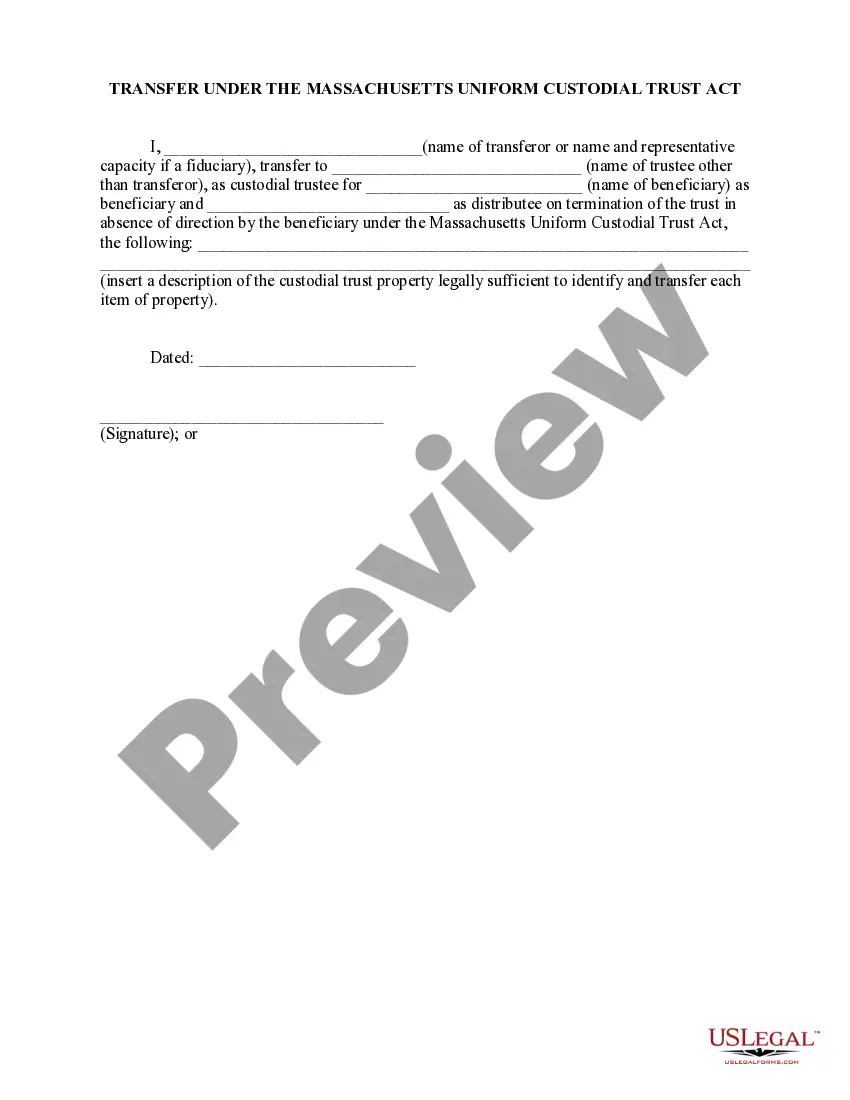
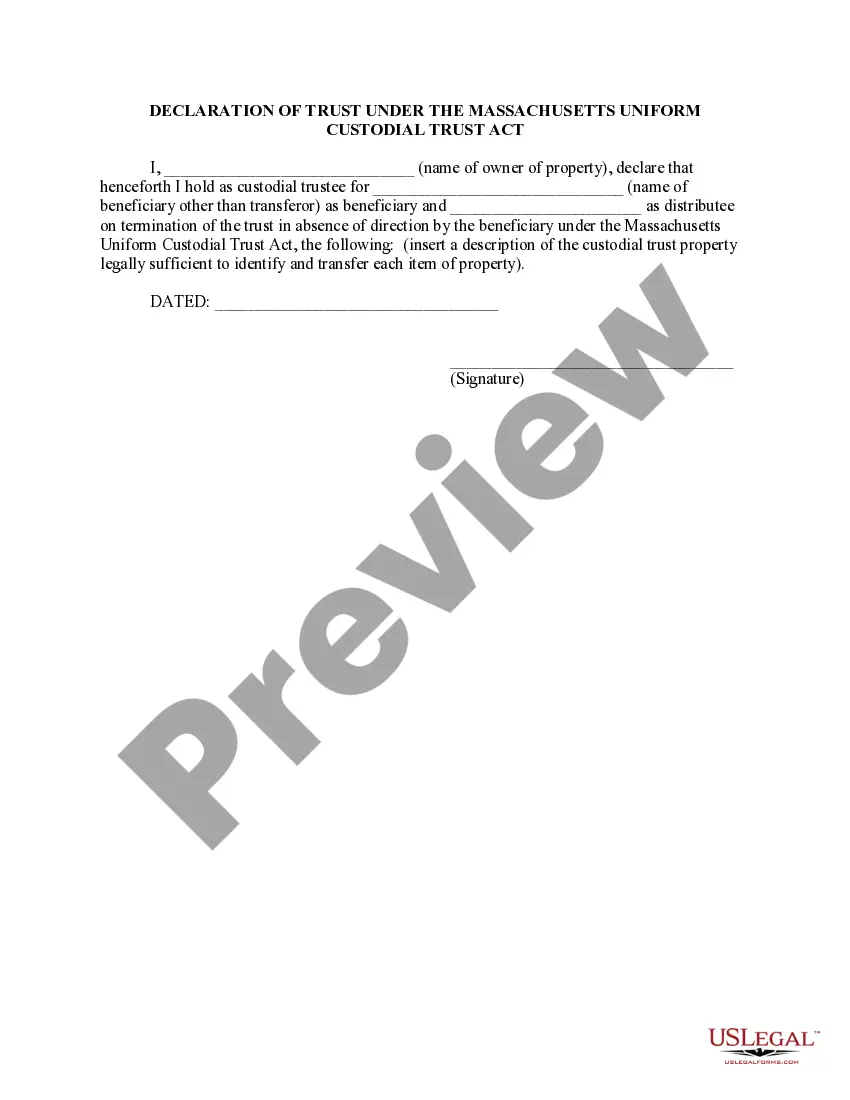
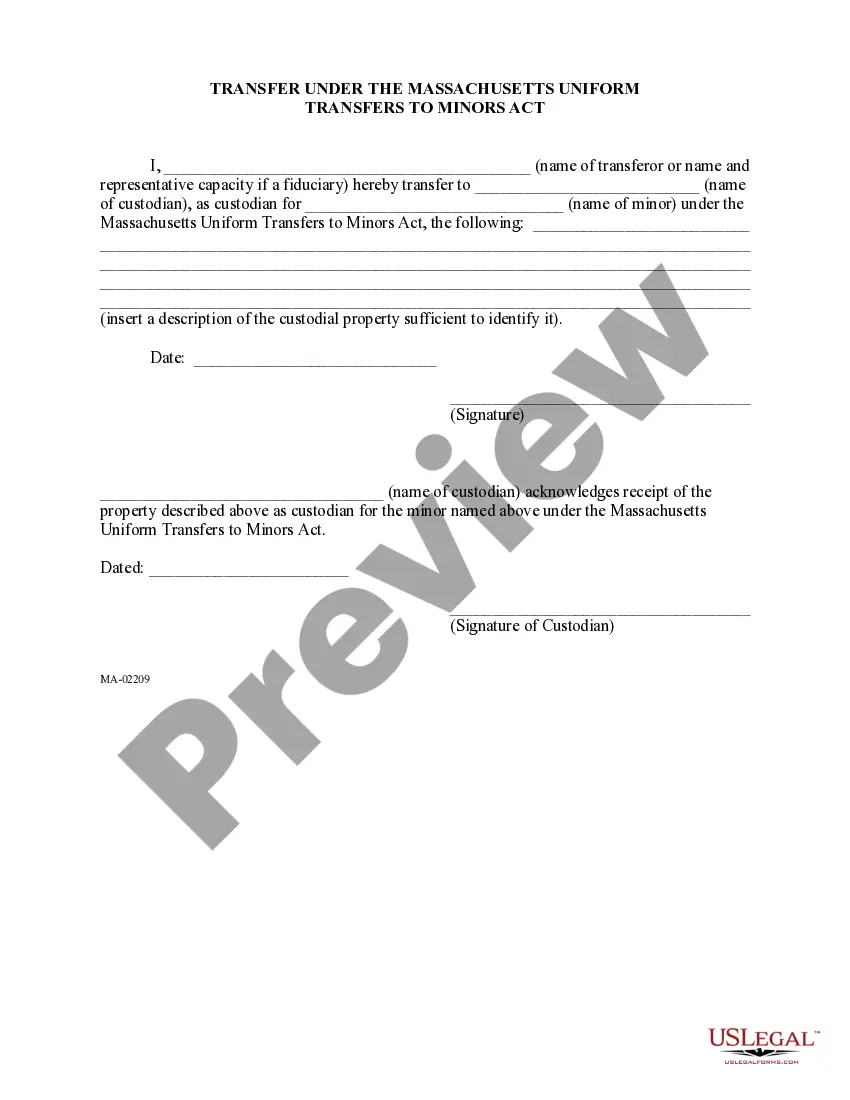
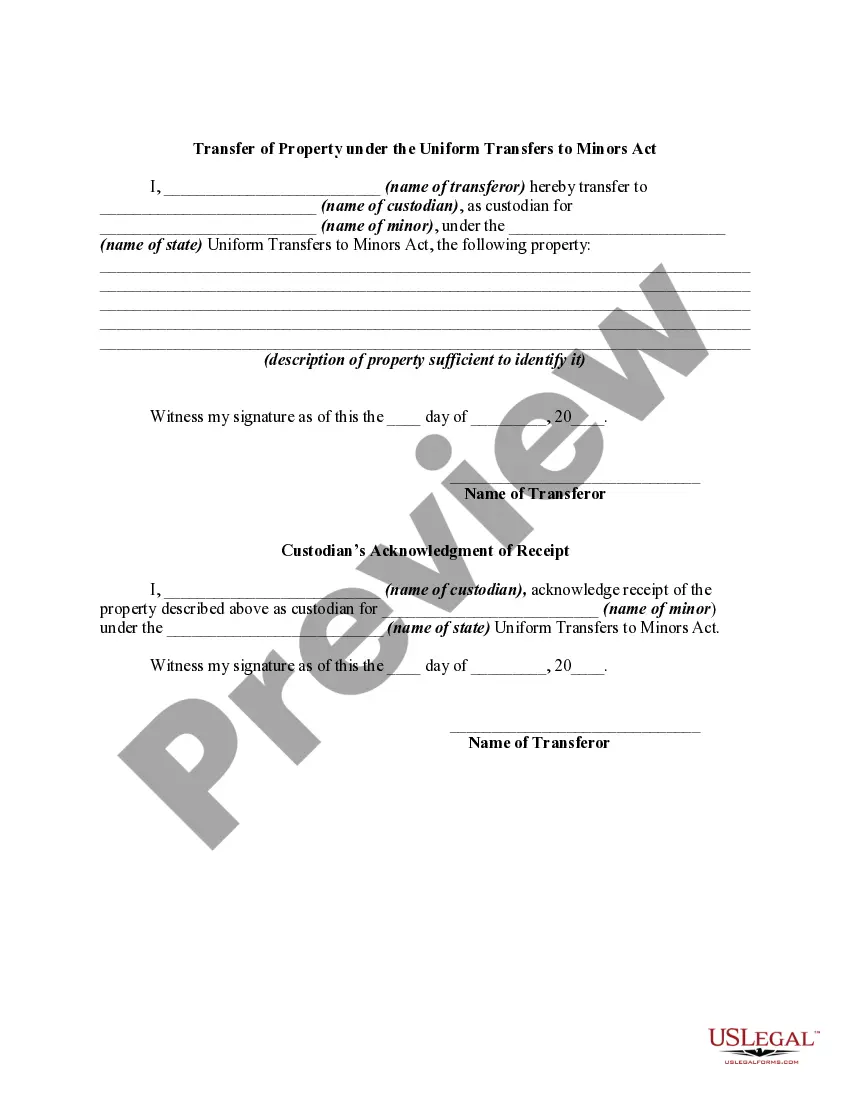
The Transfer Under The Massachusetts Uniform Custodial Trust Act form is a legal document used to transfer property or money to a trust. The Trustee, acting on behalf of the Beneficiary, acknowledges this transfer and details the items being transferred. This form is specifically tailored to comply with Massachusetts law, ensuring clear and enforceable transactions within the state.
What’s included in this form
- Name of the transferor who is transferring the property.
- Name of the trustee who will manage the trust.
- Name of the beneficiary who will benefit from the trust.
- Description of the property being transferred to the trust.
Common use cases
This form is needed when you want to establish a custodial trust in Massachusetts. Use it to officially transfer assets to a trust for management by a Trustee, ensuring that the Beneficiary receives the benefits of the property or money per the trust's terms. Common situations include gifting assets while maintaining control over their distribution or preparing for future inheritance planning.
Intended users of this form
This form is intended for:
- Individuals wanting to transfer assets into a trust for a beneficiary.
- Fiduciaries acting on behalf of individuals to establish a trust.
- Estate planners seeking to manage future asset distribution.
- Trustees responsible for managing a custodial trust.
How to prepare this document
- Identify the transferor, including their name and any representative capacity if acting as a fiduciary.
- Specify the trusteeâs name, ensuring they are not the same as the transferor.
- Enter the name of the beneficiary who will receive the trust's benefits.
- Clearly describe the property being transferred, ensuring it is legally sufficient to identify each item.
- Sign and date the form to validate the transfer.
Notarization guidance
This form does not typically require notarization unless specified by local law. However, it is advisable to verify whether notarization might be beneficial for added legal assurance.
Get your form ready online
Our built-in tools help you complete, sign, share, and store your documents in one place.
Make edits, fill in missing information, and update formatting in US Legal Forms—just like you would in MS Word.
Download a copy, print it, send it by email, or mail it via USPS—whatever works best for your next step.
Sign and collect signatures with our SignNow integration. Send to multiple recipients, set reminders, and more. Go Premium to unlock E-Sign.
If this form requires notarization, complete it online through a secure video call—no need to meet a notary in person or wait for an appointment.
We protect your documents and personal data by following strict security and privacy standards.

Make edits, fill in missing information, and update formatting in US Legal Forms—just like you would in MS Word.

Download a copy, print it, send it by email, or mail it via USPS—whatever works best for your next step.

Sign and collect signatures with our SignNow integration. Send to multiple recipients, set reminders, and more. Go Premium to unlock E-Sign.

If this form requires notarization, complete it online through a secure video call—no need to meet a notary in person or wait for an appointment.

We protect your documents and personal data by following strict security and privacy standards.
Typical mistakes to avoid
- Failing to include a comprehensive description of the transferred property.
- Not obtaining the Trustee's acknowledgment prior to signing.
- Leaving out signatures or dates which can nullify the form.
- Using outdated forms that do not comply with current Massachusetts law.
Why use this form online
- Instant access to legally crafted documents tailored for Massachusetts law.
- Edit and customize the form to meet your specific needs.
- Downloadable formats (Word and Rich Text) for convenience.
- Secure storage of your completed forms for future reference.
Key takeaways
- The form is essential for transferring assets under the Massachusetts Uniform Custodial Trust Act.
- Complete details about the transferor, trustee, beneficiary, and property are critical for validity.
- Ensure all signatures are present and correct to avoid issues with the transfer.
Looking for another form?



Form popularity
FAQ
To transfer a UTMA account, you must first complete the necessary transfer forms, which typically include the minor's details and the account information. You will need to provide documentation verifying the original custodian's identity and their intent to transfer the account. It's essential to follow the guidelines outlined under the Massachusetts Uniform Custodial Trust Act for a smooth transition. Check uslegalforms for resources that guide you through the process and ensure compliance with state regulations.
When a Trust owns a home the Trustee acts as the legal owner and makes all the management decisions, the beneficiaries only get the enjoyment partliving there (if that is allowed under the Trust terms).
A living trust in Massachusetts is created by the grantor, the person putting things into trust. As the grantor you must choose a trustee who is charged with managing the trust for your benefit while you are alive and distributing your assets to your beneficiaries after your death.
Prior to enacting G.L.c. 184, §35, Massachusetts was among the few states requiring the full trust document for trusts containing real property to be recorded.The trustee's certificate is recorded either immediately upon the trust's acquisition of real property, or when the trustee acts upon the title 1.
In order to create a general petition for the creation of a trust, the filing fee is $375 with a surcharge of $15. Once the trust has been created, there will be a great deal of paperwork involved, since every asset that is added to the trust will need to be signed for.
In California, a trust does not have to be recorded to be legal unless it holds title on real estate. If a trust does not hold title on real estate property, all assets held in the name of the trust are kept private. The trustee maintains a record of all trust property in a trust portfolio.
Since the Schedule of Beneficiaries to a trust is not recorded with the Declaration of Trust at the Registry of Deeds, the identity of the Beneficiaries is not a matter of public record.There are two types of Trusts in Massachusetts.
An unrecorded deed is a deed for real property that neither the buyer nor the seller has delivered to an appropriate government agency. Unrecorded deeds can present many issues for sellers (or grantors) and buyers (or grantees) such as proof of ownership and tax implications.