Declaration of Trust Under the Massachusetts Uniform Custodial Trust Code
What this document covers
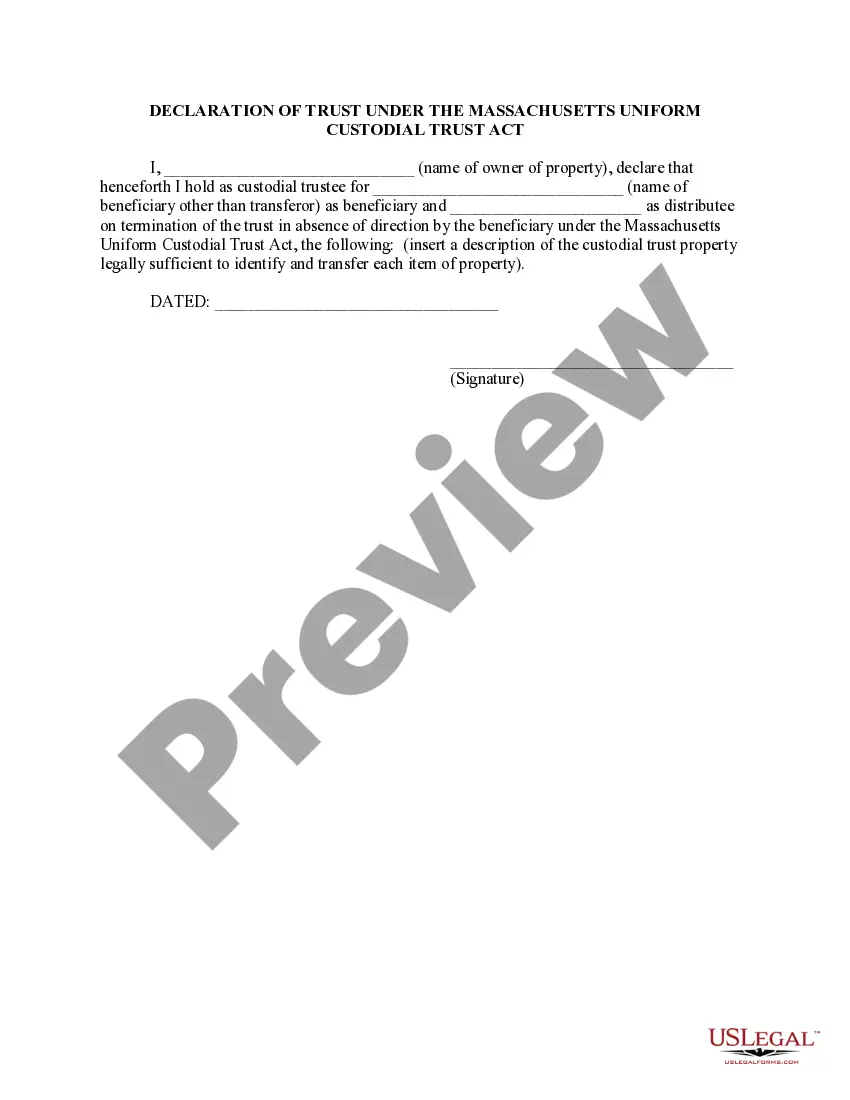
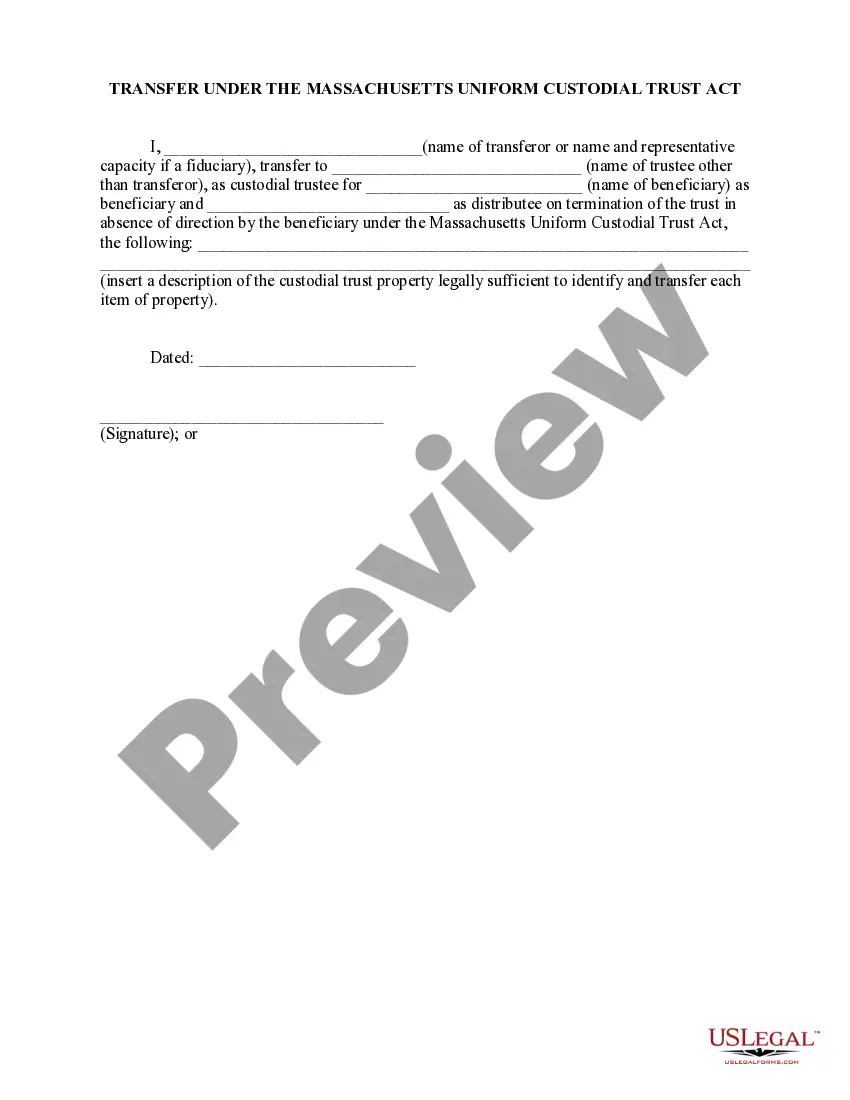
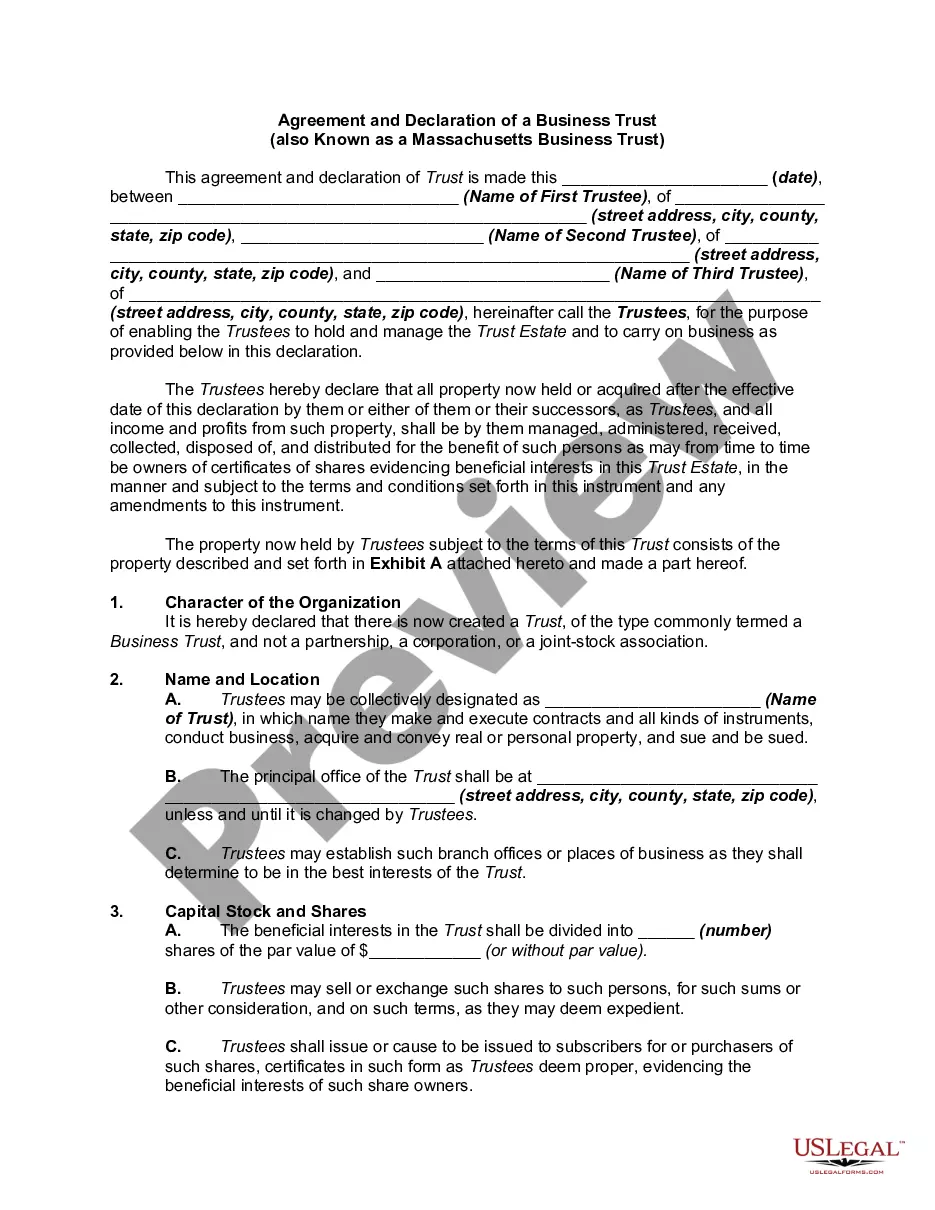
The Declaration of Trust Under the Massachusetts Uniform Custodial Trust Code is a legal document that establishes a custodial trust arrangement. This declaration specifies that the custodian (Declarant) will hold a parcel of land for the beneficiary until the beneficiary is ready to assume possession. This form is designed to clarify ownership rights and responsibilities, distinguishing it from other types of trust documents.
Key parts of this document
- Name of the property owner (Declarant).
- Name of the beneficiary who will ultimately possess the trust property.
- Description of the custodial trust property to legally identify it.
- Date of the declaration.
When to use this form
This form should be used when an individual wants to create a custodial trust for land in Massachusetts. For instance, a property owner may wish to ensure that their land is managed by a designated trustee until the intended beneficiary, such as a child or other family member, is of age or ready to take over the property. It is also appropriate in scenarios where the property owner desires to maintain control while facilitating a smoother transfer of property rights in the future.
Who this form is for
- Property owners in Massachusetts wishing to establish a custodial trust.
- Individuals planning to transfer property rights to a beneficiary at a future date.
- Trustees who are designated to manage property on behalf of a beneficiary.
Instructions for completing this form
- Identify yourself as the property owner (Declarant) and clearly state your name.
- Define the beneficiary by entering their name who will receive the property rights in the future.
- Provide a clear description of the property to be held in trust.
- Enter the date of the declaration.
- Sign the document to validate your intention.
Notarization requirements for this form
This form does not typically require notarization unless specified by local law. However, it is always advisable to check local regulations to ensure compliance with any additional requirements for the validity of the document.
Get your form ready online
Our built-in tools help you complete, sign, share, and store your documents in one place.
Make edits, fill in missing information, and update formatting in US Legal Forms—just like you would in MS Word.
Download a copy, print it, send it by email, or mail it via USPS—whatever works best for your next step.
Sign and collect signatures with our SignNow integration. Send to multiple recipients, set reminders, and more. Go Premium to unlock E-Sign.
If this form requires notarization, complete it online through a secure video call—no need to meet a notary in person or wait for an appointment.
We protect your documents and personal data by following strict security and privacy standards.

Make edits, fill in missing information, and update formatting in US Legal Forms—just like you would in MS Word.

Download a copy, print it, send it by email, or mail it via USPS—whatever works best for your next step.

Sign and collect signatures with our SignNow integration. Send to multiple recipients, set reminders, and more. Go Premium to unlock E-Sign.

If this form requires notarization, complete it online through a secure video call—no need to meet a notary in person or wait for an appointment.

We protect your documents and personal data by following strict security and privacy standards.
Common mistakes
- Failing to provide a clear property description, which can lead to legal ambiguities.
- Not stating the beneficiary's name correctly, potentially causing issues later.
- Omitting the date, which is essential for establishing a timeline for the trust.
- Forgetting to sign the document, which renders it invalid.
Advantages of online completion
- Easy access to legally drafted templates ensures accuracy and compliance.
- Editable formats allow you to customize the form to meet your specific needs.
- Immediate download means you can complete your legal work efficiently.
- Secure and trusted source for legal forms reduces risks of errors.
Key takeaways
- The Declaration of Trust is vital for managing property on behalf of others.
- Use this form when establishing custodial trusts under Massachusetts law.
- Ensure accuracy in all details to avoid legal issues later.
Looking for another form?
Form popularity
FAQ
Creating a declaration of trust involves several important steps. First, you need to determine the purpose of your trust and identify the assets you wish to include. Then, utilizing a reliable template or legal service, like those provided by U.S. Legal Forms, you can draft the Declaration of Trust Under the Massachusetts Uniform Custodial Trust Code, ensuring that it meets legal requirements. Finally, have it signed and notarized to make it effective.
A declaration of trust is something you'll come across when you're planning to buy a property with someone else, or with the support of another person. It's a legal document, also referred to as a deed of trust, which records the financial arrangements between everyone who has a financial interest in the property.
Just for your information, a trust is not a public record, so it's impossible to retrieve a trust document from a public office, agency or anyone who is not a beneficiary and doesn't have the rights to know about the details your trust.
Since the Schedule of Beneficiaries to a trust is not recorded with the Declaration of Trust at the Registry of Deeds, the identity of the Beneficiaries is not a matter of public record.There are two types of Trusts in Massachusetts.
Unlike a Will, which has to be filed with the court at the start of the probate process, a Revocable Living Trust generally does not have to be filed or recorded anywhere. Unless there's a lawsuit concerning your trust, it won't become a matter of public record.
Trusts in Massachusetts are governed by the Massachusetts Uniform Trust Code, codified at G.L.c. 203E.The trustee's certificate is recorded either immediately upon the trust's acquisition of real property, or when the trustee acts upon the title 1.
A declaration of trust under U.S. law is a document or an oral statement appointing a trustee to oversee assets being held for the benefit of one or more other individuals. These assets are held in a trust.The declaration of trust is sometimes referred to as a nominee declaration.
A trust is not required to be registered with any State or local agency and should be held by the parties involved, mainly, the Trustee. Although not legally required, having the document notarized could help prove authenticity should it be challenged.
Prior to enacting G.L.c. 184, §35, Massachusetts was among the few states requiring the full trust document for trusts containing real property to be recorded.The trustee's certificate is recorded either immediately upon the trust's acquisition of real property, or when the trustee acts upon the title 1.