Louisiana Motion for Speedy Trial
What is this form?
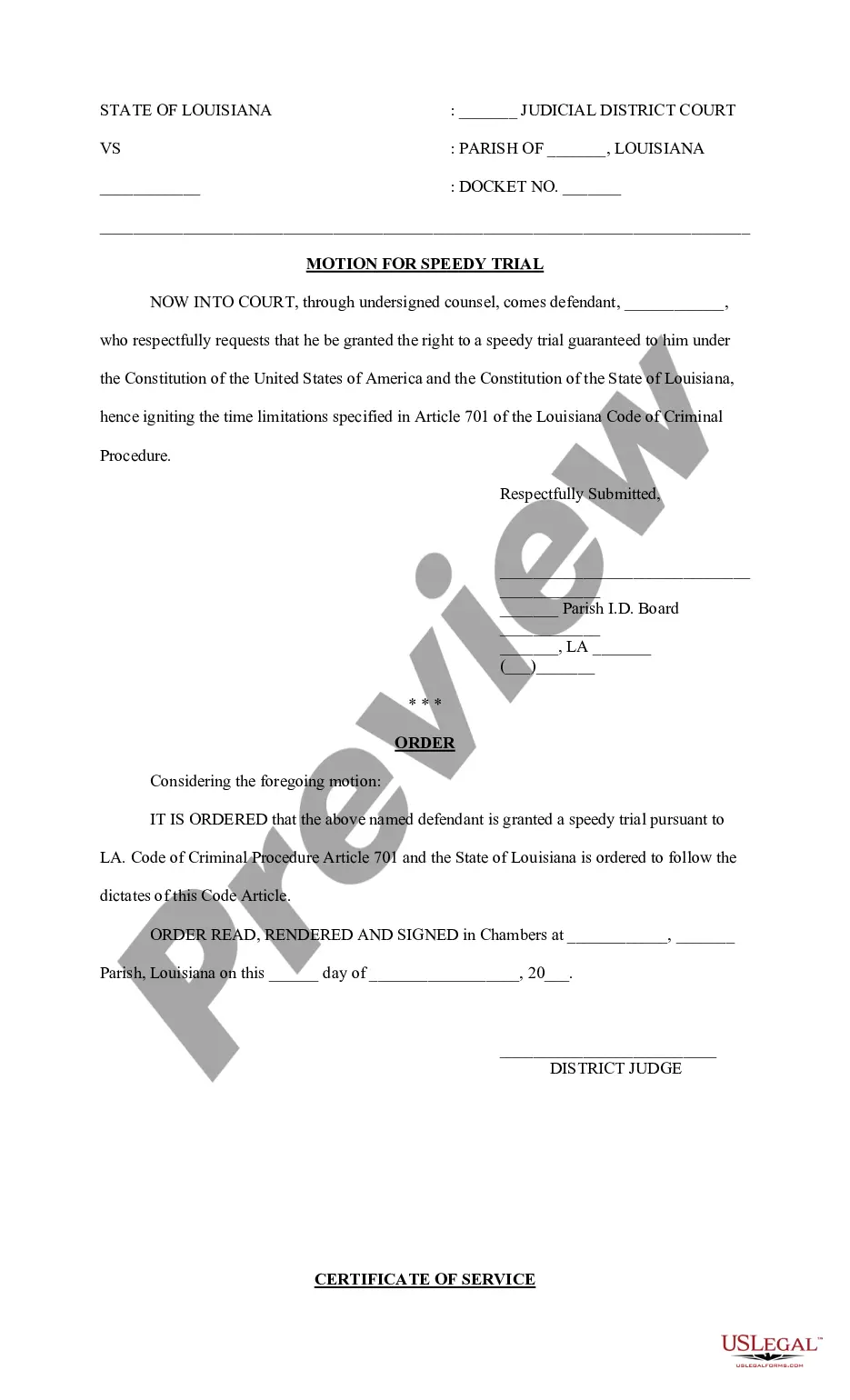
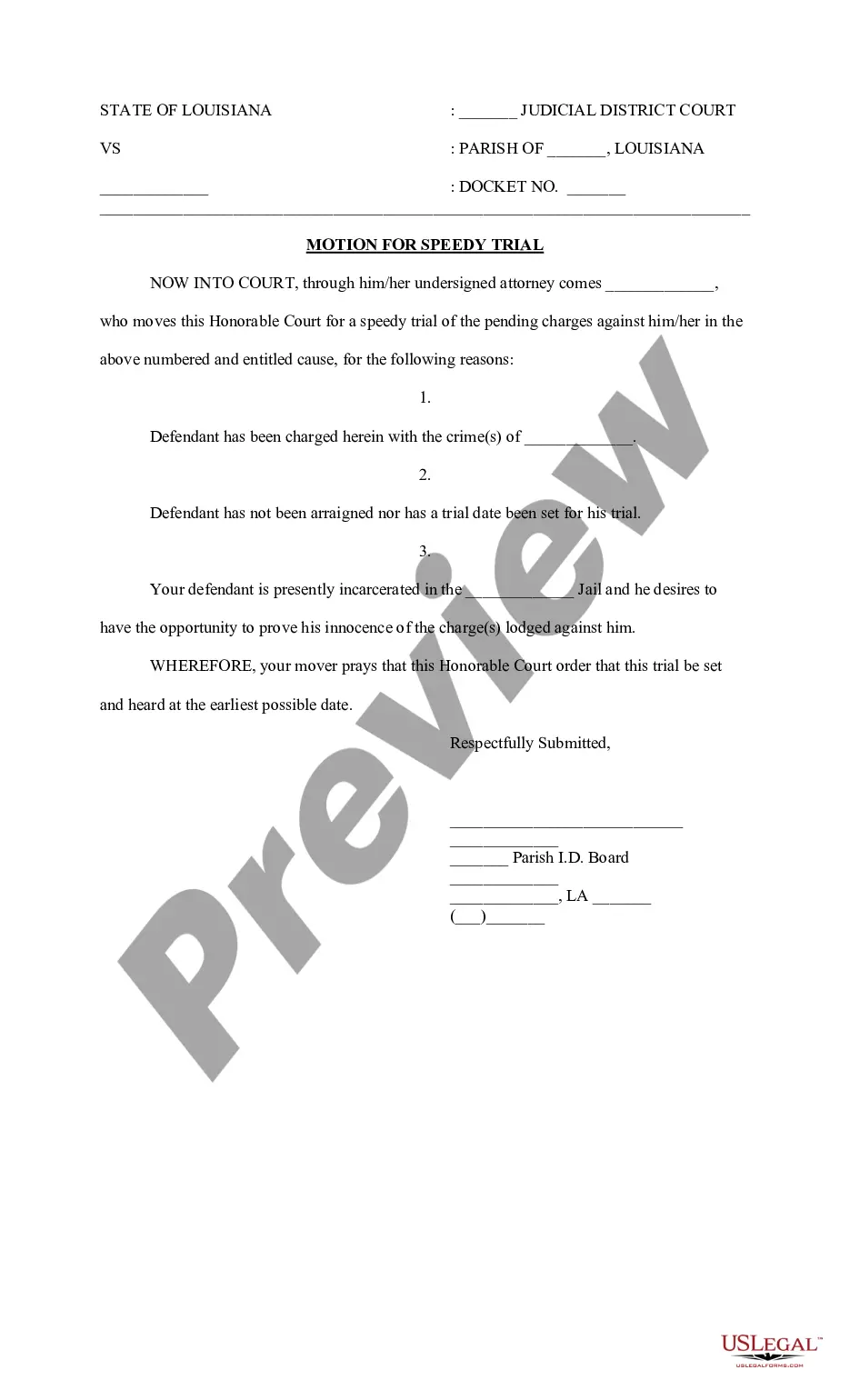
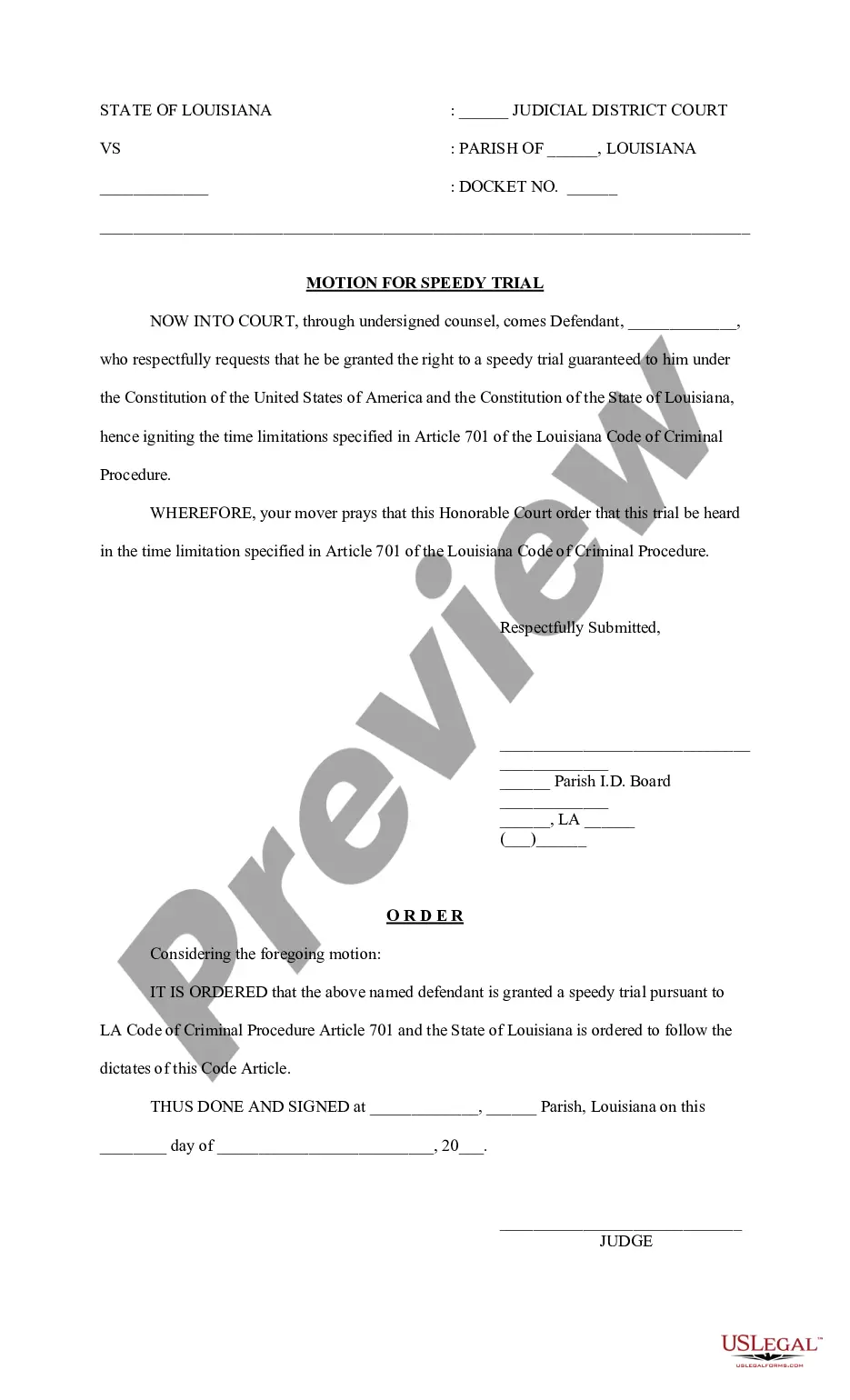
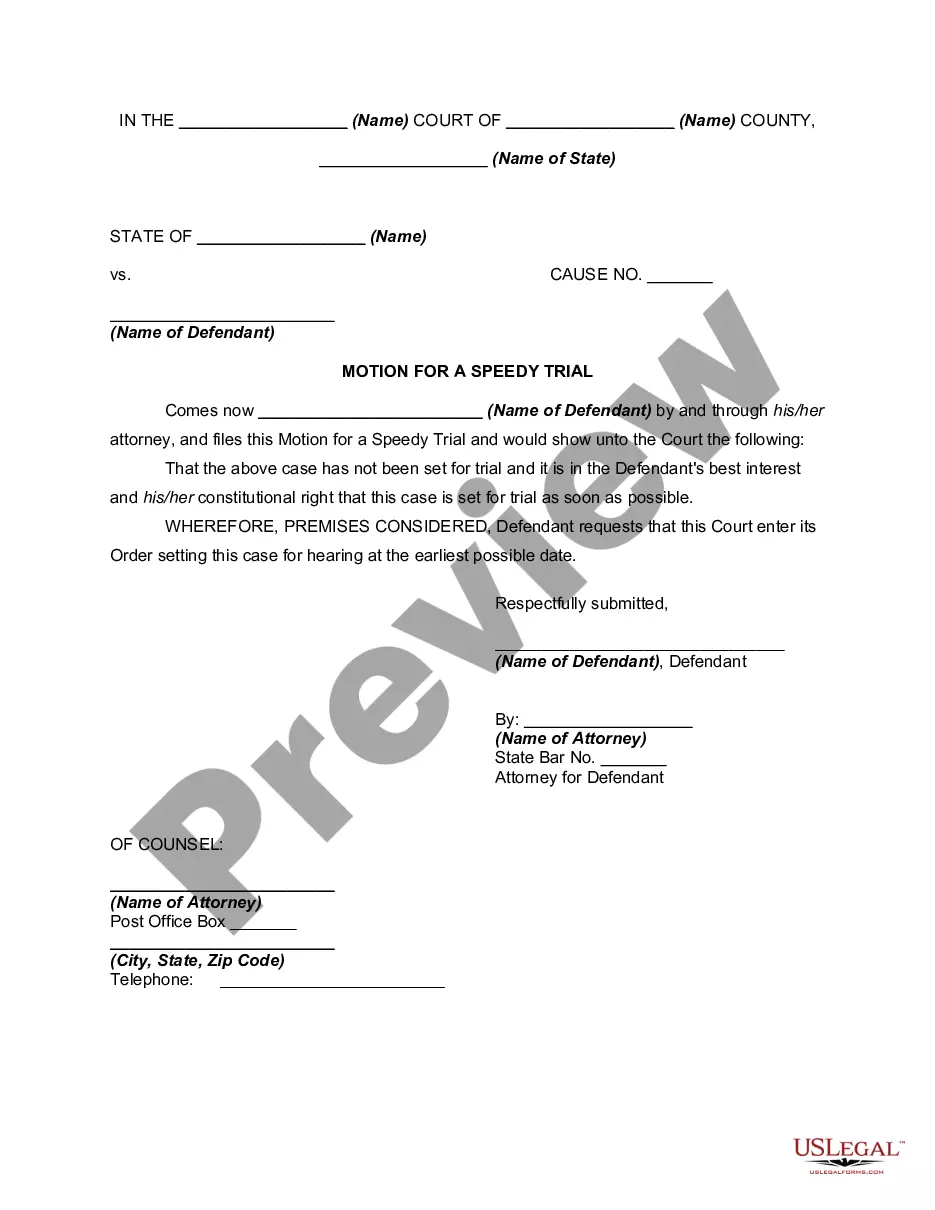
The Motion for Speedy Trial is a legal document that enables a defendant in a criminal case to request that their trial be conducted within the time limits established by law. This form serves to uphold the defendant's constitutional right to a speedy trial, distinct from other motions that may address trial scheduling or delays.
Key parts of this document
- Defendant's request for a speedy trial as per constitutional rights.
- Citation of relevant law: Article 701 of the Louisiana Code of Criminal Procedure.
- Order section where the court grants the motion.
- Certificate of service indicating the notification of the District Attorneyâs office.

When to use this document
This form should be used when a defendant in a criminal case believes that their right to a speedy trial is being compromised. It is typically filed when there is a delay in setting a trial date, and the defendant seeks to enforce their right to have their case heard without unnecessary postponement.
Intended users of this form
- Defendants in criminal cases who wish to expedite their trial process.
- Individuals who have legal representation and are advised to file this motion.
- Clients facing potential delays in court and seeking to assert their rights.
Instructions for completing this form
- Enter the defendant's name and relevant case details in the provided fields.
- Include a clear request for a speedy trial, citing the constitutional rights involved.
- Fill out the order section with the judge's information and the date of the order.
- Add your signature and the signature of your attorney, if applicable.
- Complete the certificate of service section to confirm that the appropriate parties have been notified.
Notarization guidance
This form does not typically require notarization unless specified by local law.
Get your form ready online
Our built-in tools help you complete, sign, share, and store your documents in one place.
Make edits, fill in missing information, and update formatting in US Legal Forms—just like you would in MS Word.
Download a copy, print it, send it by email, or mail it via USPS—whatever works best for your next step.
Sign and collect signatures with our SignNow integration. Send to multiple recipients, set reminders, and more. Go Premium to unlock E-Sign.
If this form requires notarization, complete it online through a secure video call—no need to meet a notary in person or wait for an appointment.
We protect your documents and personal data by following strict security and privacy standards.

Make edits, fill in missing information, and update formatting in US Legal Forms—just like you would in MS Word.

Download a copy, print it, send it by email, or mail it via USPS—whatever works best for your next step.

Sign and collect signatures with our SignNow integration. Send to multiple recipients, set reminders, and more. Go Premium to unlock E-Sign.

If this form requires notarization, complete it online through a secure video call—no need to meet a notary in person or wait for an appointment.

We protect your documents and personal data by following strict security and privacy standards.
Mistakes to watch out for
- Failing to cite the correct legal provisions when filing the motion.
- Not properly notifying the District Attorneyâs office as required.
- Missing deadlines for filing the motion, thereby weakening the request.
Why complete this form online
- Easy to download and fill out at your convenience.
- Provides a clear structure to ensure all legal requirements are met.
- Allows for quick edits and updates if necessary.
Looking for another form?
Form popularity
FAQ
While there is no hard and fast rule on how long is too long, one rule of thumb is eight months. Courts will generally presume that the delay has been sufficient to satisfy a defendant's prima facie case of the denial of the right to a speedy trial when eight months have passed.
The state has to bring you to trial with 120 days if you are accused of a felony and 30 days if you are accused of a misdemeanor and are still being held in custody. If you have bonded out, the State has 180 days to bring you to trial on a felony charge and 60 days to bring you to trial on a misdemeanor charge.
In addition to guaranteeing the right to an attorney, the Sixth Amendment to the U.S. Constitution guarantees a criminal defendant the right to a speedy trial by an "impartial jury." This means that a criminal defendant must be brought to trial for his or her alleged crimes within a reasonably short time after arrest,
A good example of when a person might request a speedy trial is when he is in jail awaiting trial.For instance, when a defendant asserts his right to a speedy trial and then flees the jurisdiction, the timeframe for holding the defendant's trial is stayed until the defendant returns.
In all criminal prosecutions, the accused shall enjoy the right to a speedy and public trial, by an impartial jury of the State and district wherein the crime shall have been committed, which district shall have been previously ascertained by law, and to be informed of the nature and cause of the accusation; to be
An arraignment in Louisiana is the first court appearance in criminal court in Louisiana. Prior to the arraignment, the prosecutor either filed a bill of information, which is the formal charge, or the grand jury returned a true bill indictinhg the defendant. The arraignment is then set.
A "speedy" trial basically means that the defendant is tried for the alleged crimes within a reasonable time after being arrested.In the most extreme situations, when a court determines that the delay between arrest and trial was unreasonable and prejudicial to the defendant, the court dismisses the case altogether.
(1) A motion by the defendant for a speedy trial, in order to be valid, must be accompanied by an affidavit by defendant's counsel certifying that the defendant and his counsel are prepared to proceed to trial within the delays set forth in this Article.