Louisiana Motion for Speedy Trial with affidavit of preparedness
About this form
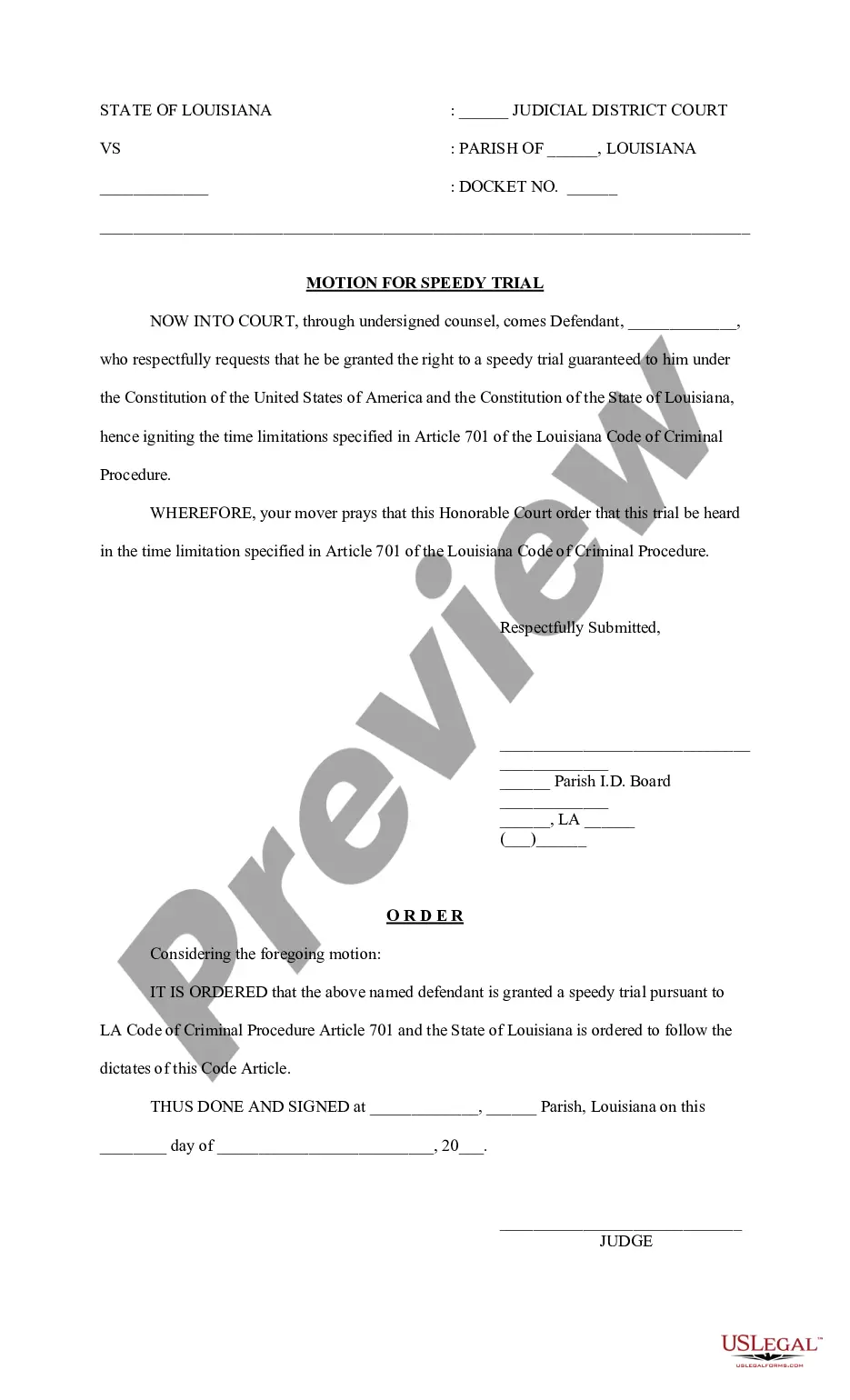
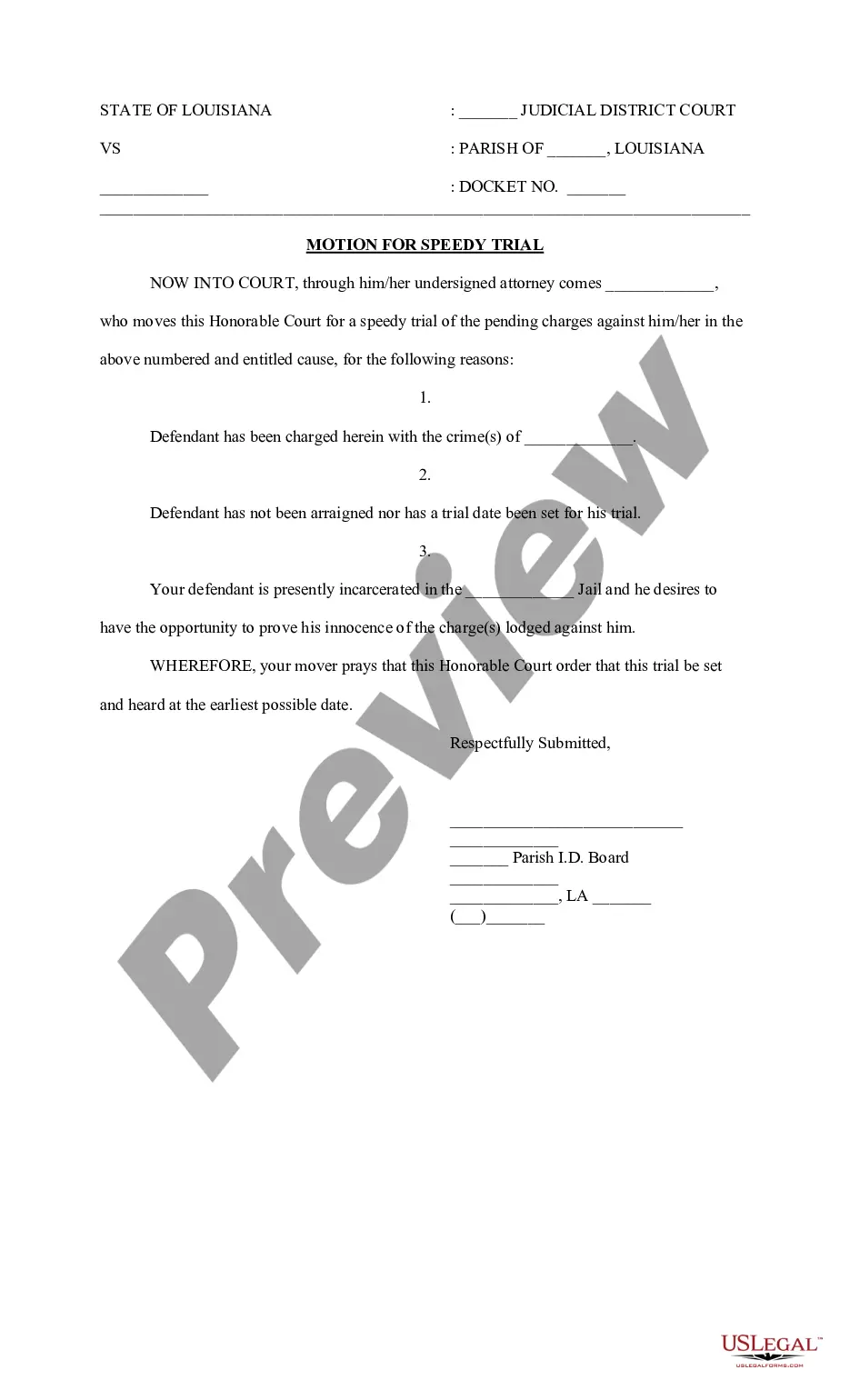
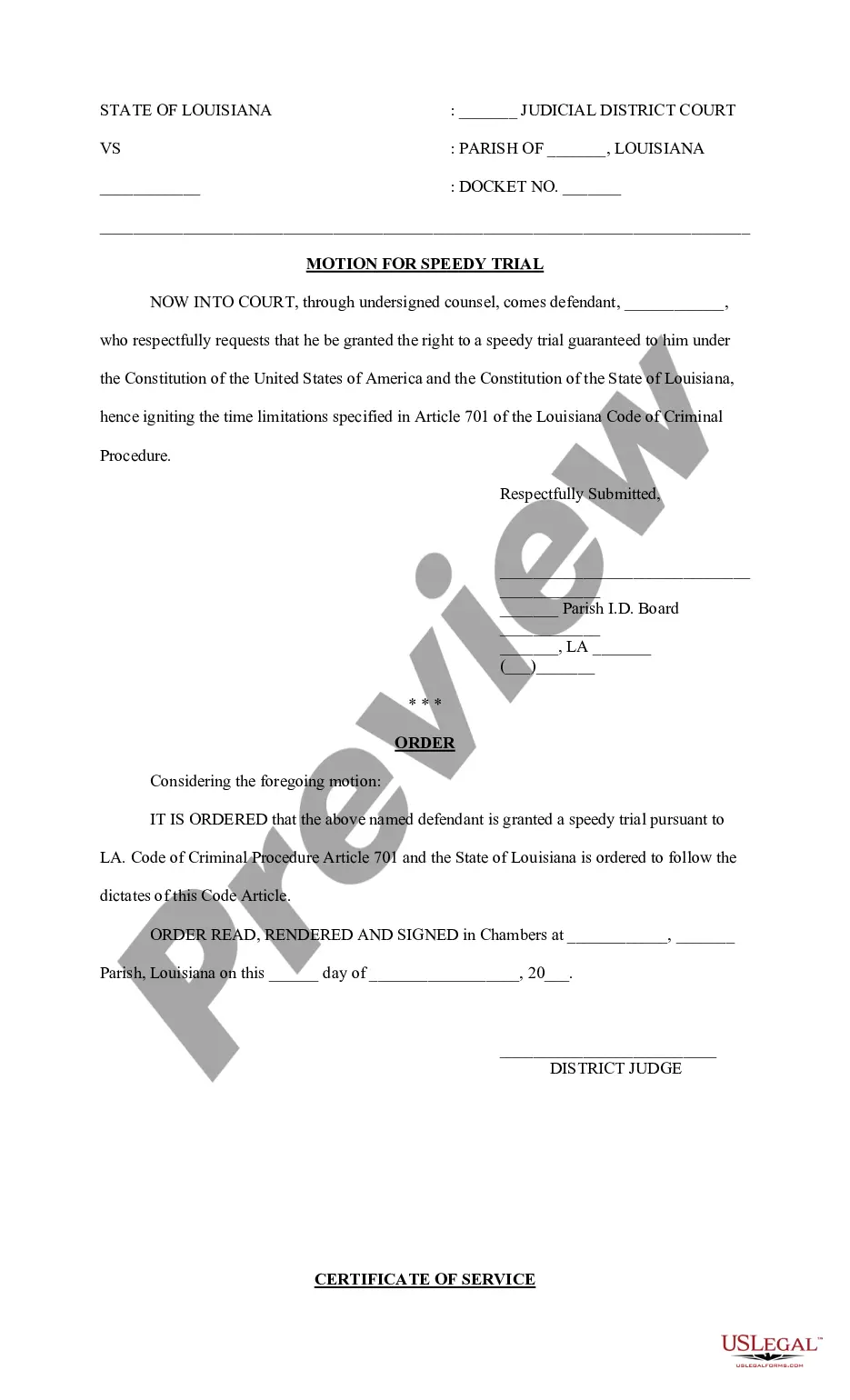
The Motion for Speedy Trial with affidavit of preparedness is a legal document used in criminal cases to request a timely trial. This motion aims to uphold the defendant's constitutional right to a speedy trial, as guaranteed by both the United States and Louisiana constitutions. Unlike other motions that may focus on delays or continuances, this form specifically addresses the timelines set forth in Article 701 of the Louisiana Code of Criminal Procedure.
Key parts of this document
- Defendant's request for a speedy trial.
- Citation of constitutional rights under U.S. and Louisiana law.
- Reference to Article 701 of the Louisiana Code of Criminal Procedure.
- Order from the court granting the motion for a speedy trial.
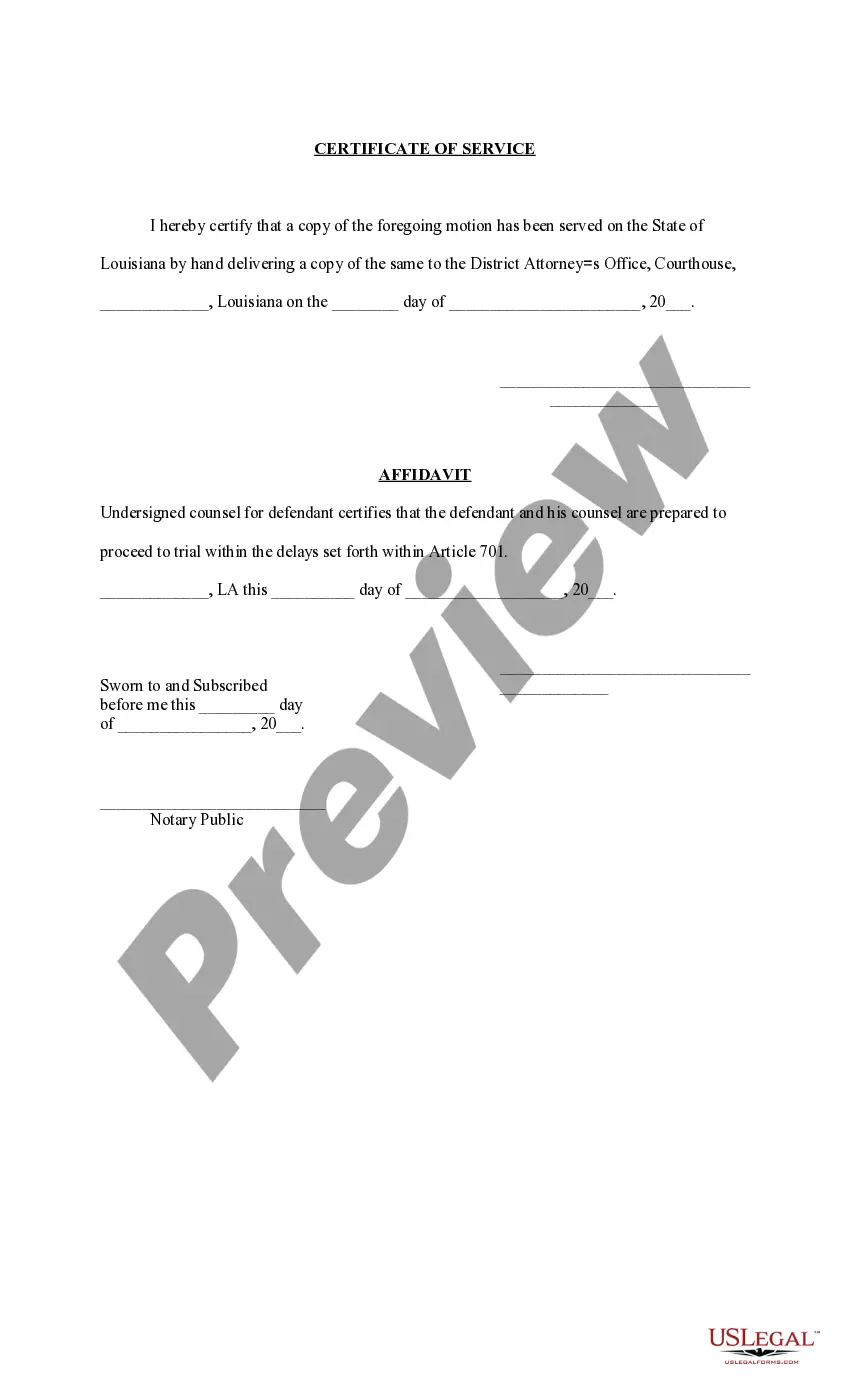
- Affidavit of preparedness from the defendant's counsel.
- Certificate of service to the State of Louisiana.
When this form is needed
This form is appropriate to use when a defendant in a criminal case wishes to ensure that their trial is held within the timeframe specified by law. It is especially relevant if the defendant feels that delays could negatively impact their case or if they want to assert their right to a quick resolution of the charges against them.
Who should use this form
- Defendants in criminal cases facing potential delays in their trial.
- Lawyers representing clients who aim to expedite trial proceedings.
- Individuals wishing to formally assert their right to a speedy trial.
Completing this form step by step
- Enter the parish and court information at the top of the form.
- Provide the defendant's name and docket number accurately.
- Include a clear statement requesting a speedy trial based on constitutional rights.
- Obtain the signature of both the defendant and their counsel at the end of the motion.
- Complete the affidavit section confirming readiness for trial.
- Ensure the certificate of service is filled out and submitted to the State.
Notarization guidance
This form does not typically require notarization unless specified by local law. However, it is crucial to verify any specific court requirements related to notarization to ensure validity.
Get your form ready online
Our built-in tools help you complete, sign, share, and store your documents in one place.
Make edits, fill in missing information, and update formatting in US Legal Forms—just like you would in MS Word.
Download a copy, print it, send it by email, or mail it via USPS—whatever works best for your next step.
Sign and collect signatures with our SignNow integration. Send to multiple recipients, set reminders, and more. Go Premium to unlock E-Sign.
If this form requires notarization, complete it online through a secure video call—no need to meet a notary in person or wait for an appointment.
We protect your documents and personal data by following strict security and privacy standards.

Make edits, fill in missing information, and update formatting in US Legal Forms—just like you would in MS Word.

Download a copy, print it, send it by email, or mail it via USPS—whatever works best for your next step.

Sign and collect signatures with our SignNow integration. Send to multiple recipients, set reminders, and more. Go Premium to unlock E-Sign.

If this form requires notarization, complete it online through a secure video call—no need to meet a notary in person or wait for an appointment.

We protect your documents and personal data by following strict security and privacy standards.
Typical mistakes to avoid
- Failing to include all necessary signatures, including that of the defendant's counsel.
- Providing incorrect or incomplete docket information.
- Neglecting to file the motion within the specific time limitations outlined in the Code.
Benefits of completing this form online
- Immediate access to a legally vetted template tailored to Louisiana laws.
- Convenience of downloading and completing from home or office.
- Ability to edit the document to reflect specific case details easily.
- This motion serves as a formal request and can significantly impact the timeline of a criminal case.
- Successfully filing this motion may compel the court to prioritize the defendant's case.
Looking for another form?
Form popularity
FAQ
Article 218.1 of the Louisiana Code of Criminal Procedure addresses the defendant's right to a speedy trial and outlines the specific timeframes within which trials must occur. It emphasizes fairness and timely justice in criminal cases, ensuring that defendants are not unduly delayed. If you find yourself awaiting a trial, you might consider a Louisiana Motion for Speedy Trial with affidavit of preparedness to invoke this right. This legal provision plays a crucial role in maintaining the integrity of the justice system.
The 60-day rule in Louisiana mandates that a defendant must be tried within 60 days of their arraignment if they are in custody. This rule is part of the legal framework that ensures timely prosecution, emphasizing the importance of expediency in the legal system. If you face delays beyond this timeframe, filing a Louisiana Motion for Speedy Trial with affidavit of preparedness may be your viable option. Understanding this rule helps you navigate the judicial process efficiently.
Public trials allow the general public to see that the justice system is functioning properly and treating defendants fairly. Holding the criminal justice system accountable. The presence of interested spectators is thought to keep the judge, jury, and courtroom staff mindful of their responsibilities and actions.
Length of delay; Reason for the delay; Defendant's assertion of his right; and. Prejudice to the defendant.
How Long Does it Take to Be Indicted in Georgia? The indictment process begins when a person is arrested or charged for a criminal act. However, the length of time for the process to conclude can take up to 2 years for a felony charge.
How many days should pass before the trial is considered not speedy enough? There is no definite answer. Still, eight months is the magic number -- after a wait of that duration, a court will fully evaluate whether a person has waited too long for the trial under a speedy trial analysis.
A "speedy" trial basically means that the defendant is tried for the alleged crimes within a reasonable time after being arrested.In the most extreme situations, when a court determines that the delay between arrest and trial was unreasonable and prejudicial to the defendant, the court dismisses the case altogether.
Everyone has the right to a speedy trial, but in California, with a misdemeanor charge that is defined as within 45 calendar days from the day they were arraigned if they're not in custody, or 30 days if they are in custody. However, most people waive their right to a speedy trial, in order to mount a good defense.
One of the main reasons for the right to a speedy trial is to prevent a defendant from being held in custody for a long time, only to eventually be found innocent. If the defendant is denied bail or cannot pay the bail amount, they will remain in jail until their trial date.
A "speedy" trial basically means that the defendant is tried for the alleged crimes within a reasonable time after being arrested.In the most extreme situations, when a court determines that the delay between arrest and trial was unreasonable and prejudicial to the defendant, the court dismisses the case altogether.