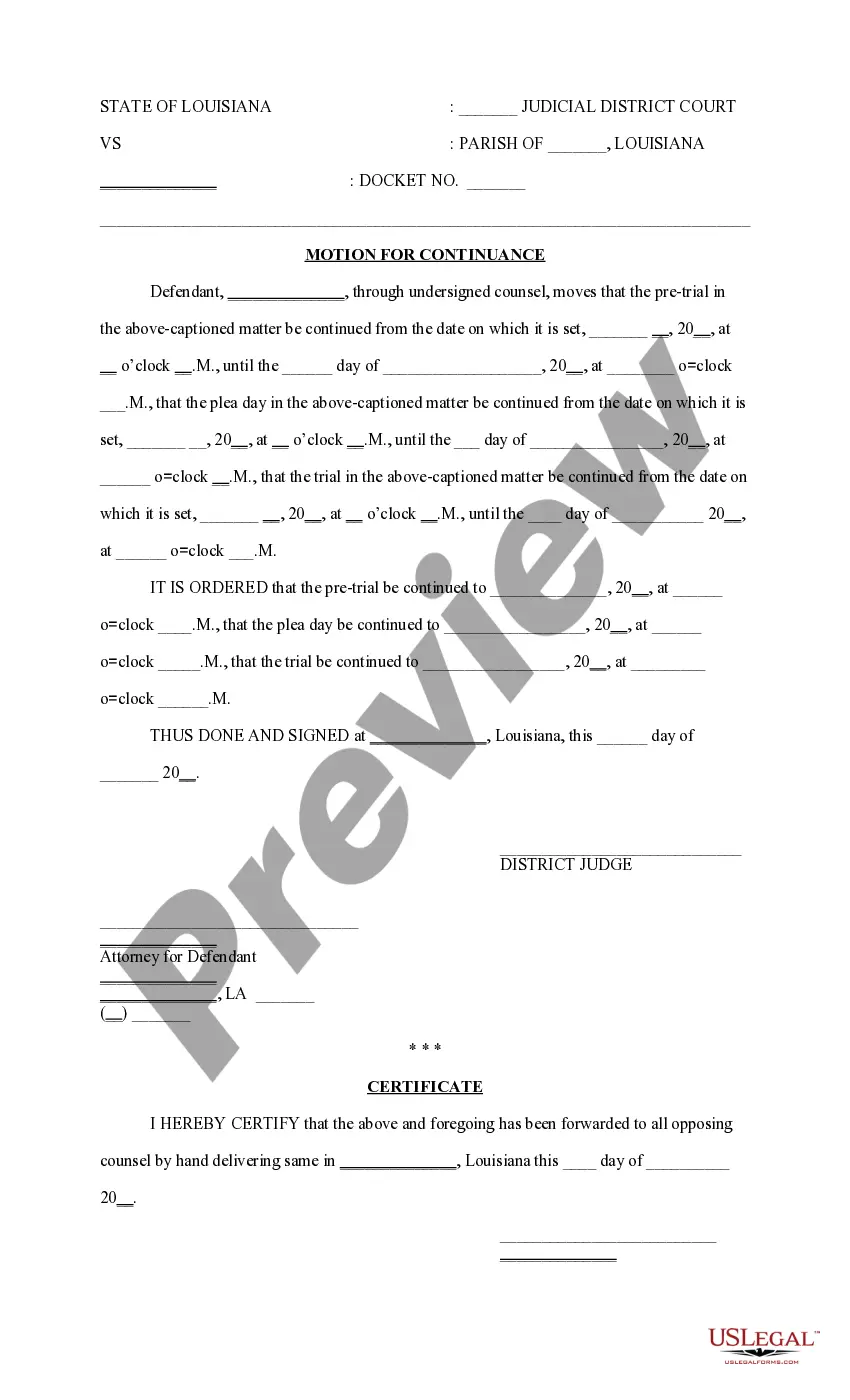
Louisiana Motion for Continuance Pretrial, Plea and Trial, and Order
Overview of this form
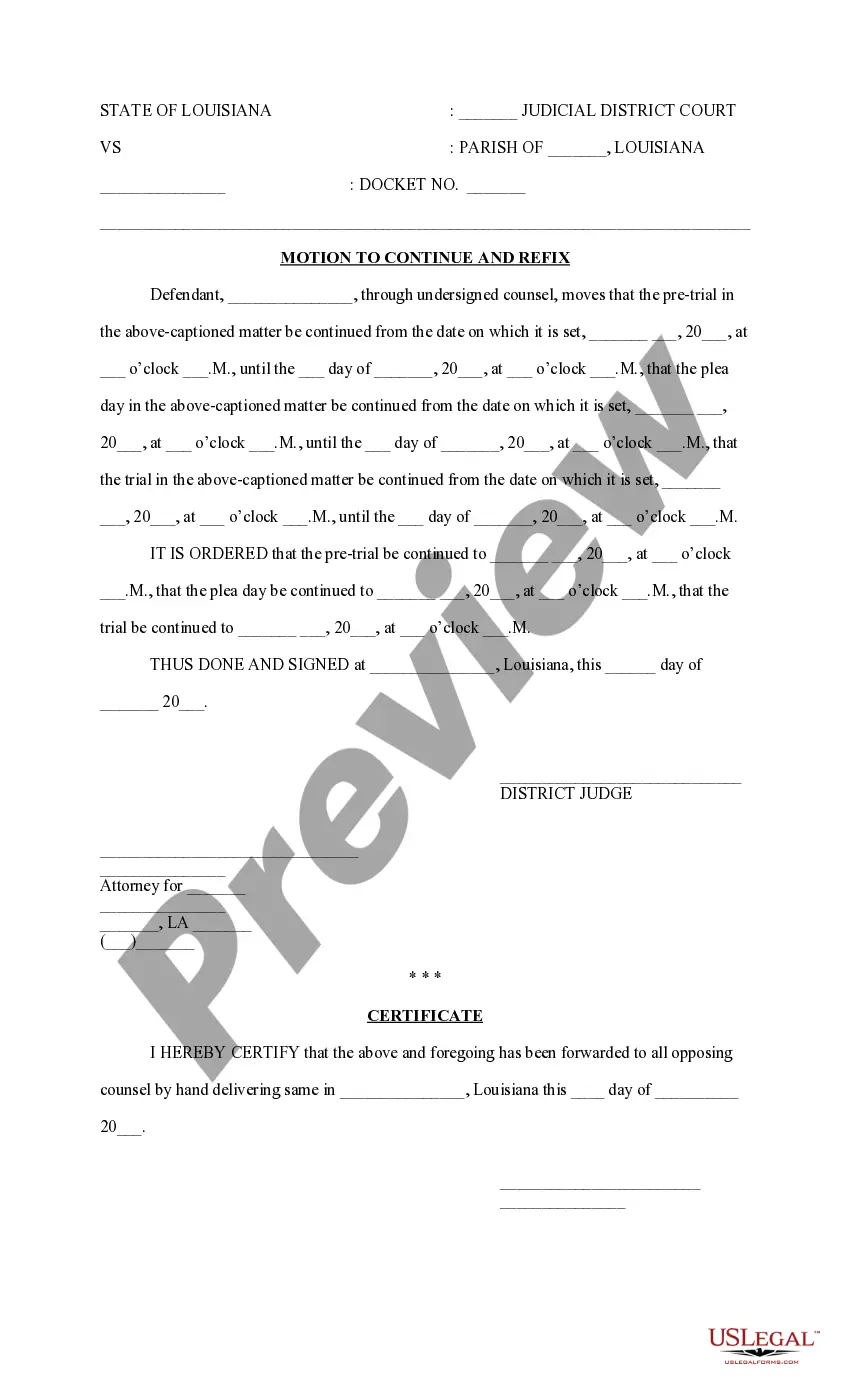
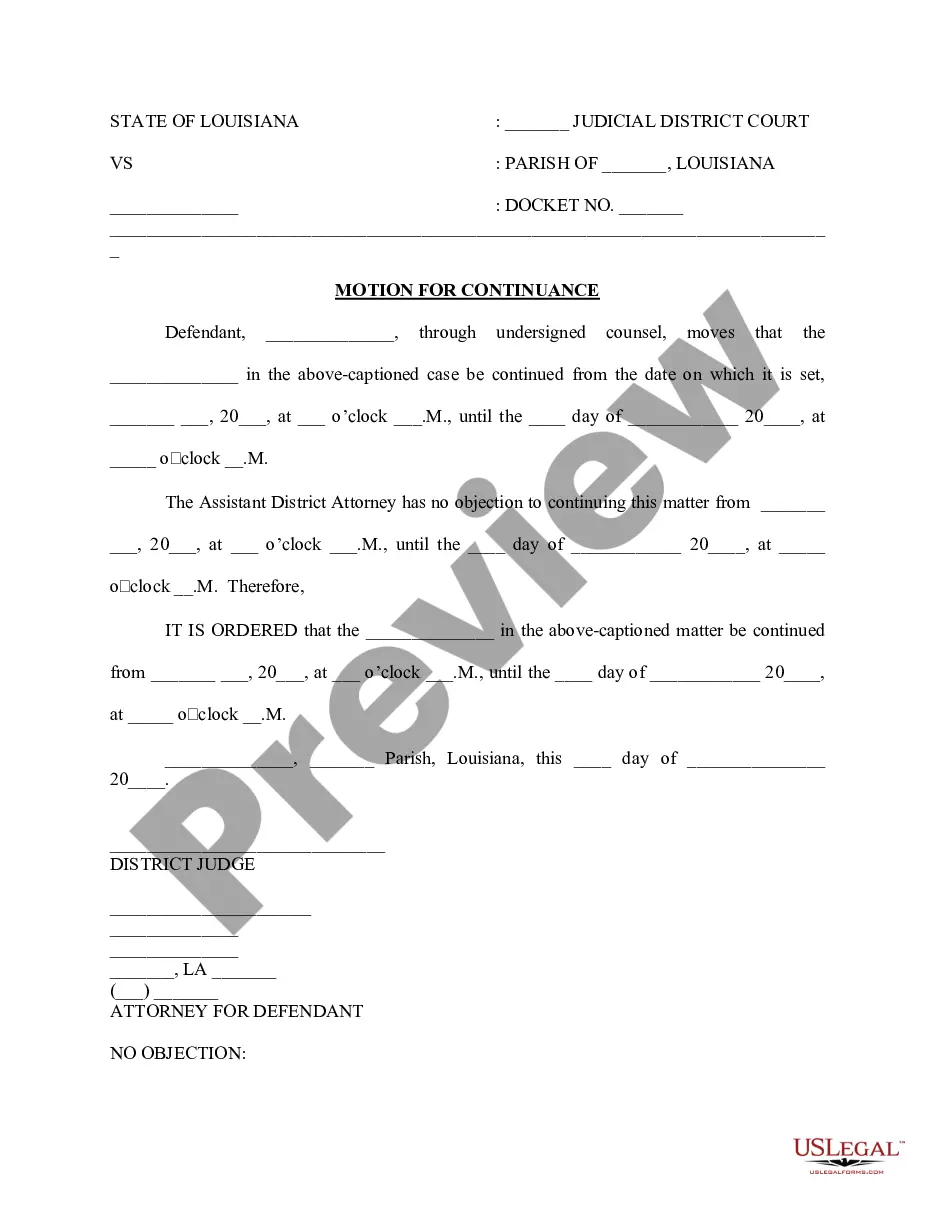
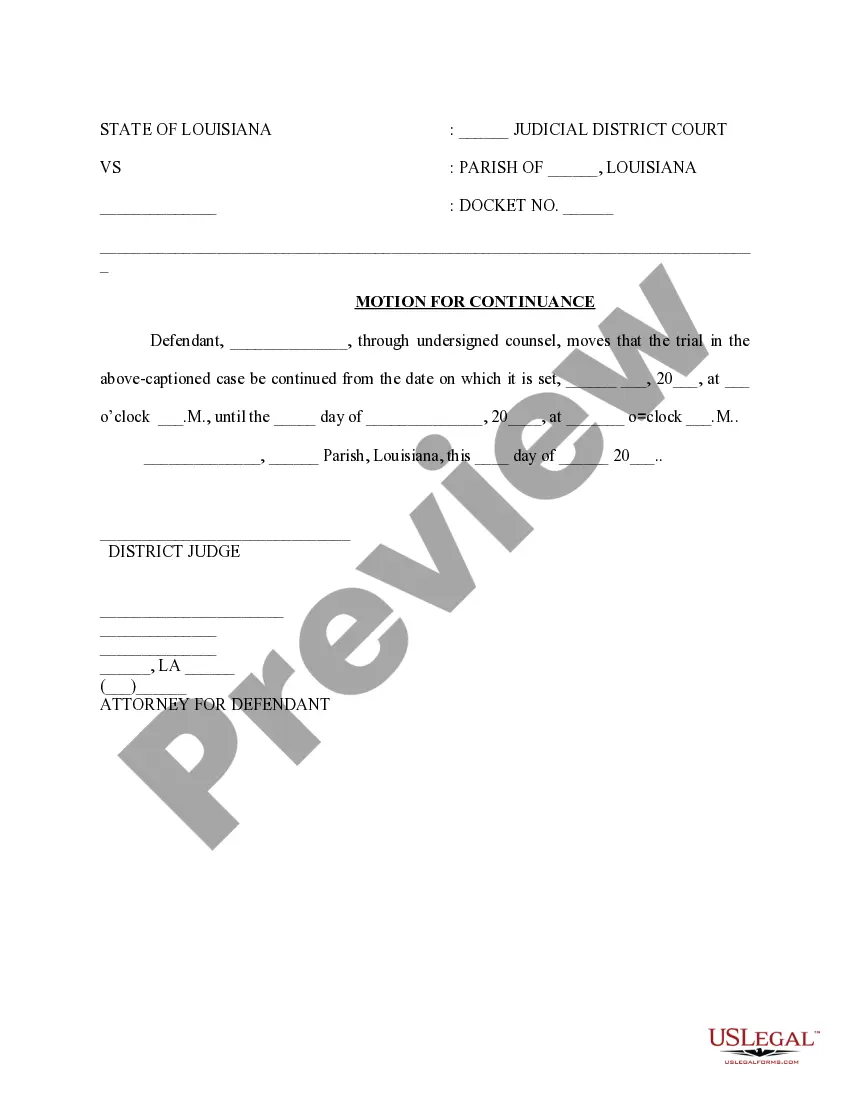
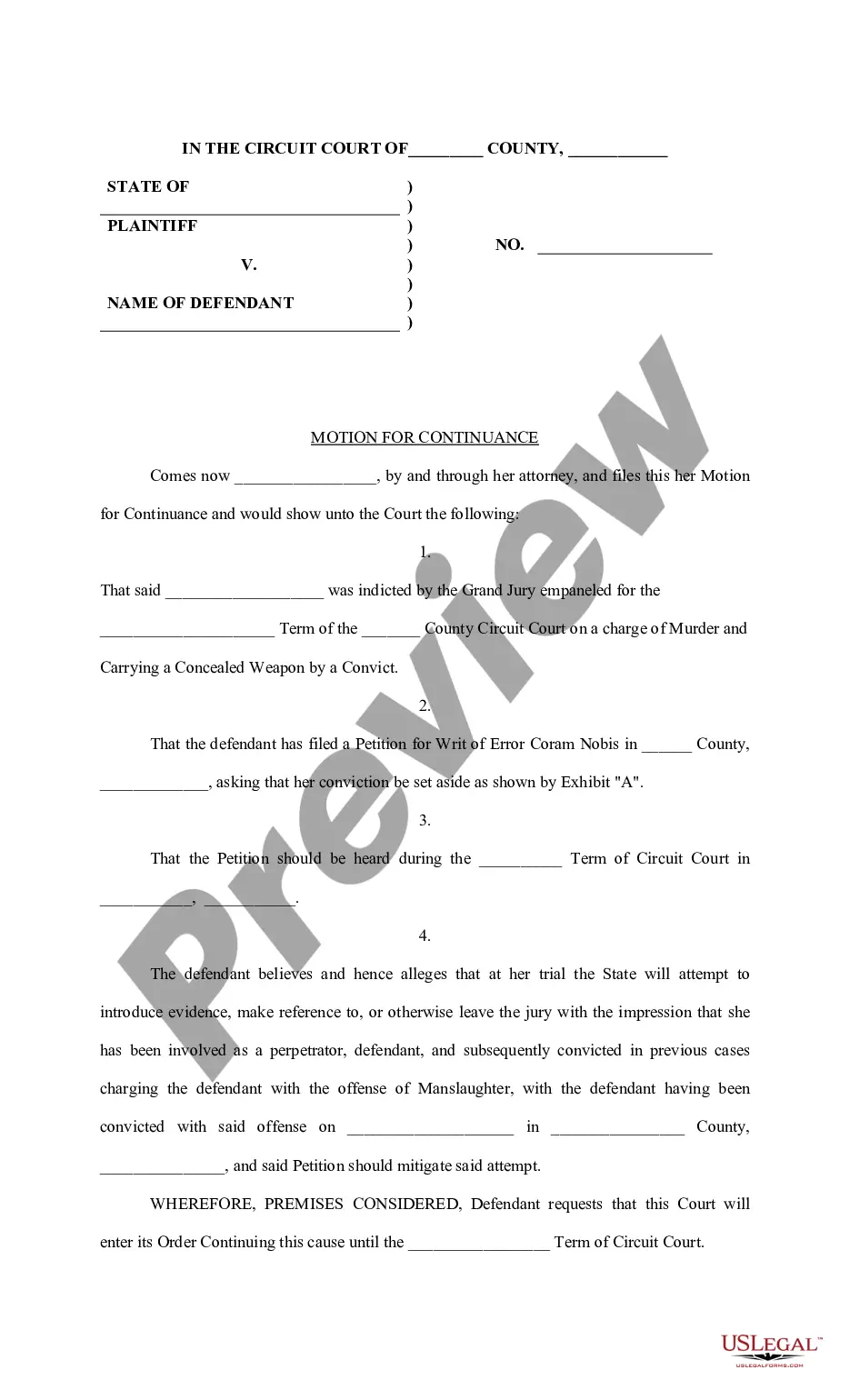
The Motion for Continuance Pretrial, Plea and Trial is a legal document used in criminal proceedings. It allows the defense counsel to request a delay in the scheduled pre-trial, plea day, and trial dates for the defendant. This motion provides the court with an explanation for the request, differentiating it from other legal forms that may not require such justification.
Key components of this form
- Defendant's information and case details.
- Proposed new dates for the pre-trial, plea day, and trial.
- Arguments or reasons for the delay.
- Signature lines for the district judge and the defendant's attorney.
- Certificate of service to opposing counsel.
Common use cases
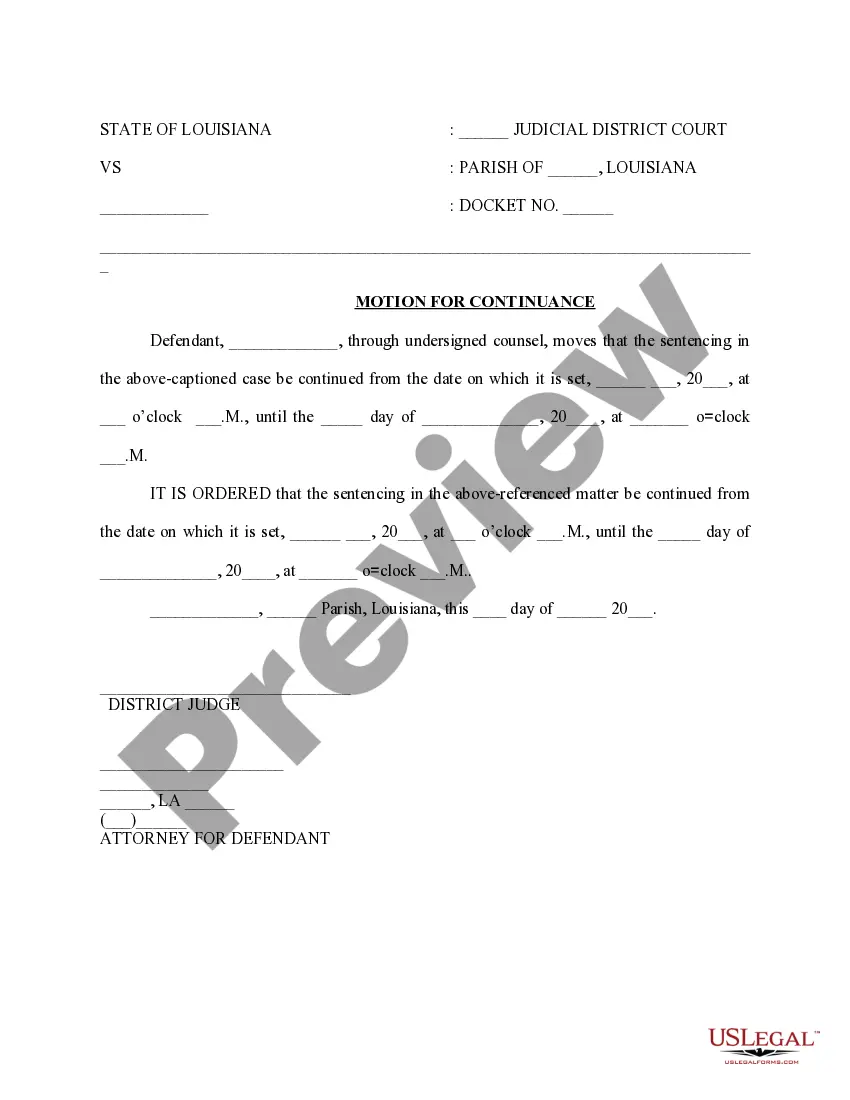
This form should be used when an attorney needs to request a rescheduling of a court date in a criminal case. Common situations include needing more time to prepare for trial, obtaining additional evidence, or addressing scheduling conflicts. The motion must typically specify valid reasons to be considered by the court.
Intended users of this form
- Counsel representing a defendant in a criminal proceeding.
- Individuals involved in a criminal case needing additional time before trial.
- Lawyers seeking to ensure proper legal representation for their clients.
How to complete this form
- Enter the name of the defendant and relevant case details at the top of the form.
- Specify the current dates for the pre-trial, plea day, and trial along with the proposed new dates.
- Provide reasons for requesting the continuance in the designated sections.
- Ensure the form is signed by both the district judge and the defense attorney.
- Complete the certificate of service to verify that all parties have been informed.
Notarization guidance
In most cases, this form does not require notarization. However, some jurisdictions or signing circumstances might. US Legal Forms offers online notarization powered by Notarize, accessible 24/7 for a quick, remote process.
Get your form ready online
Our built-in tools help you complete, sign, share, and store your documents in one place.
Make edits, fill in missing information, and update formatting in US Legal Forms—just like you would in MS Word.
Download a copy, print it, send it by email, or mail it via USPS—whatever works best for your next step.
Sign and collect signatures with our SignNow integration. Send to multiple recipients, set reminders, and more. Go Premium to unlock E-Sign.
If this form requires notarization, complete it online through a secure video call—no need to meet a notary in person or wait for an appointment.
We protect your documents and personal data by following strict security and privacy standards.

Make edits, fill in missing information, and update formatting in US Legal Forms—just like you would in MS Word.

Download a copy, print it, send it by email, or mail it via USPS—whatever works best for your next step.

Sign and collect signatures with our SignNow integration. Send to multiple recipients, set reminders, and more. Go Premium to unlock E-Sign.

If this form requires notarization, complete it online through a secure video call—no need to meet a notary in person or wait for an appointment.

We protect your documents and personal data by following strict security and privacy standards.
Avoid these common issues
- Failing to include valid reasons for the request for continuance.
- Not providing complete and accurate information about current and proposed court dates.
- Neglecting to obtain the necessary signatures before submitting.
- Overlooking the requirement to serve opposing counsel with the motion.
Why complete this form online
- Convenience of downloading and completing the form at your own pace.
- Editable templates that allow you to customize information easily.
- Reliable resources drafted by licensed attorneys to ensure legal accuracy.
Looking for another form?


Form popularity
FAQ
A motion is an application to the court made by the prosecutor or defense attorney, requesting that the court make a decision on a certain issue before the trial begins. The motion can affect the trial, courtroom, defendants, evidence, or testimony.
Maciolek. A pretrial is an event related to a court case that happens before a trial. Some pretrials are held in court in front of the judge, some are more like meetings between the two sides. Pretrials generally have to do with getting ready for trial...
Agreed Case Statement. Witness Lists. Exhibit Lists. Motions in Limine. Voir Dire Questions. Jury Instructions. The parties are instructed to meet and attempt to agree on jury instructions and to file proposed instructions before the final pre-trial conference.
A hearing for the purpose of asking a judge to issue a ruling or order. The motion is typically filed by one side and a notice is sent to the opposing attorney who responds in writing.
What Happens at a Trial Setting Conference? The judge will ask questions about the case to ascertain whether it is ready for trial and how long the trial is likely to take. If the case is indeed ready to proceed to trial, the court will set a Mandatory Settlement Conference (or MSC) as well as a trial date.
The length of time from PRETRIAL to trial date is a function of each individual judge's calander. There is no hard and fast rule. The normal time is probably between 3 and 6 months.
The length of time from PRETRIAL to trial date is a function of each individual judge's calander. There is no hard and fast rule. The normal time is probably between 3 and 6 months.
A "motion" is simply a formal request to a court that it do something or decide an issue in favor of the party that asks for it. "Granted" means the court agreed with the request, and did or decided in favor of the requester.
After you complete your motion, you must file it with the court.You must then serve (mail) a copy of your filed motion (including all exhibits and the date, time, and place of hearing) to all other parties in the case. If a party is represented by an attorney, mail the motion directly to the attorney's office.