Louisiana Motion to Continue and Refix, and Order - Pretrial, Plea and Trial
Understanding this form
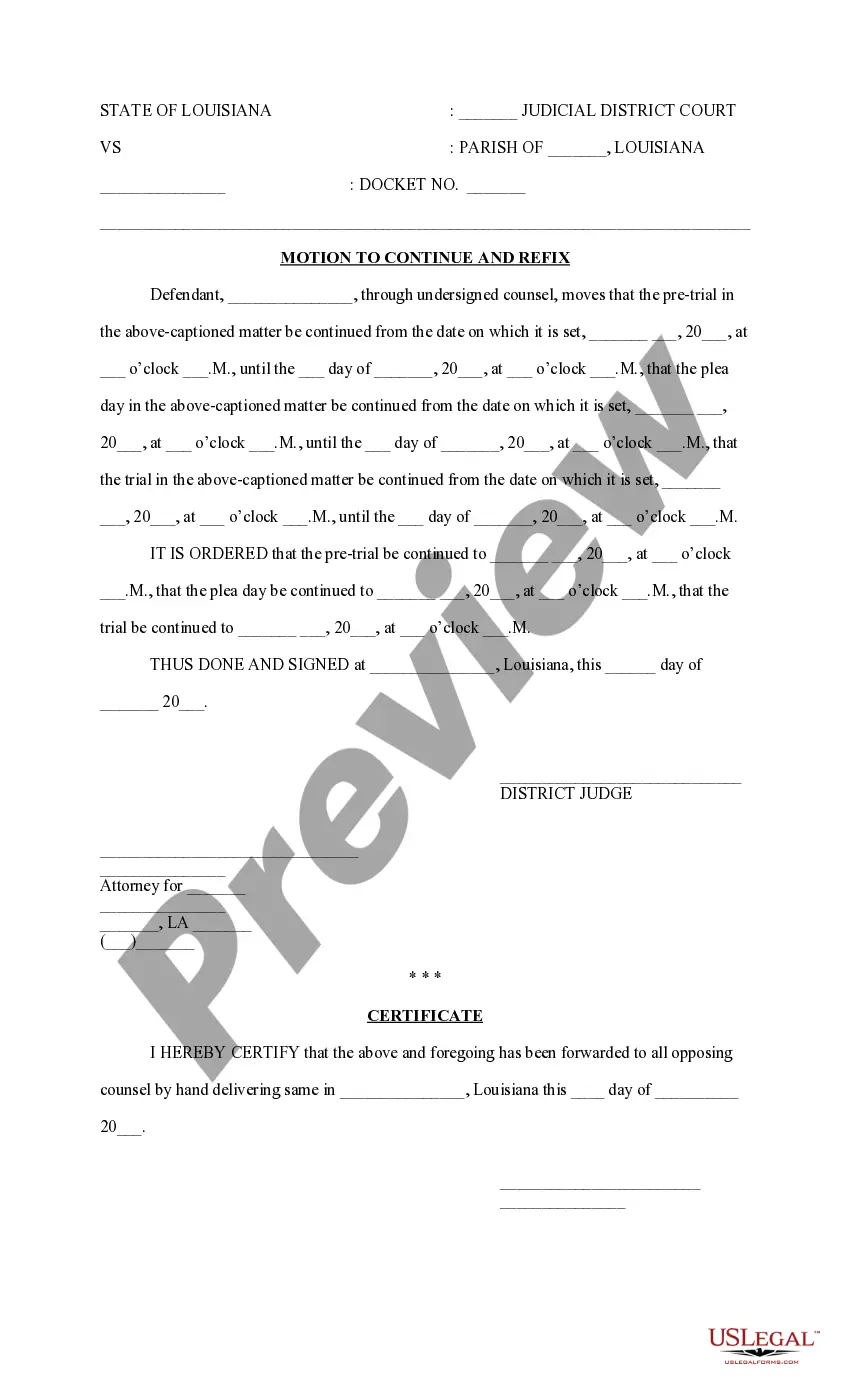
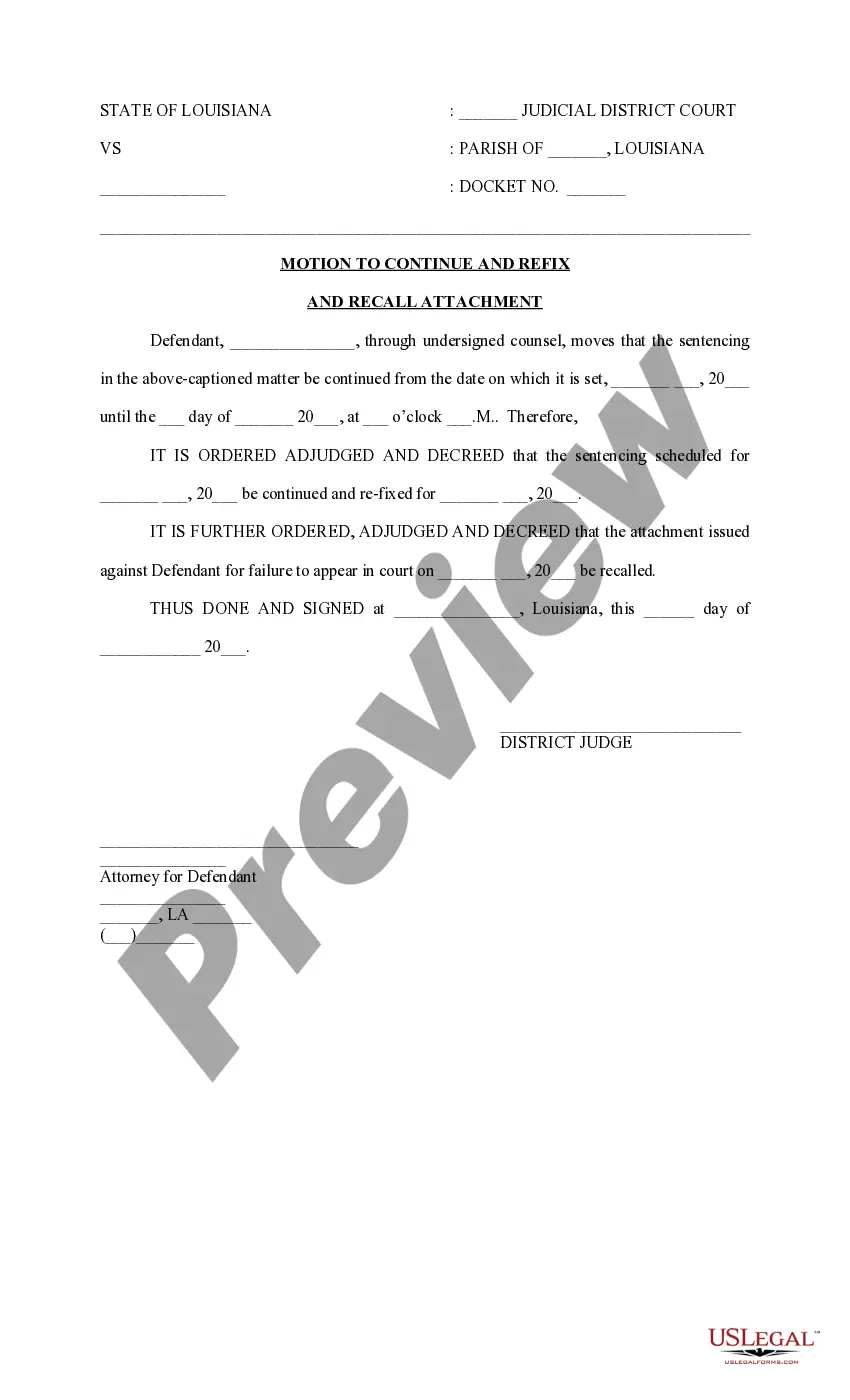
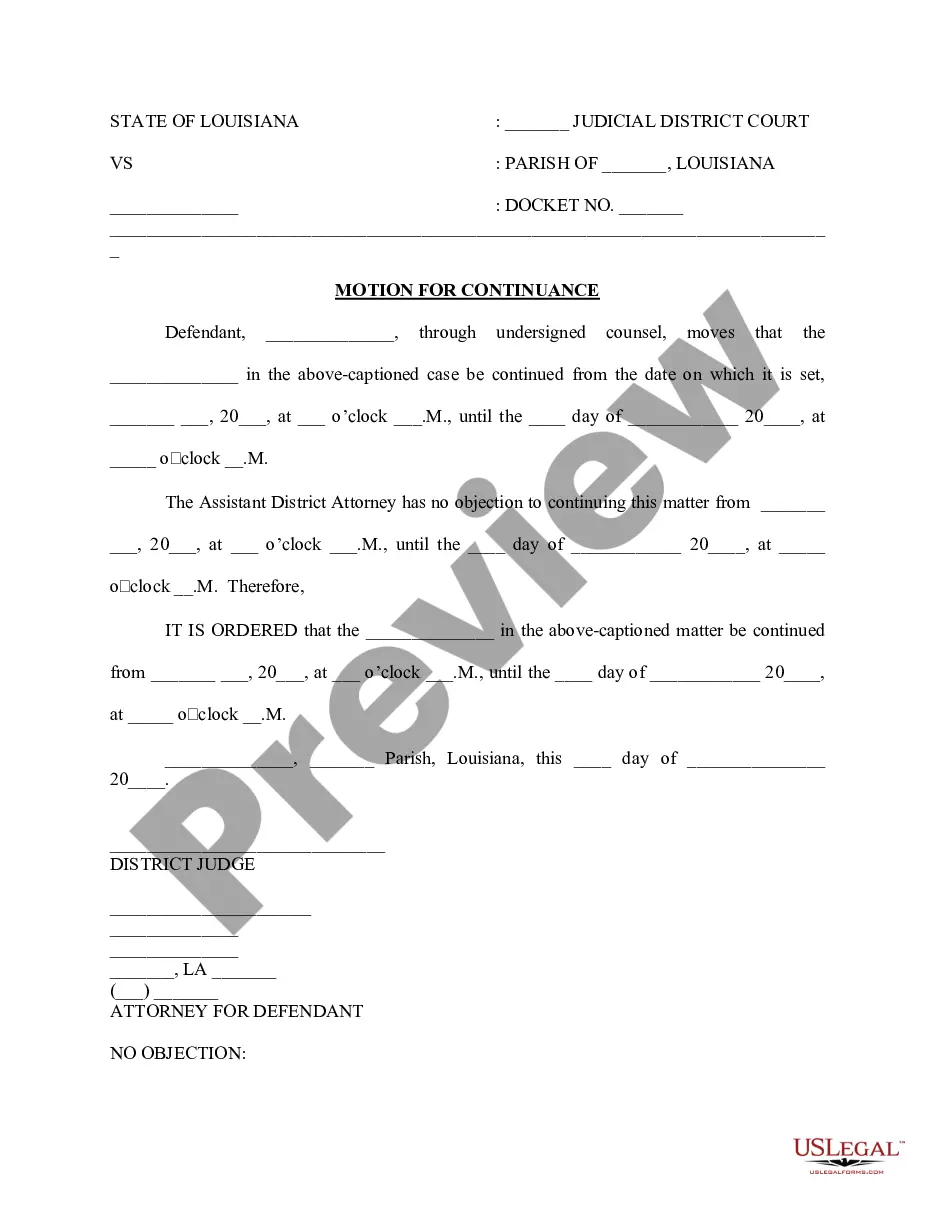
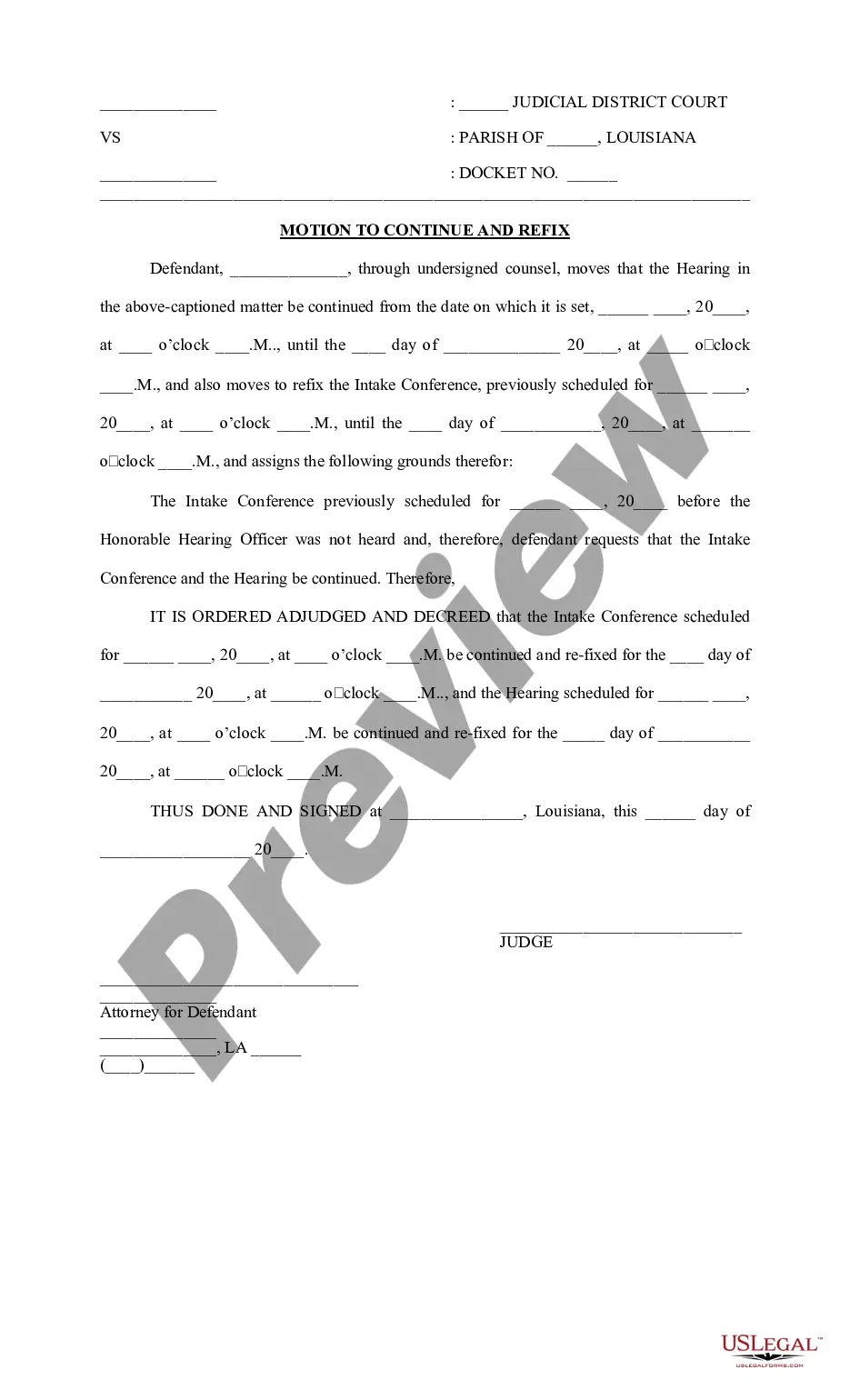
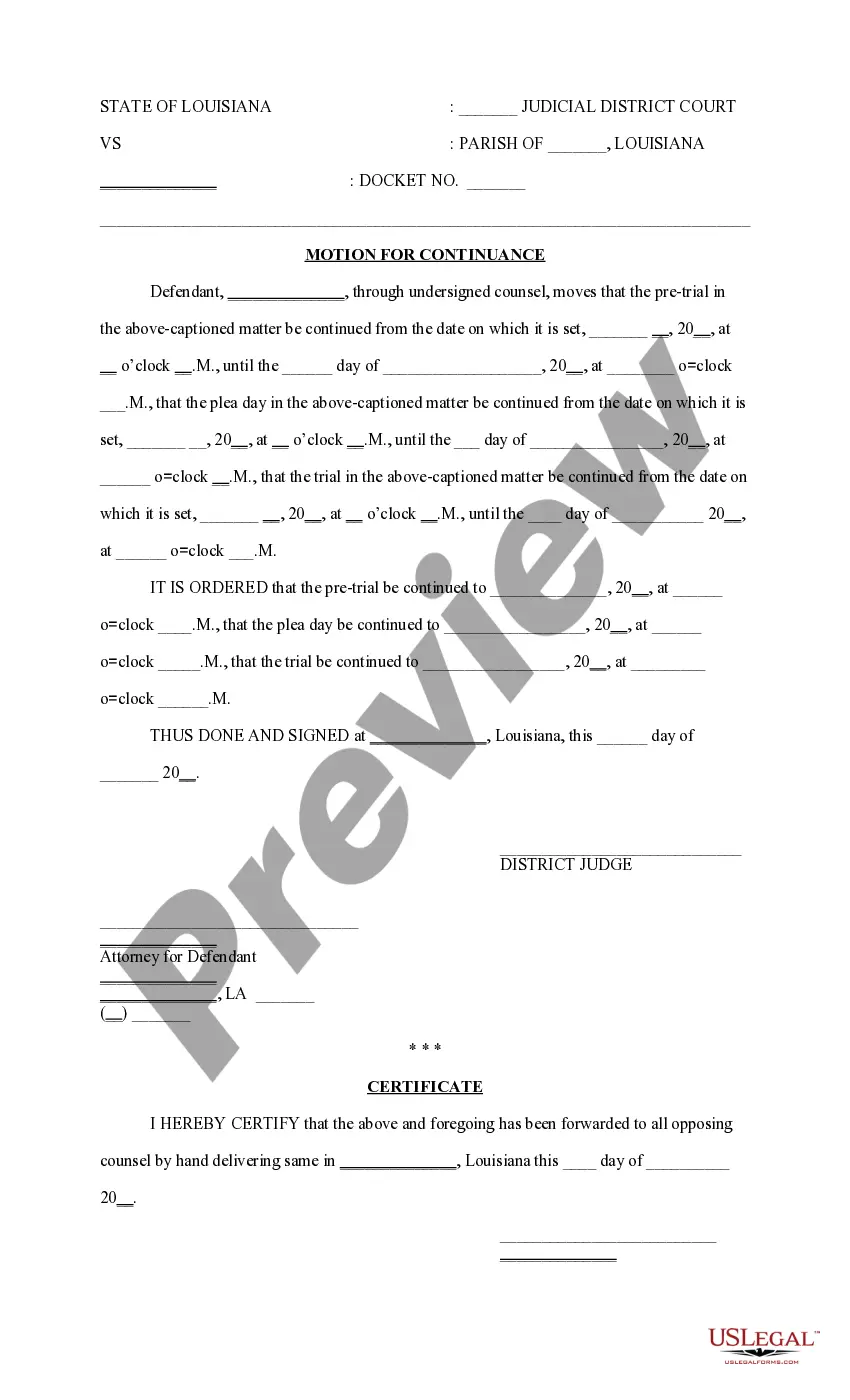
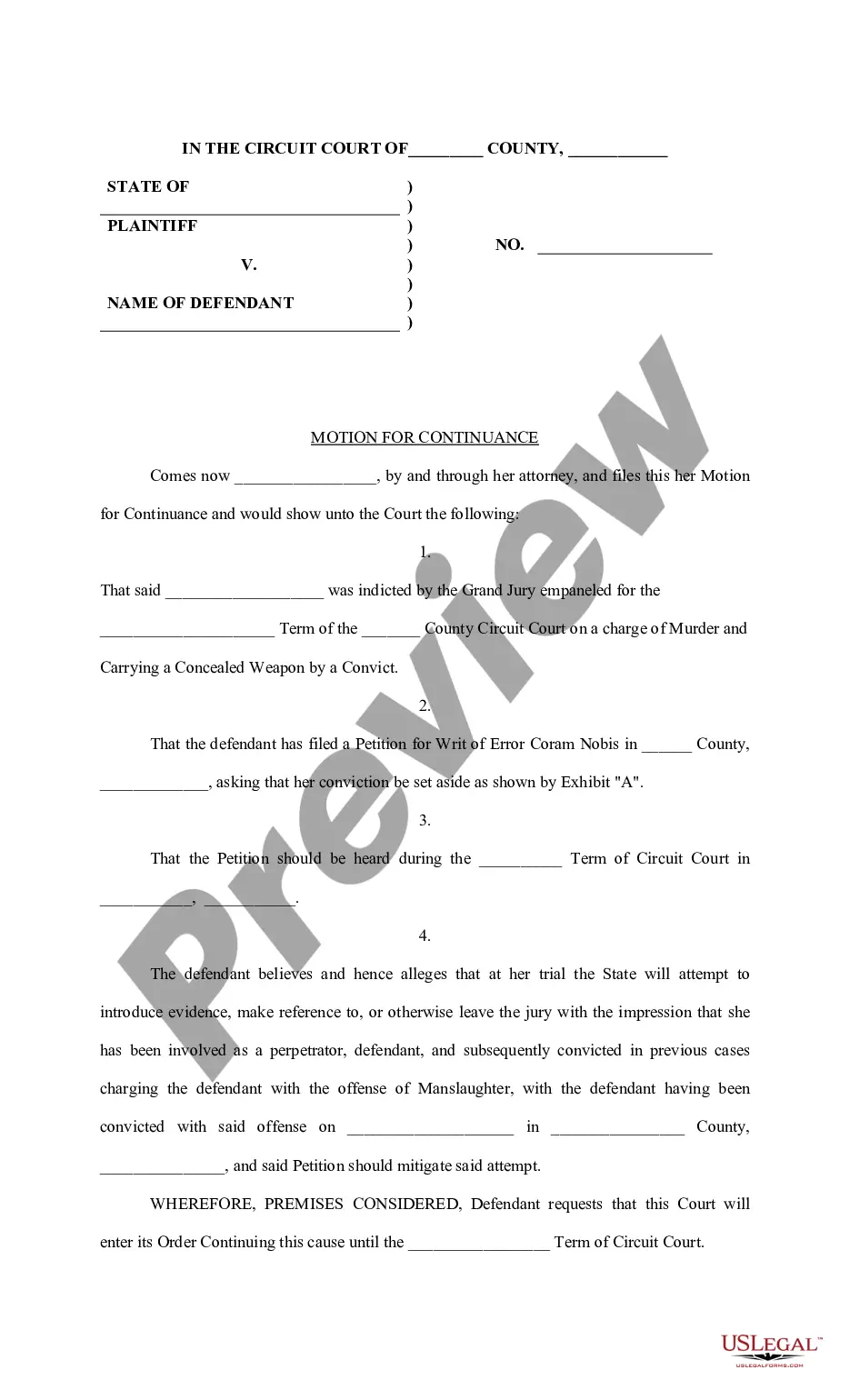
The Motion to Continue and Refix, and Order is a legal document used in criminal cases when the defense attorney requests to postpone the pre-trial date, plea day, and trial for the defendant. This form facilitates the rescheduling of these important legal proceedings and helps ensure that all parties have adequate time to prepare. It includes an attached order that authorizes the new dates as requested, distinguishing it from other motions that may only seek to delay one aspect of a criminal case.
Form components explained
- Defendant's name and information
- Current scheduled dates for pre-trial, plea, and trial
- Requested new dates for pre-trial, plea, and trial
- Order section granting the motion for continuance
- Signature lines for the district judge and the defendant's attorney
- Certificate of service confirming delivery to opposing counsel
When to use this form
This form is necessary when unforeseen circumstances prevent the defense from proceeding on the originally scheduled dates. Common scenarios include the need for additional time to prepare a defense, scheduling conflicts with the attorney, or when new evidence is discovered that requires further examination. It is crucial to file this motion in a timely manner to avoid potential legal repercussions.
Who needs this form
This form is appropriate for:
- Defendants in criminal cases seeking to delay court proceedings
- Defense attorneys representing clients in criminal matters
- Individuals looking to ensure they have sufficient time to prepare for trial
Steps to complete this form
- Identify and fill in the defendant's name and relevant case details.
- Specify the current dates for the pre-trial, plea, and trial.
- Enter the proposed new dates for rescheduling each event.
- Ensure all required signatures are obtained on the order section.
- Certificate of service should be filled out to confirm that all opposing counsel have been notified.
Does this document require notarization?
This form does not typically require notarization unless specified by local law. However, it is essential to verify any local requirements that may apply to ensure compliance.
Get your form ready online
Our built-in tools help you complete, sign, share, and store your documents in one place.
Make edits, fill in missing information, and update formatting in US Legal Forms—just like you would in MS Word.
Download a copy, print it, send it by email, or mail it via USPS—whatever works best for your next step.
Sign and collect signatures with our SignNow integration. Send to multiple recipients, set reminders, and more. Go Premium to unlock E-Sign.
If this form requires notarization, complete it online through a secure video call—no need to meet a notary in person or wait for an appointment.
We protect your documents and personal data by following strict security and privacy standards.

Make edits, fill in missing information, and update formatting in US Legal Forms—just like you would in MS Word.

Download a copy, print it, send it by email, or mail it via USPS—whatever works best for your next step.

Sign and collect signatures with our SignNow integration. Send to multiple recipients, set reminders, and more. Go Premium to unlock E-Sign.

If this form requires notarization, complete it online through a secure video call—no need to meet a notary in person or wait for an appointment.

We protect your documents and personal data by following strict security and privacy standards.
Typical mistakes to avoid
- Failing to specify new dates clearly, which can lead to confusion.
- Not obtaining the signature of the district judge on the order section.
- Missing the filing deadline to submit the motion for continuance.
Benefits of using this form online
- Convenient access to legal forms that can be downloaded anytime.
- Editable templates allow for easy customization to meet specific needs.
- Reliability of using professionally drafted forms that comply with legal standards.
Legal use & context
- This form must be filed with the court to formally request a delay in proceedings.
- Approval is at the courtâs discretion and should reflect valid reasons for delay.
- Improper use or failure to follow local court rules may affect the legitimacy of the motion.
Summary of main points
- The Motion to Continue and Refix is essential for requesting delays in criminal proceedings.
- Completing the form accurately ensures that the court properly acknowledges new dates.
- Notification to opposing counsel is required to maintain procedural integrity.
Looking for another form?

Form popularity
FAQ
(1) A motion by the defendant for a speedy trial, in order to be valid, must be accompanied by an affidavit by defendant's counsel certifying that the defendant and his counsel are prepared to proceed to trial within the delays set forth in this Article.
These pleas include: not guilty, guilty, and no contest (nolo contendere). At Worgul, Sarna & Ness, Criminal Defense Attorneys, LLC, we know how to what's on the line for you and how these different pleas can impact your life.
Plea Bargaining: Areas of Negotiation Discusses the three main areas of negotiations involving plea bargains:charge bargaining,sentence bargaining, and fact bargaining.
The state has to bring you to trial with 120 days if you are accused of a felony and 30 days if you are accused of a misdemeanor and are still being held in custody. If you have bonded out, the State has 180 days to bring you to trial on a felony charge and 60 days to bring you to trial on a misdemeanor charge.
The most common types of plea are "guilty" and "not guilty". Pleading guilty typically results in a more lenient punishment for the defendant; it is thus a type of mitigating factor in sentencing.
There are three types of pleas in court: guilty, not guilty, and no contest.
An arraignment in Louisiana is the first court appearance in criminal court in Louisiana. Prior to the arraignment, the prosecutor either filed a bill of information, which is the formal charge, or the grand jury returned a true bill indictinhg the defendant. The arraignment is then set.