Louisiana Motion for Change of Examining Psychologist, due to Physical Disability of Defendant, and Order
What is this form?
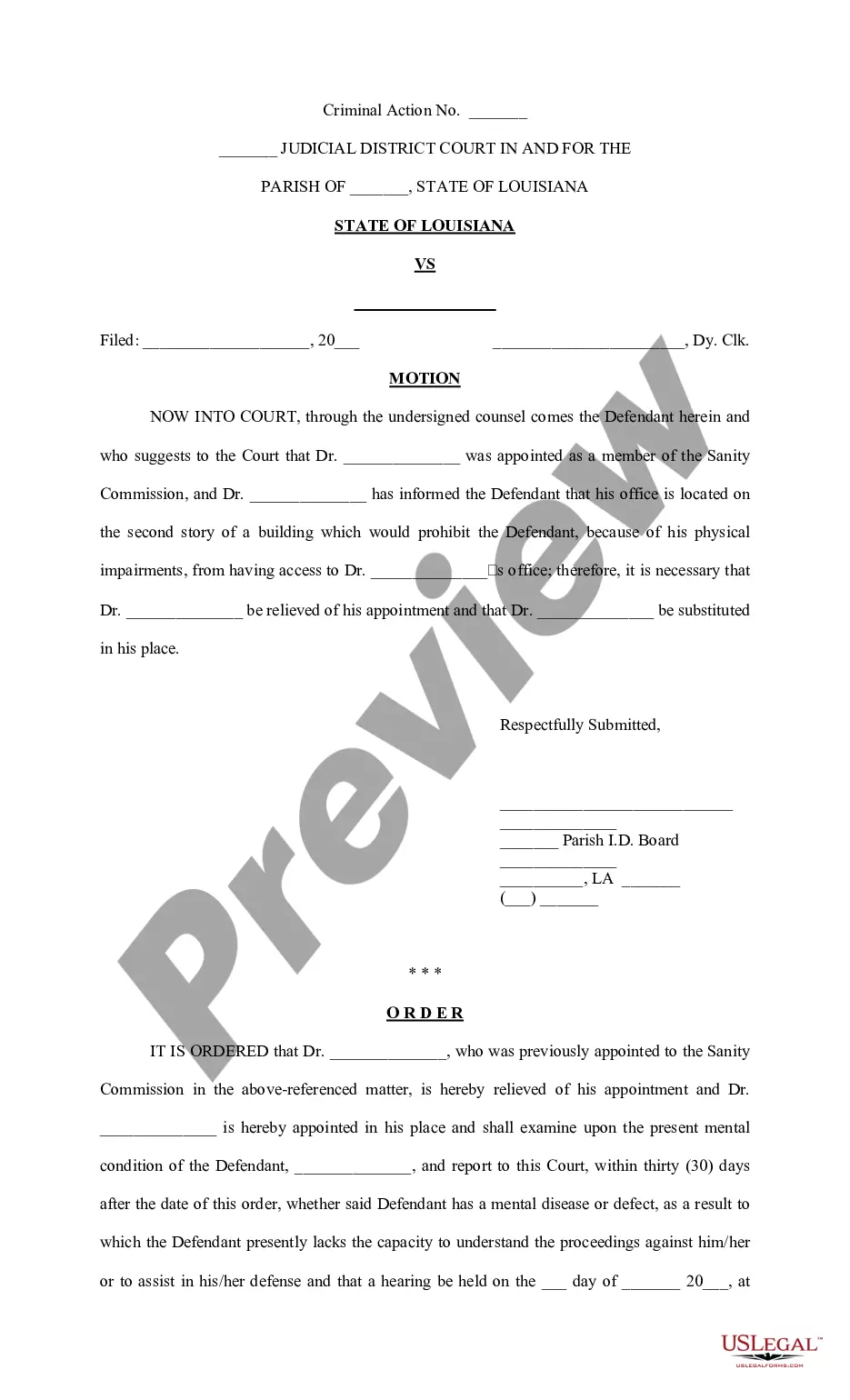
The Motion for Change of Examining Psychologist is a legal document that enables a defendant to request the substitution of an appointed doctor due to a physical disability that prevents access to the original doctor's office. This form is specifically designed for situations where a defendant's physical limitations impact their ability to participate in mental health evaluations mandated by the court. By using this form, defendants can ensure that their rights and needs are respected throughout judicial proceedings.
Main sections of this form
- Identification of the original and the proposed substitute psychologist.
- Details regarding the defendant's physical disability and access issues.
- An order from the court granting the substitution of psychologists.
- A timeline for the new psychologist to evaluate the defendant and report findings.
- Information about the composition of the sanity commission included in the order.


Situations where this form applies
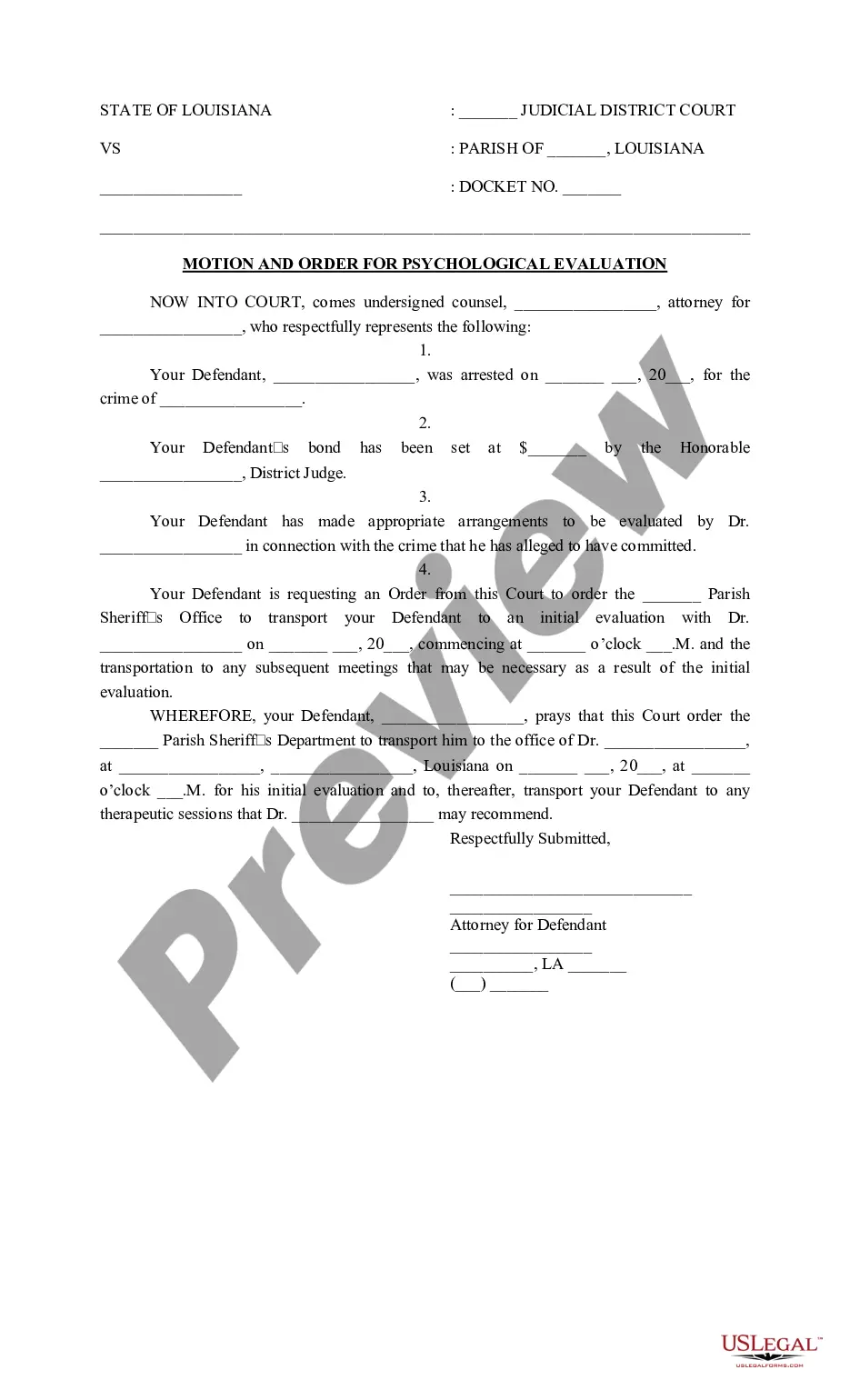
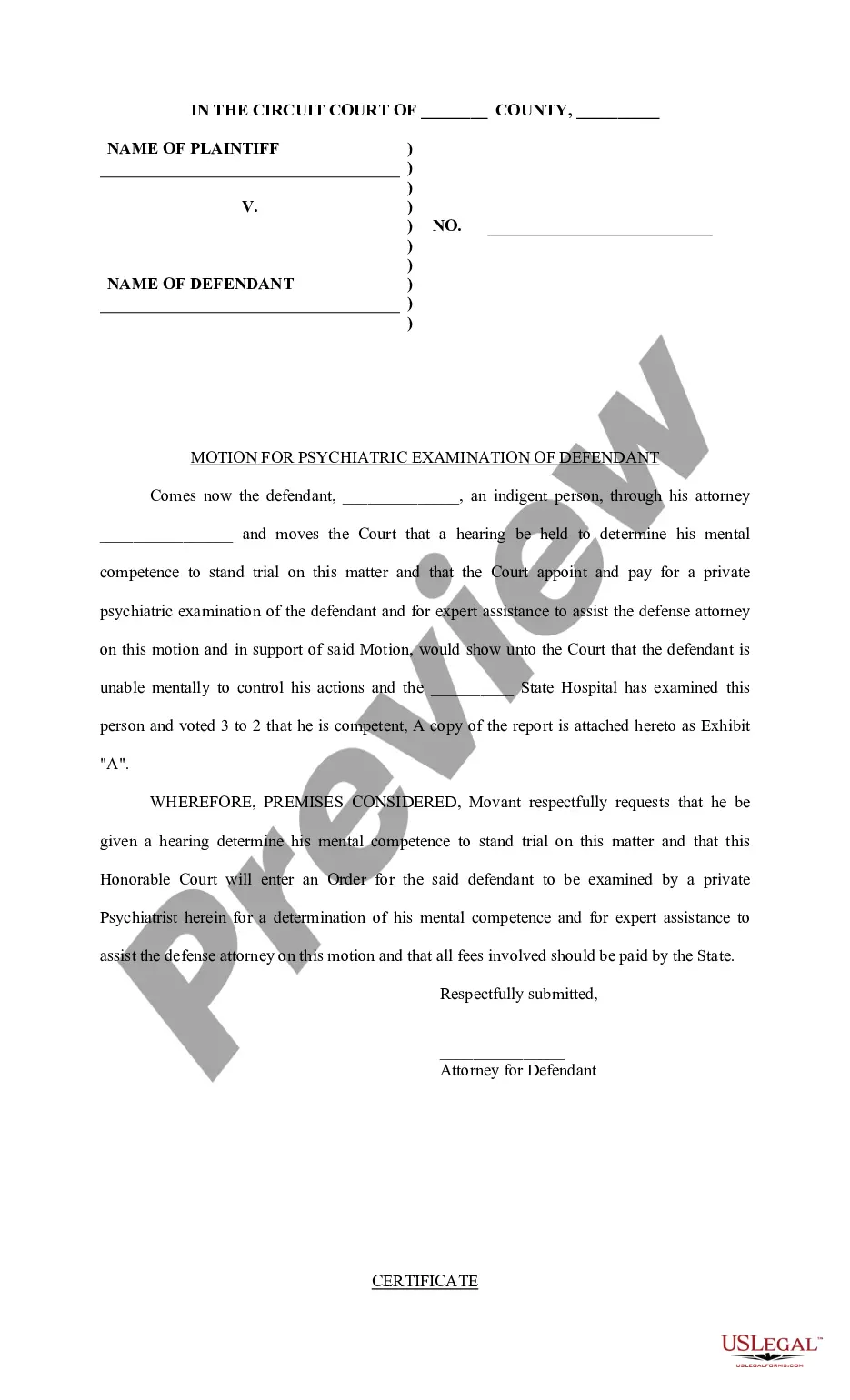
This form should be used when a defendant in a legal case cannot access the originally appointed examining psychologist due to a physical disability. It is typically required during mental competency evaluations to determine if the defendant can understand the proceedings or assist in their defense. This situation may arise in criminal cases where mental health evaluations are necessary to establish the defendant's mental capacity during or surrounding the time of the alleged offense.
Who this form is for
- Defendants with diagnosed physical disabilities that hinder access to their appointed psychologist.
- Legal representatives or attorneys advocating on behalf of a defendant facing such challenges.
- Individuals involved in criminal cases requiring mental health evaluations.
How to complete this form
- Enter the name of the judicial district court and the parish, along with the state of Louisiana.
- Fill in the names of the original psychologist and the proposed substitute psychologist.
- Clearly explain the physical disability and the reasons for the requested change.
- Complete the order section with relevant dates and county clerk information.
- Sign the motion, including your name and any relevant identification numbers.
Is notarization required?
Notarization is generally not required for this form. However, certain states or situations might demand it. You can complete notarization online through US Legal Forms, powered by Notarize, using a verified video call available anytime.
Get your form ready online
Our built-in tools help you complete, sign, share, and store your documents in one place.
Make edits, fill in missing information, and update formatting in US Legal Forms—just like you would in MS Word.
Download a copy, print it, send it by email, or mail it via USPS—whatever works best for your next step.
Sign and collect signatures with our SignNow integration. Send to multiple recipients, set reminders, and more. Go Premium to unlock E-Sign.
If this form requires notarization, complete it online through a secure video call—no need to meet a notary in person or wait for an appointment.
We protect your documents and personal data by following strict security and privacy standards.

Make edits, fill in missing information, and update formatting in US Legal Forms—just like you would in MS Word.

Download a copy, print it, send it by email, or mail it via USPS—whatever works best for your next step.

Sign and collect signatures with our SignNow integration. Send to multiple recipients, set reminders, and more. Go Premium to unlock E-Sign.

If this form requires notarization, complete it online through a secure video call—no need to meet a notary in person or wait for an appointment.

We protect your documents and personal data by following strict security and privacy standards.
Mistakes to watch out for
- Failing to provide sufficient detail about the physical disability.
- Not including signatures or necessary identification information.
- Leaving the order section incomplete or improperly filled out.
- Submitting the motion without verifying local court rules and procedures.
Why use this form online
- Convenient access to a legally sound template created by licensed attorneys.
- Editability allows customization to fit specific case needs.
- Immediate availability for download without waiting for physical copies.
- Time-efficient process to ensure legal compliance.
Looking for another form?




Form popularity
FAQ
Under current Rule 35(b), if the government believes that a sentenced defendant has provided substantial assistance in investigating or prosecuting another person, it may move the court to reduce the original sentence; ordinarily, the motion must be filed within one year of sentencing.
A request for a physical or mental examination is a discovery tool that has limited use, and the reason being is because normally a this type of request is ordered by the court. ( Thomas F. Goldman & Alice Hart Hughes, Civil Litigation: Process and Procedures 334 (2d.
(2) In addition to section (b)(1), any party may serve upon any other party not more than two sets of written interrogatories containing not more than 20 questions per set without prior permission of the court.
INTERDICTION is the term used for the plan of having a Court declare a person is not competent to take care of his own affairs and appoints a Curator for that person. In addition to a curator, there will also be an Under-Curator appointed.
An examination by a party conducted by a licensed or certified examiner which may be ordered by the court upon motion made by another party.
Generally, the petition is filed in a civil district court in the parish in which the interdict is domiciled (permanent home). If the defendant does not have a permanent home, the petition is filed where he resides or where he is physically present if he is not a resident of the state.
35, permits discovery through a medical examination of a party under carefully defined circumstances.Rule 35 does not provide for independent medical examinations or independent medical examiners, and does not permit a defendant to require that a plaintiff submit to an examination in every personal injury case.
R. Civ. P. 35) Although they can be used as a great discovery tool, it is considered limited because it is only allowed in those situations where the physical or mental condition of the person is at issue in the case.
An interdiction is a legal process where a court is asked to determine, from testimony and other evidence presented, whether a person is unable, due to an infirmity, to consistently make decisions regarding his person and/or his property, or to communicate those decisions.