Louisiana Letter to Indigent Defender regarding Assigned Cases
About this form
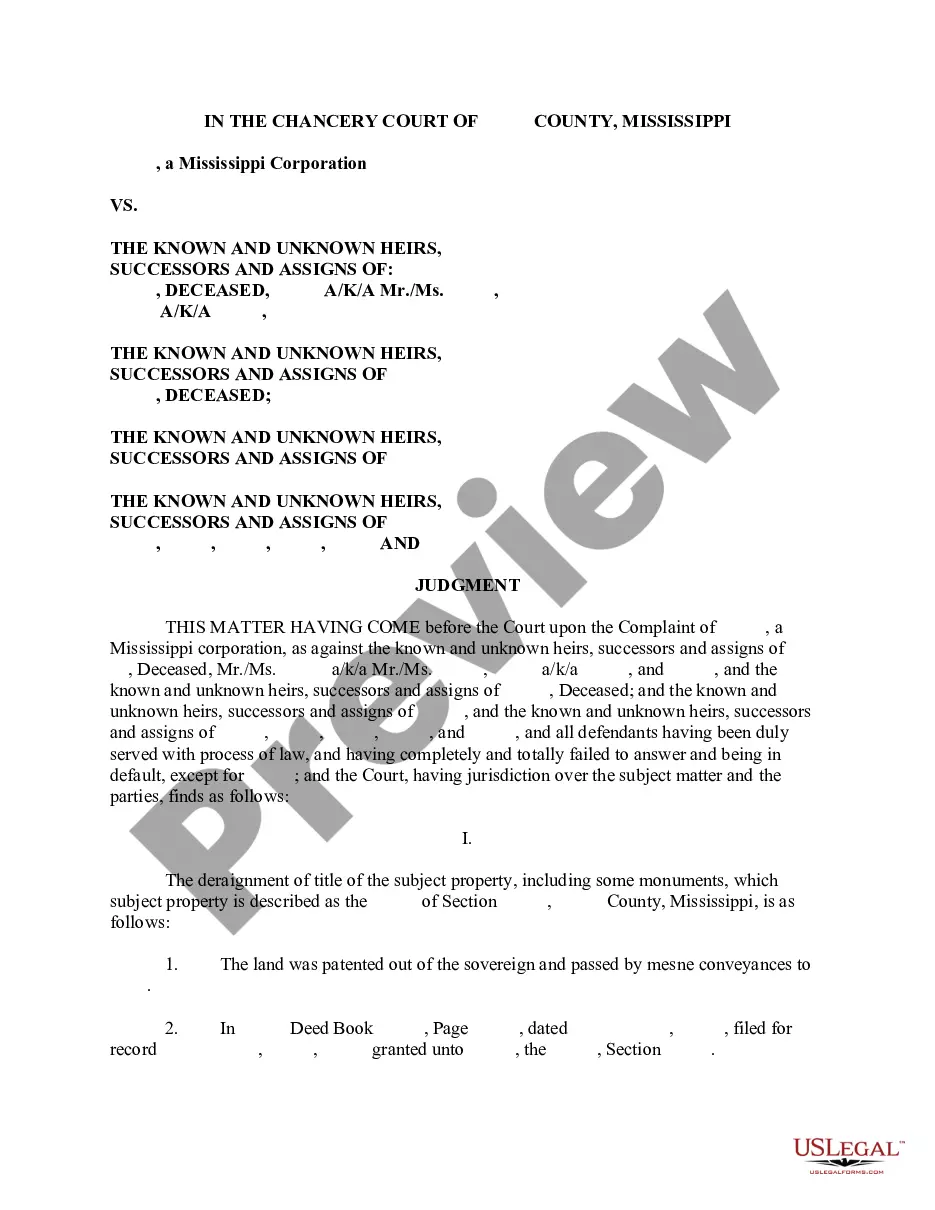
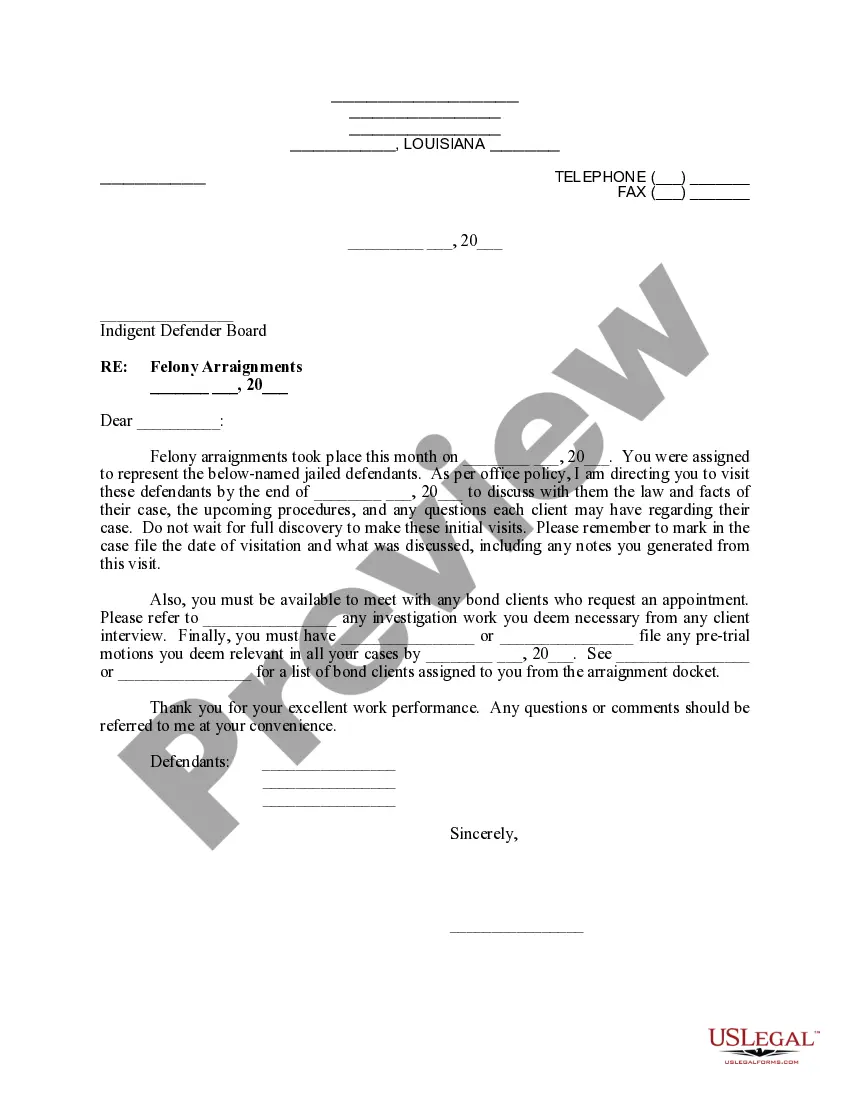
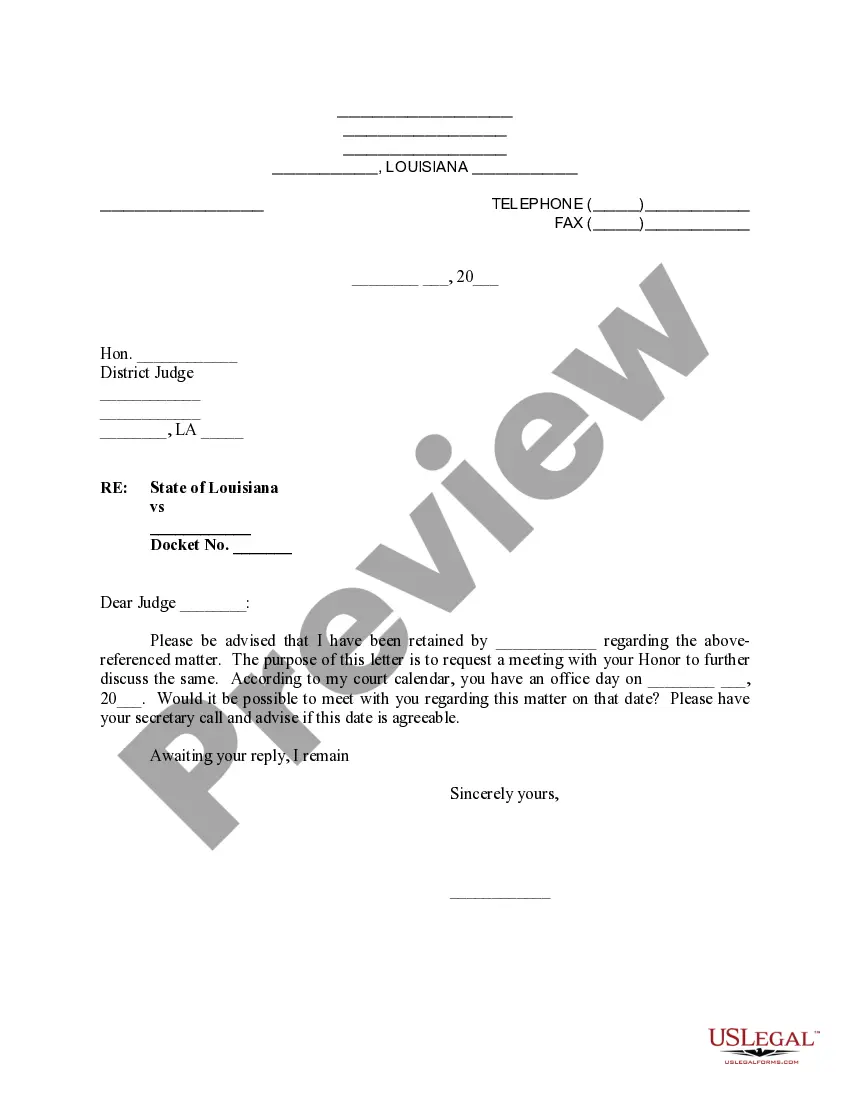
The Letter to Indigent Defender regarding Assigned Cases is a formal communication directed at an attorney designated as an Indigent Defender. This letter grants the attorney the responsibility of representing certain felony defendants and outlines essential deadlines for client meetings and required legal actions. Unlike general letters of appointment, this form focuses specifically on the attorney's obligations concerning indigent defense and case preparation.
What’s included in this form
- Contact information section for the Indigent Defender Board and the attorney.
- Identification of the defendants assigned for representation.
- Instructions regarding the timeline for meeting defendants.
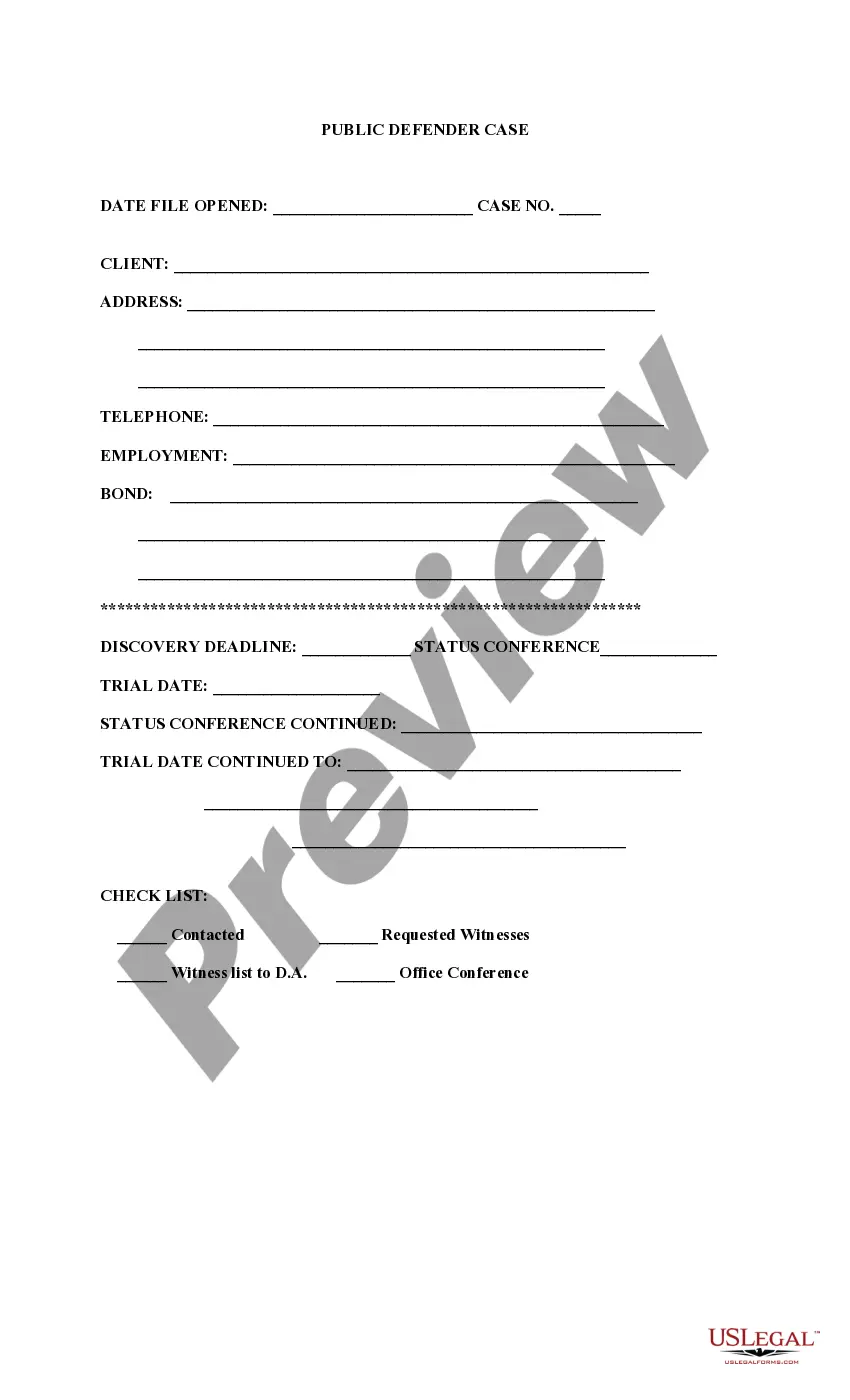
- Reminders to document visitations and discussions in case files.
- Guidance on handling bond clients and filing pre-trial motions.
When to use this form
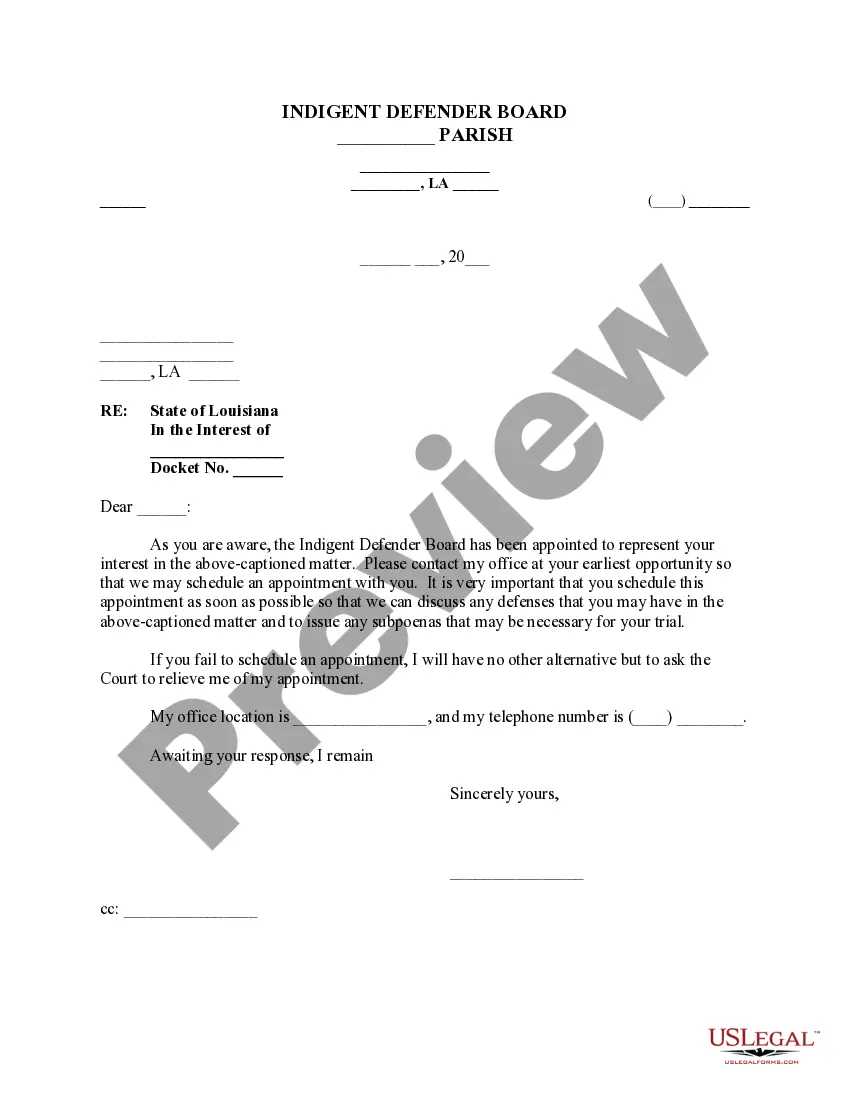
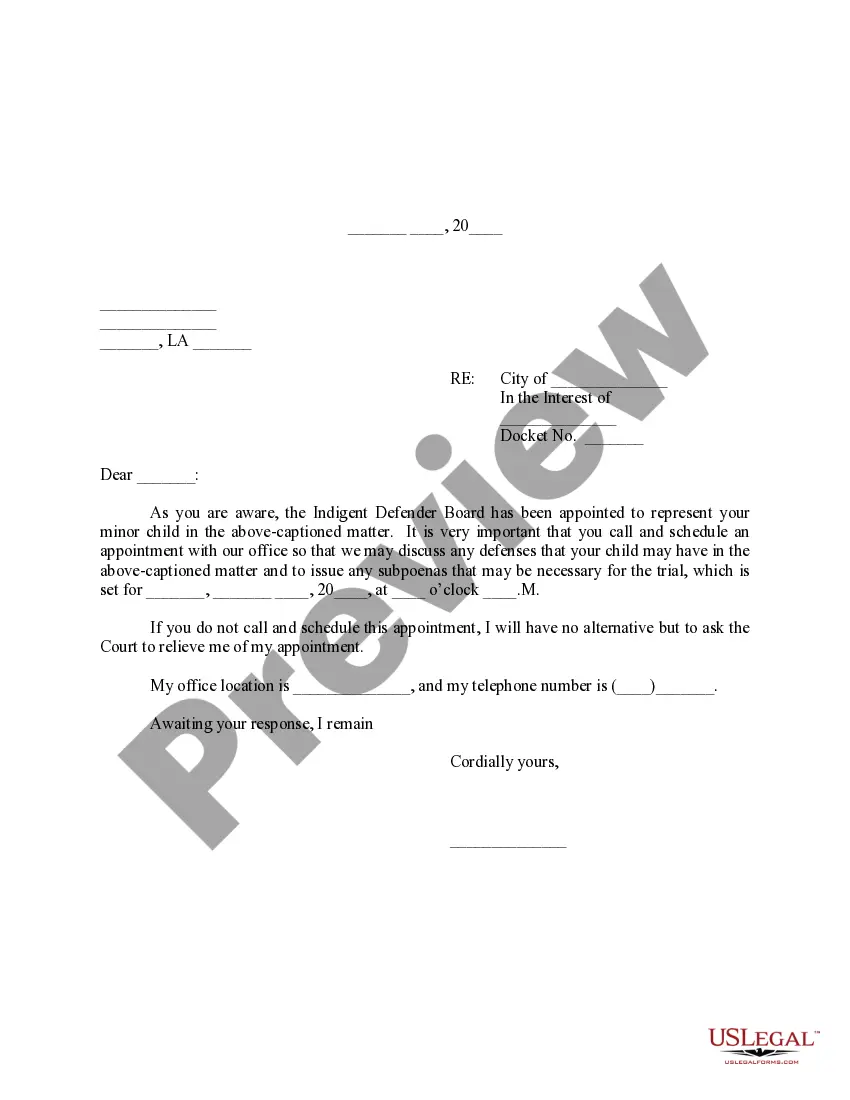
This form is used when an attorney is appointed as an Indigent Defender for felony defendants. It serves as an official record of the assignment and outlines the attorney's responsibilities, such as meeting with clients and preparing legal documents. It is essential to use this form to ensure compliance with legal procedures and provide adequate representation for indigent defendants.
Who needs this form
- Licensed attorneys appointed as Indigent Defenders.
- Legal staff responsible for overseeing indigent defense matters.
- Lawyers handling felony cases for low-income defendants.
Steps to complete this form
- Fill in the contact details of the Indigent Defender Board and the attorney.
- List the names of the defendants assigned to the attorney for representation.
- Set a deadline for the attorney to meet each defendant to discuss their case.
- Include any necessary instructions regarding bond clients and pre-trial motions.
- Ensure to sign the letter and distribute it to relevant parties.
Notarization guidance
This form usually doesn’t need to be notarized. However, local laws or specific transactions may require it. Our online notarization service, powered by Notarize, lets you complete it remotely through a secure video session, available 24/7.
Get your form ready online
Our built-in tools help you complete, sign, share, and store your documents in one place.
Make edits, fill in missing information, and update formatting in US Legal Forms—just like you would in MS Word.
Download a copy, print it, send it by email, or mail it via USPS—whatever works best for your next step.
Sign and collect signatures with our SignNow integration. Send to multiple recipients, set reminders, and more. Go Premium to unlock E-Sign.
If this form requires notarization, complete it online through a secure video call—no need to meet a notary in person or wait for an appointment.
We protect your documents and personal data by following strict security and privacy standards.

Make edits, fill in missing information, and update formatting in US Legal Forms—just like you would in MS Word.

Download a copy, print it, send it by email, or mail it via USPS—whatever works best for your next step.

Sign and collect signatures with our SignNow integration. Send to multiple recipients, set reminders, and more. Go Premium to unlock E-Sign.

If this form requires notarization, complete it online through a secure video call—no need to meet a notary in person or wait for an appointment.

We protect your documents and personal data by following strict security and privacy standards.
Common mistakes
- Failing to include all assigned defendants in the letter.
- Not adhering to the provided deadlines for client meetings.
- Neglecting to document visitations properly in case files.
- Overlooking the requirement to notify the Indigent Defender Board of any necessary investigations.
Why complete this form online
- Convenience of immediate access and download from any location.
- Editability allows personalization to fit specific cases.
- Reliability from attorney-drafted templates ensuring legal accuracy.
Legal use & context
- The form is legally binding once properly completed and signed.
- It serves as an official directive for attorneys on their responsibilities towards indigent defendants.
- Failure to comply with the instructions could result in a lack of legal representation for defendants.
Summary of main points
- This form is essential for attorneys representing indigent defendants in felony cases.
- It includes critical deadlines and responsibilities that must be met.
- Using this form helps ensure compliance with legal standards and proper client representation.
Looking for another form?


Form popularity
FAQ
If you need help over the phone start by calling the free legal help line, LawAccess NSW, on 1300 888 529 (cost of a local call from within NSW). The person you first speak to won't be a lawyer but they can point you in the right direction.
(1) A motion by the defendant for a speedy trial, in order to be valid, must be accompanied by an affidavit by defendant's counsel certifying that the defendant and his counsel are prepared to proceed to trial within the delays set forth in this Article.
Be open and honest. Your attorney cannot help you if you get caught in a lie. Make a statement. But don't do this until you have hired an attorney and they are present. Stay organized. If you have any documents pertaining to your case, be sure to keep them as organized as possible. Keep them in the loop.
The state has to bring you to trial with 120 days if you are accused of a felony and 30 days if you are accused of a misdemeanor and are still being held in custody. If you have bonded out, the State has 180 days to bring you to trial on a felony charge and 60 days to bring you to trial on a misdemeanor charge.
State your theme immediately in one sentence. Tell the story of the case without argument. Persuasively order your facts in a sequence that supports your theme. Decide whether to address the bad facts in the opening or not. Do not read your opening statement. Bring an outline, if necessary.
Get organized. Try to create a clear, comprehensive story of your situation. Be detailed. Seemingly frivolous details like the weather may, at first, seem dismissible. Be honest. Plain and simple: Don't lie. Ask to clarify. Keep them informed.
Read the Complaint. Find copies of contracts and any other written communications between you and the other side. Analyze the strengths and weaknesses of your case. Prepare your documents and evidence for trial. Identify and prepare any witnesses. Practice, Practice, Practice your presentation.
An arraignment in Louisiana is the first court appearance in criminal court in Louisiana. Prior to the arraignment, the prosecutor either filed a bill of information, which is the formal charge, or the grand jury returned a true bill indictinhg the defendant. The arraignment is then set.
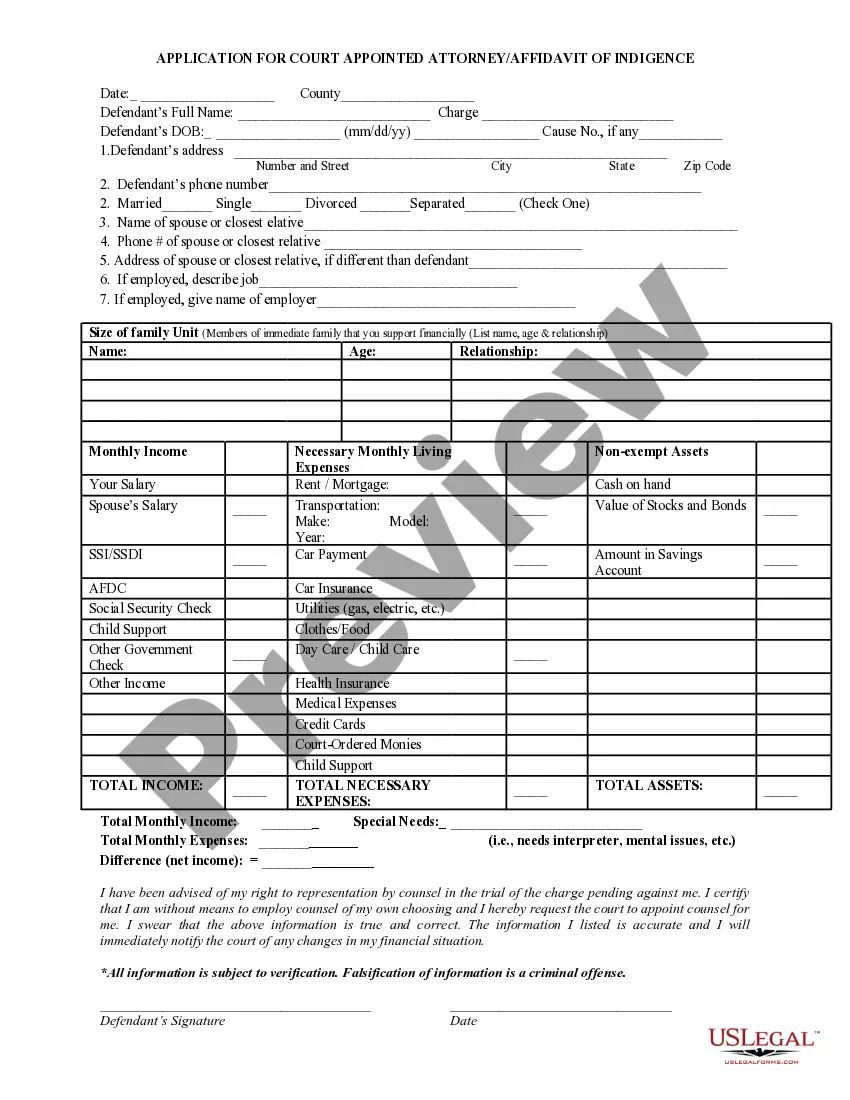
An indigent defendant is someone who has been arrested or charged with a crime punishable by imprisonment and who lacks sufficient resources to hire a lawyer without suffering undue hardship. Determination of Indigence. 3. Juvenile Justice Guide Book for Legislators.