Louisiana Letter to Indigent Defendant regarding Appointment as Attorney
About this form
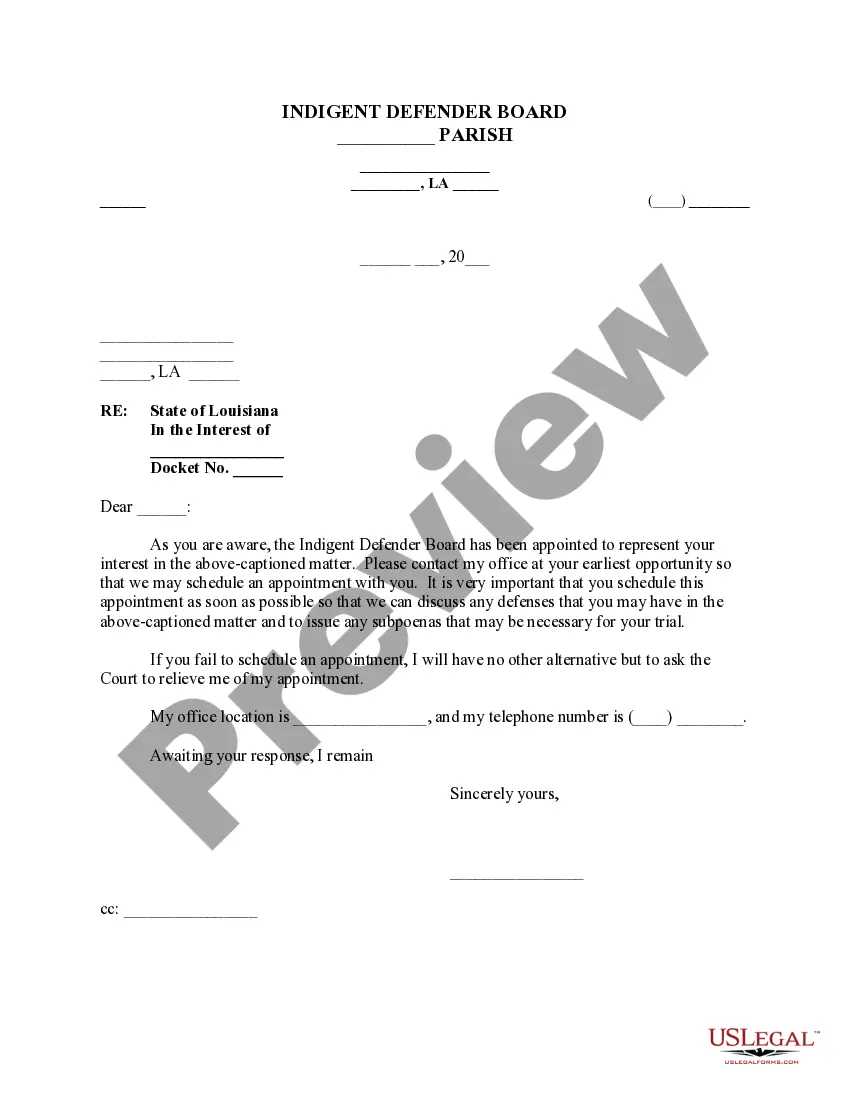
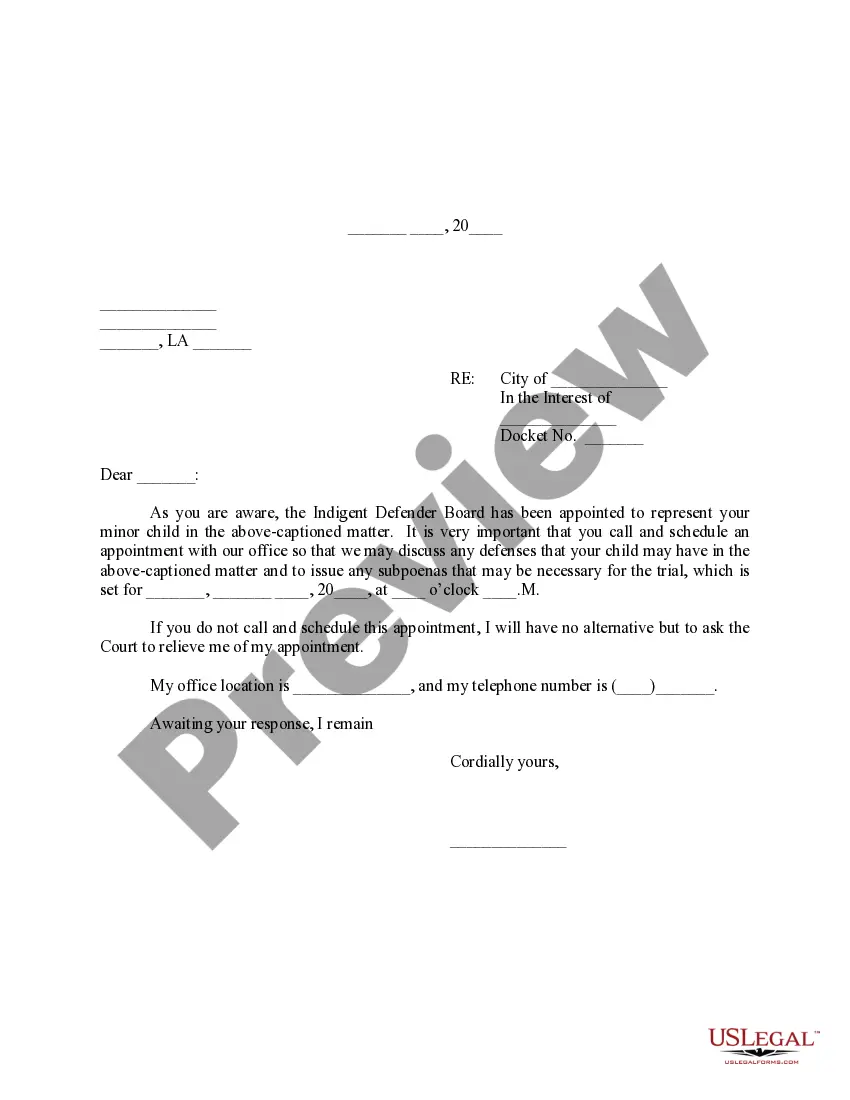
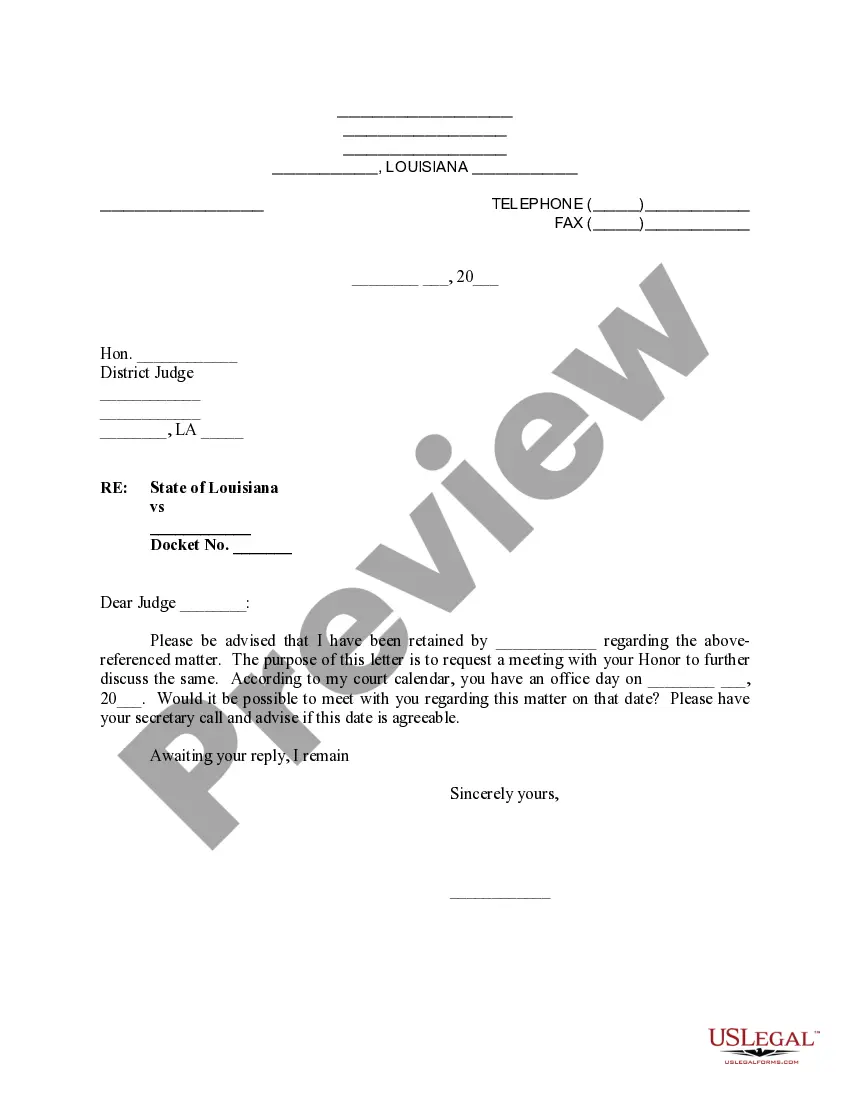
The Letter to Indigent Defendant regarding Appointment as Attorney is a formal notification from an attorney appointed by the Indigent Defender Board to represent a defendant in a criminal case. This letter serves to inform the defendant of their right to legal representation, instruct them to contact the attorney to discuss their case, and address the importance of scheduling a meeting. This form is essential for ensuring that defendants understand their legal rights and the process ahead of trial.
What’s included in this form
- Contact information for the attorney, including office location and phone number.
- Statement regarding the appointment by the Indigent Defender Board.
- Instructions for the defendant to schedule a meeting with the attorney.
- Warning about the consequences of failing to contact the attorney.
- Signature section for the attorney to validate the letter.
When to use this form
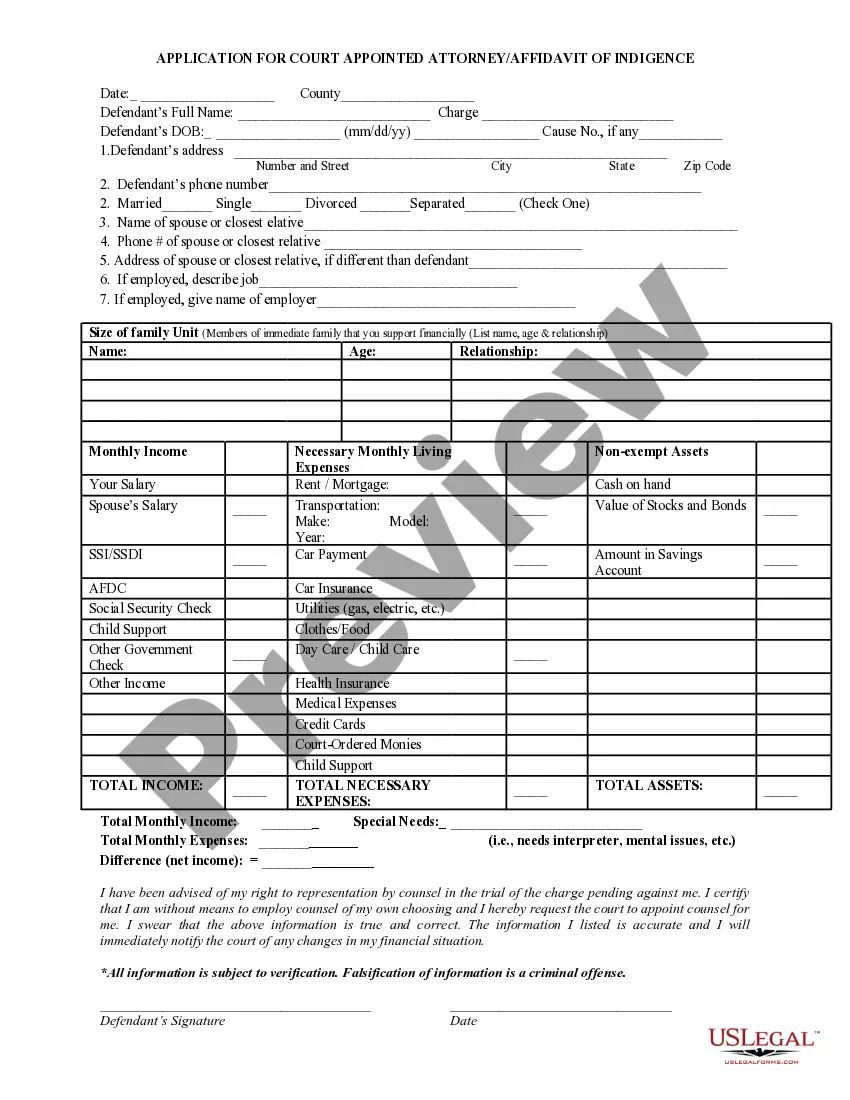
This form should be used when an individual is appointed a public defender or an attorney from the Indigent Defender Board. It is particularly relevant in criminal cases where the defendant may be unable to afford private legal representation. This letter acts as an official communication to prompt the appointed attorney and the defendant to initiate a crucial discussion about the case.
Who this form is for
- Defendants in criminal cases who have been assigned an attorney by the Indigent Defender Board.
- Attorneys representing indigent defendants seeking to formally communicate with their clients.
- Legal professionals involved in criminal defense matters concerning indigent clients.
Steps to complete this form
- Fill in the parish and jurisdiction details at the top of the letter.
- Enter the name and docket number of the defendant.
- Specify the attorney's location and contact number.
- Clearly state the importance of scheduling a meeting and any consequences of failing to do so.
- Sign the letter to authenticate the communication.
Is notarization required?
This form usually doesn’t need to be notarized. However, local laws or specific transactions may require it. Our online notarization service, powered by Notarize, lets you complete it remotely through a secure video session, available 24/7.
Get your form ready online
Our built-in tools help you complete, sign, share, and store your documents in one place.
Make edits, fill in missing information, and update formatting in US Legal Forms—just like you would in MS Word.
Download a copy, print it, send it by email, or mail it via USPS—whatever works best for your next step.
Sign and collect signatures with our SignNow integration. Send to multiple recipients, set reminders, and more. Go Premium to unlock E-Sign.
If this form requires notarization, complete it online through a secure video call—no need to meet a notary in person or wait for an appointment.
We protect your documents and personal data by following strict security and privacy standards.

Make edits, fill in missing information, and update formatting in US Legal Forms—just like you would in MS Word.

Download a copy, print it, send it by email, or mail it via USPS—whatever works best for your next step.

Sign and collect signatures with our SignNow integration. Send to multiple recipients, set reminders, and more. Go Premium to unlock E-Sign.

If this form requires notarization, complete it online through a secure video call—no need to meet a notary in person or wait for an appointment.

We protect your documents and personal data by following strict security and privacy standards.
Mistakes to watch out for
- Failing to include accurate contact information for the attorney.
- Not clearly stating the consequences of not scheduling a meeting.
- Leaving out important case details, such as the docket number.
- Using unclear or informal language that may confuse the recipient.
Why use this form online
- Convenient access to downloadable and customizable legal forms.
- Ability to edit information easily before printing.
- Secure handling of personal information and legal matters.
- Ensures compliance with state-specific legal requirements.
Looking for another form?
Form popularity
FAQ
Indigent defense is then typically provided through one or a combination of three methods: a public defender office, an assigned counsel system, or a contract system.
There are three main methods for providing legal representation to indigent defendants: public defender programs, assigned counsel or contract attorney programs. States develop their own indigent defense systems based on one or more of these methods.
An arraignment in Louisiana is the first court appearance in criminal court in Louisiana. Prior to the arraignment, the prosecutor either filed a bill of information, which is the formal charge, or the grand jury returned a true bill indictinhg the defendant. The arraignment is then set.
There are three main methods for providing legal representation to indigent defendants: public defender programs, assigned counsel or contract attorney programs. States develop their own indigent defense systems based on one or more of these methods.
Public defenders (PDs) are fully licensed lawyers whose sole job is to represent poor defendants in criminal cases.Or, the courts will maintain a list of attorneys and appoint them on a rotating basis to represent people who can't afford to hire their own lawyers.
(1) A motion by the defendant for a speedy trial, in order to be valid, must be accompanied by an affidavit by defendant's counsel certifying that the defendant and his counsel are prepared to proceed to trial within the delays set forth in this Article.
An indigent defendant is someone who has been arrested or charged with a crime punishable by imprisonment and who lacks sufficient resources to hire a lawyer without suffering undue hardship. Determination of Indigence. 3. Juvenile Justice Guide Book for Legislators.
An indigent defendant is someone who has been arrested or charged with a crime punishable by imprisonment and who lacks sufficient resources to hire a lawyer without suffering undue hardship. Determination of Indigence. 3. Juvenile Justice Guide Book for Legislators.
The state has to bring you to trial with 120 days if you are accused of a felony and 30 days if you are accused of a misdemeanor and are still being held in custody. If you have bonded out, the State has 180 days to bring you to trial on a felony charge and 60 days to bring you to trial on a misdemeanor charge.