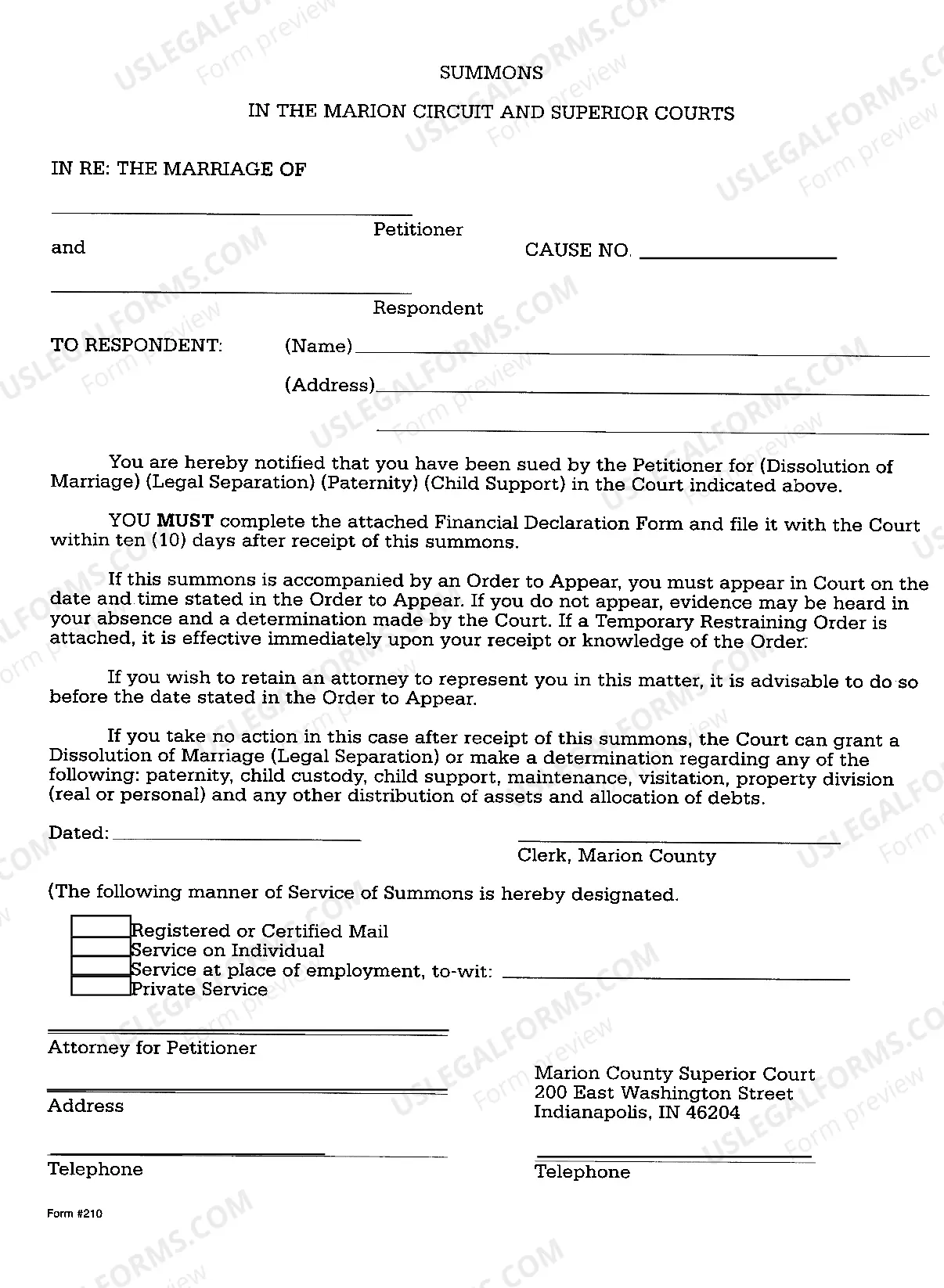
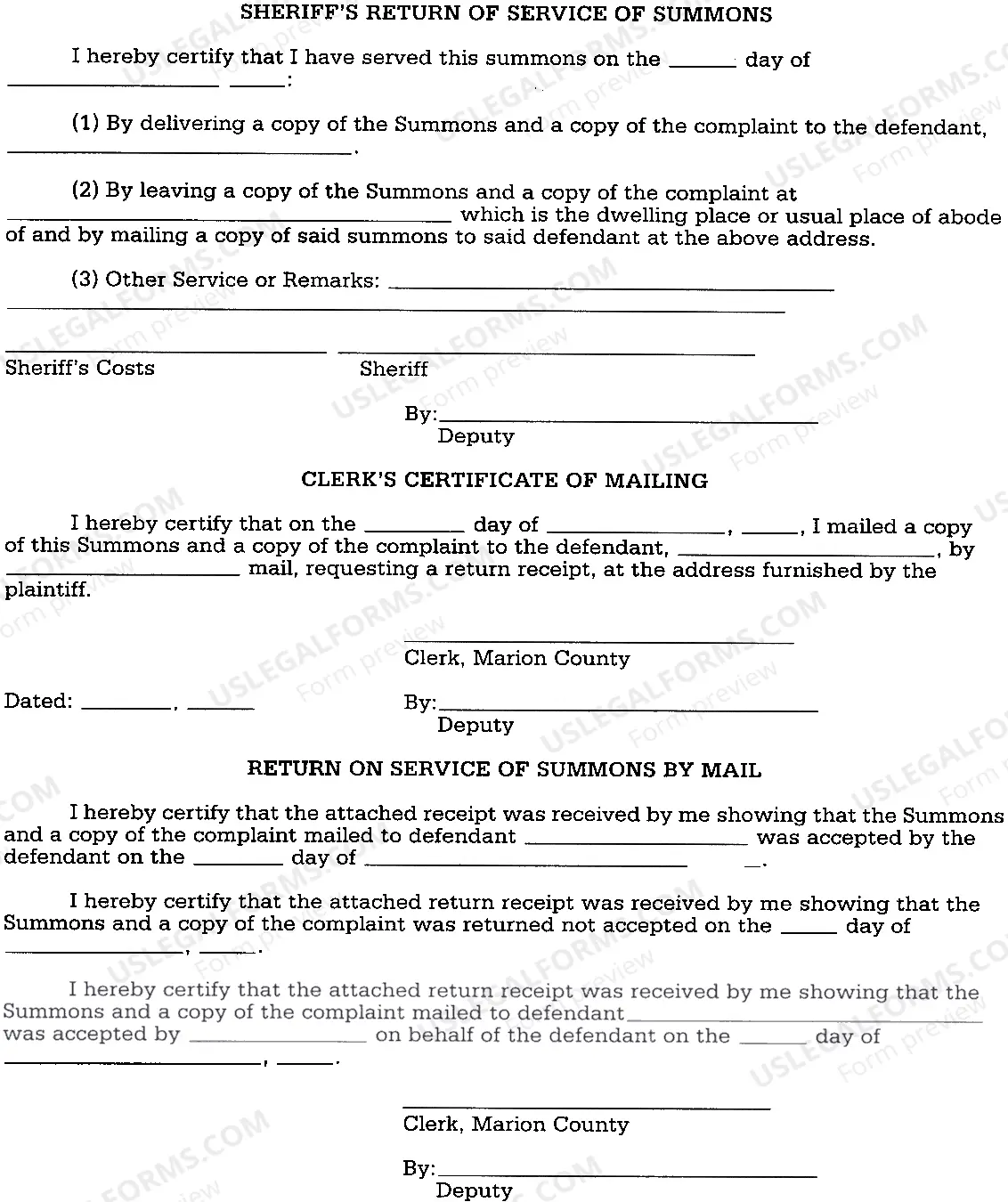
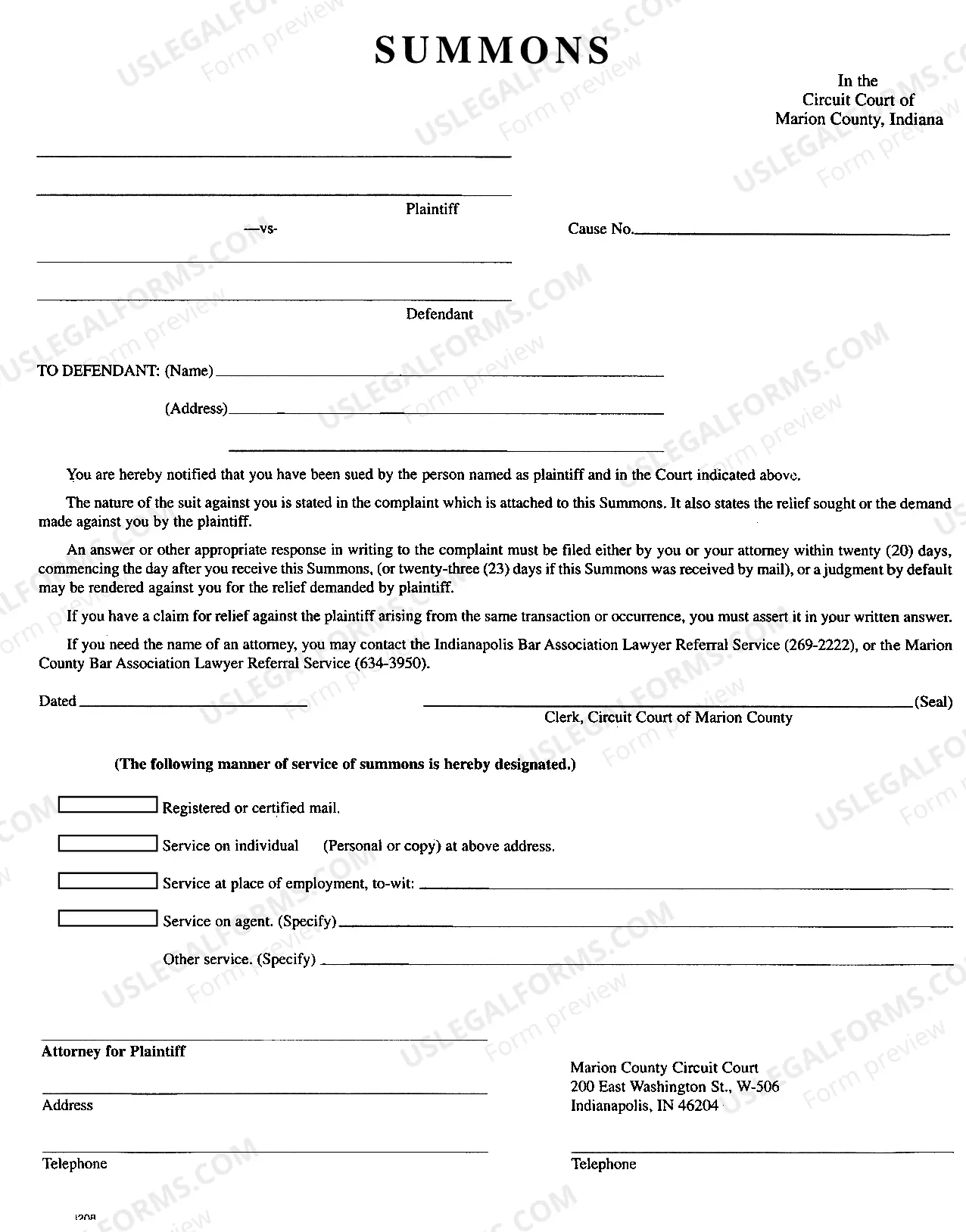
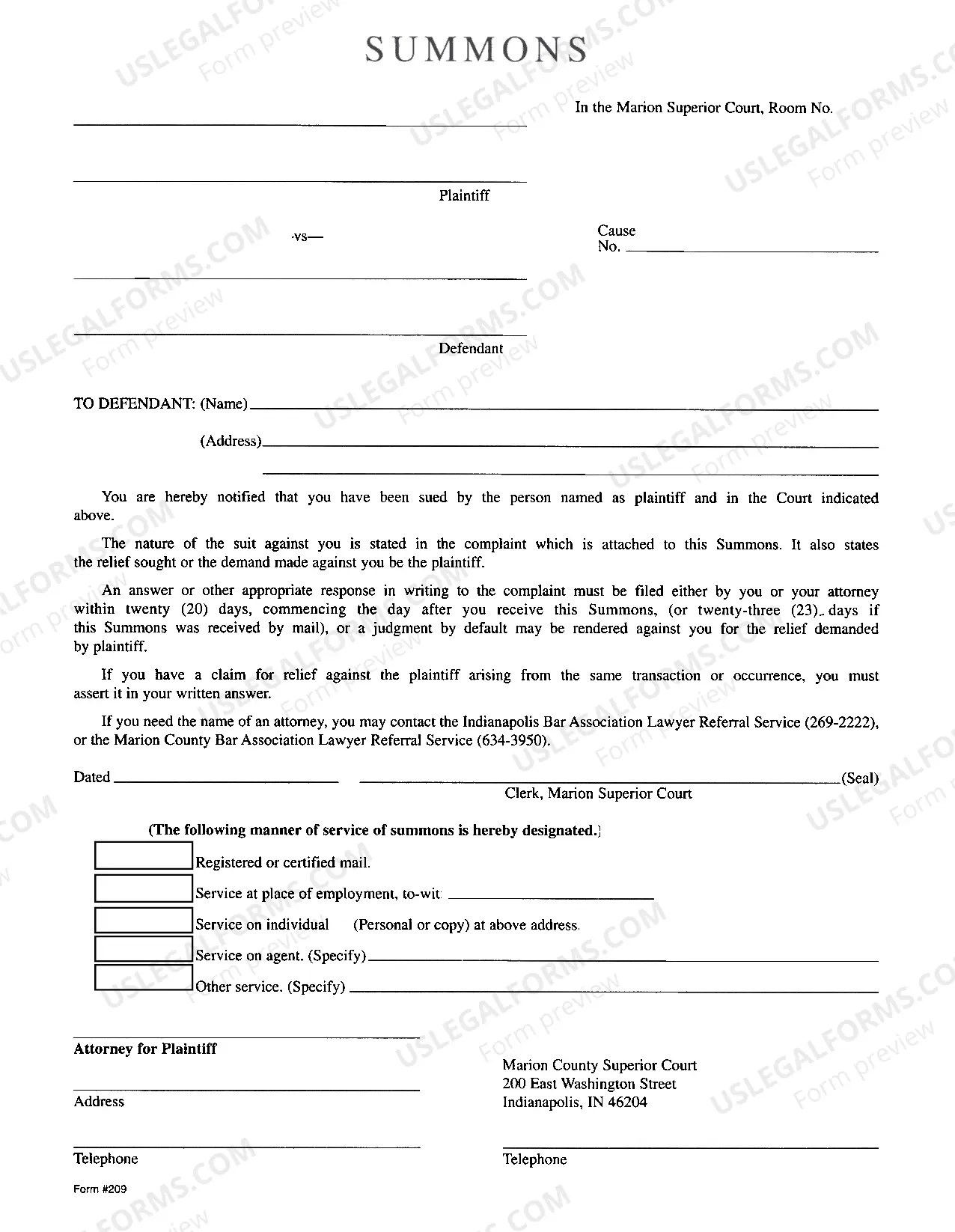
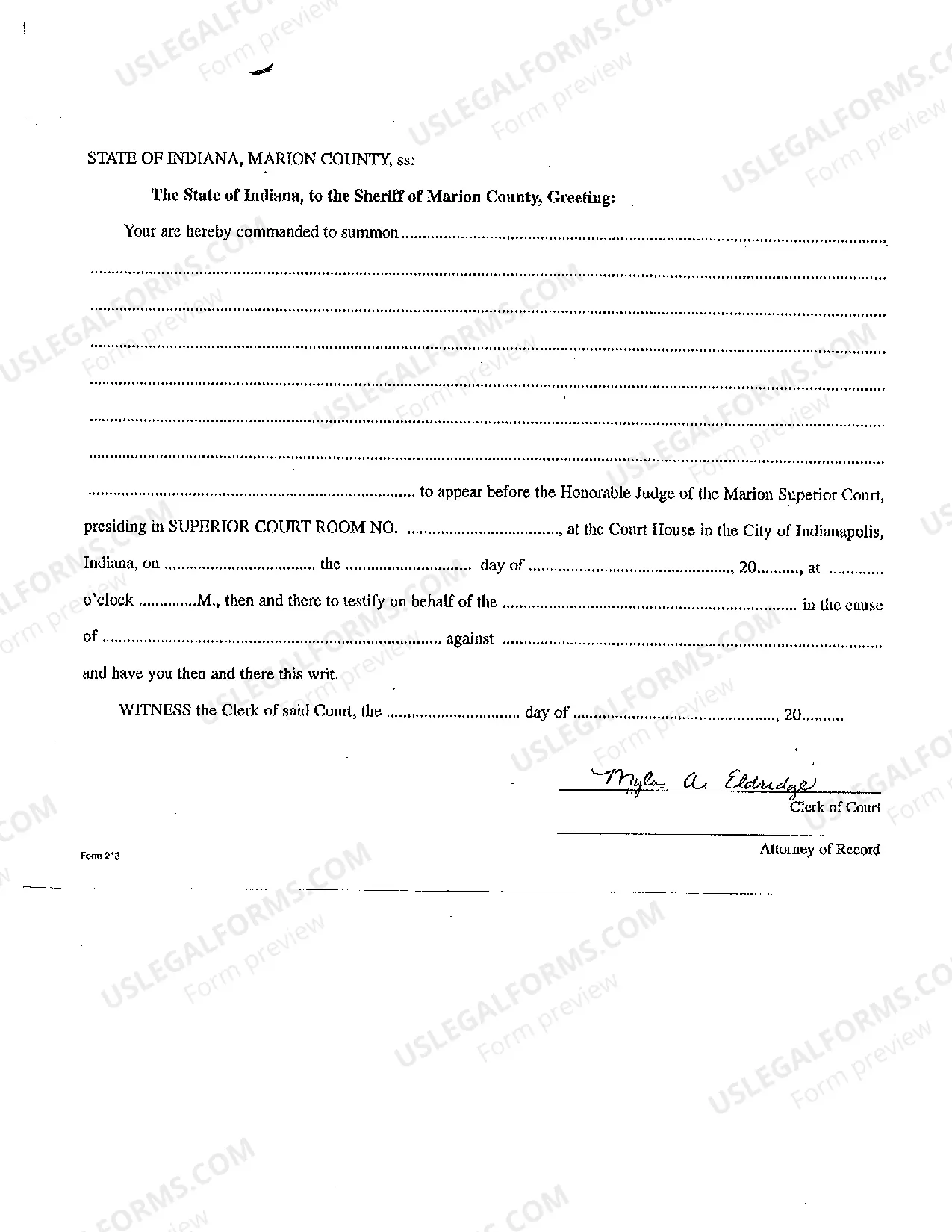
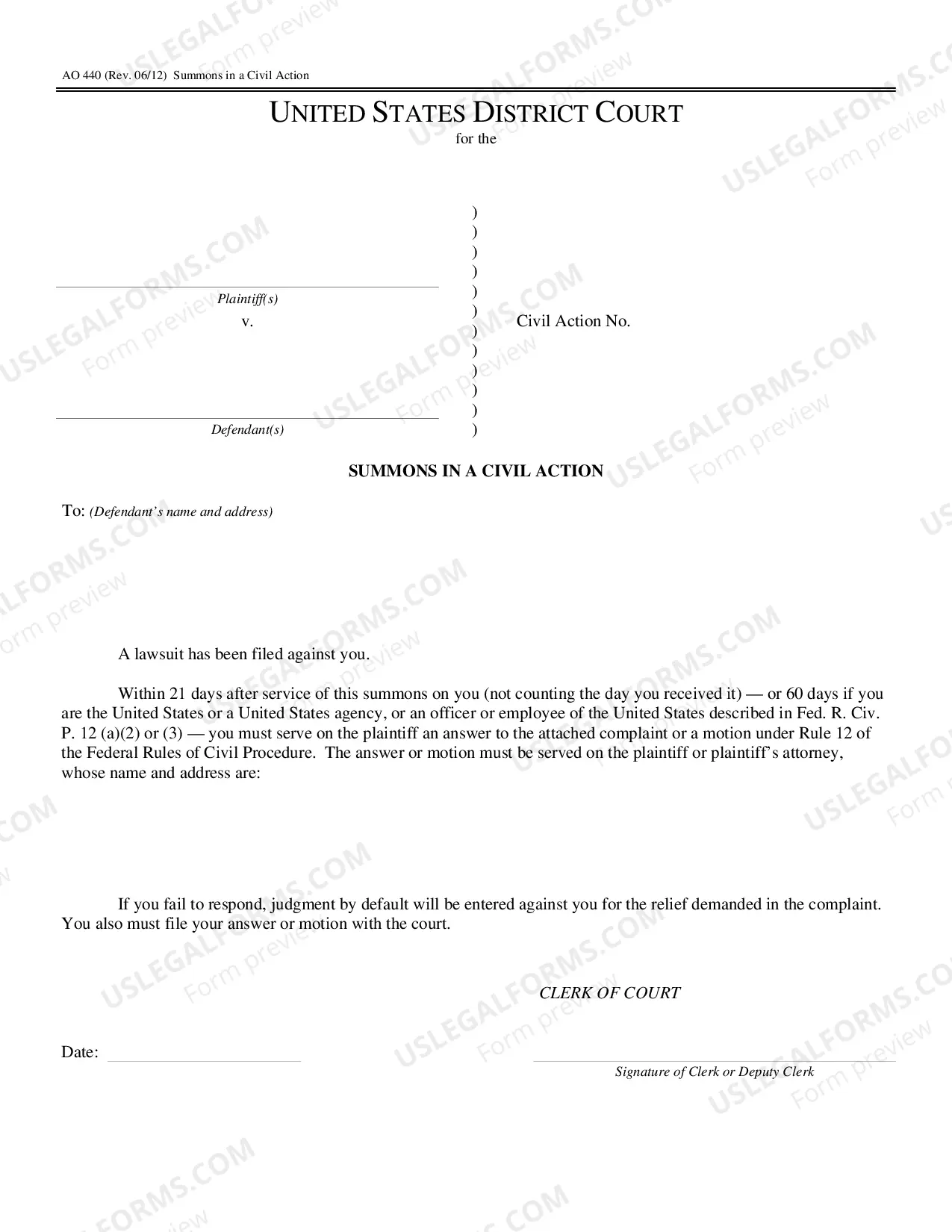
Indiana Domestic Relations Summons is a document, issued by a court, that requires an individual to appear before the court in order to answer to a case involving domestic relations, such as divorce, legal separation, child custody, child support, or spousal support. The summons is typically served by a sheriff or other designated individual and must be signed by the court clerk. There are three types of Indiana Domestic Relations Summons: Summons to Appear for Hearing, Summons to Answer Complaint, and Summons to Appear for Service of Process. The Summons to Appear for Hearing requires an individual to appear in court to contest or defend a domestic relations case. The Summons to Answer Complaint orders an individual to respond to the complaint filed against them in a domestic relations case. The Summons to Appear for Service of Process requires an individual to come to court to be served with the summons and complaint, or other legal documents related to the domestic relations case.
Indiana Domestic Relations Summons
Description
Get your form ready online
Our built-in tools help you complete, sign, share, and store your documents in one place.
Make edits, fill in missing information, and update formatting in US Legal Forms—just like you would in MS Word.
Download a copy, print it, send it by email, or mail it via USPS—whatever works best for your next step.
Sign and collect signatures with our SignNow integration. Send to multiple recipients, set reminders, and more. Go Premium to unlock E-Sign.
If this form requires notarization, complete it online through a secure video call—no need to meet a notary in person or wait for an appointment.
We protect your documents and personal data by following strict security and privacy standards.

Make edits, fill in missing information, and update formatting in US Legal Forms—just like you would in MS Word.

Download a copy, print it, send it by email, or mail it via USPS—whatever works best for your next step.

Sign and collect signatures with our SignNow integration. Send to multiple recipients, set reminders, and more. Go Premium to unlock E-Sign.

If this form requires notarization, complete it online through a secure video call—no need to meet a notary in person or wait for an appointment.

We protect your documents and personal data by following strict security and privacy standards.
Looking for another form?
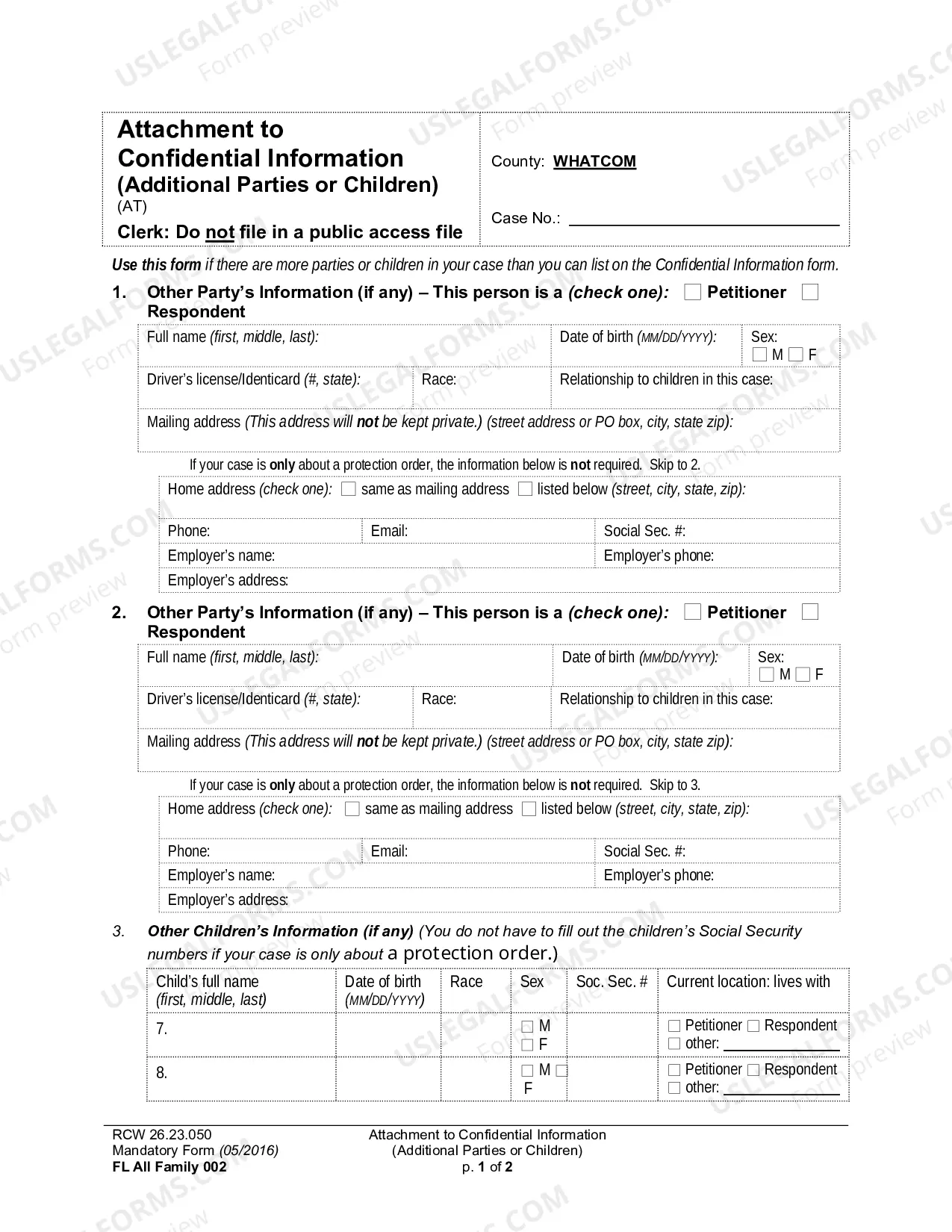
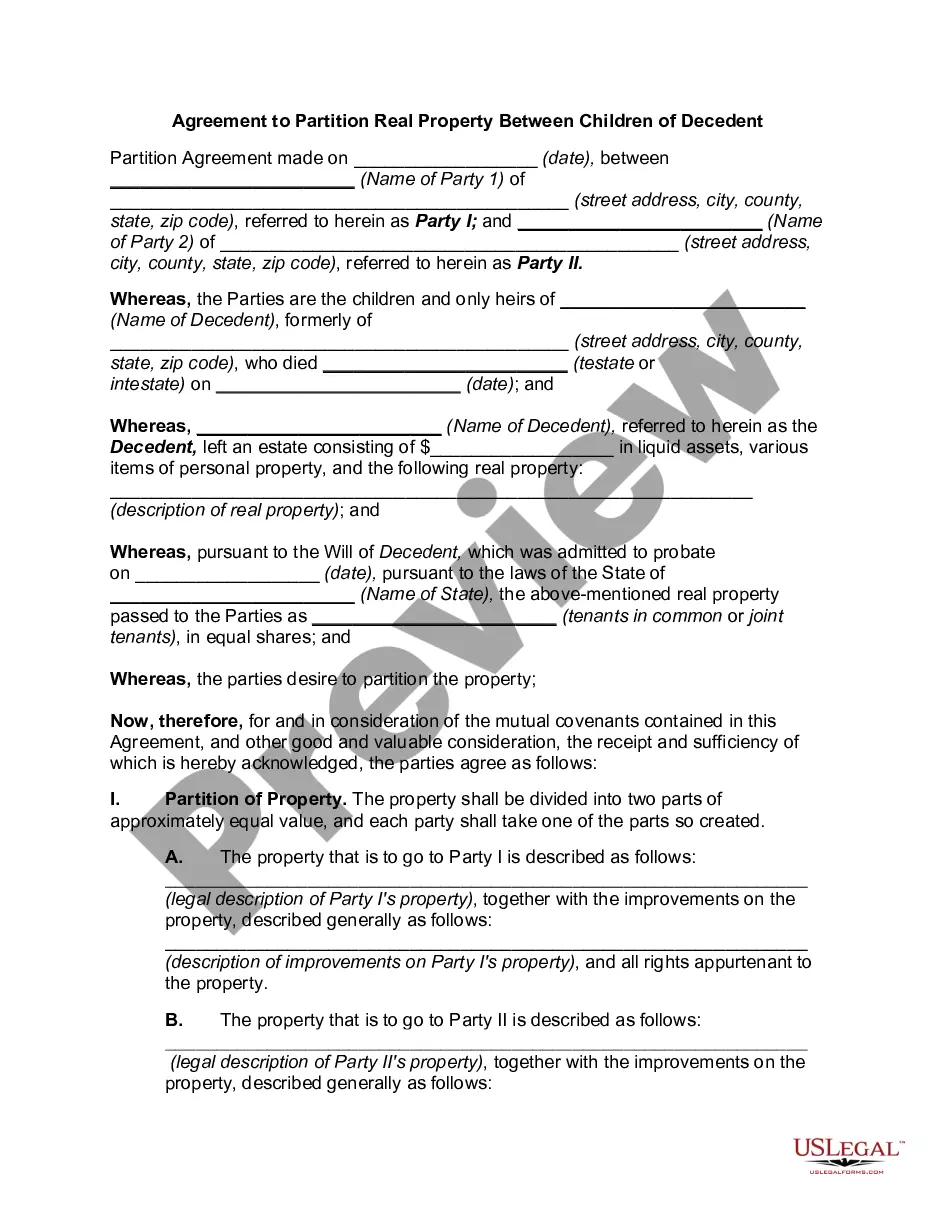

How to fill out Indiana Domestic Relations Summons?
How much time and effort do you generally allocate to creating official documentation.
There’s a more efficient method to obtain such forms than enlisting legal professionals or spending countless hours searching online for a suitable template.
Another benefit of our library is that you can retrieve documents you have previously acquired, which you can securely store in your profile under the My documents tab. Access them at any time and redo your paperwork as often as necessary.
Streamline your time and energy spent on formal documentation with US Legal Forms, one of the most reliable online services. Sign up today!
- Inspect the form details to ensure it aligns with your state criteria. To do this, review the form description or use the Preview option.
- If your legal template does not satisfy your needs, find an alternative one using the search bar at the page's top.
- If you are already a member of our service, Log In and download the Indiana Domestic Relations Summons. If not, move on to the next steps.
- Click Buy now once you locate the appropriate blank. Choose the subscription plan that best fits you to access our library's complete service.
- Create an account and complete your subscription payment. You can make a payment using your credit card or via PayPal – our service is entirely secure for that.
- Download your Indiana Domestic Relations Summons onto your device and fill it in on a printed copy or electronically.
Form popularity
FAQ
Failure by any person without adequate excuse to obey a subpoena served upon him may be deemed a contempt of the court from which the subpoena issued, or court of the county where the witness was required thereunder to appear or act.
Rule 12 - Defenses and Objections-When and How Presented-By Pleading or Motion-Motion for Judgment on the Pleadings (A) When presented. The time allowed for the presentation of defenses and objections in a motion or responsive pleading shall be computed pursuant to the provisions of Rule 6(C).
Service may be made upon an individual, or an individual acting in a representative capacity, by: (1) sending a copy of the summons and complaint by registered or certified mail or other public means by which a written acknowledgment of receipt may be requested and obtained to his residence, place of business or
Trial Rule 11 of the Indiana Rules of Trial Procedure tracks Federal Rule 11 in stating that an attorney's signature on a pleading or motion "constitutes a certificate by him that he has read the pleadings; that to the best of his knowledge, information, and belief, there is good ground to support it; and that it is
Every pleading, written motion, and other paper must be signed by at least one attorney of record in the attorney's name?or by a party personally if the party is unrepresented. The paper must state the signer's address, e-mail address, and telephone number.
A defendant may plead guilty, not guilty, or, with the consent of the court, nolo contendere. If the defendant refuses to plead, or if a defendant corporation fails to appear, the court must enter a plea of not guilty.
Upon entering a conviction, whether the acceptance of a guilty plea or by finding or by verdict, the court shall sentence a defendant convicted in a criminal case within thirty (30) days of the plea or the finding or verdict of guilty, unless an extension for good cause is shown.
Rule 37-Failure to Make or Cooperate in Discovery: Sanctions. (a) Motion for Order Compelling Disclosure or Discovery. A party, upon reasonable notice to other parties and all persons affected thereby, may apply for an order compelling disclosure or discovery as follows: (1) Appropriate Court.