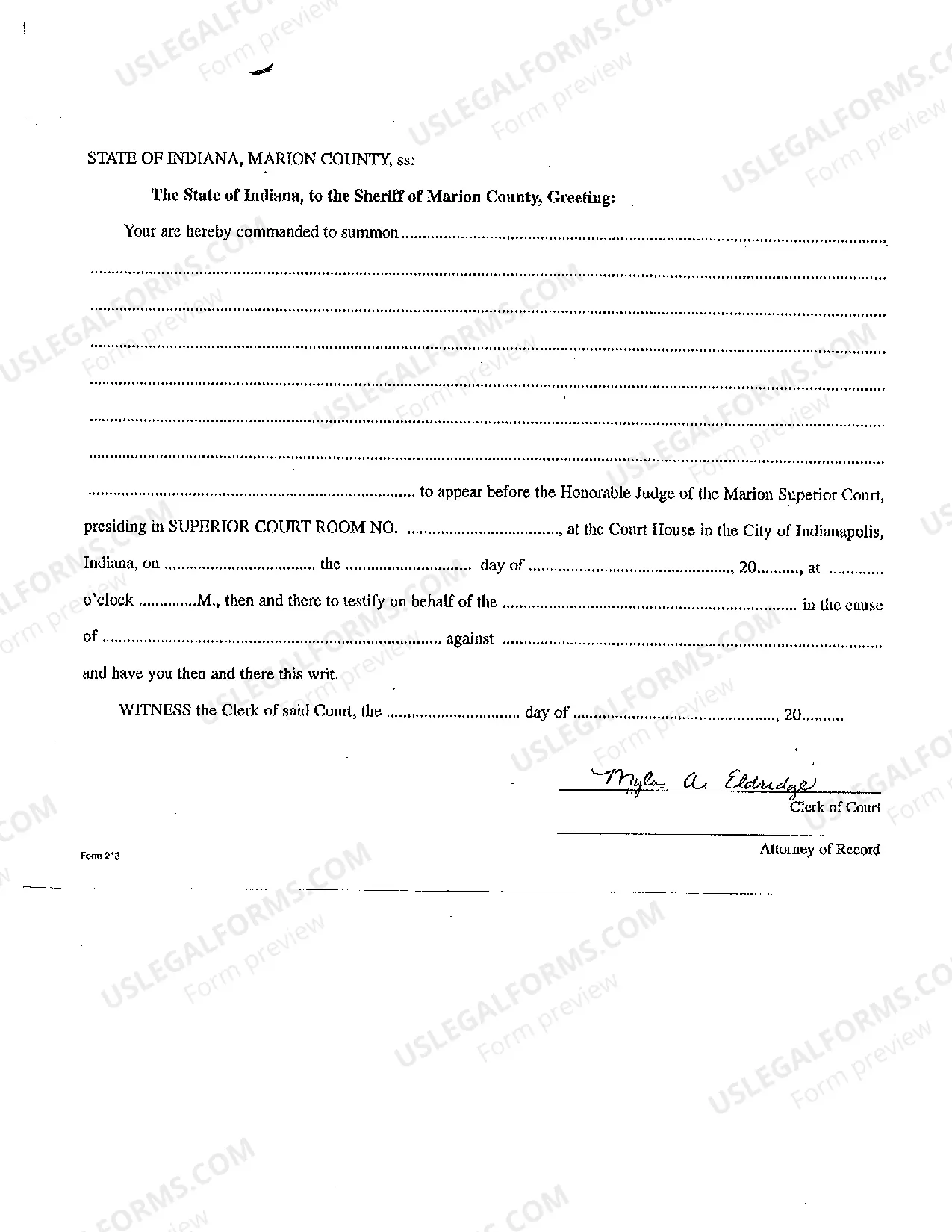
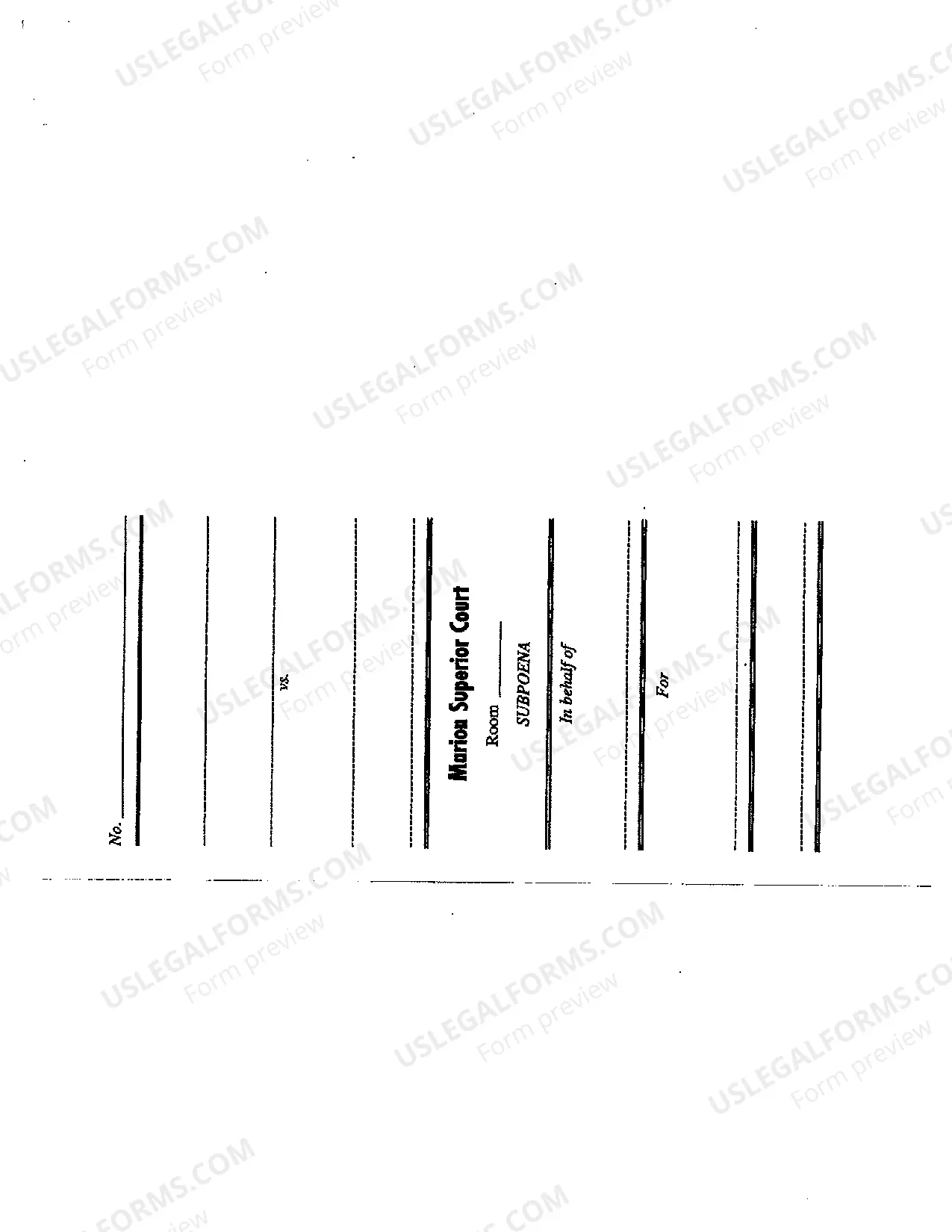
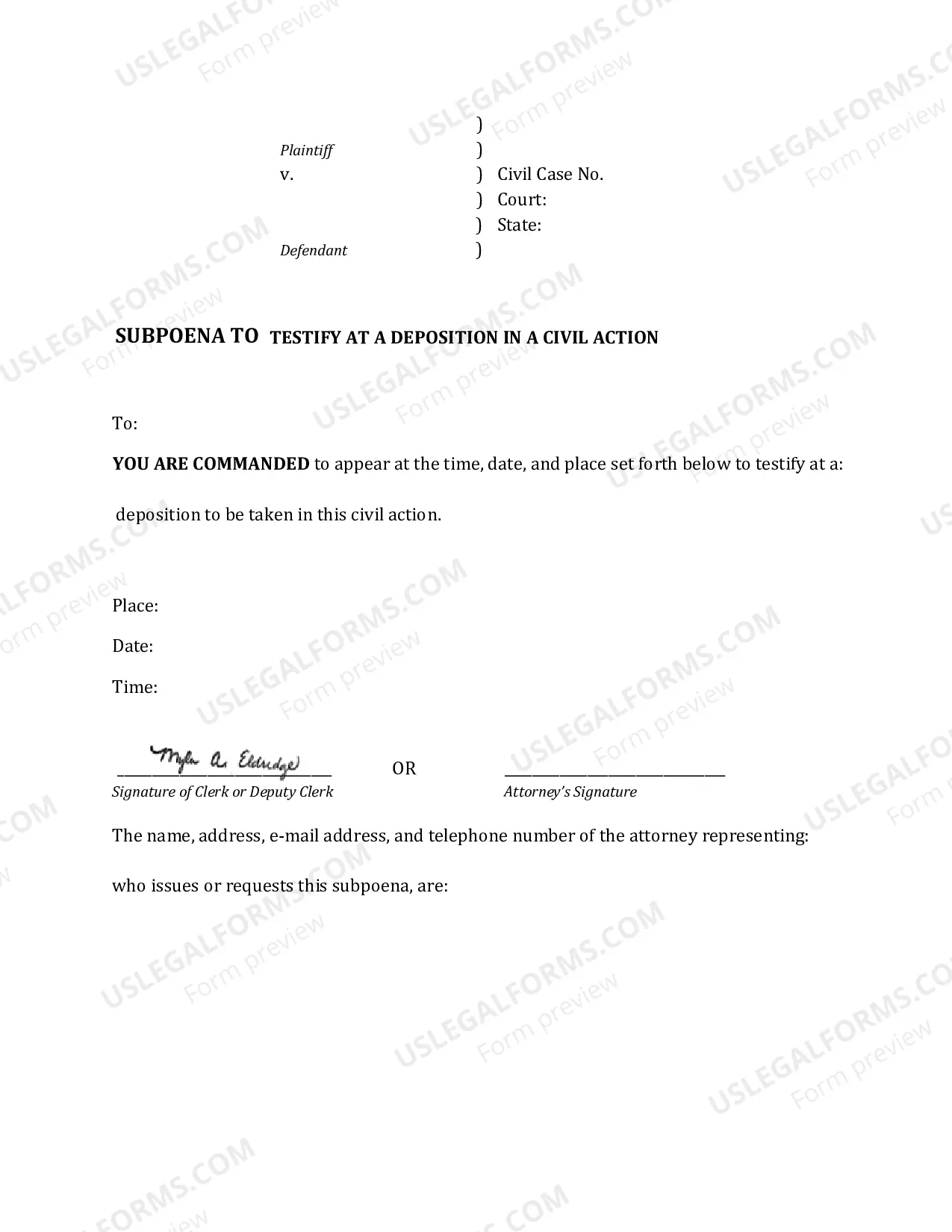
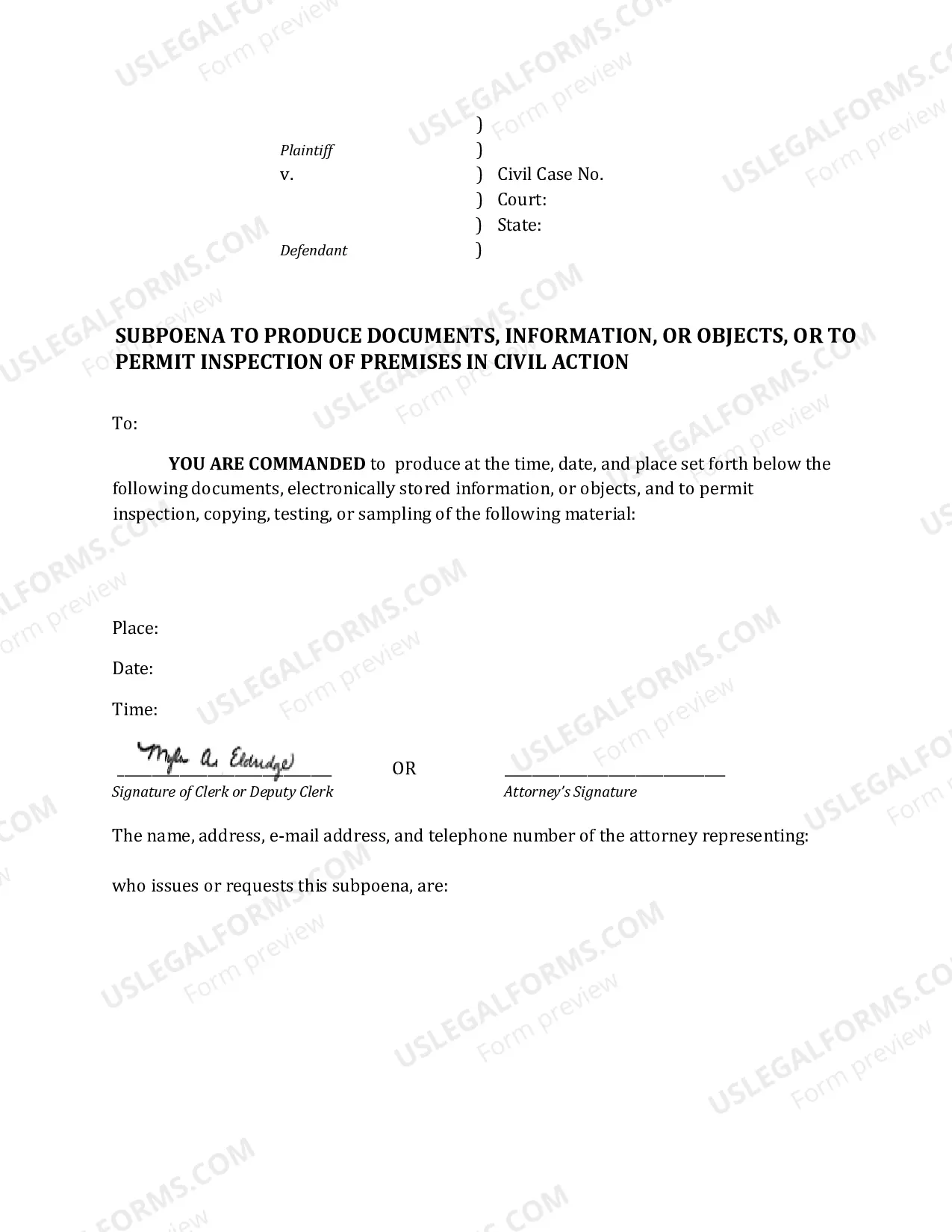
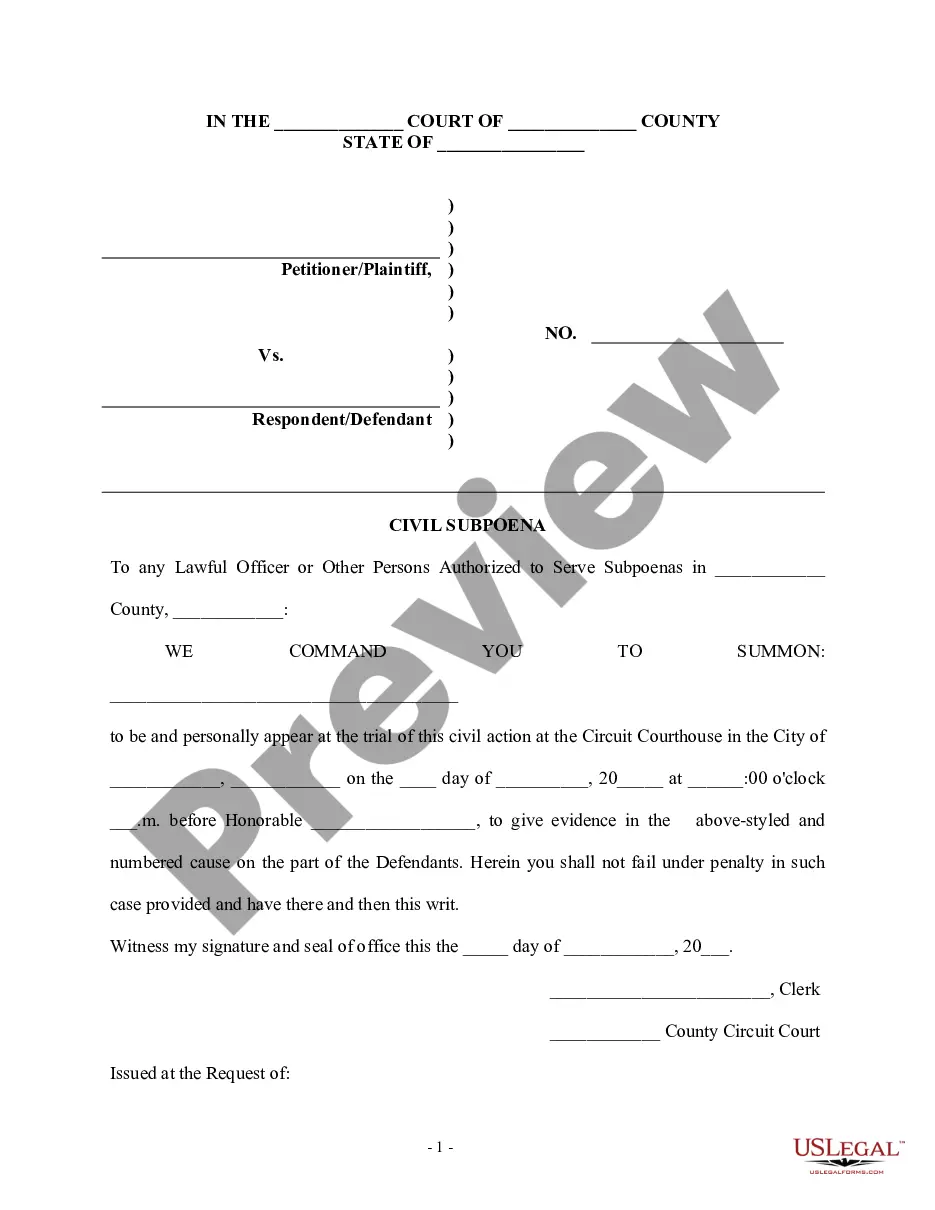
Indiana Civil Subpoena is a legal document used in the state of Indiana to compel a witness, party, or custodian of records to appear and testify in a civil proceeding. The two main types of Indiana Civil Subpoenas are Subpoena Ducks Cecum and Subpoena Ad Testificandum. Subpoena Ducks Cecum requires the person served to produce documents or tangible things related to the case such as photographs, videos, reports, and other evidence. Subpoena Ad Testificandum requires the person served to appear in court and testify about the case. Both types of subpoenas must include specific information such as the name of the court, the case caption, the date and time of appearance, and a list of any documents or tangible things to be produced.
Indiana CivilSubpoena
State:
Indiana
Control #:
IN-MCC-213
Format:
PDF
Instant download
This website is not affiliated with any governmental entity
Public form
Description
CivilSubpoena
Free preview
Get your form ready online
Our built-in tools help you complete, sign, share, and store your documents in one place.
Built-in online Word editor
Make edits, fill in missing information, and update formatting in US Legal Forms—just like you would in MS Word.
Export easily
Download a copy, print it, send it by email, or mail it via USPS—whatever works best for your next step.
E-sign your document
Sign and collect signatures with our SignNow integration. Send to multiple recipients, set reminders, and more. Go Premium to unlock E-Sign.
Notarize online 24/7
If this form requires notarization, complete it online through a secure video call—no need to meet a notary in person or wait for an appointment.
Store your document securely
We protect your documents and personal data by following strict security and privacy standards.

Make edits, fill in missing information, and update formatting in US Legal Forms—just like you would in MS Word.

Download a copy, print it, send it by email, or mail it via USPS—whatever works best for your next step.

Sign and collect signatures with our SignNow integration. Send to multiple recipients, set reminders, and more. Go Premium to unlock E-Sign.

If this form requires notarization, complete it online through a secure video call—no need to meet a notary in person or wait for an appointment.

We protect your documents and personal data by following strict security and privacy standards.
Looking for another form?
How to fill out Indiana CivilSubpoena?
If you’re looking for a method to correctly prepare the Indiana CivilSubpoena without enlisting a lawyer, then you have come to the right spot.
US Legal Forms has established itself as the most comprehensive and reliable repository of formal templates for various personal and business situations. Each document accessible on our online platform is crafted in accordance with federal and state regulations, ensuring that your paperwork is accurate.
Another great aspect of US Legal Forms is that you will never lose the documents you acquired - you can access any of your downloaded templates from the My documents section of your profile whenever required.
- Verify that the document visible on the page aligns with your legal context and state regulations by reviewing its text description or utilizing the Preview mode.
- Enter the form title in the Search tab located at the top of the page and choose your state from the dropdown list to locate alternative templates if necessary.
- Repeat the content verification process and click Buy now once you are certain that the paperwork meets all requirements.
- Log in to your account and select Download. If you do not have a subscription, sign up for the service and choose a subscription plan.
- Use your credit card or the PayPal option to complete your US Legal Forms subscription. The document will be ready for download immediately.
- Choose the format in which you would like to save your Indiana CivilSubpoena and download it by clicking the corresponding button.
- Upload your template to an online editor for quick completion and signing, or print it out for manual preparation of your paper copy.
Form popularity
FAQ
A subpoena may be served by the sheriff or his deputy, a party or any person. Service of a subpoena upon a person named therein shall be made by delivering a copy thereof to such person. Service may be made in the same manner as provided in Rule 4.1, Rule 4.16 and Rule 5(B).
(A) If an arrestee does not present a substantial risk of flight or danger to themselves or others, the court should release the arrestee without money bail or surety subject to such restrictions and conditions as determined by the court except when: (1) The arrestee is charged with murder or treason.
Service upon the attorney or party shall be made by delivering or mailing a copy of the papers to him at his last known address. Delivery. Delivery of a copy within this rule means: offering or tendering it to the attorney or party and stating the nature of the papers being served.
Subpoenas that are procedurally defective are usually invalid and professionals do not have to respond to them. Federal courts have limited reach across state lines and are limited in how far they can force a witness to travel to appear for testimony.
An attorney may sign and issue a subpoena as an officer of a court if the attorney is authorized to practice in the court where the matter is pending. The Clerk's Office will provide signed subpoenas to requesting counsel but counsel should be encouraged to proceed without involvement of the clerk's office.
Rule 37-Failure to Make or Cooperate in Discovery: Sanctions. (a) Motion for Order Compelling Disclosure or Discovery. A party, upon reasonable notice to other parties and all persons affected thereby, may apply for an order compelling disclosure or discovery as follows: (1) Appropriate Court.