Louisiana Motion and Order to Reduce Bond - No Objection by District Attorney
Overview of this form
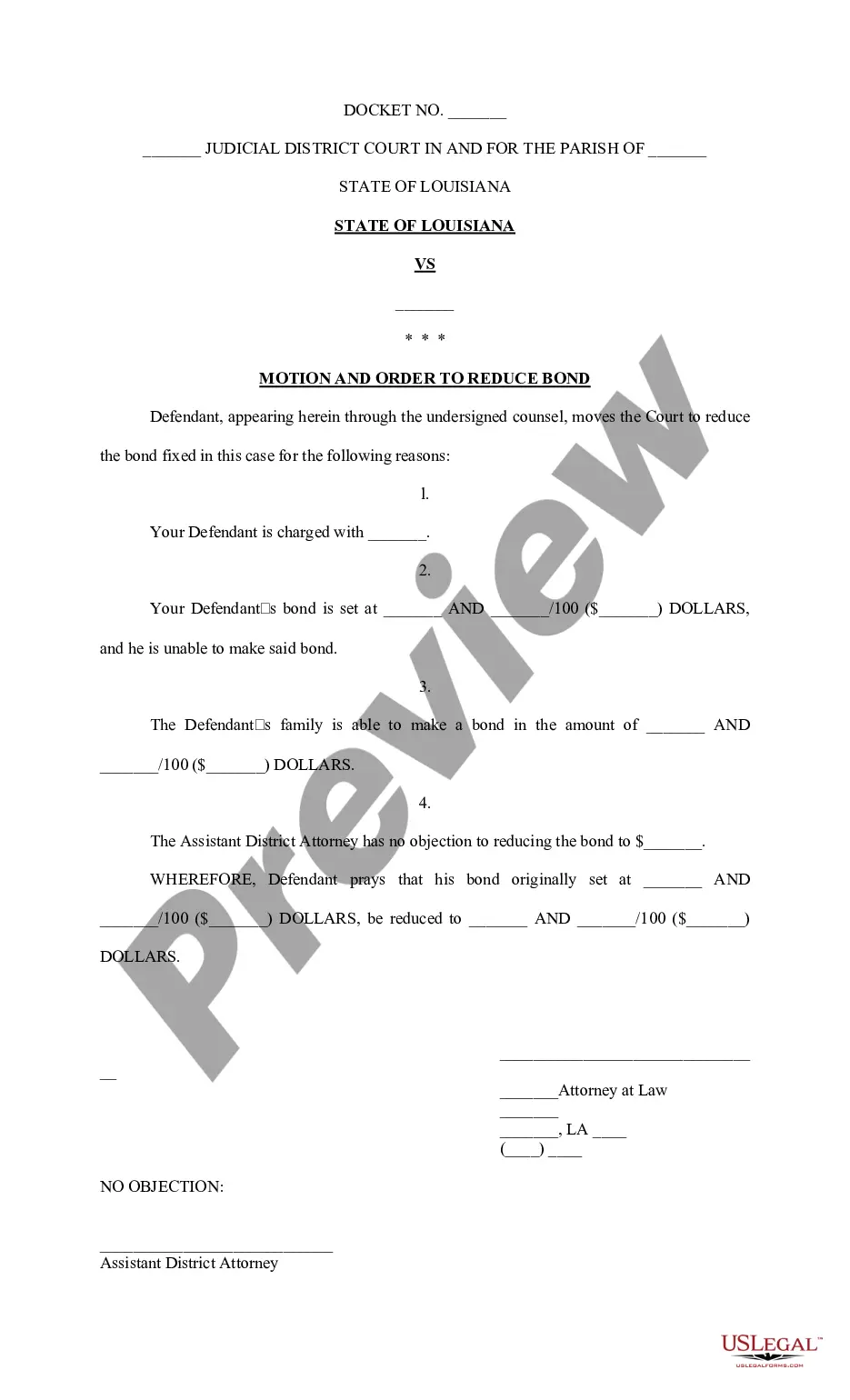
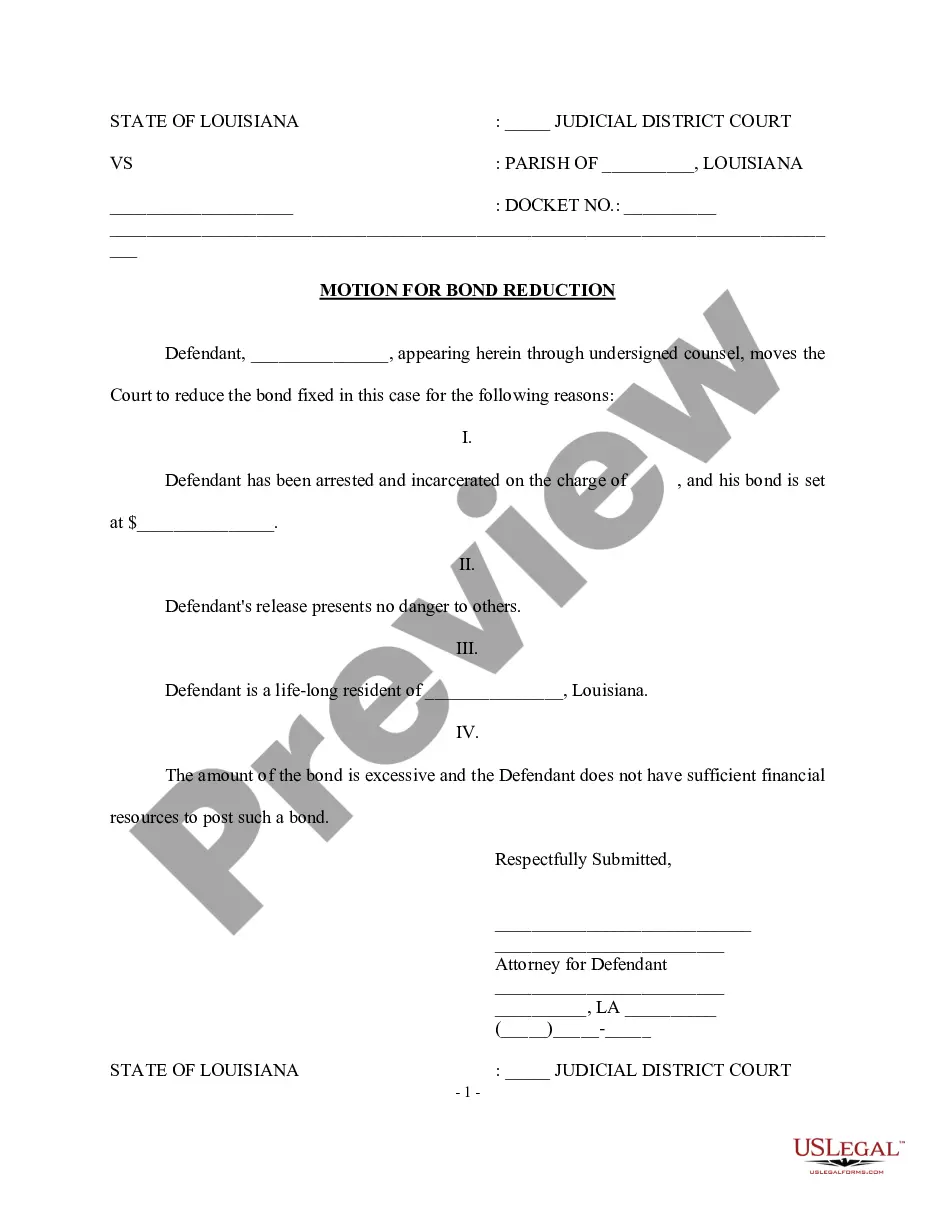
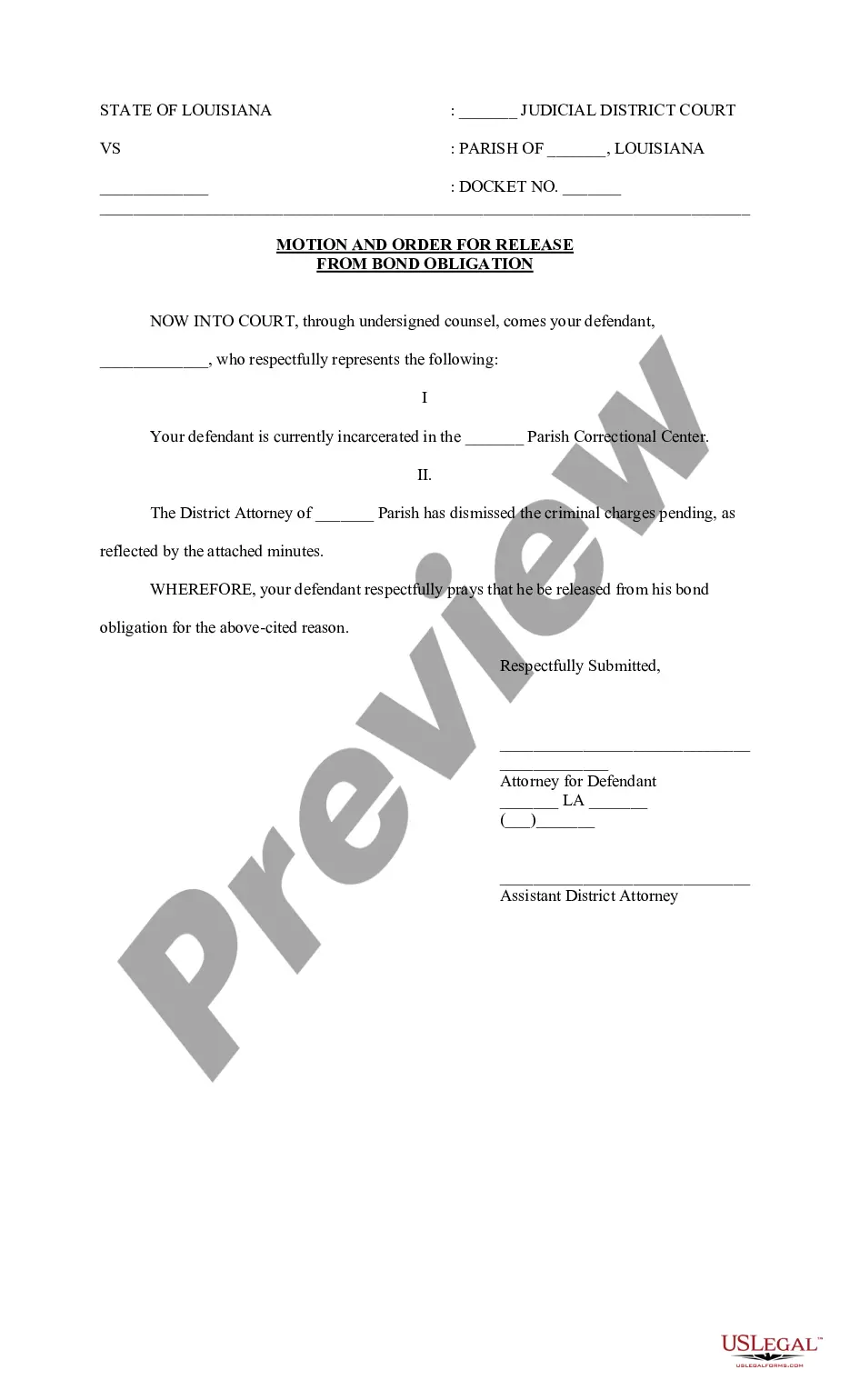
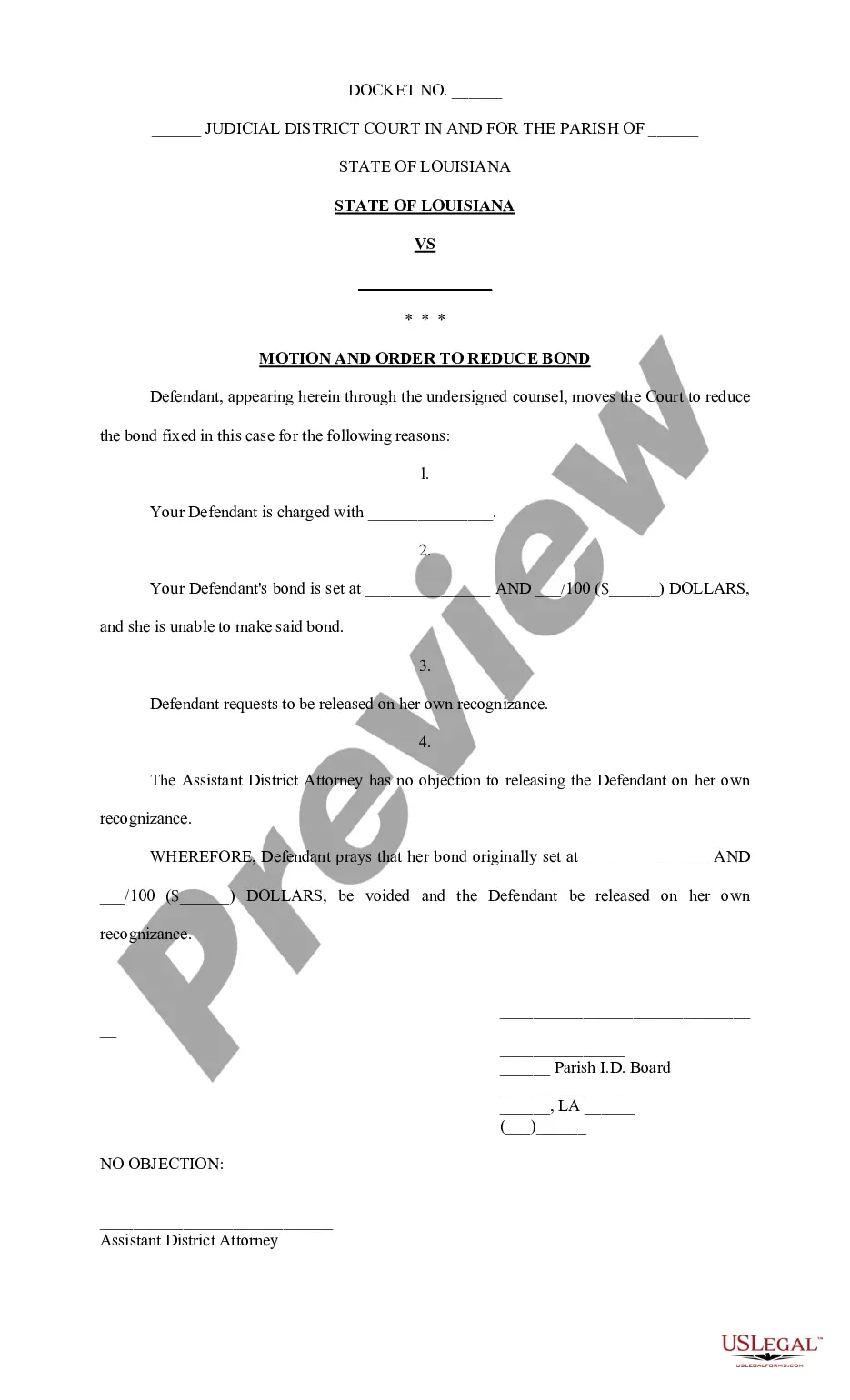
The Motion and Order to Reduce Bond - No Objection by District Attorney is a legal document used in criminal cases. It allows the defense counsel to request a reduction in a defendant's bond amount due to financial hardship, asserting that the defendant's family can post a lower amount. This motion is unique because it includes a statement from the assistant district attorney indicating no objection to the reduction, facilitating a smoother process in court.
Main sections of this form
- Identification of the judicial district and parties involved.
- Current bond amount and reasons for requesting a reduction.
- Statement that the assistant district attorney does not object to the bond reduction.
- Proposed new bond amount that the family can post.
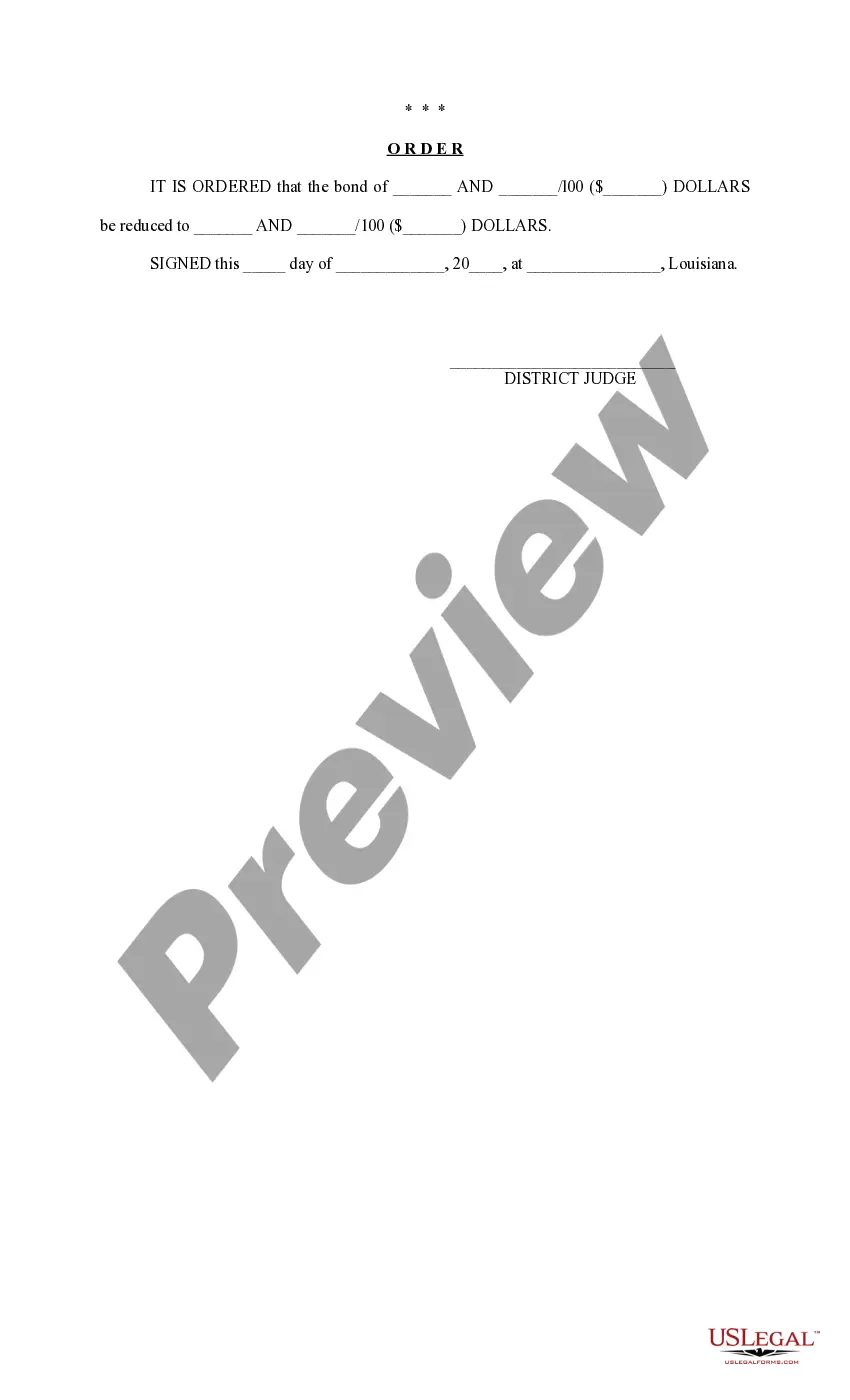
- Order from the judge confirming the bond reduction.
When to use this form
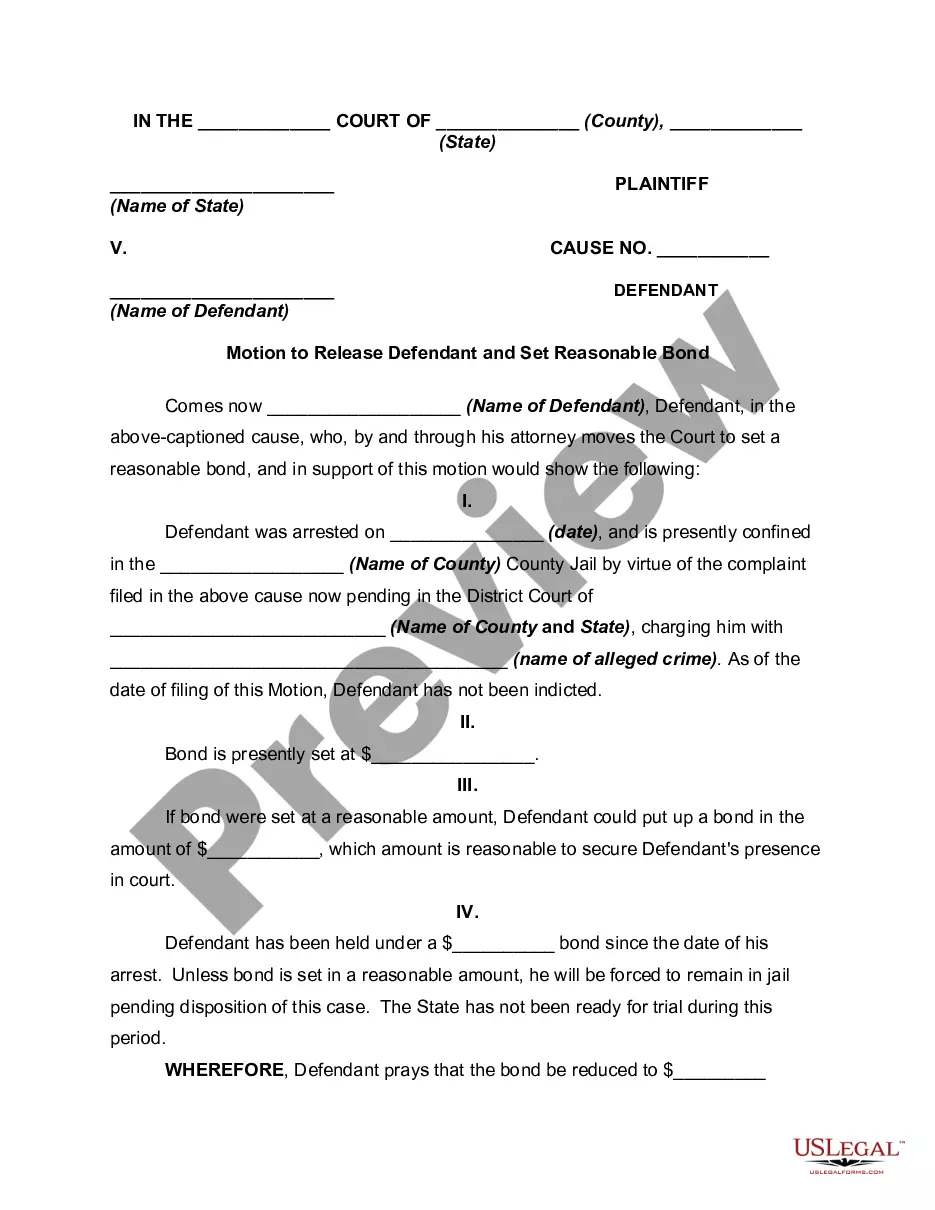
This form is used when a defendant in a criminal case is unable to afford the existing bond set by the court. If the defendant's family is willing and able to pay a reduced amount and the prosecution does not oppose the change, this motion can be filed to request that the court approve the lower bond.
Who needs this form
- Defendants in criminal cases seeking a reduction in their bond amount.
- Defense attorneys representing clients who cannot afford the current bond.
- Family members of defendants who are prepared to cover a lower bond amount.
How to complete this form
- Fill in the names of the parties involved and the judicial district.
- Specify the original bond amount and the reason for requesting a reduction.
- Indicate the new bond amount the family can afford to pay.
- Ensure the assistant district attorney provides a statement of no objection.
- Obtain a judge's signature to finalize the bond reduction order.
Notarization guidance
This form does not typically require notarization unless specified by local law. Always check jurisdictional requirements to ensure compliance.
Get your form ready online
Our built-in tools help you complete, sign, share, and store your documents in one place.
Make edits, fill in missing information, and update formatting in US Legal Forms—just like you would in MS Word.
Download a copy, print it, send it by email, or mail it via USPS—whatever works best for your next step.
Sign and collect signatures with our SignNow integration. Send to multiple recipients, set reminders, and more. Go Premium to unlock E-Sign.
If this form requires notarization, complete it online through a secure video call—no need to meet a notary in person or wait for an appointment.
We protect your documents and personal data by following strict security and privacy standards.

Make edits, fill in missing information, and update formatting in US Legal Forms—just like you would in MS Word.

Download a copy, print it, send it by email, or mail it via USPS—whatever works best for your next step.

Sign and collect signatures with our SignNow integration. Send to multiple recipients, set reminders, and more. Go Premium to unlock E-Sign.

If this form requires notarization, complete it online through a secure video call—no need to meet a notary in person or wait for an appointment.

We protect your documents and personal data by following strict security and privacy standards.
Common mistakes to avoid
- Failing to obtain the assistant district attorneyâs statement of no objection.
- Not specifying clear reasons for the bond reduction.
- Leaving out required signatures or not properly formatting the document.
Benefits of completing this form online
- Access to professionally drafted templates by licensed attorneys.
- Convenience of downloading the form instantly without the need for office visits.
- Editable forms that allow you to fill out information relevant to your specific case.
Legal use & context
- The motion is recognized within Louisiana law as a valid request to amend bail conditions.
- Proper use of this form can influence the courtâs decision on bail adjustments.
- This form is legally binding once signed by the District Judge and filed correctly.
Main things to remember
- This form is essential for defendants unable to afford their set bond.
- It facilitates communication between the defense and prosecution regarding bond adjustments.
- Proper completion and filing can lead to a successful reduction of financial burdens associated with bail.
Looking for another form?
Form popularity
FAQ
The 72-hour rule in Louisiana requires that a defendant be given a hearing within 72 hours of being arrested. This rule ensures that defendants are not held without due process. It becomes particularly significant when discussing a Louisiana Motion and Order to Reduce Bond - No Objection by District Attorney since timely hearings can influence the outcome of bond requests. Understanding this timeline can help defendants plan their legal strategies.
Rule 9.4 in Louisiana District Court concerns the requirement for timely responses to pleadings and discovery requests. It is designed to promote efficiency and accountability in legal proceedings. When filing a Louisiana Motion and Order to Reduce Bond - No Objection by District Attorney, being aware of the implications of Rule 9.4 can be essential in ensuring your process is streamlined and compliant.
A defendant can request a hearing to seek a bail reduction. At the hearing, the defendant can argue that the initial bail set by the court is so high that it is effectively a denial of bail and amounts to pretrial detention in jail, even though the defendant is not a flight risk or a threat to the public.
There is no set minimum or maximum amount of times bond can be reduced. It is something that is usually within the discretion of the judge. In general, a person has a right to a reasonable bond. If there is a set bond and a judge reduces...
If the amount of your bail is more than you can reasonably afford, you may be able to get it reduced by enlisting the aid of a Fort Bend County bail bond reduction attorney. Your attorney can argue for a reduction of bail on your behalf so that you do not have to remain in jail prior to trial.
In a Nutshell: One can request that a judge reduce bail by explaining the individual's ties to community through employment and family, history of never failing to appear and, if applicable, tendering one's passport or visa to the court clerk.
A bail reduction hearing usually takes place within 48 hours of the request and sometimes the next day.
California law also permits courts to reduce bail following a change in circumstances. Specifically, Penal Code § 1289 authorizes a court to reduce the bail if good cause is shown. succeeds in having some charges dismissed, he or she may also be able to reduce your bail.
Motions for Bond Reductions are filed in Court when a person can't afford to get out of jail. Hiring a private criminal defense attorney may get you a court hearing quicker. It's a hearing where your lawyer asks the judge for a lower bond amount.
Motions for Bond Reductions are filed in Court when a person can't afford to get out of jail. In order to get out of jail, someone must either hire a bondsman and pay them 10% of the bond amount, or actually go to the jail and pay the full amount of the bond.