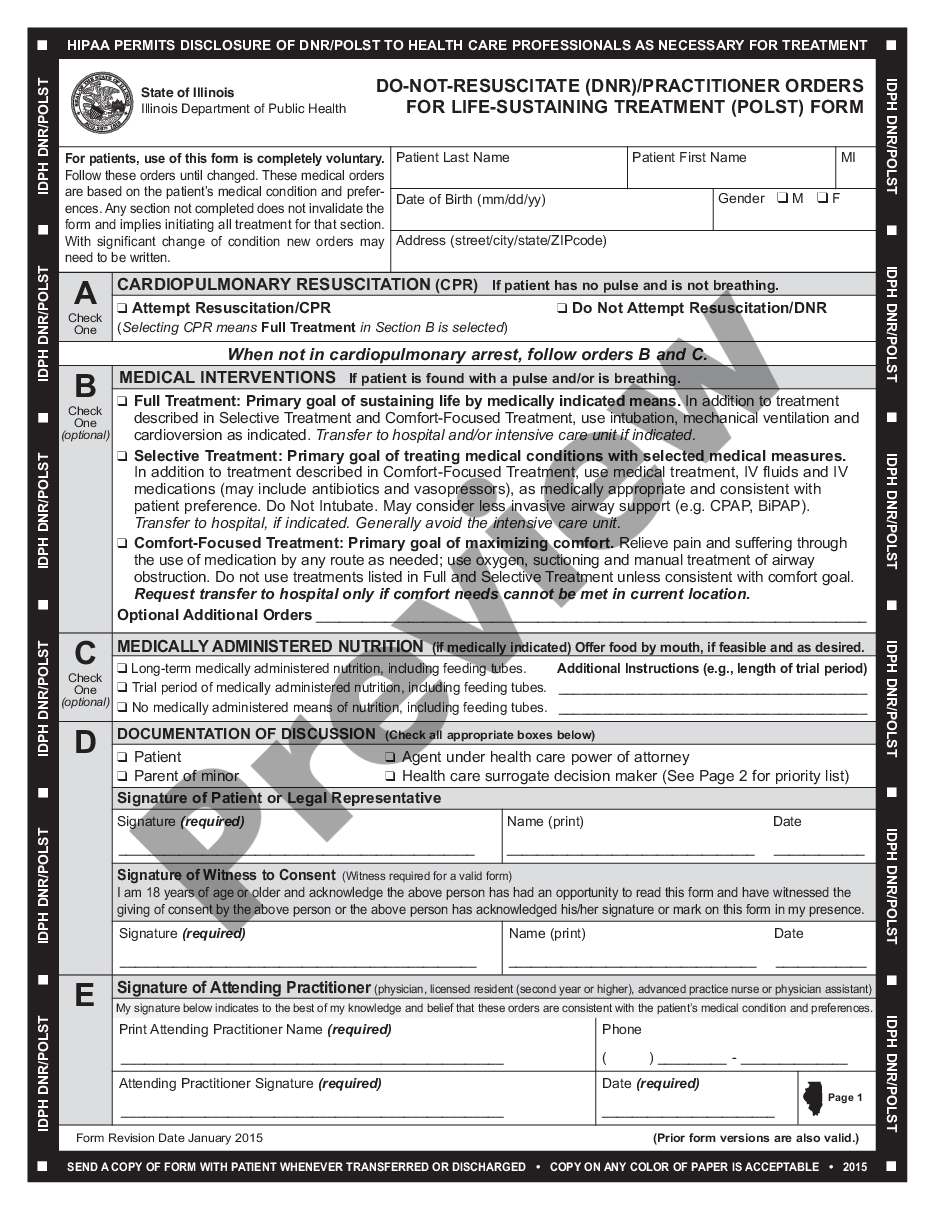
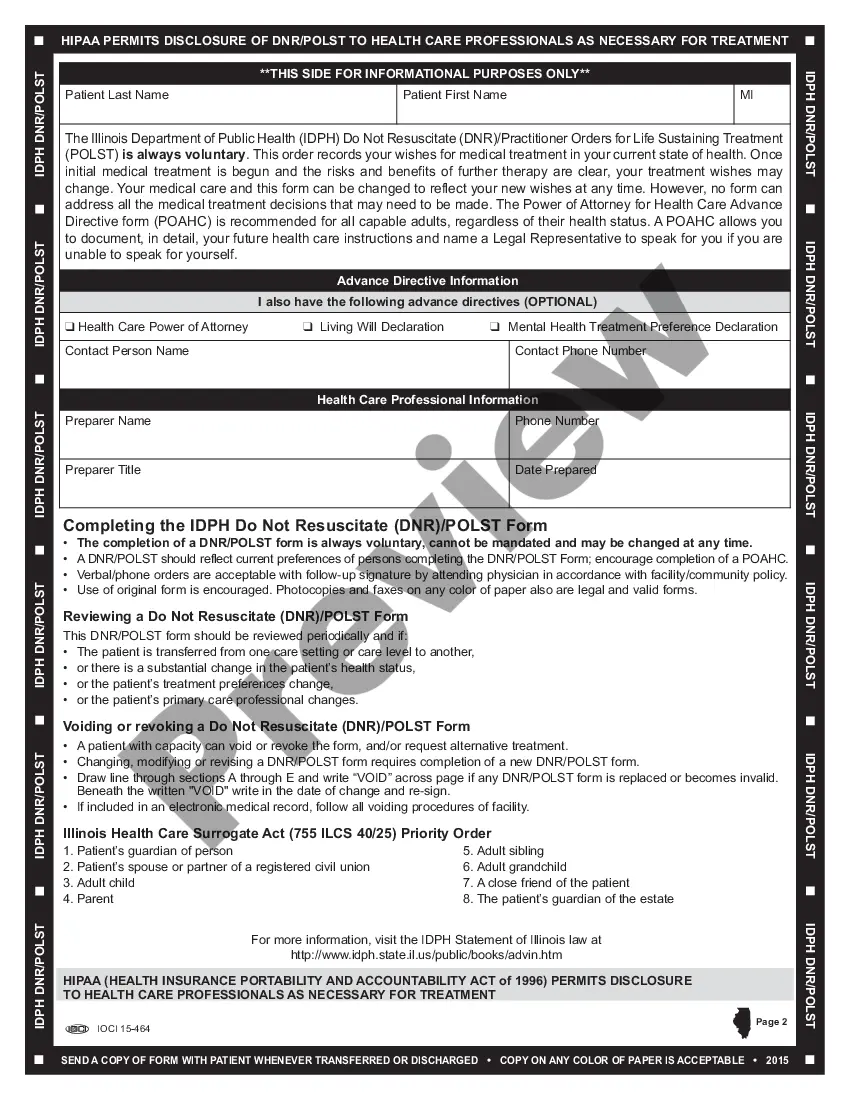
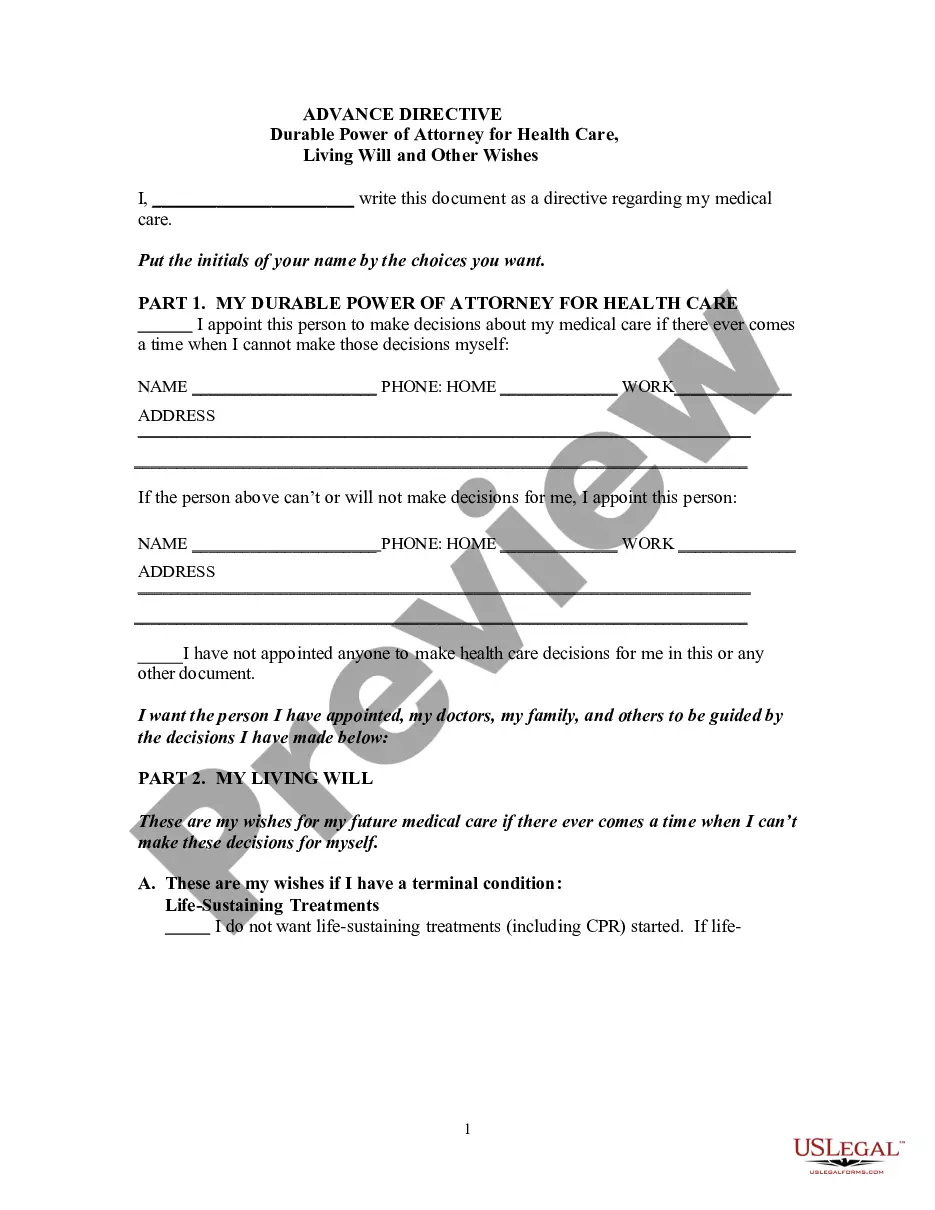
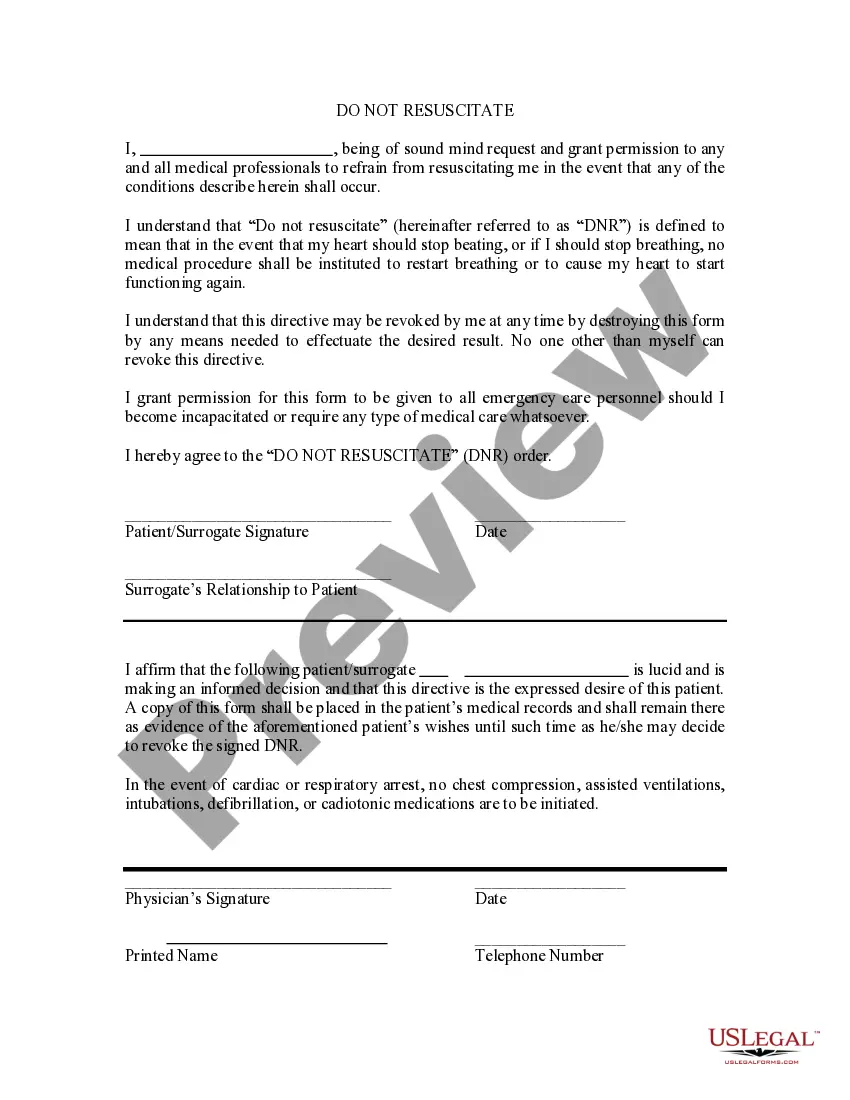
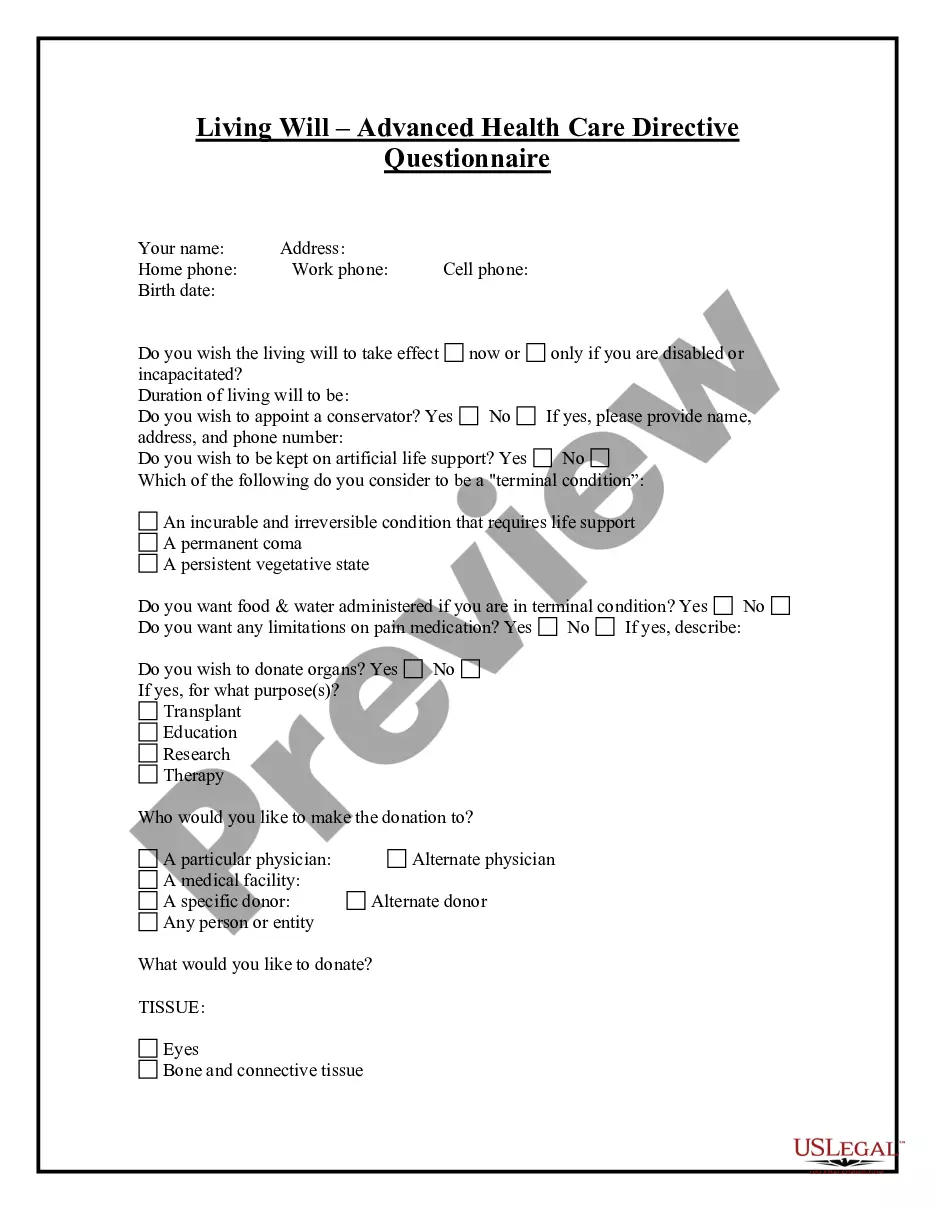
Uniform Do Not Resuscitate Advance Directive - DNR
STATUTORY REFERENCE
ALL REFERENCES ARE TO THE ILLINOIS COMPILED STATUTES
DECLARATION (LIVING WILL)
(§§ 755 ILCS 35/1 through 755 ILCS 35/9)
755 ILCS 35/1: Purpose. The legislature finds that persons
have the fundamental right to control the decisions relating to the rendering
of their own medical care, including the decision to have death delaying
procedures withheld or withdrawn in instances of a terminal condition.
In order that the rights of patients may be respected even after
they are no longer able to participate actively in decisions
about themselves, the legislature hereby declares that the laws of
this State shall recognize the right of a person to make a written declaration
instructing his or her physician to withhold or withdraw death delaying
procedures in the event of a terminal condition.
755 ILCS 35/2: Definitions:
(a) "Attending physician" means the
physician selected by, or assigned to, the patient who has primary
responsibility for the treatment and care of the patient.
(b) "Declaration" means a witnessed document in writing, voluntarily
executed by the declarant in accordance with the requirements of
Section 3.
(c) "Health-care provider" means a person who is
licensed, certified or otherwise authorized by the law of this State to
administer health care in the ordinary course of business or practice
of a profession.
(d) "Death delaying procedure" means any medical
procedure or intervention which, when applied to a qualified patient, in
the judgment of the attending physician would serve only to postpone
the moment of death. In appropriate circumstances, such procedures
include, but are not limited to, assisted ventilation, artificial kidney
treatments, intravenous feeding or medication, blood transfusions,
tube feeding and other procedures of greater or lesser magnitude that serve
only to delay death. However, this Act does not affect the responsibility
of the attending physician or other health care provider to provide treatment
for a patient's comfort care or alleviation of pain. Nutrition and
hydration shall not be withdrawn or withheld from a
qualified patient if the withdrawal or withholding would result
in death solely from dehydration or starvation rather than from the existing
terminal condition.
(e) "Person" means an individual,
corporation, business trust, estate, trust, partnership, association, government,
governmental subdivision or agency, or any other legal entity.
(f)
"Physician" means a person licensed to practice medicine in all its branches.
(g) "Qualified patient" means a patient who has executed a declaration
in accordance with this Act and who has been diagnosed and verified in
writing to be afflicted with a terminal condition by his or her attending
physician who has personally examined the patient. A qualified patient
has the right to make decisions regarding death delaying procedures as
long as he or she is able to do so.
(h) "Terminal condition" means
an incurable and irreversible condition which is such that death is imminent
and the application of death delaying procedures serves only to prolong
the dying process. (Source: P.A. 85-860.)
755 ILCS 35/3: Execution of a Document.
(a) An individual
of sound mind and having reached the age of majority or having obtained
the status of an emancipated person pursuant to the "Emancipation
of Mature Minors Act", as now or hereafter amended, may execute a
document directing that if he is suffering from a terminal condition,
then death delaying procedures shall not be utilized for the prolongation
of his life.
(b) The declaration must be signed by the declarant,
or another at
the declarant's direction, and witnessed by 2 individuals 18 years
of age or older.
(c) The declaration of a qualified patient diagnosed
as pregnant by the attending physician shall be given no force and effect
as long as in the opinion of the attending physician it is possible that
the fetus
could develop to the point of live birth with the continued
application of death delaying procedures.
(d) If the patient is able, it shall be the responsibility of the
patient to provide for notification to his or her attending physician of
the existence of a declaration, to provide the declaration to the
physician and to ask the attending physician whether he or she
is willing to comply with its provisions. An attending physician who is
so notified shall make the declaration, or copy of the declaration, a part
of the patient's medical records. If the physician is at any time unwilling
to comply with its provisions, the physician shall promptly so advise the
declarant. If the physician is unwilling to comply with its provisions
and the patient is able, it is the patient's responsibility
to initiate the transfer to another physician of the patient's
choosing. If the physician is unwilling to comply with its provisions
and the patient is at any time not able to initiate the transfer, then
the attending physician shall without delay notify the person with the
highest priority, as set forth in this subsection, who is available, able,
and willing to make arrangements for the transfer of the patient
and the appropriate medical records to another physician for the effectuation
of the patient's declaration. The order of priority is as follows:
(1) any person authorized by the patient to make such arrangements,
(2) a guardian of the person of the patient, without the necessity of obtaining
a court order to do so, and
(3) any member of the patient's family.
(e) The declaration may, but need not, be in the following form, and in
addition may include other specific directions. Should any
specific direction be determined to be invalid, such invalidity
shall not affect other directions of the declaration which can be given
effect without the invalid direction, and to this end the directions in
the declaration are severable.
755 ILCS 35/4: Recording of a Terminal Condition. Upon determining
that the declarant has a terminal condition, the attending physician who
knows of a declaration shall record the determination and the terms
of the declaration in the declarant's medical record. A physician
who records in writing a terminal condition under this Section is presumed
to be acting in good faith. Unless it is alleged and proved that
his action violated the standard of reasonable professional care and judgment
under the circumstances, he is immune from civil or criminal liability
that otherwise might be incurred.
755 ILCS 35/5: Revocation.
(a) A declaration may be revoked
at any time by the declarant, without regard to declarant's mental
or physical condition, by any of the following methods:
(1) By being
obliterated, burnt, torn or otherwise destroyed or defaced in a manner
indicating intention to cancel;
(2) By a written revocation of the declaration signed and dated
by the declarant or person acting at the direction of the declarant; or
(3) By a oral or any other expression of the intent to revoke
the
declaration, in the presence of a witness 18 years of age or older
who signs and dates a writing confirming that such expression of intent
was made.
(b) A revocation is effective upon communication to the
attending physician by the declarant or by another who witnessed the revocation.
The attending physician shall record in the patient's medical record the
time and date when and the place where he or she received notification
of the revocation.
(c) There shall be no criminal or civil liability
on the part of any person for failure to act upon a revocation made
pursuant to this Section unless that person has actual knowledge of the
revocation.
755 ILCS 35/6: Physician Responsibilities. An attending physician
who has been notified of the existence of a declaration executed under
this Act, without delay after the diagnosis of a terminal condition of
the patient, shall take the necessary steps to provide for written recording
of the patient's terminal condition, so that the patient may be deemed
to be a qualified patient under this Act, or shall notify the patient or,
if the patient is unable to initiate a transfer, the person or
persons described in subsection (d) of Section 3 in the order of
priority stated therein that the physician is unwilling to comply with
the provisions of the patient's declaration.
(755 ILCS 35/7)
Sec. 7. Immunity. The desires of
a qualified patient shall at all times supersede the effect of the
declaration. A physician or other health-care
provider may presume, in the absence of knowledge to the contrary,
that a declaration complies with this Act and is valid.
No physician, health care provider or employee thereof who in good
faith and pursuant to reasonable medical standards causes or
participates in the withholding or withdrawing of death delaying procedures
from a qualified patient pursuant to a declaration which purports to have
been made in accordance with this Act shall as a result thereof, be subject
to criminal or civil liability, or be found to have committed an act of
unprofessional conduct.
755 ILCS 35/8:
(a) Any person who willfully conceals, cancels, defaces,
obliterates, or damages the declaration of another without such declarant's
consent or who falsifies or forges a revocation of
the declaration of another or who willfully fails to comply with
Section 6 shall be civilly liable.
(b) Any person who coerces or fraudulently induces another to execute
a declaration or falsifies or forges the declaration of another, or willfully
conceals or withholds personal knowledge of a revocation as provided in
Section 5 with the intent to cause a withholding or withdrawal of death
delaying procedures contrary to the wishes of the qualified patient and
thereby, because of such act, directly causes death delaying procedures
to be withheld or withdrawn and death to another thereby be hastened,
shall be subject to prosecution for involuntary manslaughter.
(c) A physician
or other health-care provider who willfully fails to notify the health
care facility or fails to comply with Section 6 is guilty of engaging in
unethical and unprofessional conduct in violation of paragraph (A)(5) of
Section 22 of the Medical Practice Act of 1987.
(d) A physician
who willfully fails to record the determination of terminal condition in
accordance with Section 4, without giving the
notice required by Section 6 of his unwillingness to comply with
the provisions of the patient's declaration, is guilty of willfully omitting
to file or record medical reports as required by law in
violation of paragraph (A)(22) of Section 22 of the Medical Practice Act
of 1987.
(e) A person who requires or prohibits the execution
of a declaration as a condition for being
insured for, or receiving, health-care services is guilty of
a class A misdemeanor.
(f) The penalties provided in this Section
do not displace any penalty applicable under other law.
755 ILCS 35/9: General provisions.
(a) The withholding or
withdrawal of death delaying procedures from a qualified patient
in accordance with the provisions of this Act shall not, for any
purpose, constitute a suicide.
(b) The making of a declaration
pursuant to Section 3 shall not affect in any manner the sale, procurement,
or issuance of any policy of life insurance, nor shall it be deemed to
modify the terms of an existing policy of life insurance. No policy
of life insurance shall be legally impaired or invalidated in any manner
by the withholding or withdrawal of death delaying procedures from
an insured qualified patient, notwithstanding any term of the policy to
the contrary.
(c) No physician, health care facility, or other
health care provider, and no health care service plan, health
maintenance organization, insurer issuing disability insurance, self-insured
employee
welfare benefit plan, non-profit medical service corporation or
mutual nonprofit hospital service corporation shall require any person
to execute a declaration as a condition for being insured for, or
receiving, health care services.
(d) Nothing in this Act
shall impair or supersede any legal right
or legal responsibility which any person may have to effect the
withholding or withdrawal of death delaying procedures in any lawful manner.
In such respect the provisions of this Act are cumulative.
(e) This Act shall create no presumption concerning the intention
of an individual who has not executed a declaration to consent to the use
or withholding of death delaying procedures in the event of a terminal
condition.
(f) Nothing in this Act shall be construed to condone,
authorize or
approve mercy killing or to permit any affirmative or deliberate
act or omission to end life other than to permit the natural process of
dying as provided in this Act.
(g) An instrument executed before
the effective date of this Act that substantially complies with paragraph
(e) of Section 3 shall be given effect pursuant to the provisions of this
Act.
(h) A declaration executed in another state in compliance with
the law of that state or this State is validly executed for purposes of
this Act, and such declaration shall be applied in accordance with the
provisions of this Act.
Note: All Information and Previews are subject to the Disclaimer
located on the main forms page, and also linked at the bottom
of all search results.