Illinois Notice of Hearing
Understanding this form
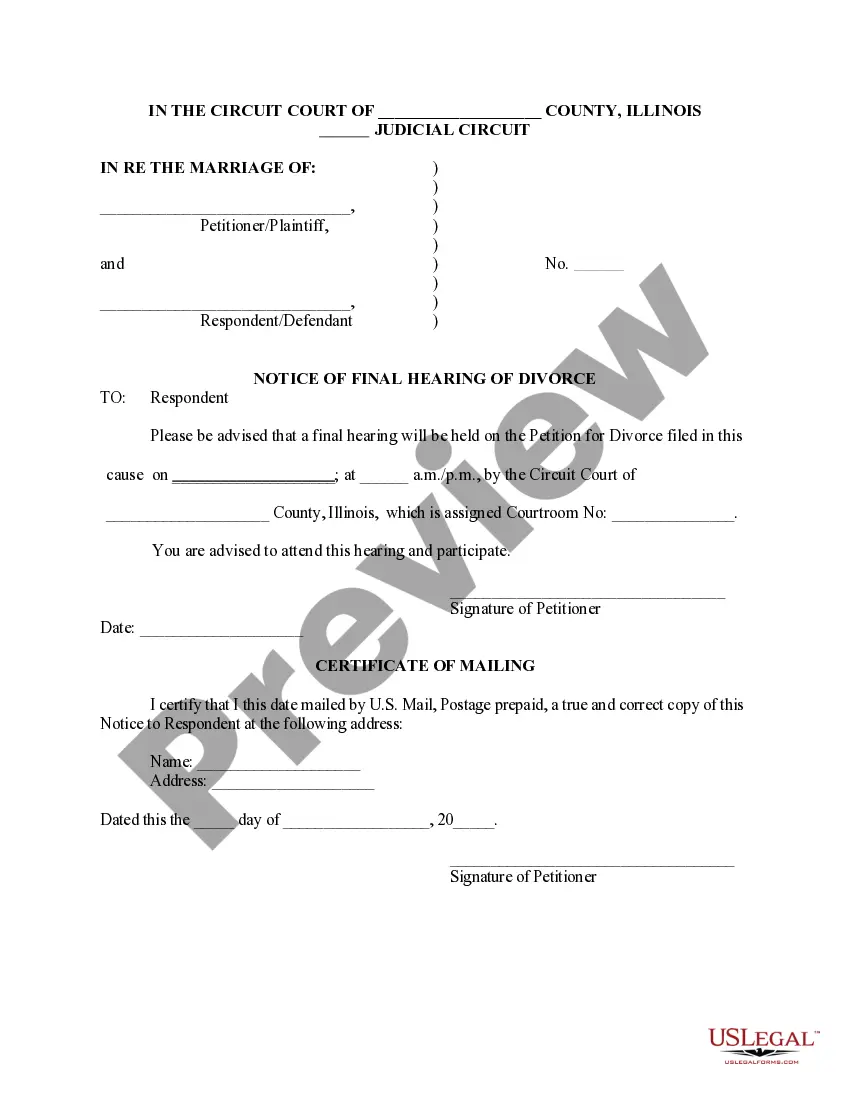
The Notice of Hearing is a legal document that informs both spouses about the scheduled Final Hearing date and time for a divorce case. This essential form ensures that both parties are aware of when they need to attend court to discuss the matters related to their divorce. Unlike similar forms, this document focuses specifically on notifying parties about court hearings rather than other procedural aspects of divorce.
Key parts of this document
- Identification of the judicial circuit and parties involved.
- Date and time of the final hearing.
- Location of the court and assigned courtroom number.
- Signature line for the petitioner, indicating acknowledgment of the notice.
- Certificate of mailing to confirm that the notice was delivered to the respondent.
Common use cases
You should use the Notice of Hearing when you have filed a Petition for Divorce and need to notify your spouse about the scheduled final hearing in your divorce case. This form is necessary to ensure both parties are informed and can attend court on the designated date to resolve any outstanding issues related to the divorce.
Who should use this form
This form is intended for:
- Individuals who are petitioning for divorce.
- Respondents in a divorce case who need notification of the final hearing date.
- Legal representatives handling divorce cases on behalf of clients.
How to complete this form
- Identify the judicial circuit and fill in the names of the petitioner and respondent.
- Enter the date and time of the hearing.
- Specify the location of the hearing, including the courtroom number.
- Sign and date the form as the petitioner.
- Complete the certificate of mailing by entering the respondent's address and signing it.
Does this document require notarization?
This form does not typically require notarization to be legally valid. However, some jurisdictions or document types may still require it. US Legal Forms provides secure online notarization powered by Notarize, available 24/7 for added convenience.
Get your form ready online
Our built-in tools help you complete, sign, share, and store your documents in one place.
Make edits, fill in missing information, and update formatting in US Legal Forms—just like you would in MS Word.
Download a copy, print it, send it by email, or mail it via USPS—whatever works best for your next step.
Sign and collect signatures with our SignNow integration. Send to multiple recipients, set reminders, and more. Go Premium to unlock E-Sign.
If this form requires notarization, complete it online through a secure video call—no need to meet a notary in person or wait for an appointment.
We protect your documents and personal data by following strict security and privacy standards.

Make edits, fill in missing information, and update formatting in US Legal Forms—just like you would in MS Word.

Download a copy, print it, send it by email, or mail it via USPS—whatever works best for your next step.

Sign and collect signatures with our SignNow integration. Send to multiple recipients, set reminders, and more. Go Premium to unlock E-Sign.

If this form requires notarization, complete it online through a secure video call—no need to meet a notary in person or wait for an appointment.

We protect your documents and personal data by following strict security and privacy standards.
Common mistakes
- Failing to include the correct date and time of the hearing.
- Leaving out the courtroom number or location details.
- Not signing the document before mailing it.
- Failing to send a copy to the respondent within the required timeframe.
Why use this form online
- Convenient access to the form from anywhere.
- Easy customization and editing to fit your needs.
- Instant downloading in Word or rich text formats for flexibility.
- Reliability from templates created by licensed attorneys.
Looking for another form?

Form popularity
FAQ
Ask the court for a motion date. Identify and fill out your motion forms. Serve and file your motion forms. Confirm that you will attend the motion. Go to your motion hearing. Receive the judge's decision.
Know the Rules. Know Your Judge. Know Your Opponent. Write Effectively. Prepare for Oral Argument. Practice! Make Your Oral Argument Count.
Step 1: File your Answer/Response to Complaint/Petition with the Circuit Clerk in the county where the court case is filed. you can use to e-file your form. Step 2: Send a copy of your Answer/Response to Complaint/Petition to the other parties.
A motion is an application to the court made by the prosecutor or defense attorney, requesting that the court make a decision on a certain issue before the trial begins.
The motion must include a separate "Notice of Motion" which includes a brief summary of the nature of the motion, the deadline for filing a response, and if there is a hearing, the date, time, and location of the hearing.
An emergency motion must state exactly why it is an emergency. The emergency nature of the motion must be described by the party in a signed affidavit that is attached to the emergency motion. The first thing a judge will do before hearing an emergency motion is decide whether it is an emergency or not.
Fill out the forms. You have to fill out at least 2 forms, maybe more, to file your opposition. File the forms. Turn in your completed forms by mail or efiling. Serve the other party. Get ready for the hearing. Prepare an order.