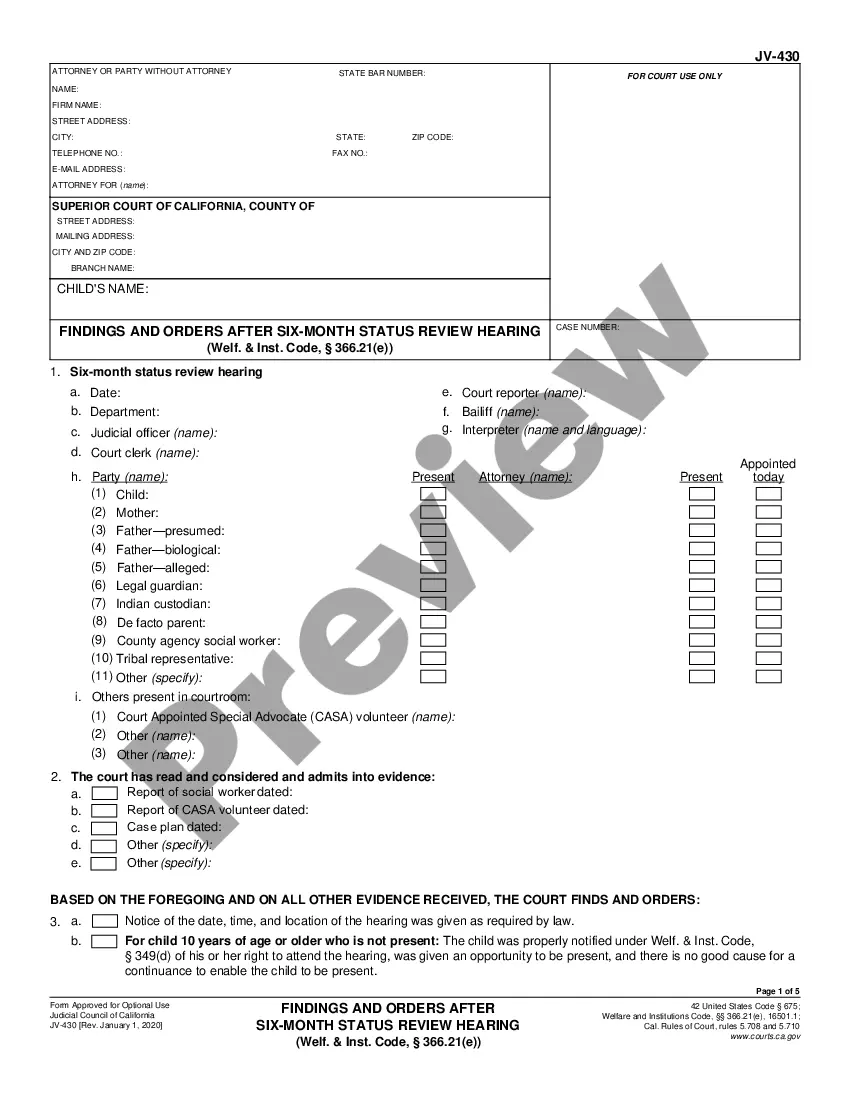
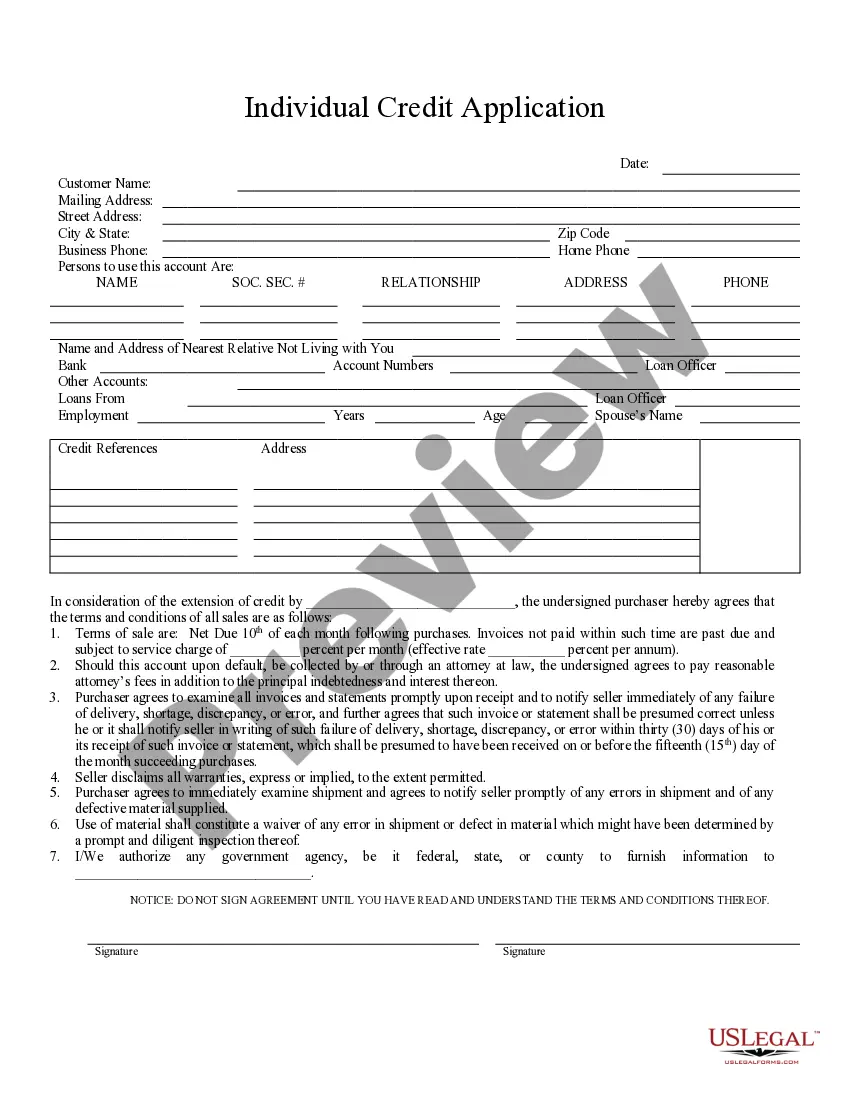
Illinois Individual Credit Application
Overview of this form
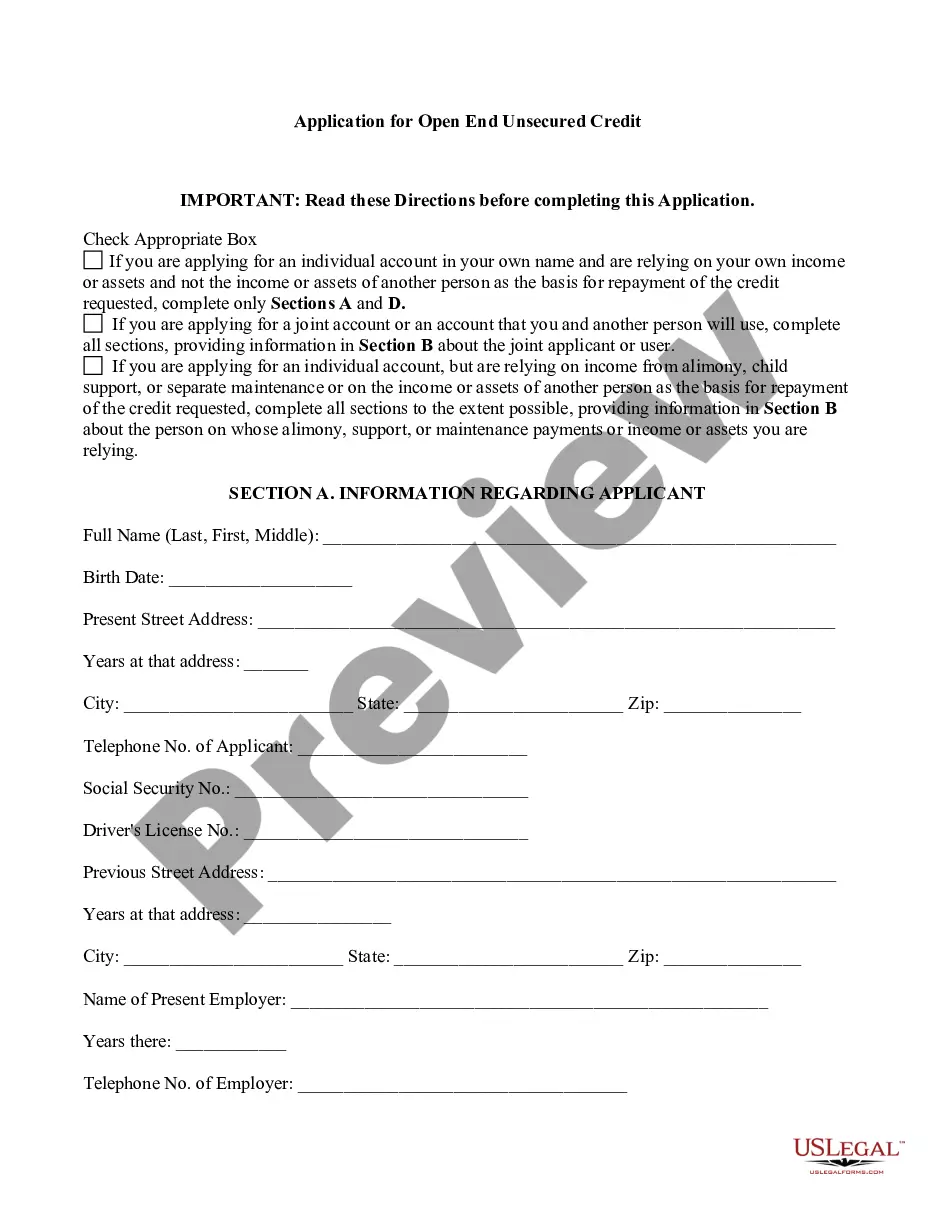
The Individual Credit Application is a legal document used by individuals seeking credit for purchases. It outlines the terms of payment, interest rates, default provisions, and the sellerâs right to access personal information if required. This form is essential for establishing a clear agreement between the purchaser and the seller, differentiating it from other credit applications by its specific focus on individual consumers rather than businesses or commercial entities.
What’s included in this form
- Buyerâs identification: Includes fields for the purchaser's name and contact information.
- Terms of sale: Specifies payment due dates and potential service charges for late payments.
- Default provisions: Outlines the steps and fees involved if payments are defaulted.
- Warranties disclaimer: Indicates the seller does not provide warranties for goods sold.
- Authorization for personal information: Grants the seller permission to obtain personal information from government agencies.
- Signature section: Requires the purchaserâs signature to validate the agreement.
Common use cases
This form should be used when an individual is applying for credit to purchase goods or services. It is applicable in scenarios such as a consumer buying expensive items on credit, applying for a loan for personal purchases, or establishing a new credit account with a seller requiring a formal application. Using this form creates a legal framework for both the buyer and seller in case of disputes.
Who can use this document
- Consumers seeking to finance a large purchase.
- Sellers providing credit or installment plans for their products.
- Individuals who want to formalize the terms of their credit arrangements.
- Business owners looking to extend credit to individual customers.
How to complete this form
- Identify the parties: Enter the full name and contact details of the purchaser and seller.
- Specify the terms of sale: Fill out the payment due date and any applicable service charges.
- Review default provisions: Make sure you understand the consequences of late payments and fees.
- Sign the document: The purchaser must sign and date the application to acknowledge the terms.
- Submit the application: Provide the completed form to the seller for processing.
Notarization requirements for this form
This form does not typically require notarization unless specified by local law. It is recommended to check with a legal advisor for your specific jurisdiction's requirements.
Get your form ready online
Our built-in tools help you complete, sign, share, and store your documents in one place.
Make edits, fill in missing information, and update formatting in US Legal Forms—just like you would in MS Word.
Download a copy, print it, send it by email, or mail it via USPS—whatever works best for your next step.
Sign and collect signatures with our SignNow integration. Send to multiple recipients, set reminders, and more. Go Premium to unlock E-Sign.
If this form requires notarization, complete it online through a secure video call—no need to meet a notary in person or wait for an appointment.
We protect your documents and personal data by following strict security and privacy standards.

Make edits, fill in missing information, and update formatting in US Legal Forms—just like you would in MS Word.

Download a copy, print it, send it by email, or mail it via USPS—whatever works best for your next step.

Sign and collect signatures with our SignNow integration. Send to multiple recipients, set reminders, and more. Go Premium to unlock E-Sign.

If this form requires notarization, complete it online through a secure video call—no need to meet a notary in person or wait for an appointment.

We protect your documents and personal data by following strict security and privacy standards.
Common mistakes
- Failing to read and understand the terms before signing.
- Leaving blank spaces in the form, which can lead to disputes later.
- Not notifying the seller within the specified time if there are discrepancies.
- Inaccurate information provided about personal details or financial status.
Why complete this form online
- Convenience of downloading and completing the form at your own pace.
- Editability allows for easy corrections without the need for reprinting.
- Reliable source with templates drafted by licensed attorneys for legality.
- Immediate access eliminates the wait time for receiving forms through traditional methods.
Quick recap
- The Individual Credit Application is essential for defining credit terms between the purchaser and seller.
- It is critical to review and understand all provisions before signing the form.
- Always ensure that personal information is accurate to avoid any issues in processing the application.
Looking for another form?



Form popularity
FAQ
To qualify for the earned income credit: You must file as single or married filing jointly.You cannot earn over a certain amount of investment income for the year. For 2019 this amount is $3,600, for 2020 the amount is $3,650.
No, Illinois does not have a renter's credit.
For tax years beginning January 1, 2020, it is $2,325 per exemption. If someone else can claim you as a dependent and your Illinois base income is $2,325 or less, your exemption allowance is $2,325. If income is greater than $2,325, your exemption allowance is 0.
No, there are no circumstances where you can deduct rent payments on your tax return.Deducting rent on taxes is not permitted by the IRS. However, if you use the property for your trade or business, you may be able to deduct a portion of the rent from your taxes.
Must have a Social Security number that is valid for employment. Must have earned income from wages or running a business or a farm. May have some investment income. Generally must be a U.S. citizen or resident alien all year.
If you live in private rented accommodation and pay income tax, you may be eligible for tax relief on part of your rent.
Do I qualify for the Illinois EITC/EIC? In general, if you qualified for a federal Earned Income Tax Credit, you also qualify for the Illinois EITC/EIC. Federally, you qualify for EITC/EIC if: you have earned income and adjusted gross income within certain limits; AND.
As far as I know, the states that have anything for rent are Vermont, Michigan, Maine,Maryland, Massachusetts, Minnesota, Missouri, New Jersey, Rhode Island, California, Hawaii, Indiana, Iowa, Arizona, Wisconsin, and Connecticut.
If you have a qualifying child, you must file the Schedule EIC listing the children with either the Form 1040A or the Form 1040. If you do not have a qualifying child, you can use the Form 1040EZ.