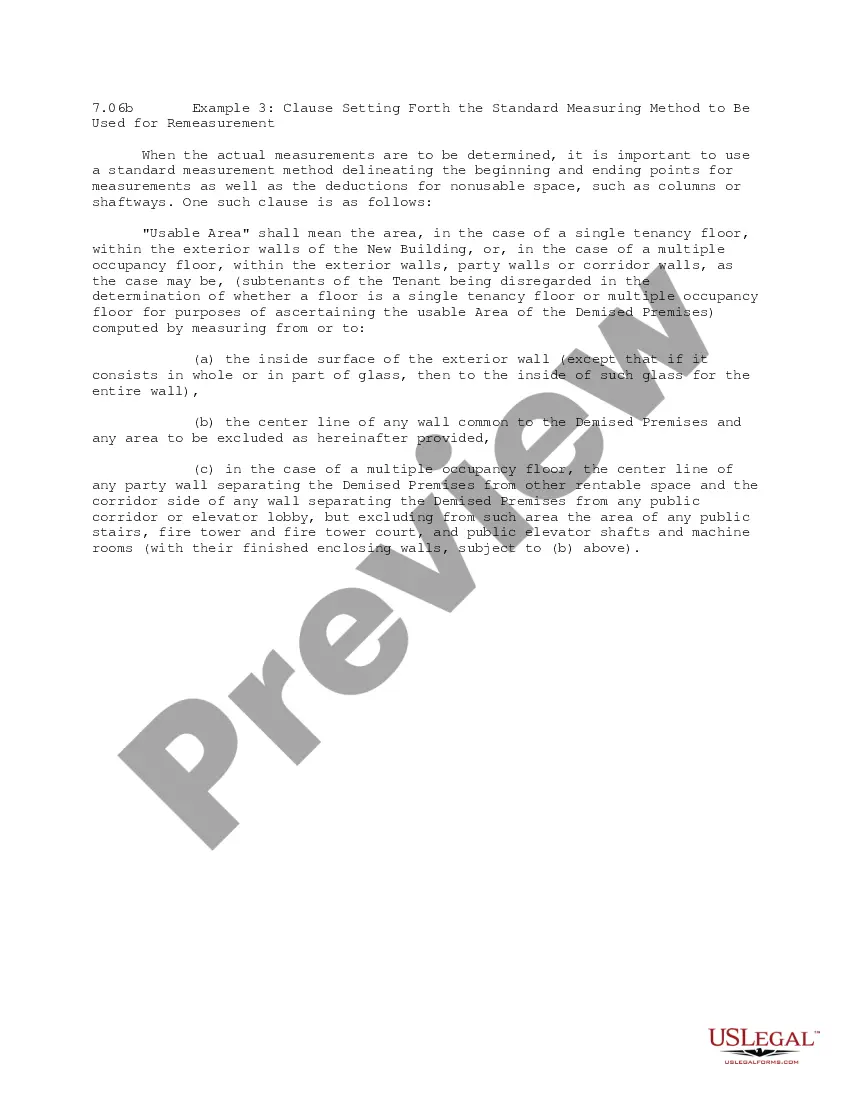
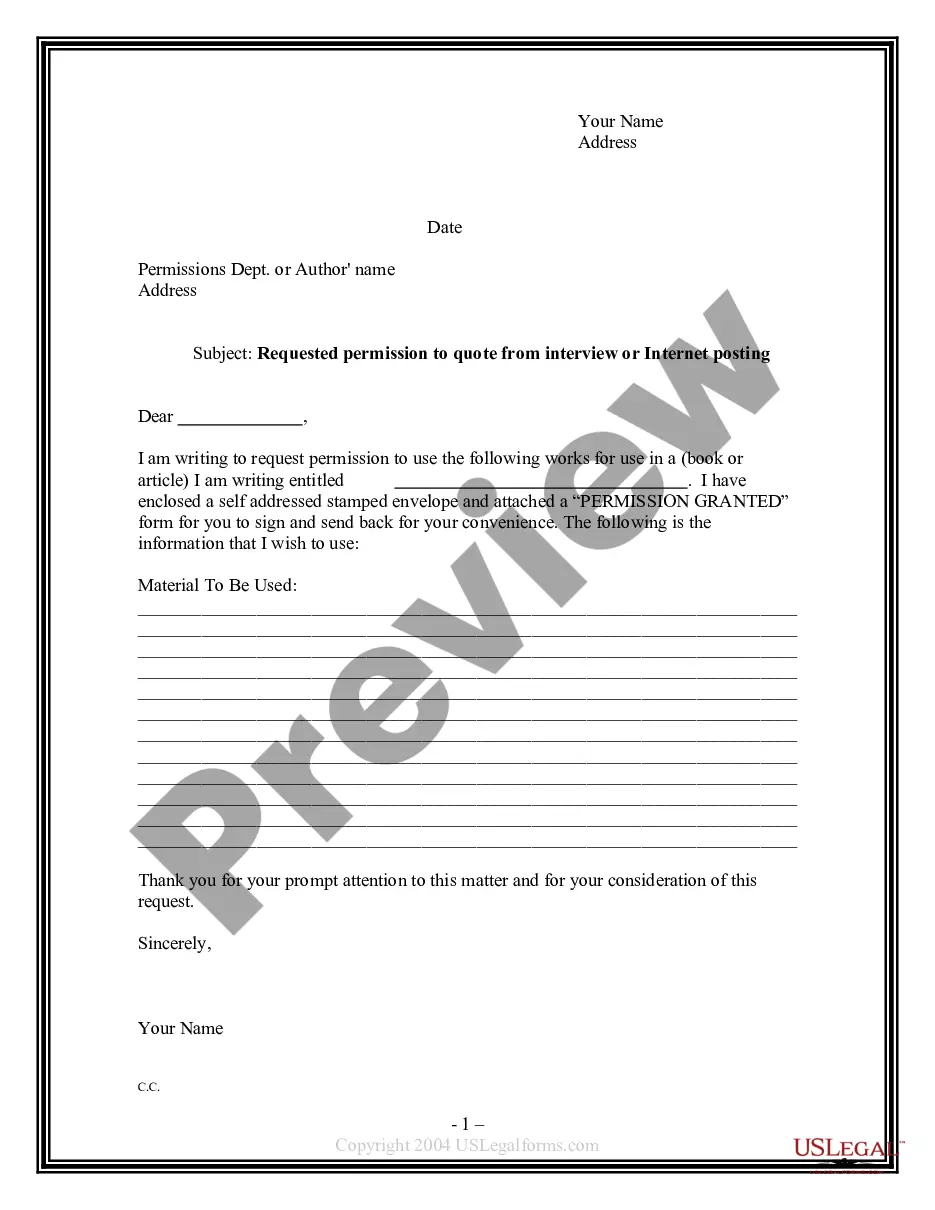
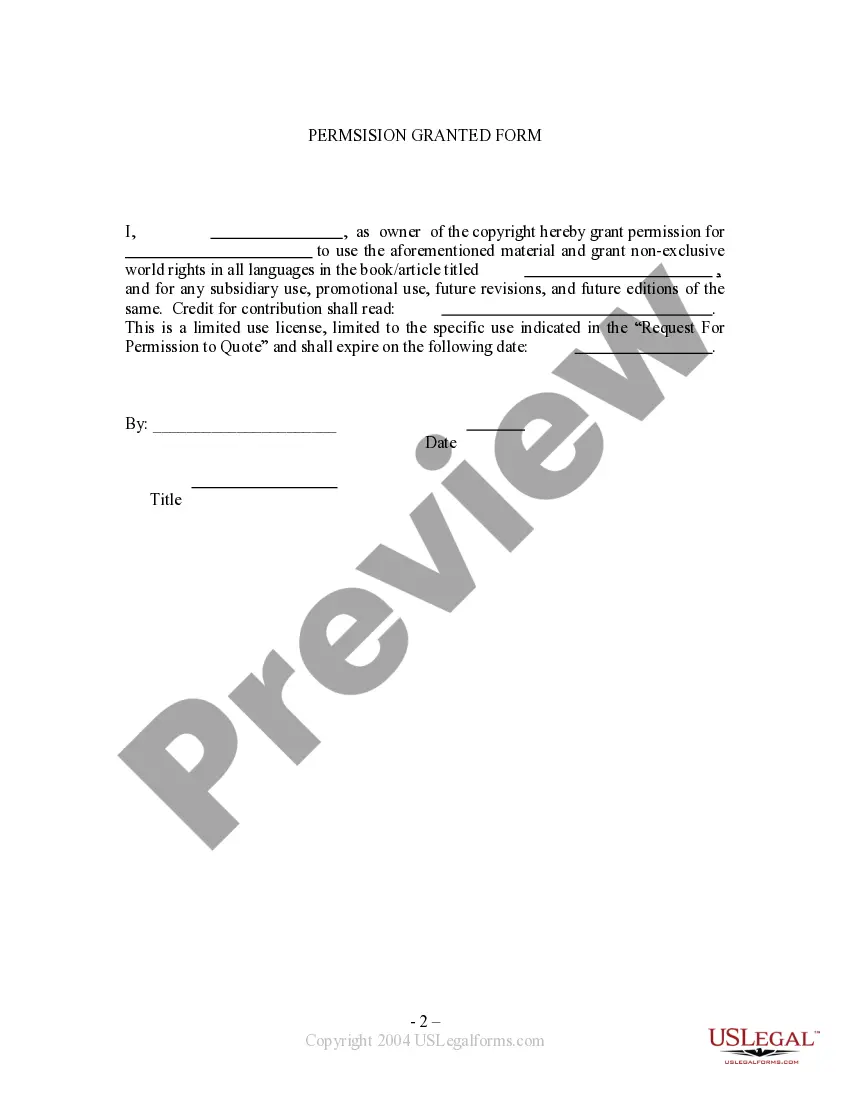
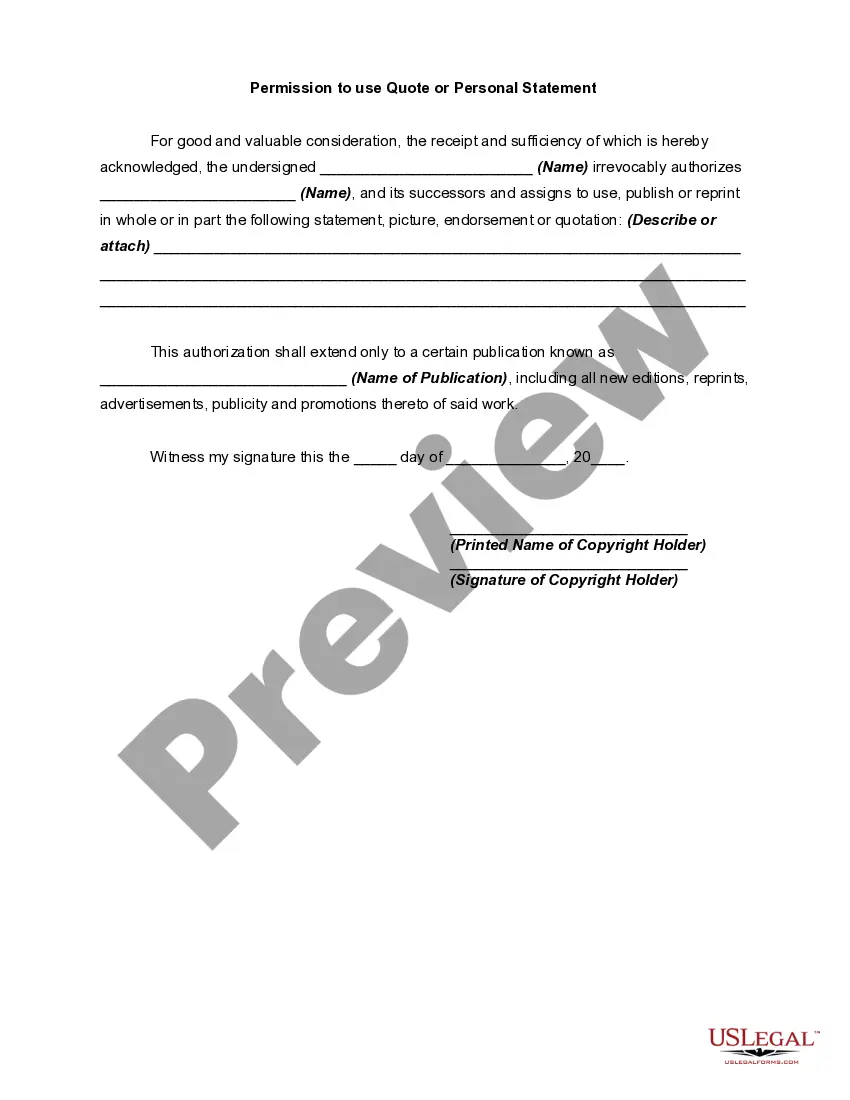
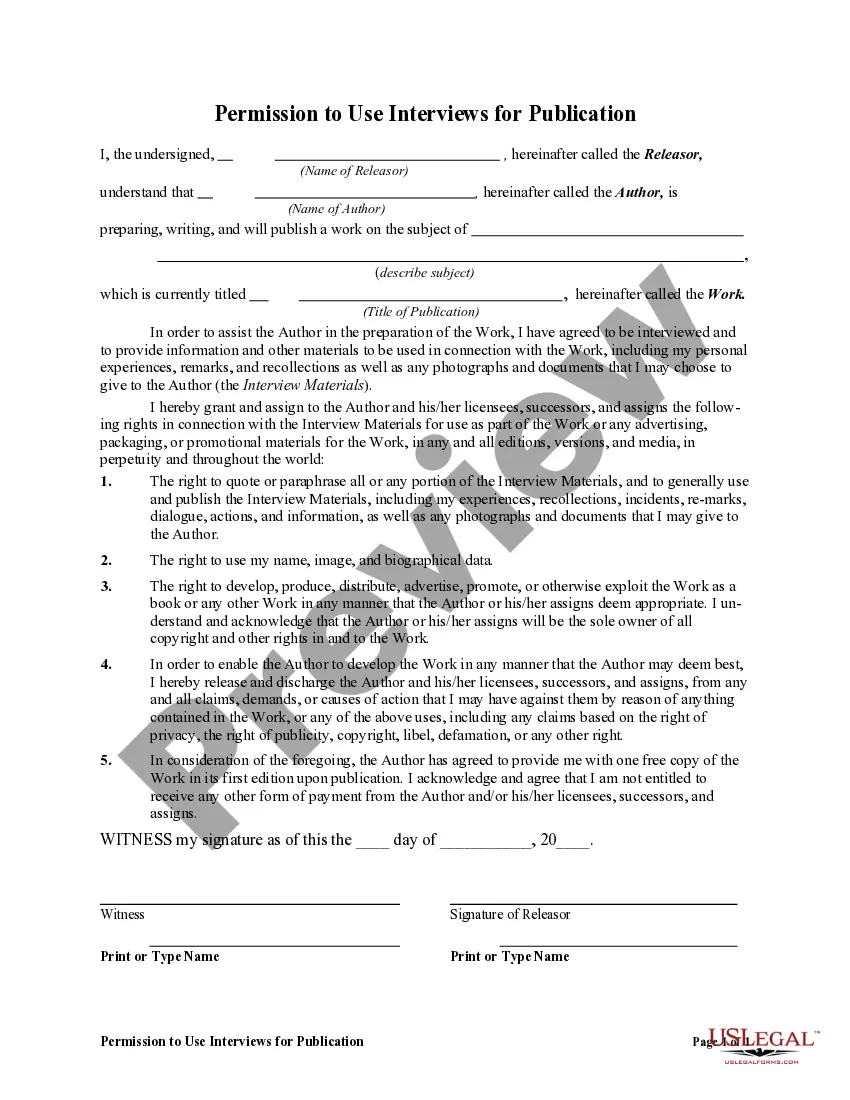
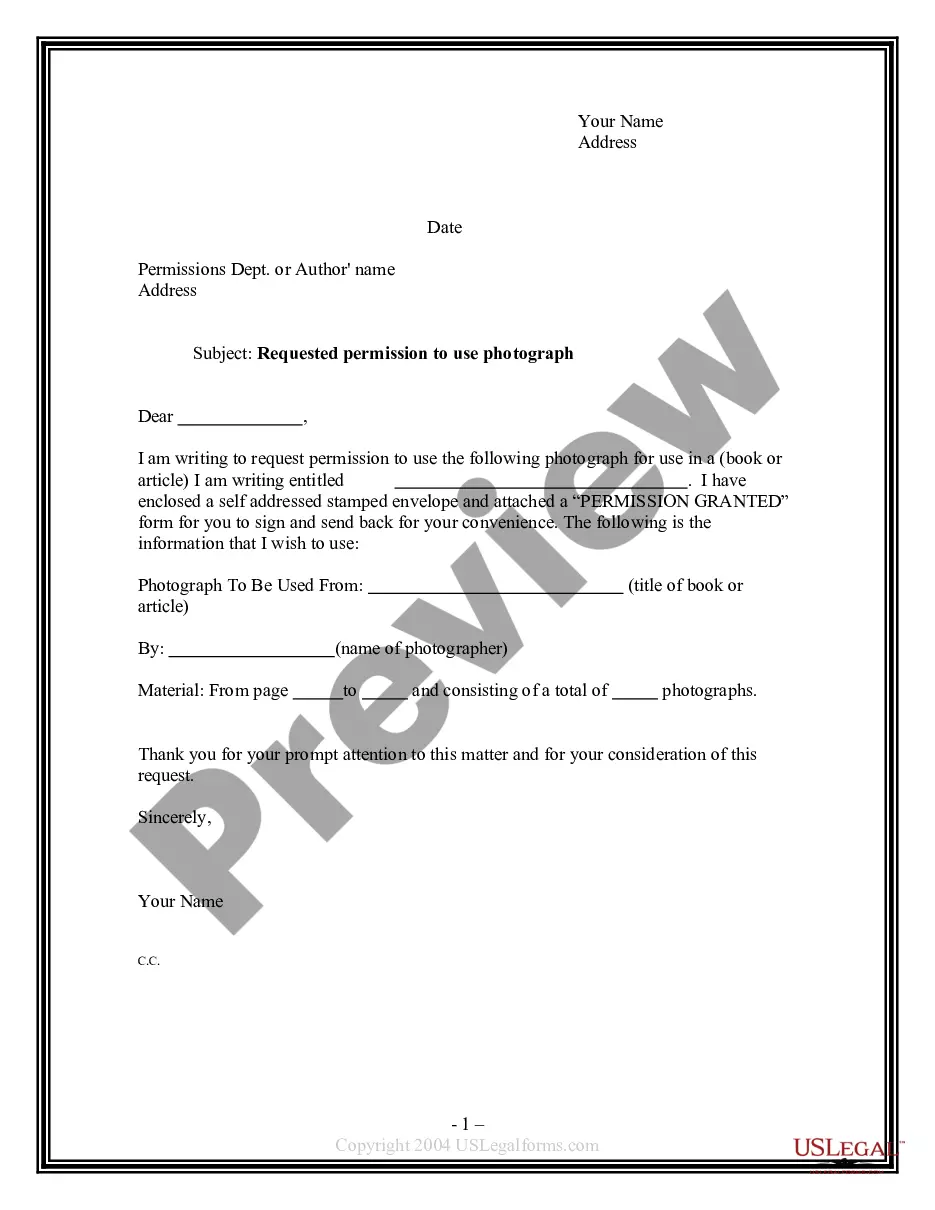
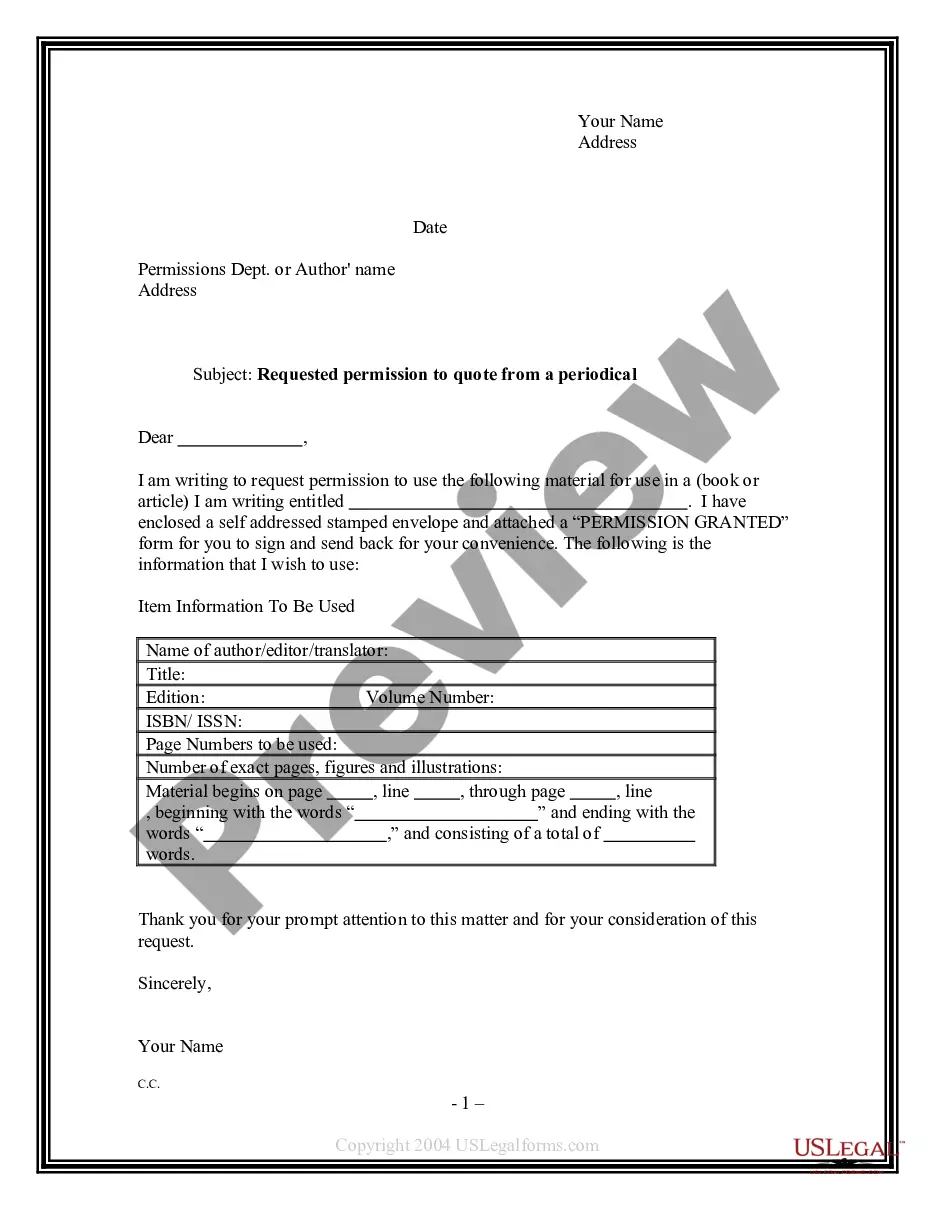
This is a request to the holder of a copyright asking permission to use the copyrighted material in a book or article. There is an attached addendum for the copyright holder to sign granting permission. The request can be granted for only a fixed period of time if the copyright holder does not want to grant the request to be used indefinitely.
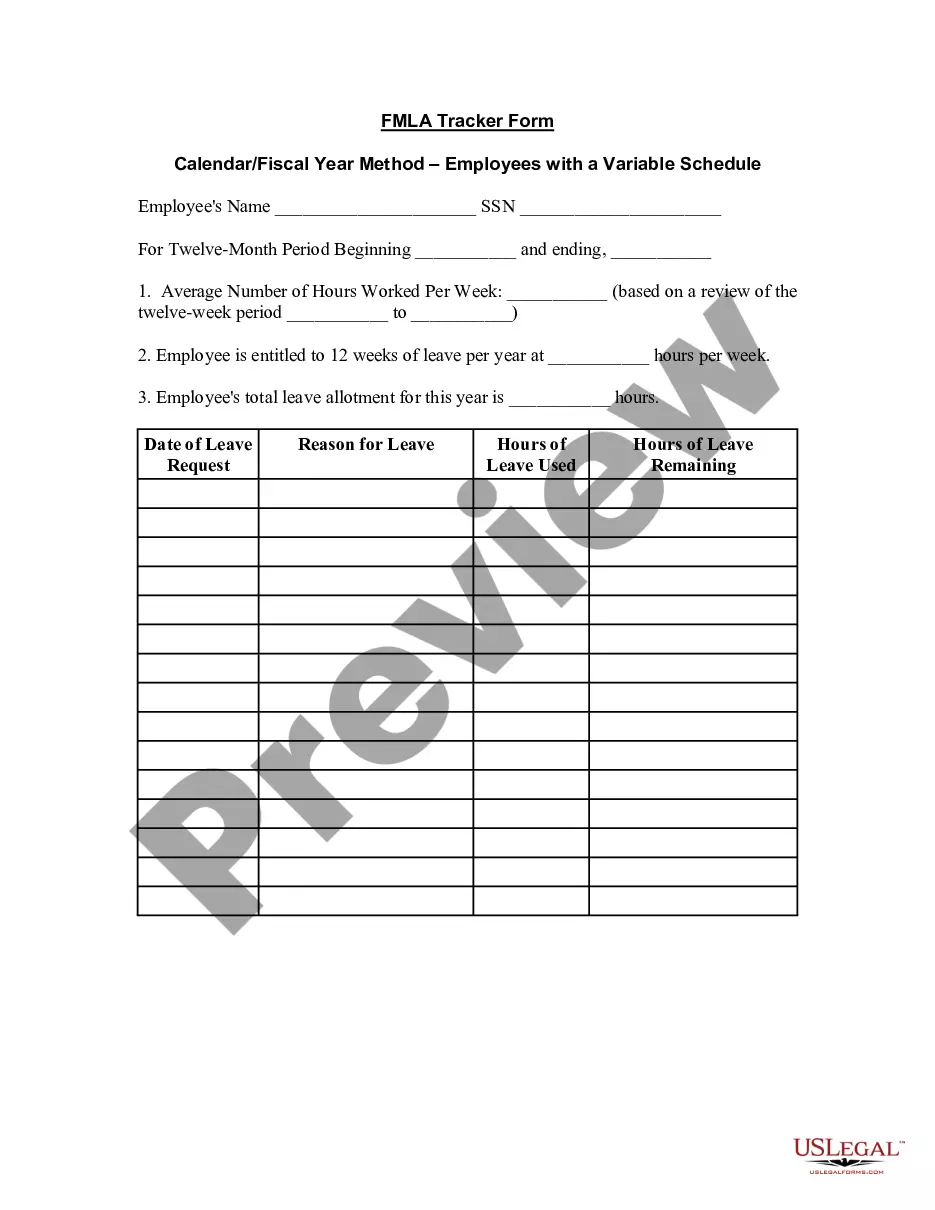
Florida Requested Permission to Quote From Interview or Internet Posting
Category:
State:
Multi-State
Control #:
US-PRM-06
Format:
Word;
Rich Text
Instant download
Description
Free preview

Get your form ready online
Our built-in tools help you complete, sign, share, and store your documents in one place.
Built-in online Word editor
Make edits, fill in missing information, and update formatting in US Legal Forms—just like you would in MS Word.
Export easily
Download a copy, print it, send it by email, or mail it via USPS—whatever works best for your next step.
E-sign your document
Sign and collect signatures with our SignNow integration. Send to multiple recipients, set reminders, and more. Go Premium to unlock E-Sign.
Notarize online 24/7
If this form requires notarization, complete it online through a secure video call—no need to meet a notary in person or wait for an appointment.
Store your document securely
We protect your documents and personal data by following strict security and privacy standards.

Make edits, fill in missing information, and update formatting in US Legal Forms—just like you would in MS Word.

Download a copy, print it, send it by email, or mail it via USPS—whatever works best for your next step.

Sign and collect signatures with our SignNow integration. Send to multiple recipients, set reminders, and more. Go Premium to unlock E-Sign.

If this form requires notarization, complete it online through a secure video call—no need to meet a notary in person or wait for an appointment.

We protect your documents and personal data by following strict security and privacy standards.
Looking for another form?


How to fill out Requested Permission To Quote From Interview Or Internet Posting?
You can spend hours online searching for the legal document template that meets the federal and state requirements you need. US Legal Forms offers a vast array of legal forms that can be reviewed by experts. You can obtain or print the Florida Requested Permission to Quote From Interview or Internet Posting through my service.
If you already have a US Legal Forms account, you can Log In and click the Acquire button. After that, you can complete, modify, print, or sign the Florida Requested Permission to Quote From Interview or Internet Posting. Each legal document template you obtain is yours permanently. To get an additional copy of a purchased form, go to the My documents section and click the corresponding button.
If you are using the US Legal Forms website for the first time, follow the simple instructions below: First, ensure that you have selected the correct document template for your county/area of choice. Review the form summary to confirm you have chosen the right form. If available, utilize the Preview button to view the document template as well. If you wish to find another version of your form, use the Search field to locate the template that suits your needs and requirements. Once you have identified the template you want, simply click Get now to proceed. Choose the pricing plan you prefer, enter your details, and create an account on US Legal Forms. Complete the transaction. You can use your credit card or PayPal account to pay for the legal form. Select the format of your document and download it to your device. Make modifications to your document if necessary. You can complete, modify, sign, and print the Florida Requested Permission to Quote From Interview or Internet Posting. Download and print a vast number of document templates using the US Legal Forms website, which offers the largest selection of legal forms. Use professional and state-specific templates to address your business or personal needs.
Form popularity
FAQ
To get permission to use a quote, directly approach the original author or the publisher of the content. Clearly explain how you intend to use the quote, including any specific details on your publication or project. This helps in building trust and increases the likelihood of obtaining permission. For more guidance, consider exploring the resources available on the US Legal Forms platform, which can assist you in understanding the Florida Requested Permission to Quote From Interview or Internet Posting.
Yes, you typically need permission to publish an interview. This ensures that you respect the interviewee's rights and intentions regarding their words. It's wise to obtain consent in writing, especially if you plan to distribute the interview widely. Familiarizing yourself with the Florida Requested Permission to Quote From Interview or Internet Posting can provide clarity on what is required.
To ask for permission to use content, start by identifying the content owner. Reach out through email or a direct message, clearly stating your intent to use their material. Include details such as how you plan to use it and the context in which it will appear. Remember, when dealing with content, understanding the Florida Requested Permission to Quote From Interview or Internet Posting guidelines can help streamline the process.
Generally, you do not need permission to cite sources in academic or non-commercial contexts, but it’s best practice to give credit. However, the Florida Requested Permission to Quote From Interview or Internet Posting suggests that for extensive quotes or commercial use, permission is advisable. Citing sources correctly helps uphold credibility and respect for the original authors. If you're navigating these complexities, US Legal Forms provides useful templates and guidance to ensure compliance.
Quoting people without their permission can lead to legal issues, particularly if the quotes are used for commercial purposes. The Florida Requested Permission to Quote From Interview or Internet Posting highlights the need to seek consent to avoid potential copyright infringements. While some exceptions may apply under fair use, it’s safer to secure permission. Using resources like US Legal Forms can help clarify your rights and responsibilities in these situations.
Yes, you typically need to get permission to use quotes, especially if they come from interviews or internet postings. The concept of Florida Requested Permission to Quote From Interview or Internet Posting emphasizes the importance of respecting intellectual property rights. Obtaining permission not only protects you legally but also maintains a good relationship with the original source. If you're unsure, consider using platforms like US Legal Forms to guide you through the process.
Yes, you often need copyright permission for quotes, particularly if they are not considered fair use. In Florida, you can request permission through a formal process known as Florida Requested Permission to Quote From Interview or Internet Posting. Taking these steps protects you legally and respects the rights of the original creator.
To use quotes without infringing copyright, stick to short excerpts and ensure they qualify under fair use. Always attribute the original author to maintain transparency. If you're unsure, you can utilize resources like USLegalForms to help navigate Florida Requested Permission to Quote From Interview or Internet Posting, ensuring you follow the correct procedures.
You can legally use quotes that fall under fair use, public domain, or those that you have received explicit permission to use. If you plan to use quotes from interviews or internet postings, you may want to consider Florida Requested Permission to Quote From Interview or Internet Posting. This ensures that you respect the rights of the original author and stay compliant with legal standards.
Yes, you typically need to get permission to use a quote in a book, especially if the quote is from a copyrighted source. In Florida, the process is often referred to as Florida Requested Permission to Quote From Interview or Internet Posting. It's essential to ensure you follow the proper guidelines to avoid copyright issues.