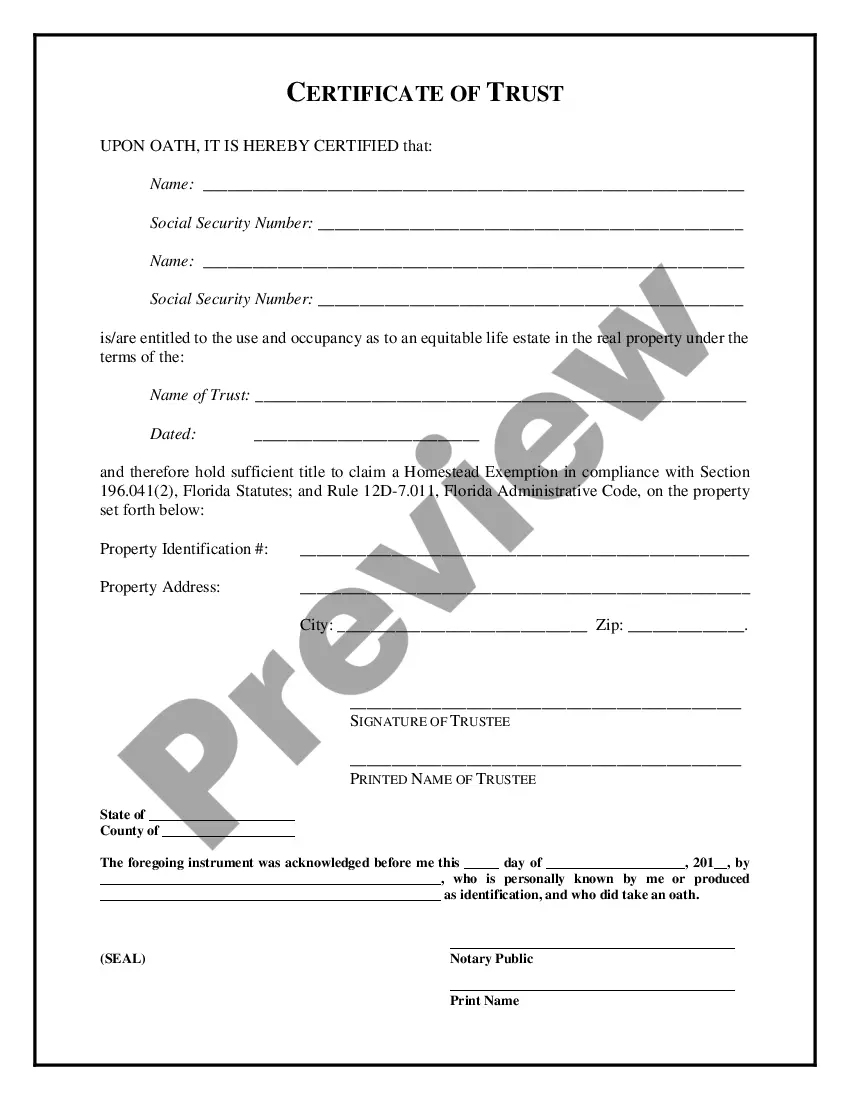
Florida Certificate of Trust
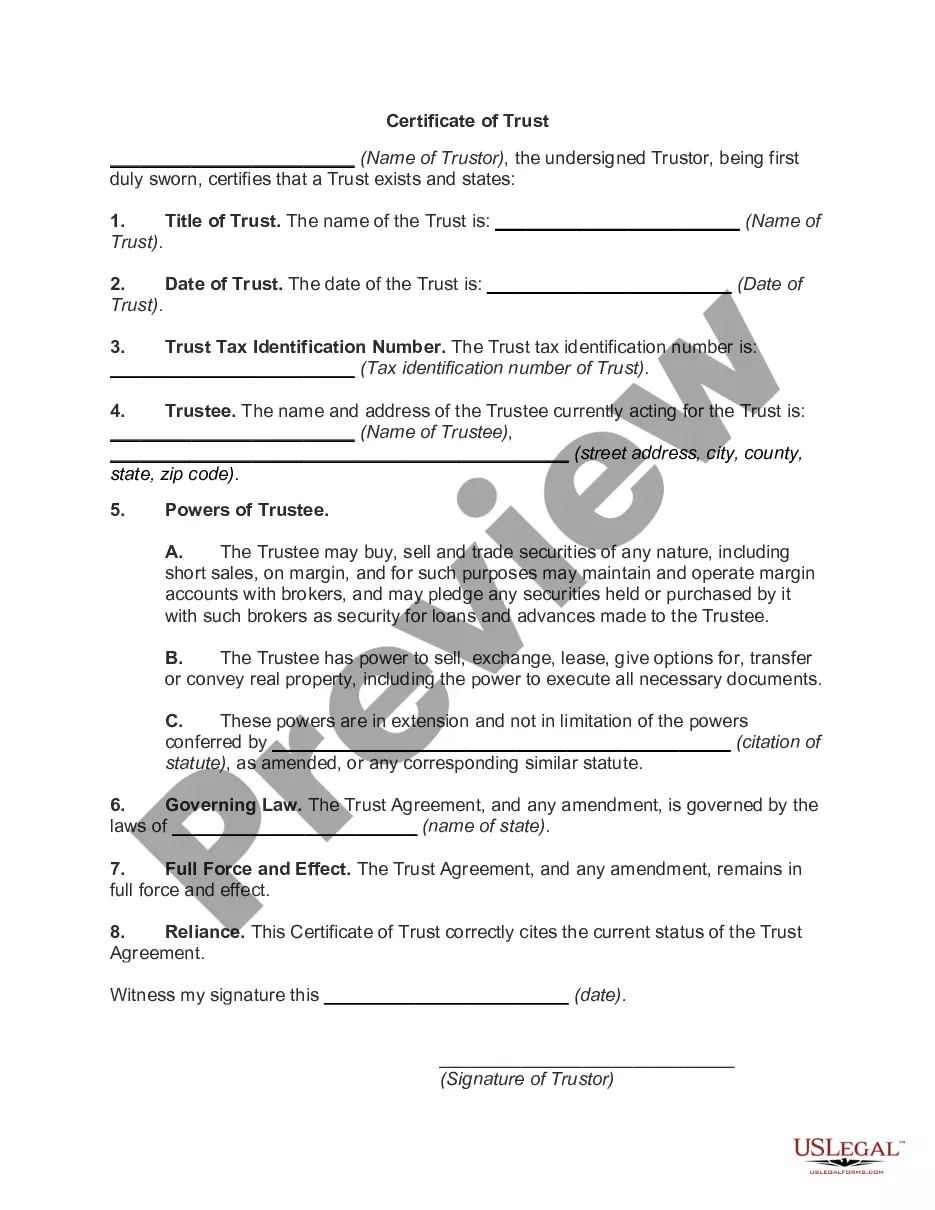
Notarization requirements for this form
Notarization is not commonly needed for this form. However, certain documents or local rules may make it necessary. Our notarization service, powered by Notarize, allows you to finalize it securely online anytime, day or night.
Get your form ready online
Our built-in tools help you complete, sign, share, and store your documents in one place.
Make edits, fill in missing information, and update formatting in US Legal Forms—just like you would in MS Word.
Download a copy, print it, send it by email, or mail it via USPS—whatever works best for your next step.
Sign and collect signatures with our SignNow integration. Send to multiple recipients, set reminders, and more. Go Premium to unlock E-Sign.
If this form requires notarization, complete it online through a secure video call—no need to meet a notary in person or wait for an appointment.
We protect your documents and personal data by following strict security and privacy standards.

Make edits, fill in missing information, and update formatting in US Legal Forms—just like you would in MS Word.

Download a copy, print it, send it by email, or mail it via USPS—whatever works best for your next step.

Sign and collect signatures with our SignNow integration. Send to multiple recipients, set reminders, and more. Go Premium to unlock E-Sign.

If this form requires notarization, complete it online through a secure video call—no need to meet a notary in person or wait for an appointment.

We protect your documents and personal data by following strict security and privacy standards.
Looking for another form?



Form popularity
FAQ
The relevant statute for trust certification in Florida is mainly found in Chapter 736, particularly around statutes that detail the management and oversight of trusts. This legislation provides specific guidelines on how trust certifications should be formatted and what information must be included. If you're looking to navigate trust certifications effectively, uSlegalforms offers comprehensive resources to ensure compliance with Florida laws.
To obtain a certificate of trust in Florida, you usually need to prepare a document that includes key details about the trust and the trustee. This may involve drafting a formal certification or using standardized forms provided by legal platforms. Organizations like uSlegalforms can provide ready-made templates and guidance to simplify this process, making it easier for you to secure your Florida Certificate of Trust.
Statute 736.0111 in Florida pertains to trust certification and outlines how trustees can prove their status. This statute allows a trustee to provide a certification rather than the complete trust document, ensuring privacy while maintaining legal compliance. Particularly for managing a Florida Certificate of Trust, understanding this statute can enhance your legal standing. Resources from uSlegalforms can clarify any confusion about this law.
A trust agreement is the foundational document that outlines the terms, beneficiaries, and rules governing the trust. In contrast, a trust certification is a concise document that verifies the trust's existence and the trustee's authority. While the trust agreement provides detailed legal information, the certification serves to confirm essential aspects without revealing everything. You may find uSlegalforms useful for accessing templates for both documents.
A trust is a legal arrangement that allows a trustee to manage assets for the benefit of beneficiaries, while a certificate of trust is a document that confirms the existence of that trust. The certificate provides proof of the trust without disclosing sensitive information contained in the trust document itself. This distinction is vital when dealing with financial institutions or other entities requiring trust verification. To navigate these complexities, consider using uSlegalforms for helpful templates and advice.
Section 732.103 in the Florida statute outlines the requirements for the creation and validity of trusts. This section sets forth basic laws governing the establishment of trusts in Florida, ensuring that they comply with state regulations. Understanding this section is crucial for anyone looking to draft or manage a Florida Certificate of Trust. You can always refer to uSlegalforms for detailed explanations and resources regarding this statute.
A certification of trust in Florida is a document that verifies the existence of a trust and the authority of its trustee. It provides essential information without revealing the full details of the trust itself. This certification can help streamline transactions by confirming the trust's validity to third parties. You can obtain a Florida Certificate of Trust through proper legal channels or services like uSlegalforms.
A trustees certificate is a document that verifies the authority of a trustee to act on behalf of a trust. This certificate typically includes details about the trust, such as its creation date, the trustee's powers, and necessary signatures. Understanding this document, especially the Florida Certificate of Trust, is vital for effective trust management.
You can get your trust certificate by contacting the trustee managing the trust. They will provide you with the official Florida Certificate of Trust upon request. If you lack the necessary documents, US Legal Forms can guide you through the steps to create one tailored to your needs.
To obtain a certificate of trust, you should start by preparing the trust declaration and identifying the trustee. Once you've compiled this information, platforms like US Legal Forms can simplify the process of drafting and obtaining your Florida Certificate of Trust. It's essential to ensure that you follow the required legal procedures.