District of Columbia Transfer on Death Deed or TOD - Beneficiary Deed for Individual to a Business Entity
What this document covers
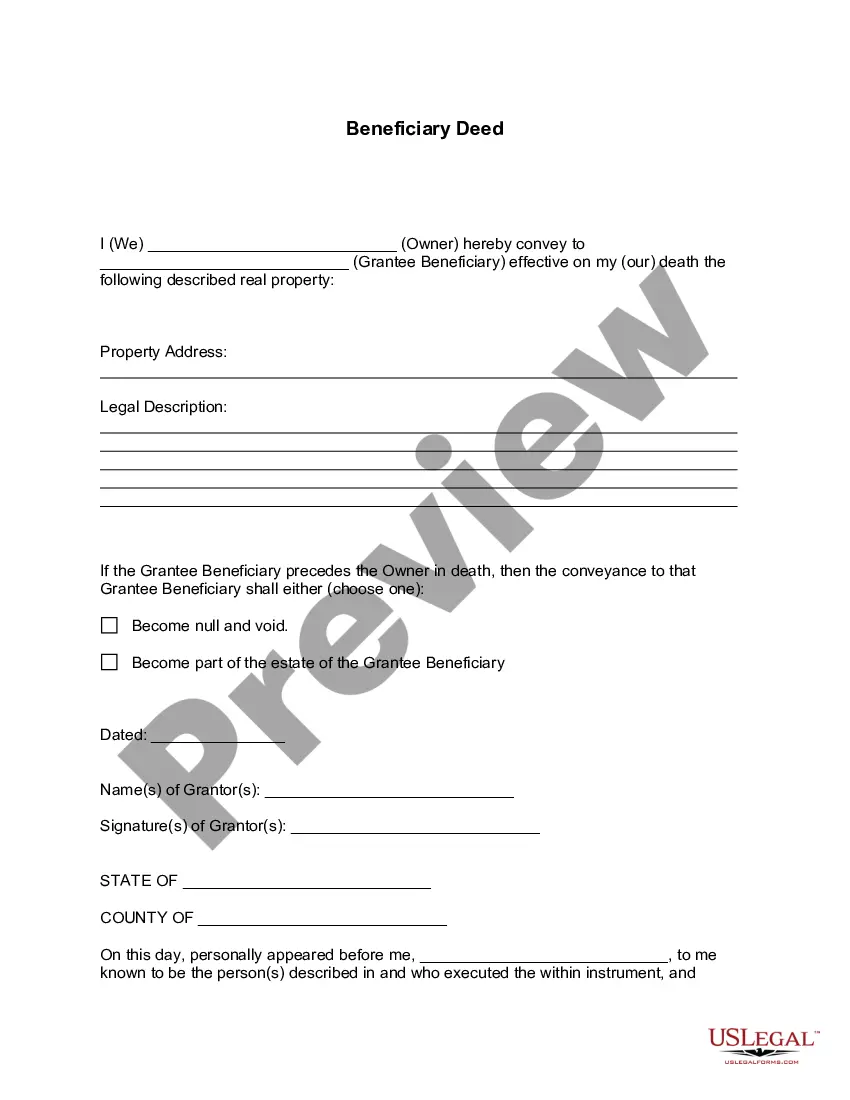
The Transfer on Death Deed (TOD) is a legal document that allows an individual to designate a business entity as the beneficiary of their real property upon their death. This deed specifically transfers ownership of the property without the need for probate, ensuring a smooth transition of ownership to the specified business. Unlike traditional deeds, a TOD deed does not transfer ownership during the Grantor's lifetime, allowing them to maintain control over the property until their passing.
What’s included in this form
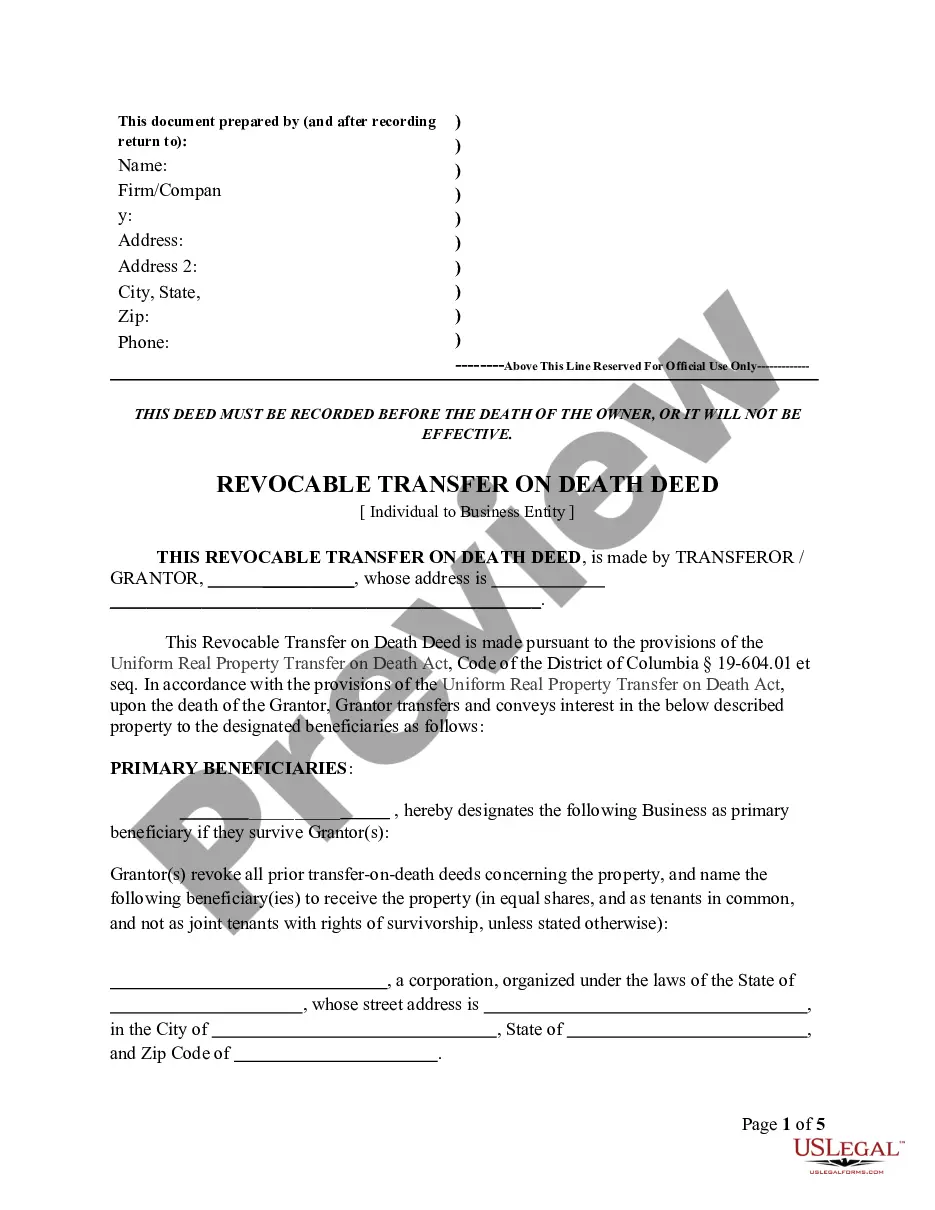
- Transferor/Grantor information, including name and address.
- Designated primary beneficiary, which is a business entity.
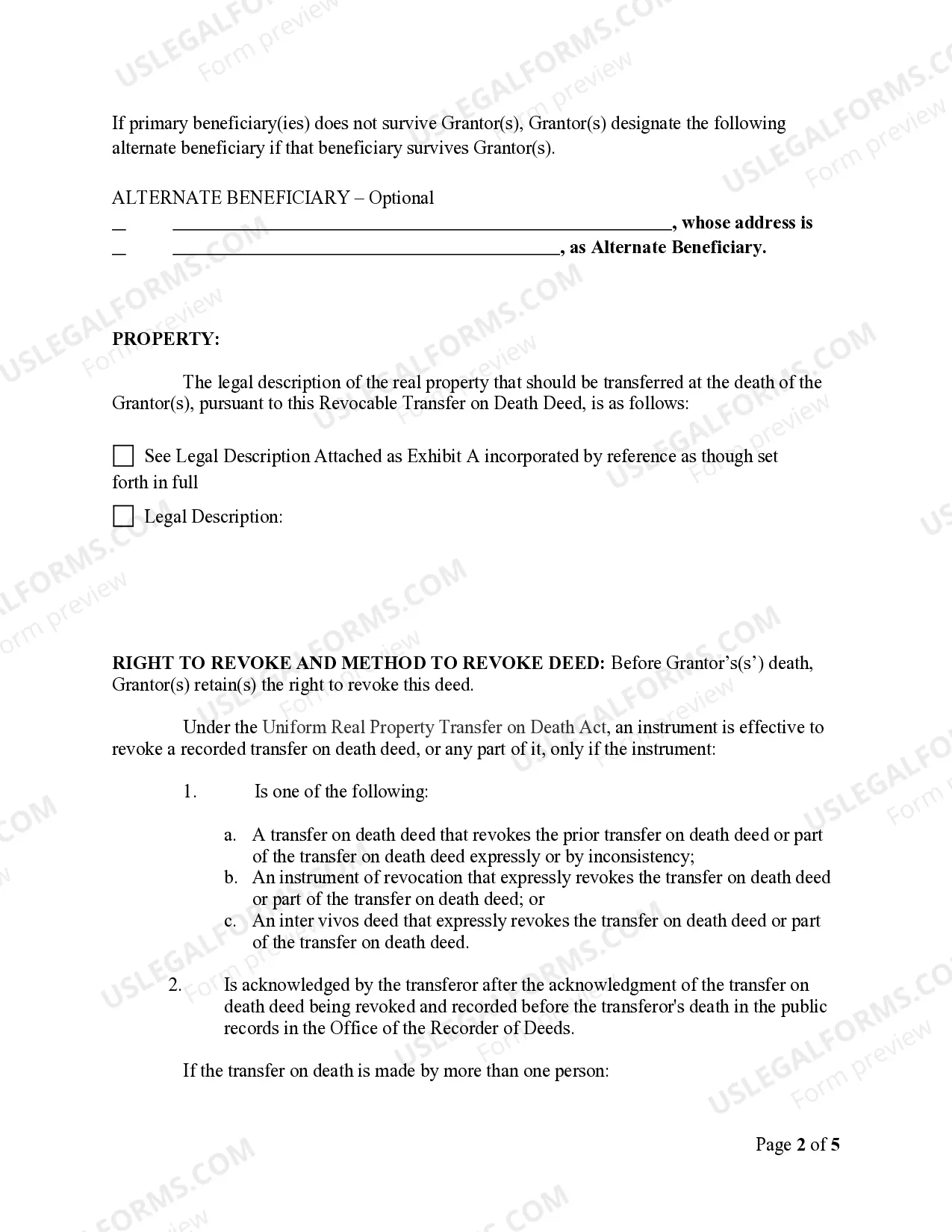
- Legal description of the property being transferred.
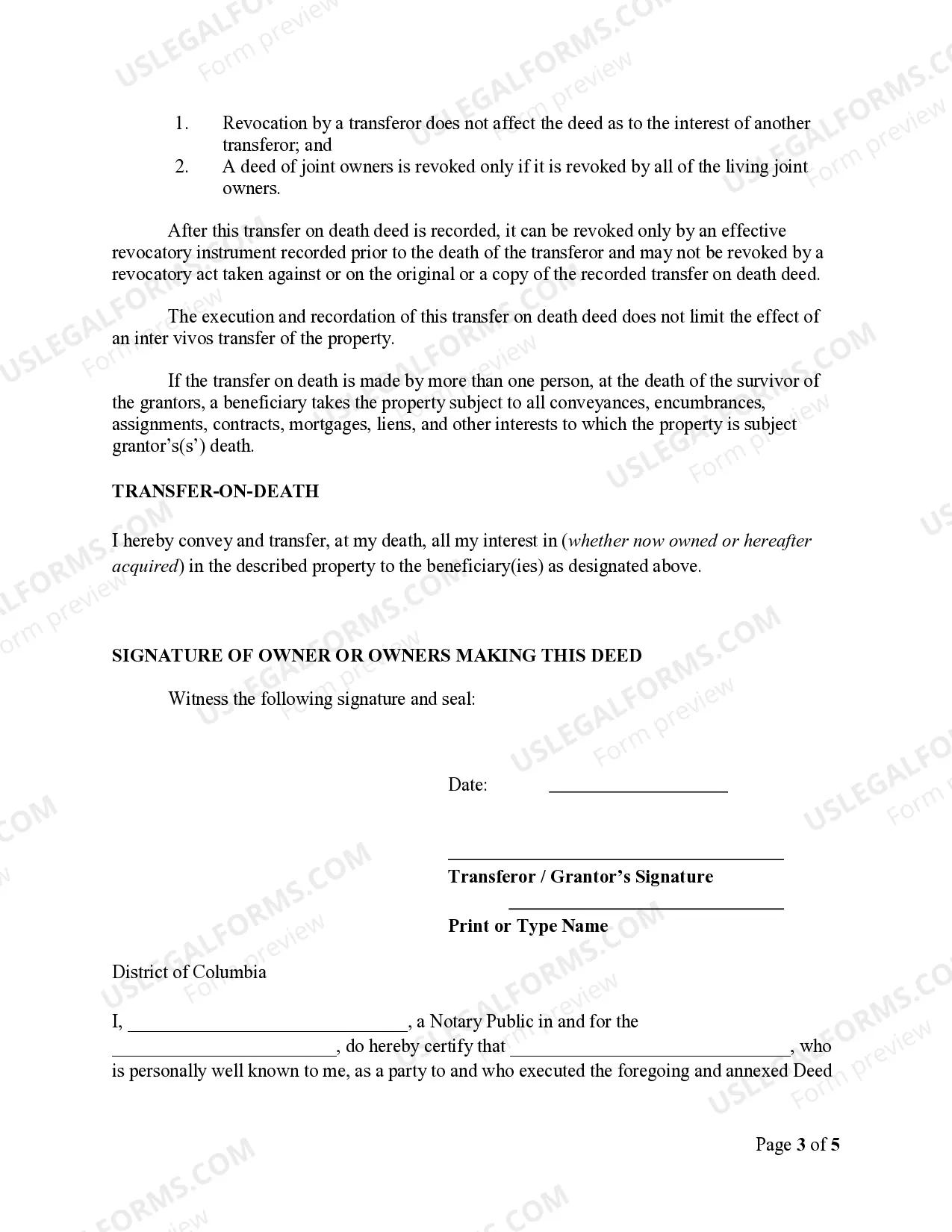
- Right to revoke the deed prior to the Grantor's death.
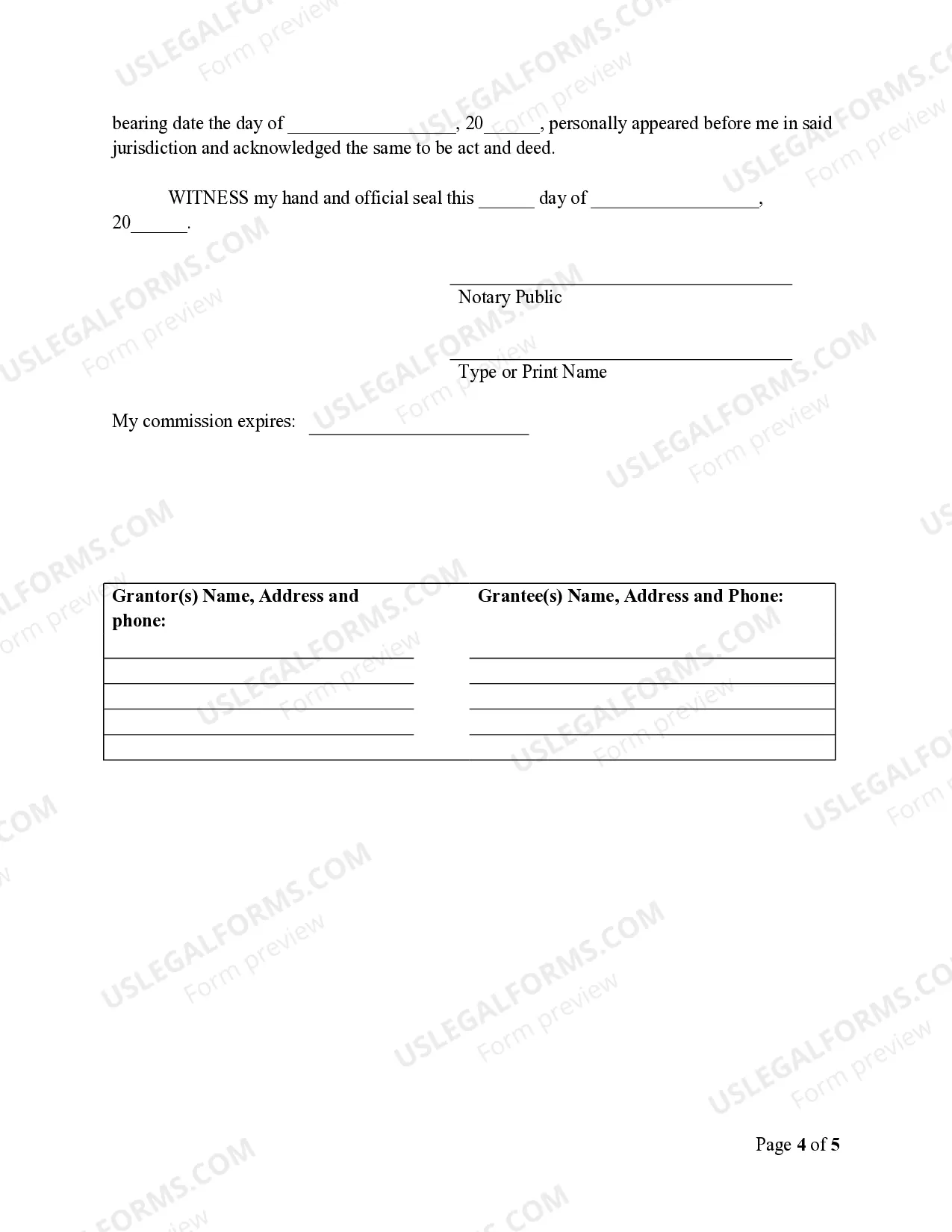
- Signature of the Transferor/Grantor and notarization section.


When this form is needed
This form is suitable for individuals who wish to secure the transfer of their property to a specific business entity after their death. It is particularly beneficial when the property owner wants to avoid the lengthy probate process, ensuring that their property transfers directly to the designated business without complications. Use this document when planning your estate, particularly if you desire that certain assets pass directly to a business rather than being divided among heirs or relatives.
Who should use this form
- Property owners looking to establish a clear plan for property transfer after death.
- Individuals wanting to designate a business entity as a beneficiary of their assets.
- Anyone wanting to avoid probate complications associated with property transfer.
How to prepare this document
- Identify the Transferor/Grantor by entering their name and address.
- Designate the primary beneficiary by specifying the business entityâs name and address.
- Include the legal description of the property to be transferred.
- Sign and date the document as the Grantor; this must be done in the presence of a notary public.
- Ensure the deed is recorded in the appropriate office before the Grantorâs death.
Notarization guidance
Yes, this form must be notarized to be legally valid. It is crucial that the signature of the Grantor is witnessed by a notary public to ensure the authenticity of the document. US Legal Forms offers integrated online notarization services, providing secure video calls with a notary at any time.
Get your form ready online
Our built-in tools help you complete, sign, share, and store your documents in one place.
Make edits, fill in missing information, and update formatting in US Legal Forms—just like you would in MS Word.
Download a copy, print it, send it by email, or mail it via USPS—whatever works best for your next step.
Sign and collect signatures with our SignNow integration. Send to multiple recipients, set reminders, and more. Go Premium to unlock E-Sign.
If this form requires notarization, complete it online through a secure video call—no need to meet a notary in person or wait for an appointment.
We protect your documents and personal data by following strict security and privacy standards.

Make edits, fill in missing information, and update formatting in US Legal Forms—just like you would in MS Word.

Download a copy, print it, send it by email, or mail it via USPS—whatever works best for your next step.

Sign and collect signatures with our SignNow integration. Send to multiple recipients, set reminders, and more. Go Premium to unlock E-Sign.

If this form requires notarization, complete it online through a secure video call—no need to meet a notary in person or wait for an appointment.

We protect your documents and personal data by following strict security and privacy standards.
Common mistakes to avoid
- Failing to record the deed before the death of the Grantor, rendering it ineffective.
- Not specifying the legal description of the property correctly.
- Omitting the name and details of the business entity as the designated beneficiary.
Why use this form online
- Convenient access to legal forms that can be downloaded and filled out at your convenience.
- Editability allows for corrections or updates before finalizing the document.
- Reliable templates drafted by licensed attorneys, ensuring compliance with legal standards.
Looking for another form?

Form popularity
FAQ
Filling out a transfer on death designation affidavit requires you to provide essential information about yourself, your property, and the designated beneficiary. First, specify the property you want to transfer and include all relevant details. After that, fill in your beneficiary’s information and sign the document. To avoid complications, consider using platforms like uslegalforms that guide you through this process thoroughly.
Yes, the District of Columbia does allow transfer on death deeds. This provision helps streamline the transfer of property upon your death, bypassing the probate process. You can confidently use this method to name a beneficiary, ensuring your property passes to them seamlessly.
One disadvantage of the District of Columbia Transfer on Death Deed or TOD - Beneficiary Deed for Individual to a Business Entity is that it may not be recognized in every jurisdiction. Additionally, once you name a beneficiary, you cannot change this designation easily without following specific procedures. Also, if your beneficiary predeceases you and you haven't made alternative arrangements, the deed may become invalid.
Many states in the U.S. recognize transfers on death deeds, including California, Nevada, and Maryland, to name a few. The District of Columbia also allows this option. This means you can specify a beneficiary to receive your property outside of probate when you pass away, giving your loved ones an efficient way to inherit your assets.
Yes, the District of Columbia does allow for a Transfer on Death Deed. This method enables individuals to transfer their real estate assets directly to a designated beneficiary upon their passing, bypassing the often complex probate process. Utilizing a District of Columbia Transfer on Death Deed or TOD - Beneficiary Deed for Individual to a Business Entity can streamline your estate planning and provide peace of mind.
While it is not legally required to enlist a lawyer for a District of Columbia Transfer on Death Deed or TOD - Beneficiary Deed for Individual to a Business Entity, having legal guidance can make the process easier. A lawyer can help ensure that the deed is executed properly, reducing the risk of future complications related to your estate. It’s worth considering consultation to protect your interests.
TOD accounts can be beneficial for many individuals. They allow seamless asset transfer, avoiding the probate process, which can be lengthy and costly. However, whether they are a good idea for you depends on your individual situation and estate planning goals, particularly when it comes to a District of Columbia Transfer on Death Deed or TOD - Beneficiary Deed for Individual to a Business Entity. Consulting with professionals can provide tailored advice.
While a District of Columbia Transfer on Death Deed or TOD - Beneficiary Deed for Individual to a Business Entity simplifies asset transfer, it could expose your property to your beneficiaries' creditors after your passing. Moreover, if beneficiaries disagree on property management or sale, disputes may arise, complicating the transition. It's crucial to weigh these potential pitfalls when considering the use of a TOD.
One potential disadvantage of a District of Columbia Transfer on Death Deed or TOD - Beneficiary Deed for Individual to a Business Entity is that it does not provide control over the asset after your passing. This could lead to complications if your beneficiary's situation changes or if they are not prepared to manage the property. Additionally, the deed may not account for changes in your beneficiary's life circumstances or your own estate plans.
The main difference lies in what each term signifies. A District of Columbia Transfer on Death Deed or TOD - Beneficiary Deed for Individual to a Business Entity specifically allows an individual to transfer real property to a designated beneficiary upon death. Conversely, a beneficiary generally refers to anyone who receives assets, not limited to property, which could include bank accounts or life insurance proceeds. Understanding these differences can help you make more informed estate planning choices.