General Trademark License Agreement
Overview of this form
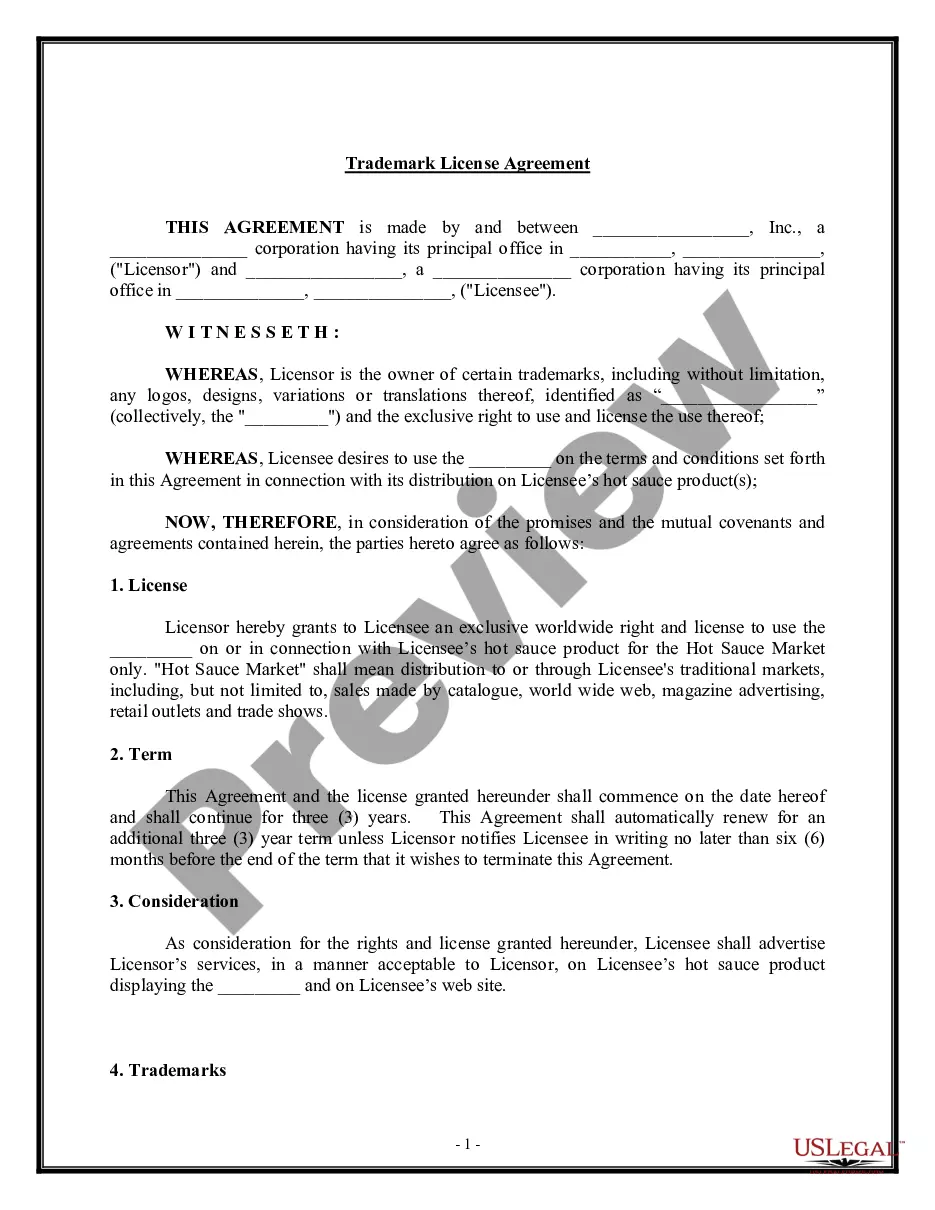
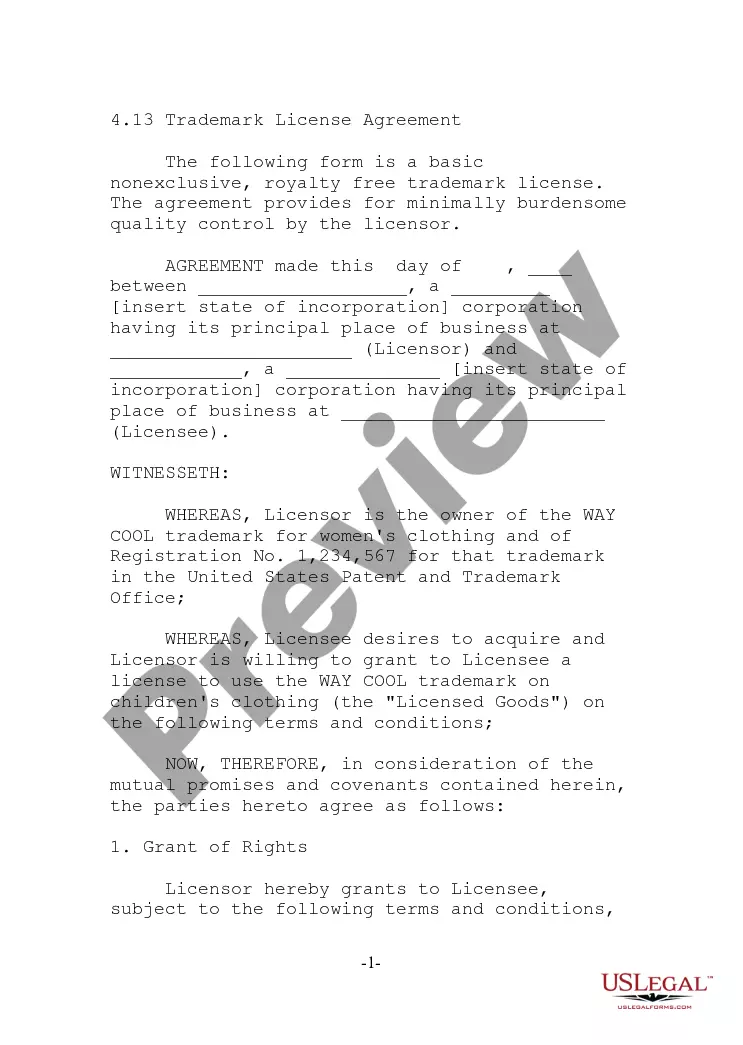
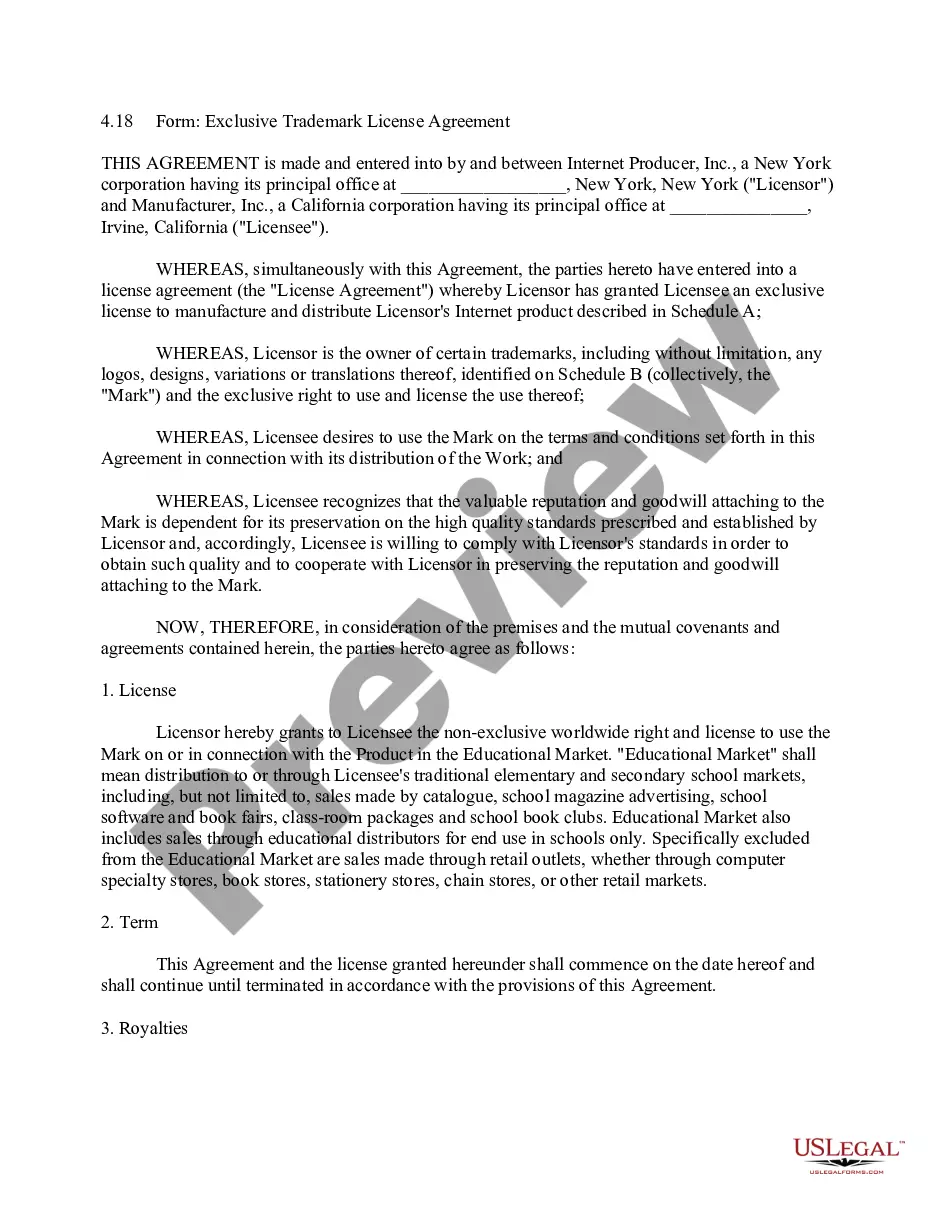
The General Trademark License Agreement is a legal document that outlines the terms under which a trademark owner (licensor) allows another party (licensee) to use their trademark. This form is specifically designed for situations where a licensee wishes to use the licensor's trademark in connection with their products, such as in a hot sauce market. Unlike other forms of trademark agreements, this document grants exclusive worldwide rights and defines important terms regarding usage, renewal, and infringement.
Key components of this form
- Identification of parties: Names and corporate details of the licensor and licensee.
- License grant: Exclusive rights given to the licensee for the trademark usage.
- Term of agreement: Duration of the license and conditions for renewal.
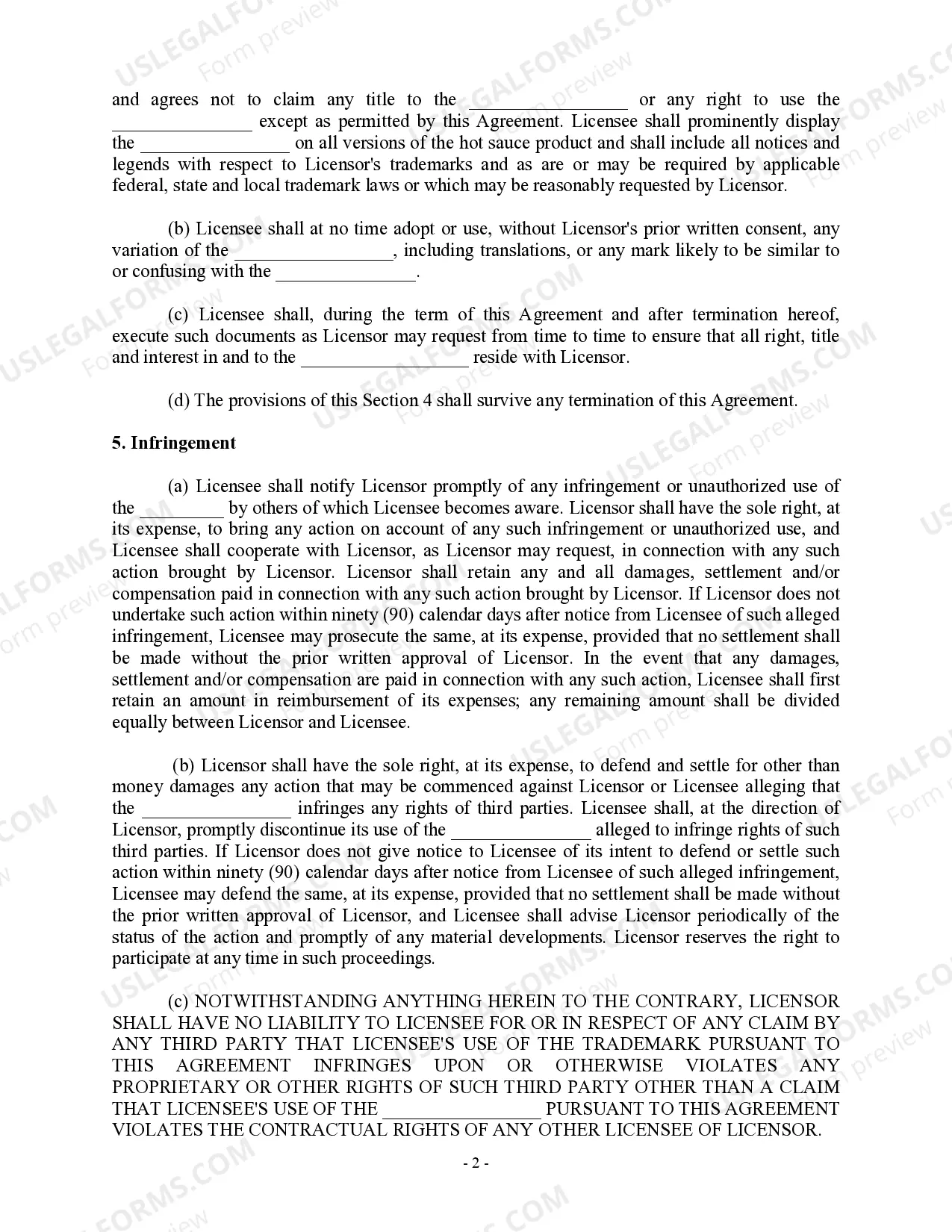
- Infringement procedures: How potential trademark infringements are handled and reported.
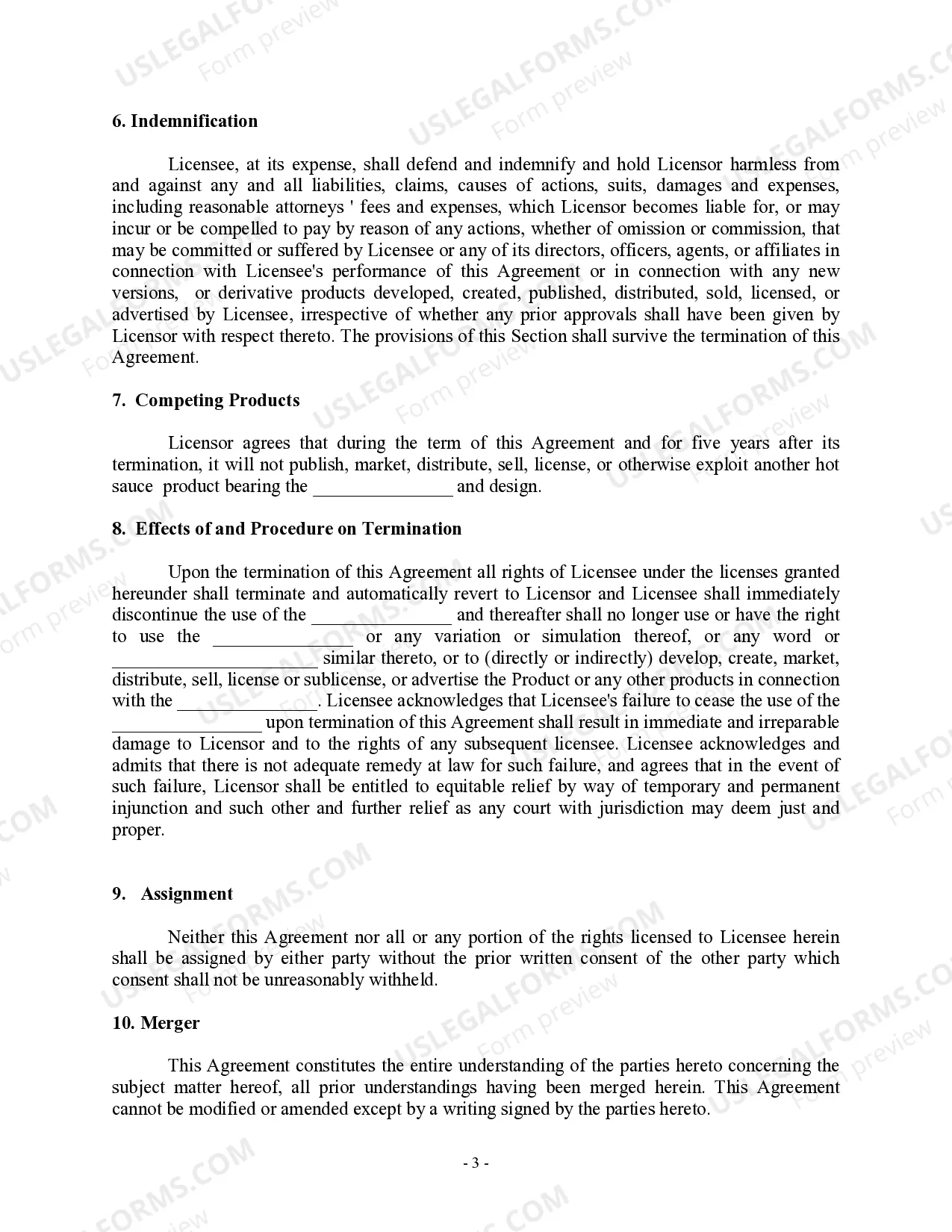
- Indemnification: Responsibilities of the licensee involving potential liabilities.
- Termination effects: Rights that revert to the licensor upon termination of the agreement.
Common use cases
This form should be used when a business wants to legally use a trademark owned by another entity. For instance, if a hot sauce company wants to feature a specific logo or brand name on their products, they will need to secure a trademark license from the trademark owner. This agreement is essential to protect both parties' rights and clarify the scope of usage.
Who this form is for
- Businesses seeking to license a trademark for their products.
- Trademark owners who wish to grant the use of their trademarks to another entity.
- Attorneys looking for a standardized agreement for their clients involving trademark licensing.
Steps to complete this form
- Identify the parties involved by entering the names and addresses of the licensor and licensee.
- Specify the trademark being licensed, describing any associated logos or designs.
- Determine the duration of the agreement and indicate any renewal terms.
- Outline the scope of the license, including the specific products and markets covered.
- Have both parties sign and date the agreement to finalize it legally.
Notarization guidance
This form does not typically require notarization unless specified by local law. However, notarization can enhance the legal validity of the agreement if needed, particularly in disputes.
Get your form ready online
Our built-in tools help you complete, sign, share, and store your documents in one place.
Make edits, fill in missing information, and update formatting in US Legal Forms—just like you would in MS Word.
Download a copy, print it, send it by email, or mail it via USPS—whatever works best for your next step.
Sign and collect signatures with our SignNow integration. Send to multiple recipients, set reminders, and more. Go Premium to unlock E-Sign.
If this form requires notarization, complete it online through a secure video call—no need to meet a notary in person or wait for an appointment.
We protect your documents and personal data by following strict security and privacy standards.

Make edits, fill in missing information, and update formatting in US Legal Forms—just like you would in MS Word.

Download a copy, print it, send it by email, or mail it via USPS—whatever works best for your next step.

Sign and collect signatures with our SignNow integration. Send to multiple recipients, set reminders, and more. Go Premium to unlock E-Sign.

If this form requires notarization, complete it online through a secure video call—no need to meet a notary in person or wait for an appointment.

We protect your documents and personal data by following strict security and privacy standards.
Typical mistakes to avoid
- Failing to specify the trademark clearly, which can lead to disputes.
- Omitting details about what happens in case of infringement.
- Not defining the term and renewal conditions of the agreement.
- Forgetting to include a clause about indemnification against third-party claims.
Why complete this form online
- Convenience: Easily download and customize the form to suit specific needs.
- Editable: Modify the agreement as necessary to reflect changes in business arrangements.
- Reliable: Access a document prepared by licensed attorneys, ensuring legal compliance and effectiveness.
Legal use & context:
- This agreement establishes enforceable rights for both the licensor and licensee.
- It protects the intellectual property of the licensor while allowing the licensee to benefit from the brand value.
- Failure to adhere to the terms can result in legal action from the licensor.
Summary of main points
Key takeaways:
- The General Trademark License Agreement is essential for legally permitting trademark use between parties.
- Clear understanding and documentation of rights and obligations protect both partiesâ interests.
- Proper completion of the form ensures validity and enforceability of the agreement.
Looking for another form?
Form popularity
FAQ
This form is a legal document in which a trademark owner (licensor) allows another party (licensee) to use the trademark. It is designed to grant exclusive worldwide rights for the licensee to use the mark on specified products, with terms for usage, renewal, and handling infringement. It covers identification of parties, the license grant, term, infringement procedures, indemnification, and termination effects.
A licensing agreement should identify the parties, define the license grant, specify the term and renewal conditions, outline infringement procedures, establish indemnification responsibilities, and explain termination effects. This General Trademark License Agreement uses these components to formalize exclusive worldwide rights and set clear rules for usage, quality control, and enforcement across products.
It is a contract where a trademark owner (licensor) grants permission to another party (licensee) to use the mark in connection with specific products or services. In this form, the grant is exclusive worldwide, with defined usage terms, a renewal option, and procedures for handling infringement, along with indemnification and termination rules.
Common licensing mistakes include vague or broad usage scope, undefined term or renewal terms, missing or unclear infringement procedures, no enforcement remedies, and lack of indemnification or termination specifics. This General Trademark License Agreement addresses these areas by detailing the license grant, term, infringement procedures, indemnification, and termination effects to reduce risk.
For example, a hot sauce brand wants to use a particular logo on its bottles. The licensor grants exclusive worldwide rights to the trademark for that product line, with a defined term and renewal options, plus infringement procedures, indemnification, and termination effects to protect both sides.
This form provides exclusive worldwide rights to use the trademark, rather than a non-exclusive arrangement. It also specifies key terms like usage, term, renewal, infringement procedures, indemnification, and termination effects to govern the license. The combination of exclusivity with a defined structure helps protect the licensor and guide the licensee across products.