Oregon Transfer on Death Deed from an individual Owner/Grantor to four individual Beneficiaries.
What is this form?
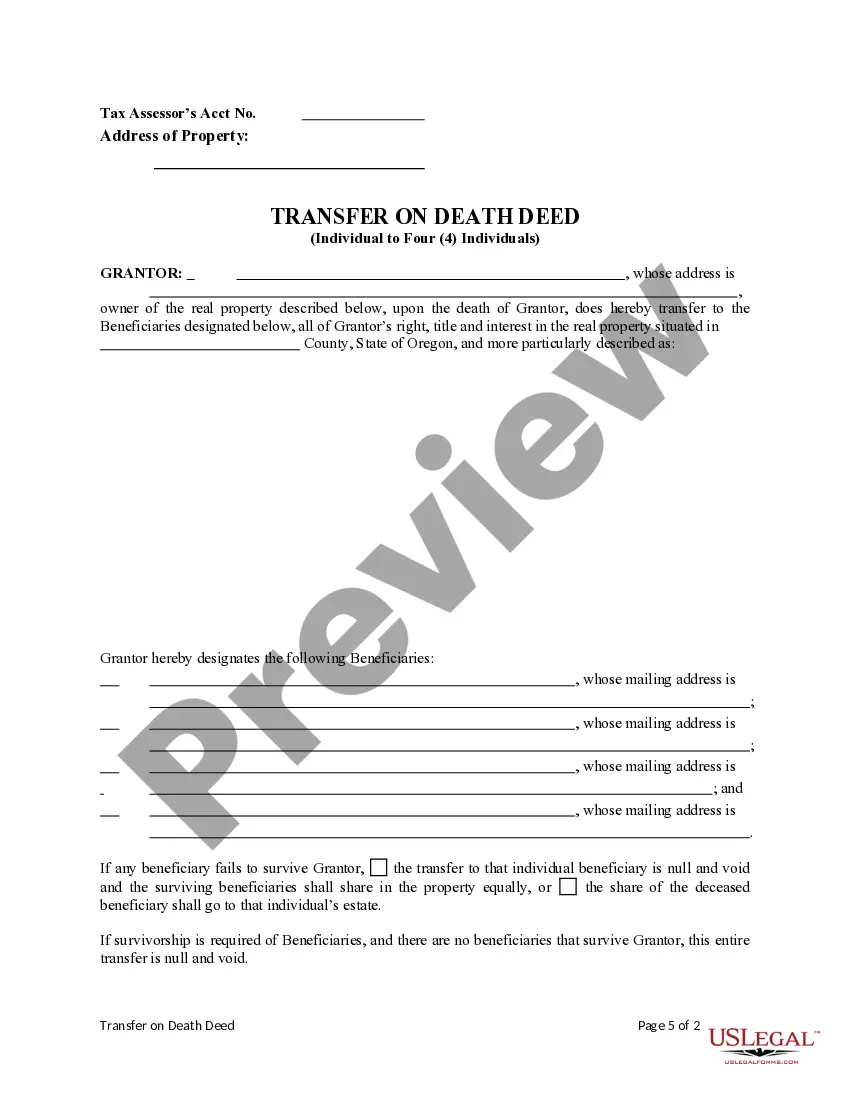
This Transfer on Death Deed allows an individual Grantor to transfer property to four designated beneficiaries upon their death. Unlike other deeds, this transfer remains revocable until the Grantor passes away, ensuring flexibility while providing a clear plan for asset distribution. This form is compliant with state statutory laws, making it a reliable option for those looking to manage their estate effectively.
Key parts of this document
- Grantor information: Details regarding the individual transferring the property.
- Beneficiaries: Identification of the four individuals who will receive the property.
- Property description: Specifics about the property being transferred, including its legal description.
- Revocation clause: A statement affirming the Grantor's right to revoke the deed prior to death.
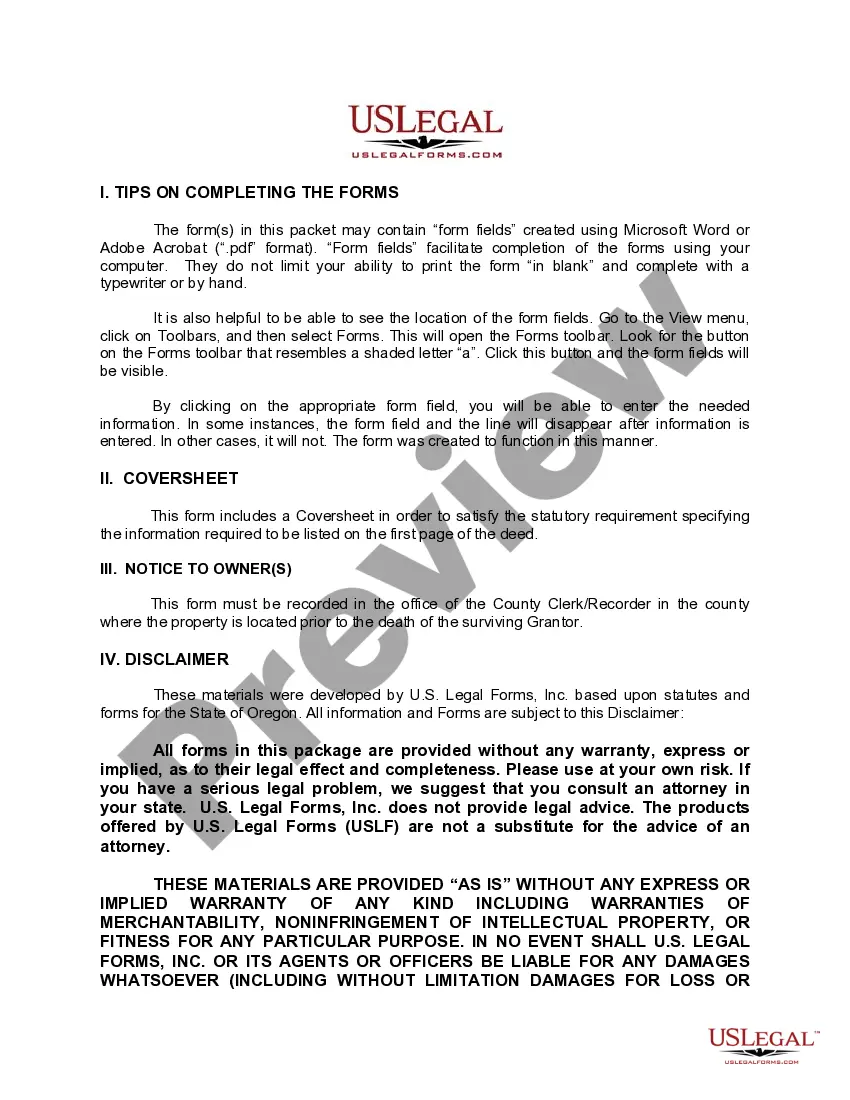
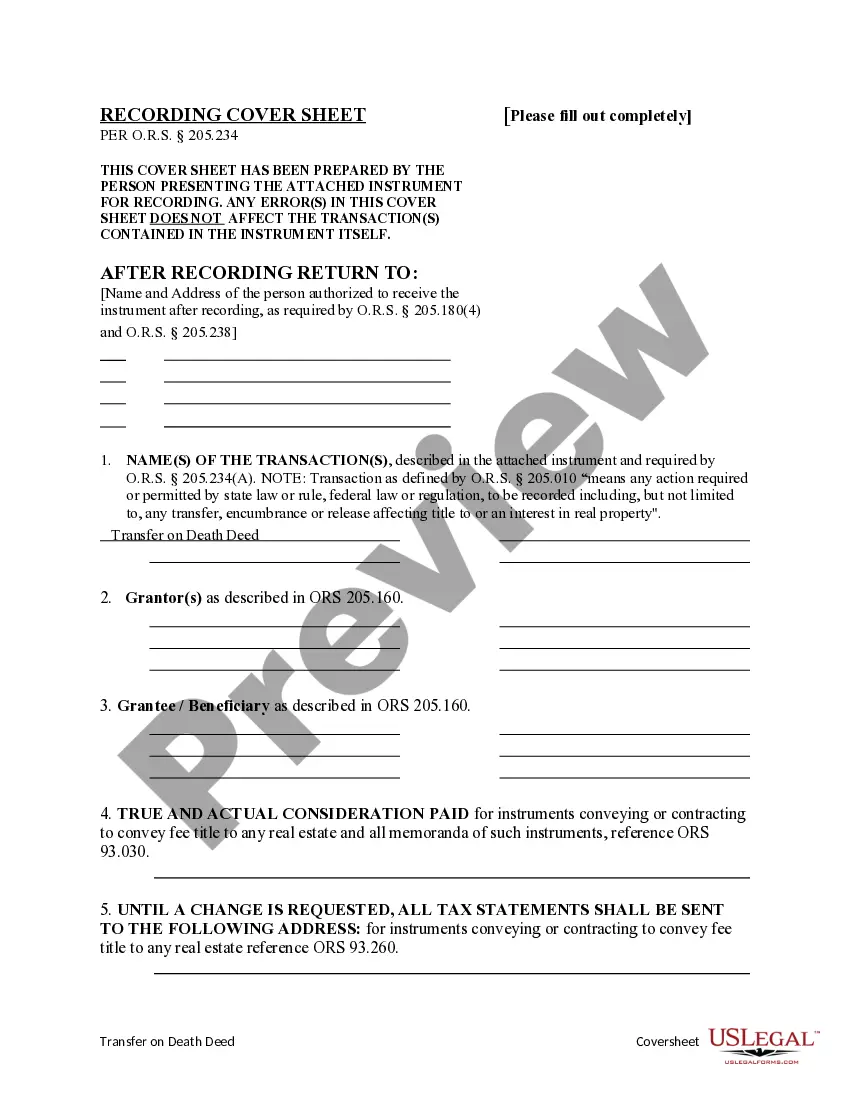
- Coversheet: Information required by statute must be listed on the first page of the deed.
- Recording requirements: Instructions on where and when to record the deed for legality.



When to use this document
This form is useful when an individual owner wants to ensure that their property passes directly to designated beneficiaries without going through probate. It is ideal for those who wish to maintain control over their property during their lifetime while having a clear plan in place for after their passing. Situations may include estate planning for retirement, avoiding probate costs, or simplifying property transfer for family members.
Intended users of this form
- Individuals with sole ownership of real estate who want to designate beneficiaries.
- Those seeking to avoid the complexities of probate for their heirs.
- People looking for a flexible estate planning solution that can be altered before death.
- Property owners who understand the legal implications of transferring real property to beneficiaries.
How to complete this form
- Identify the Grantor and complete their information accurately.
- List the four beneficiaries clearly, ensuring their names and details are correct.
- Describe the property being transferred in detail, including any legal descriptions.
- Complete the Coversheet by filling in the required information as per statutory guidelines.
- Sign the document in the presence of a notary to ensure legal validity upon recording.
- Record the signed deed with the County Clerk/Recorder in the appropriate county before the Grantor's death.
Is notarization required?
Notarization is required for this form to take effect. Our online notarization service, powered by Notarize, lets you verify and sign documents remotely through an encrypted video session, available 24/7.
Get your form ready online
Our built-in tools help you complete, sign, share, and store your documents in one place.
Make edits, fill in missing information, and update formatting in US Legal Forms—just like you would in MS Word.
Download a copy, print it, send it by email, or mail it via USPS—whatever works best for your next step.
Sign and collect signatures with our SignNow integration. Send to multiple recipients, set reminders, and more. Go Premium to unlock E-Sign.
If this form requires notarization, complete it online through a secure video call—no need to meet a notary in person or wait for an appointment.
We protect your documents and personal data by following strict security and privacy standards.

Make edits, fill in missing information, and update formatting in US Legal Forms—just like you would in MS Word.

Download a copy, print it, send it by email, or mail it via USPS—whatever works best for your next step.

Sign and collect signatures with our SignNow integration. Send to multiple recipients, set reminders, and more. Go Premium to unlock E-Sign.

If this form requires notarization, complete it online through a secure video call—no need to meet a notary in person or wait for an appointment.

We protect your documents and personal data by following strict security and privacy standards.
Typical mistakes to avoid
- Failing to accurately describe the property being transferred.
- Not listing all beneficiaries or providing incorrect names.
- Neglecting to record the deed before the Grantor's death.
- Overlooking the need for signatures or notarization when required.
Why use this form online
- Convenience of downloading and completing the form from any device.
- Editability allows for adjustments before finalizing the document.
- Reliable templates drafted by licensed attorneys ensure compliance with legal standards.
- Easy access to state-specific forms and guidelines for accurate completion.
Summary of main points
- This Transfer on Death Deed allows property transfer outside of probate.
- The document is revocable until the Grantor's death.
- Recording the deed is essential for it to take effect.
- Ensure all parties are accurately identified to avoid legal issues.
Looking for another form?
Form popularity
FAQ
In most cases, the surviving owner or heir obtains the title to the home, the former owner's death certificate, a notarized affidavit of death, and a preliminary change of ownership report form. When all these are gathered, the transfer gets recorded, the fees are paid, and the county issues a new title deed.
If you die without leaving a will, then your estate will be distributed in accordance with the law of succession. This also happens: When the will is not valid because it was not made properly.
If the property is to be transferred to a beneficiary the Executor or Administrator will need to submit a document called an 'Assent' to the Land Registry, with a copy of the Grant of Representation. The Land Registry will then transfer the property into the name of the new owner.
A TOD designation supersedes a will. For bank accounts, you can set up a similar account known as payable-on-death, sometimes referred to as a Totten trust. Your beneficiaries can't touch the account while you're alive, and you're free to change beneficiaries or close the accounts at any time.
When someone dies without a will, it's called dying intestate. When that happens, none of the potential heirs has any say over who gets the estate (the assets and property). When there's no will, the estate goes into probate.Legal fees are paid out of the estate and it often gets expensive.
File a petition in probate court. The first step to transferring the property to the rightful new owners is to open up a case in probate court. Petition the court for sale and convey the property to the purchaser. Next, you must petition the court to sell the property.
If it was inherited, succession law comes into play. Once the beneficiaries and their shares, rights and liabilities are decided, the property has to be transferred in their names. For this you need to apply for property transfer at the sub-registrar's office.
Effective January 1, 2012, Oregon law provides for a new form of deed known as a transfer on death (TOD) deed. These deeds allow an owner of real property to designate a beneficiary who will obtain title to that real property when the owner dies, without having to go through probate (subject to some exceptions).
If you'd like to avoid having your property going through the probate process, it's a good idea to look into a transfer on death deed. A transfer on death deed allows you to select a beneficiary who will receive your property, but only when you've passed away.