District of Columbia Satisfaction, Release or Cancellation of Deed of Trust by Corporation
What this document covers
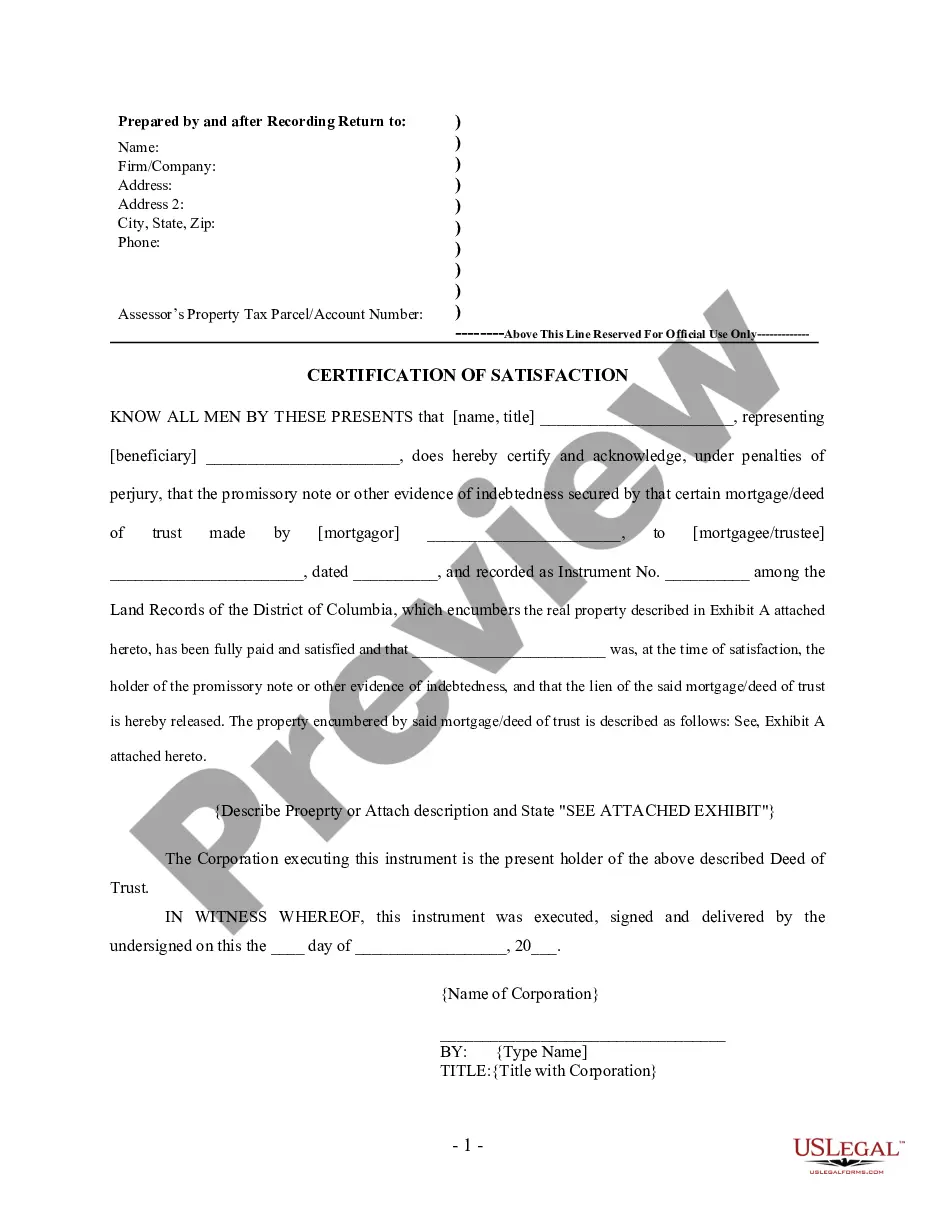
The Satisfaction, Release or Cancellation of Deed of Trust by Corporation is a legal document used by a corporation to formally release a mortgage or deed of trust against a property. This form indicates that the debt has been satisfied, thereby freeing the property from the mortgage obligation. It is important to note that this form is specific to the context of corporate lenders and differs from personal mortgage satisfaction documents.
Key components of this form
- Description of the property associated with the deed of trust.
- Identification of the corporation executing the release.
- Signature and title of the authorized representative of the corporation.
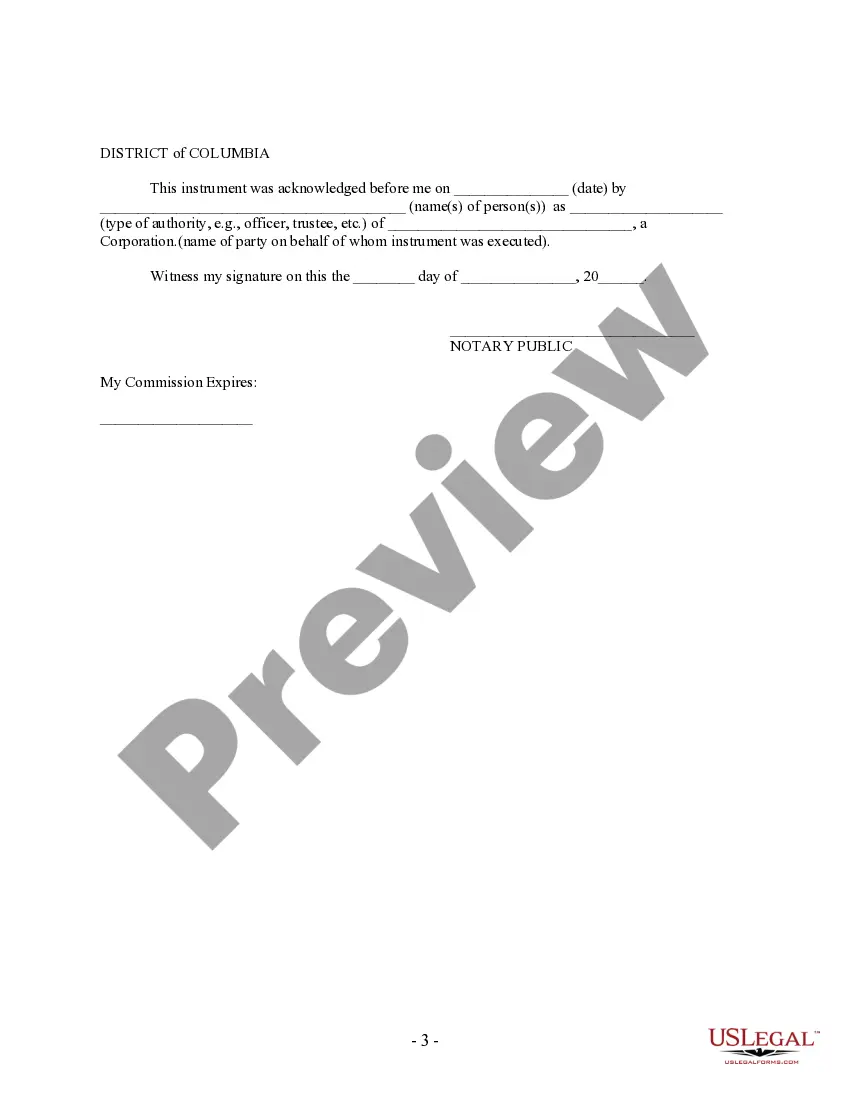
- Notarization section to acknowledge the execution of the document.
- Space for the date of execution and expiration of the notary's commission.

Situations where this form applies
This form should be used when a corporation has paid off a mortgage or deed of trust on a property and wishes to formally document the release. It is applicable in situations where the corporation has fulfilled its financial obligations and wants to notify relevant parties that the lender's claim on the property is satisfied.
Who should use this form
- Corporations that have paid off a mortgage or deed of trust on a property.
- Corporate representatives or officers authorized to sign legal documents on behalf of the corporation.
- Financial institutions or lenders looking to document the satisfaction of a corporate loan.
Steps to complete this form
- Identify and describe the property being released from the mortgage.
- Complete the corporation's name and the title of the individual signing the document.
- Sign the document on behalf of the corporation, including the date of the signature.
- Have the signing party appear before a notary public for acknowledgment.
- Ensure all relevant dates and the notary's commission expiration are accurately filled out.
Is notarization required?
This form must be notarized to be legally valid. US Legal Forms provides secure online notarization powered by Notarize, allowing you to complete the process through a verified video call.
Get your form ready online
Our built-in tools help you complete, sign, share, and store your documents in one place.
Make edits, fill in missing information, and update formatting in US Legal Forms—just like you would in MS Word.
Download a copy, print it, send it by email, or mail it via USPS—whatever works best for your next step.
Sign and collect signatures with our SignNow integration. Send to multiple recipients, set reminders, and more. Go Premium to unlock E-Sign.
If this form requires notarization, complete it online through a secure video call—no need to meet a notary in person or wait for an appointment.
We protect your documents and personal data by following strict security and privacy standards.

Make edits, fill in missing information, and update formatting in US Legal Forms—just like you would in MS Word.

Download a copy, print it, send it by email, or mail it via USPS—whatever works best for your next step.

Sign and collect signatures with our SignNow integration. Send to multiple recipients, set reminders, and more. Go Premium to unlock E-Sign.

If this form requires notarization, complete it online through a secure video call—no need to meet a notary in person or wait for an appointment.

We protect your documents and personal data by following strict security and privacy standards.
Common mistakes to avoid
- Failing to provide a complete and accurate property description.
- Not having the signature properly notarized.
- Leaving out the date of execution.
- Using an outdated version of the form that does not comply with current laws.
Advantages of online completion
- Convenience of immediate access to legal forms without the need for in-person visits.
- Editability, allowing you to customize the form to fit specific details easily.
- Reliability, as forms are prepared by licensed attorneys and comply with legal standards.
Quick recap
- The Satisfaction, Release or Cancellation of Deed of Trust by Corporation is essential for officially releasing a mortgage lien.
- It must be completed with accurate property descriptions and corporate details.
- The form requires notarization to be recognized legally.
- Using this form can simplify transactions related to property ownership and release financial obligations effectively.
Looking for another form?

Form popularity
FAQ
To remove someone from a deed of trust, you must obtain their consent and file a formal document, often called a deed of release. This legally transfers removal and ensures all parties are aware of the changes. In the District of Columbia, following the appropriate legal steps is crucial for a valid outcome. Using US Legal Forms can provide the necessary documentation and guidance to navigate this procedure effectively.
While you can technically remove a name from a deed without a lawyer, it is highly recommended to seek legal assistance for clarity and compliance. A lawyer can help ensure that the removal process adheres to local laws and regulations in the District of Columbia. They can also assist with drafting the necessary documents to prevent future disputes. Engaging with US Legal Forms can simplify this process by providing guidance and templates tailored to your needs.
Yes, you can sell a house that has a deed of trust. However, the proceeds from the sale often go toward paying off the outstanding balance of the mortgage secured by the deed of trust. This ensures that all parties involved are satisfied, including the lender. It's advisable to consult with a professional to ensure the process aligns with the requirements for the District of Columbia Satisfaction, Release or Cancellation of Deed of Trust by Corporation.
One disadvantage of a deed of trust is that, unlike a traditional mortgage, the lender can initiate foreclosure without going through court proceedings. This can lead to a quicker loss of property in case of default. It's essential for borrowers to understand these risks and explore alternatives. Engaging with resources like uslegalforms can provide you with guidance on the District of Columbia Satisfaction, Release or Cancellation of Deed of Trust by Corporation.
If you default on a note secured by a deed of trust, the lender has the right to initiate a foreclosure process to recover their investment. This action can result in losing the property and significantly impacting your credit. It's vital to communicate with your lender upon facing financial difficulties, as there may be options to avoid foreclosure. This scenario highlights the importance of understanding the District of Columbia Satisfaction, Release or Cancellation of Deed of Trust by Corporation.
After the final payment on a trust deed is made, the lender is responsible for providing a satisfaction of the deed. This document must then be filed with the local recorder to complete the release process. Without this step, the lien may still appear active, which could complicate future transactions involving the property. Therefore, it's essential to understand how this relates to District of Columbia Satisfaction, Release or Cancellation of Deed of Trust by Corporation.
When the debt secured by a deed of trust is satisfied, the lender must issue a satisfaction of the deed. This document is essential because it indicates that the borrower has fulfilled their obligation and that the lien is no longer in effect. The borrower should then file this satisfaction with the local registry to formally release the deed. This is particularly important in the District of Columbia Satisfaction, Release or Cancellation of Deed of Trust by Corporation.
The release of a deed of trust occurs when the debt attached to the property is satisfied. This process typically involves filing a satisfaction document in the appropriate local registry. Upon completing this process, the lender officially marks the deed of trust as released, freeing the property from the lien. In the context of District of Columbia Satisfaction, Release or Cancellation of Deed of Trust by Corporation, this process is crucial for both parties.
A quitclaim deed in the District of Columbia allows a person to transfer their interest in a property to another party quickly and easily. It does not guarantee that the person transferring the property has a good title. It's often used in situations such as transferring property between family members. When dealing with the District of Columbia Satisfaction, Release or Cancellation of Deed of Trust by Corporation, understanding quitclaim deeds can be essential.
To remove a deed of trust from your property, you typically need to obtain a release from the lender, which is often filed with the county records office. If your property is in Washington, D.C., and you qualify for a District of Columbia Satisfaction, Release or Cancellation of Deed of Trust by Corporation, consider using US Legal Forms to navigate the process smoothly. They offer the necessary forms and guidance to help you handle this property matter effectively.