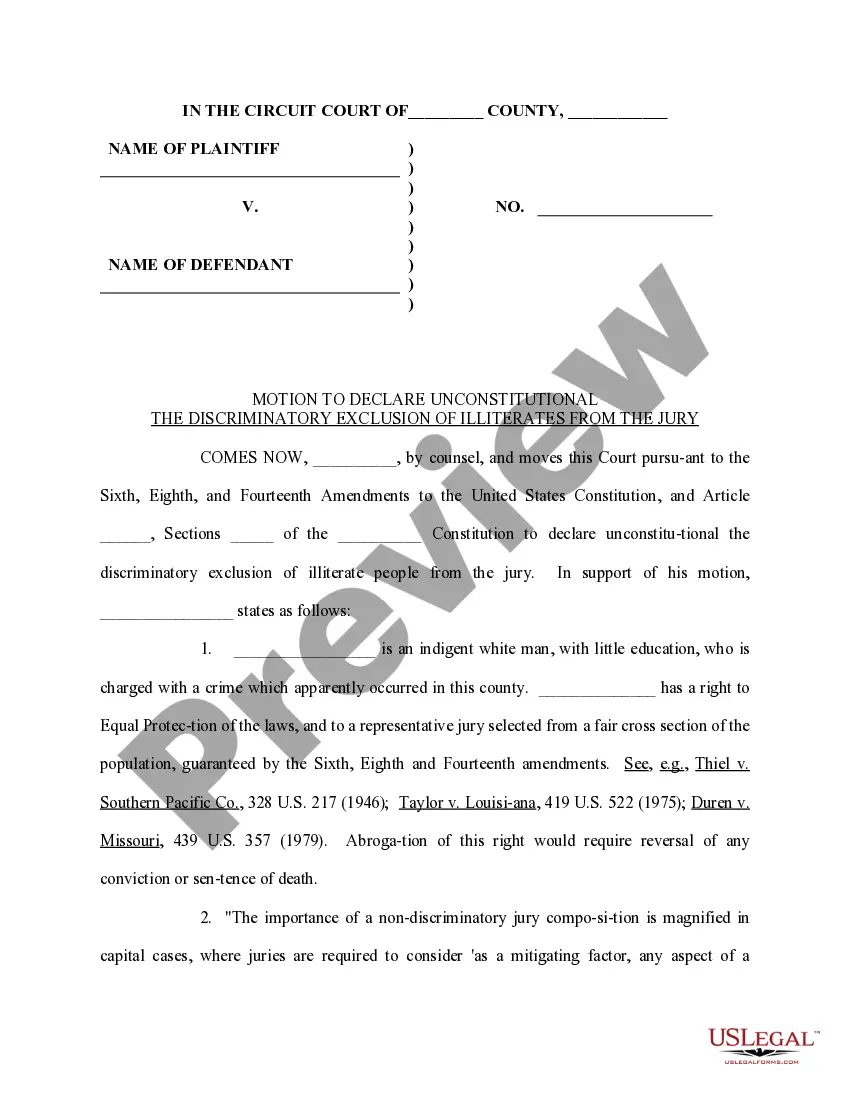
Motion to Declare Unconstitutional the Discriminatory Exclusion of Illiterates from the Jury
Overview of this form
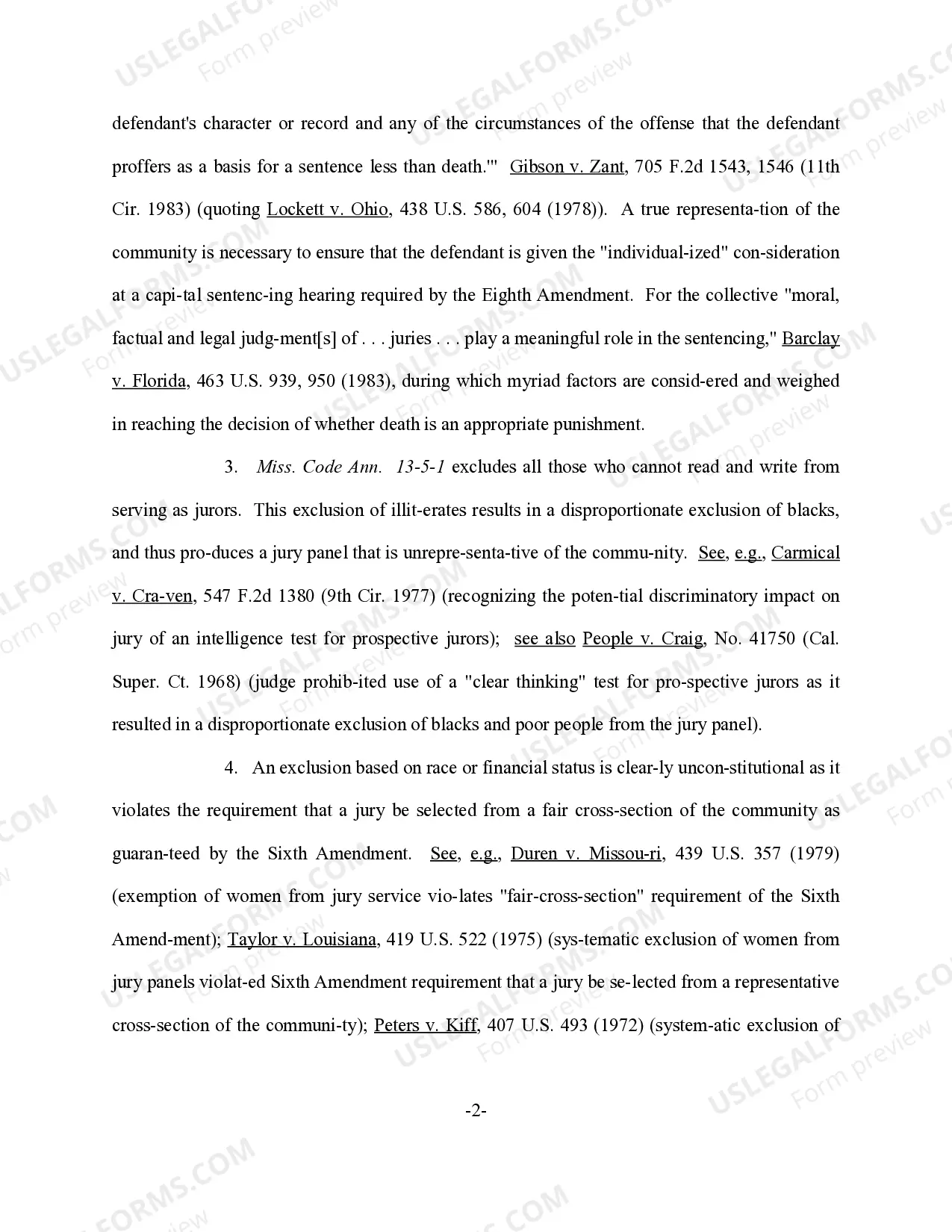
This form, known as the Motion to Declare Unconstitutional the Discriminatory Exclusion of Illiterates from the Jury, is a legal document requesting the court to declare that the exclusion of illiterate individuals from jury duty is discriminatory and unconstitutional. It provides legal arguments based on constitutional protections and relevant case law, distinguishing it from other motions related to jury selection and rights.
Main sections of this form
- Introduction that identifies the party making the motion and cites applicable constitutional amendments.
- Statement of the plaintiff's rights to equal protection and a representative jury.
- References to precedents that support the argument against discriminatory jury exclusions.
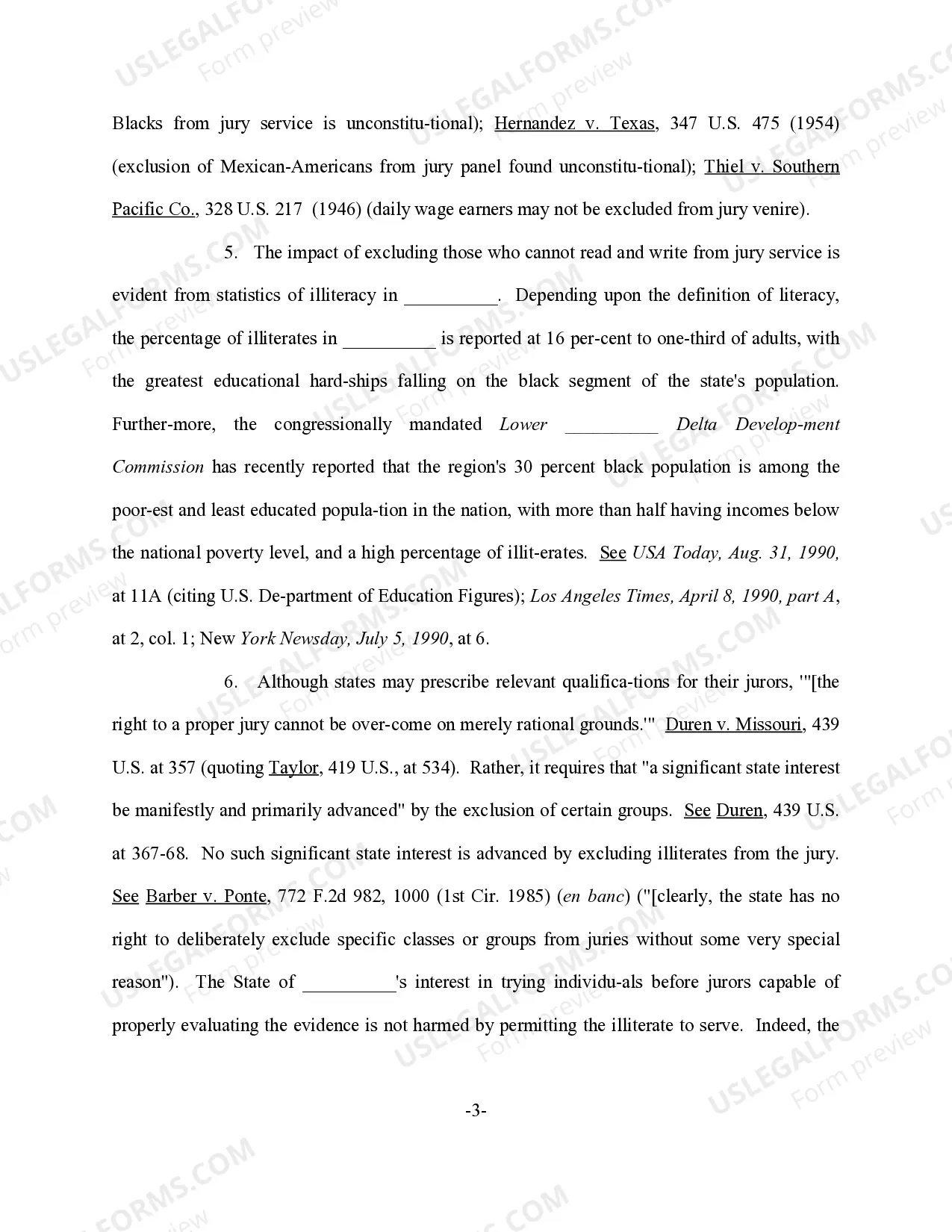
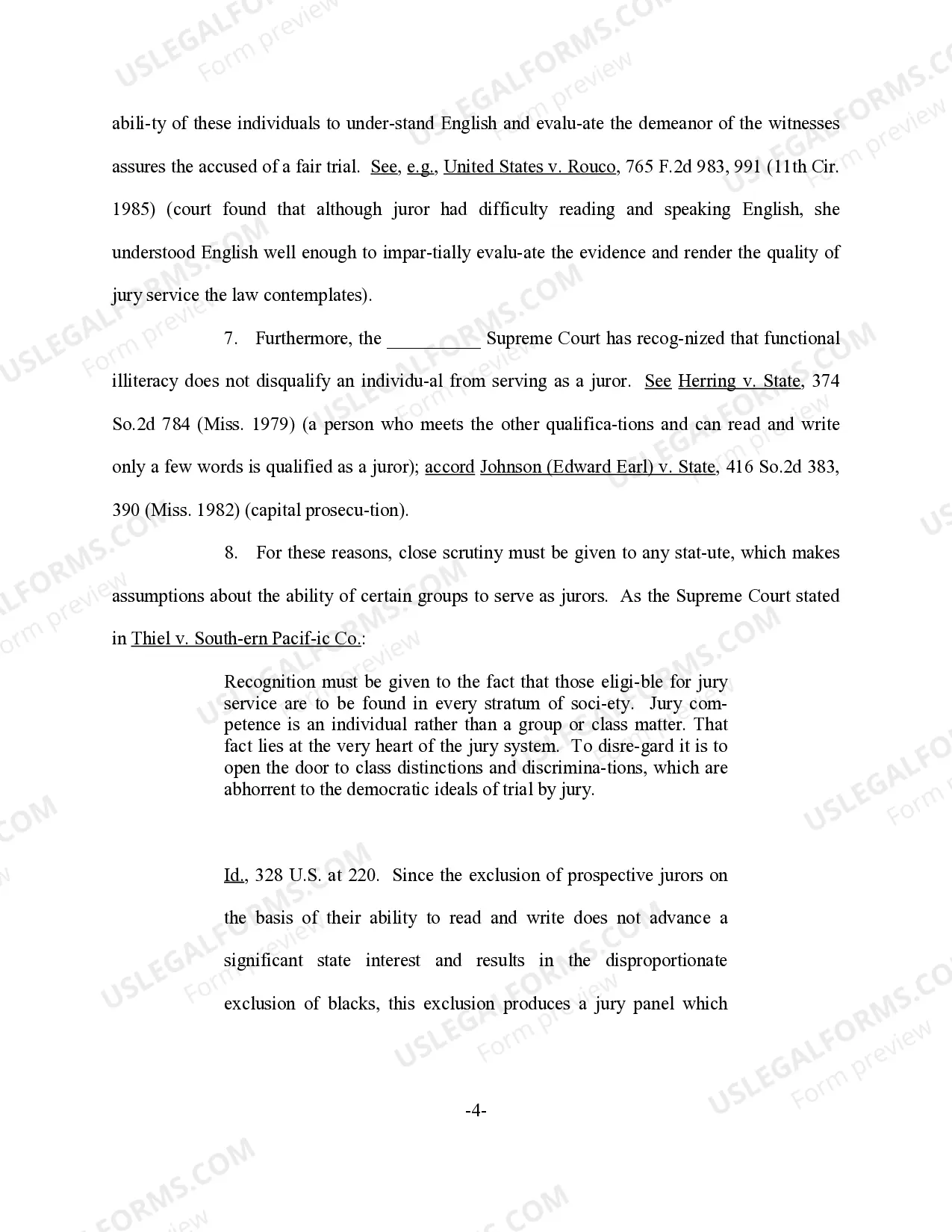
- Statistical evidence highlighting the impact of excluding illiterate individuals from jury service.
- Legal reasoning addressing state interests versus individual rights related to jury selection.
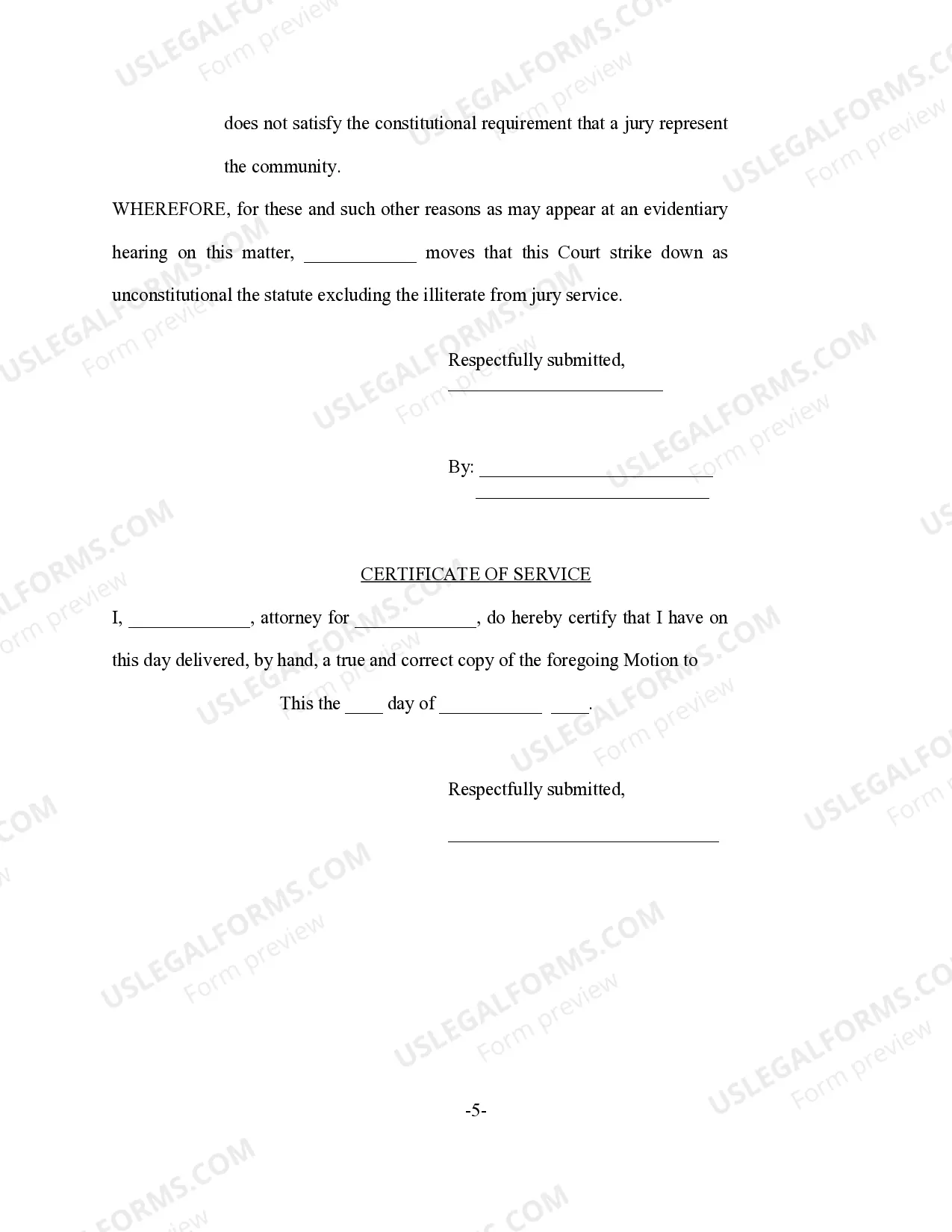
- A request for the court to strike down statutes excluding illiterates from jury duty.
When to use this document
This form should be used when an individual believes that their constitutional right to a fair trial is compromised due to the exclusion of illiterate persons from the jury pool. It is particularly relevant in cases involving serious criminal charges where a trial by a representative jury is critical. This motion may be necessary in jurisdictions that uphold literacy requirements for jury service, which could disproportionately affect certain populations.
Who can use this document
This form is intended for:
- Defendants facing criminal charges who are concerned about the composition of their jury.
- Legal practitioners representing clients in cases where jury exclusion based on literacy is an issue.
- Advocates for civil rights seeking to challenge discriminatory practices in the legal system.
How to prepare this document
- Identify the party making the motion and fill in their name.
- Provide details about the case, including charges and circumstances.
- Cite relevant constitutional amendments and legal precedents supporting your argument.
- Include statistical evidence regarding the illiteracy rate in the relevant population.
- Conclude with a clear request for the court to declare the exclusion unconstitutional.
- Sign and date the form, including a certificate of service if required.
Notarization guidance
In most cases, this form does not require notarization. However, some jurisdictions or signing circumstances might. US Legal Forms offers online notarization powered by Notarize, accessible 24/7 for a quick, remote process.
Get your form ready online
Our built-in tools help you complete, sign, share, and store your documents in one place.
Make edits, fill in missing information, and update formatting in US Legal Forms—just like you would in MS Word.
Download a copy, print it, send it by email, or mail it via USPS—whatever works best for your next step.
Sign and collect signatures with our SignNow integration. Send to multiple recipients, set reminders, and more. Go Premium to unlock E-Sign.
If this form requires notarization, complete it online through a secure video call—no need to meet a notary in person or wait for an appointment.
We protect your documents and personal data by following strict security and privacy standards.

Make edits, fill in missing information, and update formatting in US Legal Forms—just like you would in MS Word.

Download a copy, print it, send it by email, or mail it via USPS—whatever works best for your next step.

Sign and collect signatures with our SignNow integration. Send to multiple recipients, set reminders, and more. Go Premium to unlock E-Sign.

If this form requires notarization, complete it online through a secure video call—no need to meet a notary in person or wait for an appointment.

We protect your documents and personal data by following strict security and privacy standards.
Typical mistakes to avoid
- Failing to cite relevant legal precedents adequately.
- Neglecting to provide appropriate statistical data that supports the motion.
- Omitting necessary signatures or information in the certificate of service.
- Using vague language that does not clearly outline the discriminatory practices being challenged.
Why complete this form online
- Instant access to a professionally drafted legal document.
- Can be easily customized to fit individual circumstances and state-specific requirements.
- Convenient downloading and printing options for immediate use in court filings.
- Guidance throughout the form completion process to minimize errors.
Looking for another form?


Form popularity
FAQ
Influential examples of Supreme Court decisions that declared U.S. laws unconstitutional include Roe v. Wade (1973), which (unconstitutionally) declared that prohibiting abortion is unconstitutional, and Brown v. Board of Education (1954), which found racial segregation in public schools to be unconstitutional.
As of 2014, the United States Supreme Court has held 176 Acts of the U.S. Congress unconstitutional. In the period 1960-2019, the Supreme Court has held 483 laws unconstitutional in whole or in part.
State or local laws held to be preempted by federal law are void not because they contravene any provision of the Constitution, but rather because they confb02ict with a federal statute or treaty, and through operation of the Supremacy Clause.
Illegal means that a given activity by a person, group, or organization violates a law. Unconstitutional means that a law violates conditions laid down in the constitution, and therefore is not a law and is not enforceable... as applied by the independent judiciary, all the way up to the supreme court.
The judicial branch interprets laws and determines if a law is unconstitutional. The judicial branch includes the U.S. Supreme Court and lower federal courts. There are nine justices on the Supreme Court.
Unconstitutional refers to a government action which is in violation of the authority and rights defined and granted in the government's constitution.For example, the U.S. Constitution guarantees that the nation shall not have any particular religion imposed upon its citizens.
: not according or consistent with the constitution of a body politic (such as a nation) an unconstitutional infringement on rights.
When a law is declared unconstitutional, it can no longer be enforced within the jurisdiction of the court issuing that ruling.When a law is declared unconstitutional, it can no longer be enforced within the jurisdiction of the court issuing that ruling.
Illegal means that a given activity by a person, group, or organization violates a law. Unconstitutional means that a law violates conditions laid down in the constitution, and therefore is not a law and is not enforceable... as applied by the independent judiciary, all the way up to the supreme court.