Connecticut Subcontractors Package
About this form package
The Connecticut Subcontractors Package is a comprehensive collection of legal documents designed to assist subcontractors in managing their construction projects. This package includes vital forms that protect legal rights and streamline communication between parties involved in construction. Unlike generic forms, these documents are specifically drafted to comply with Connecticut state laws, ensuring that subcontractors can operate confidently within legal boundaries.
What’s included in this form package
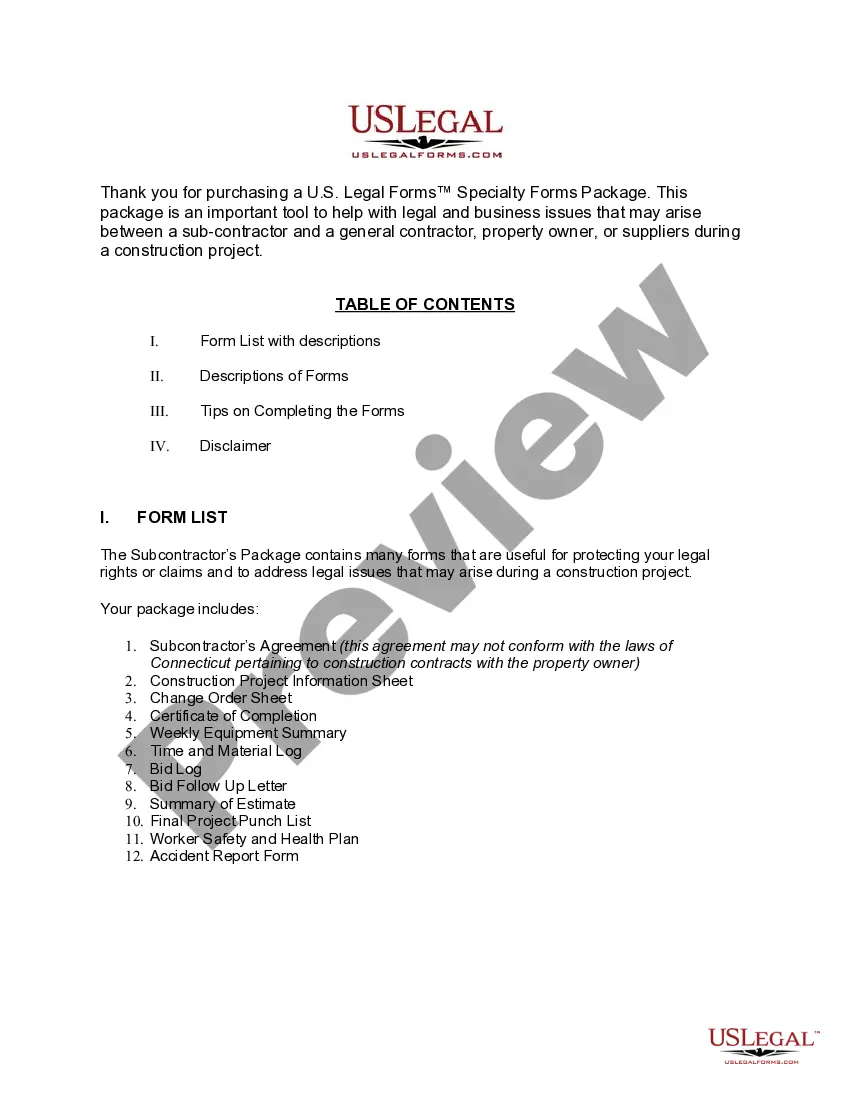
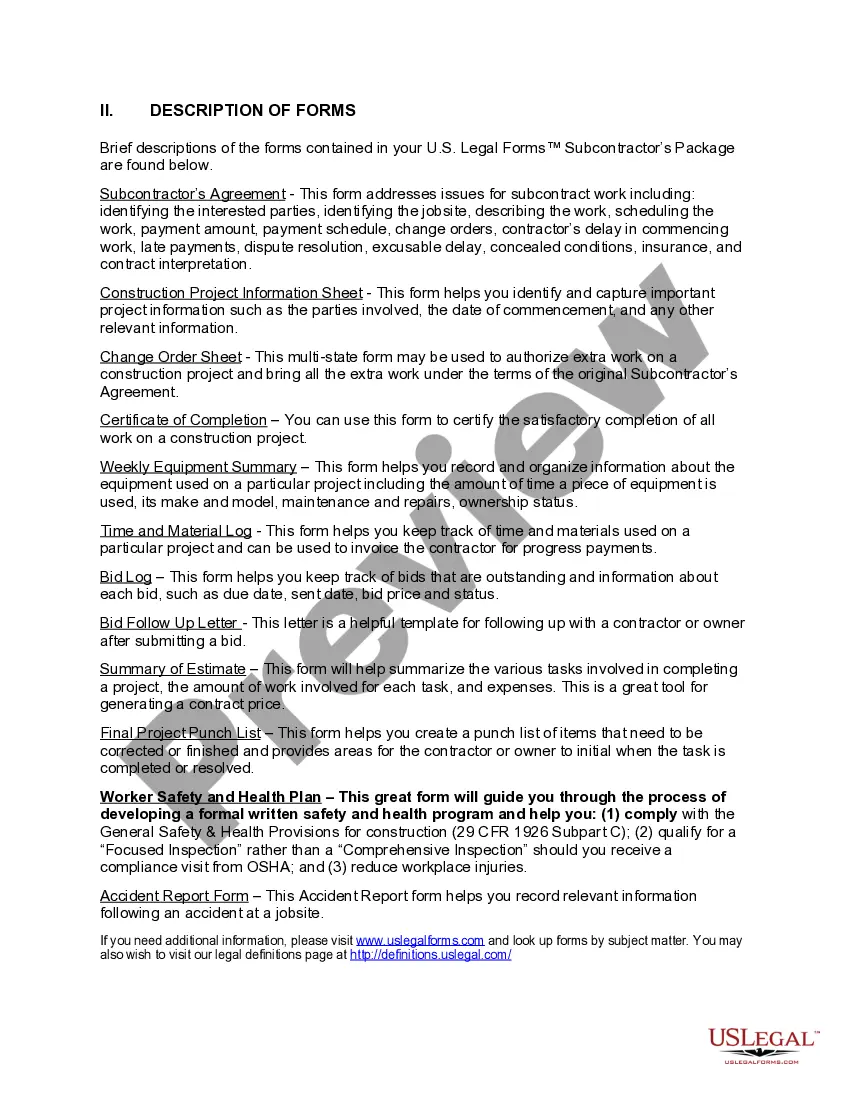
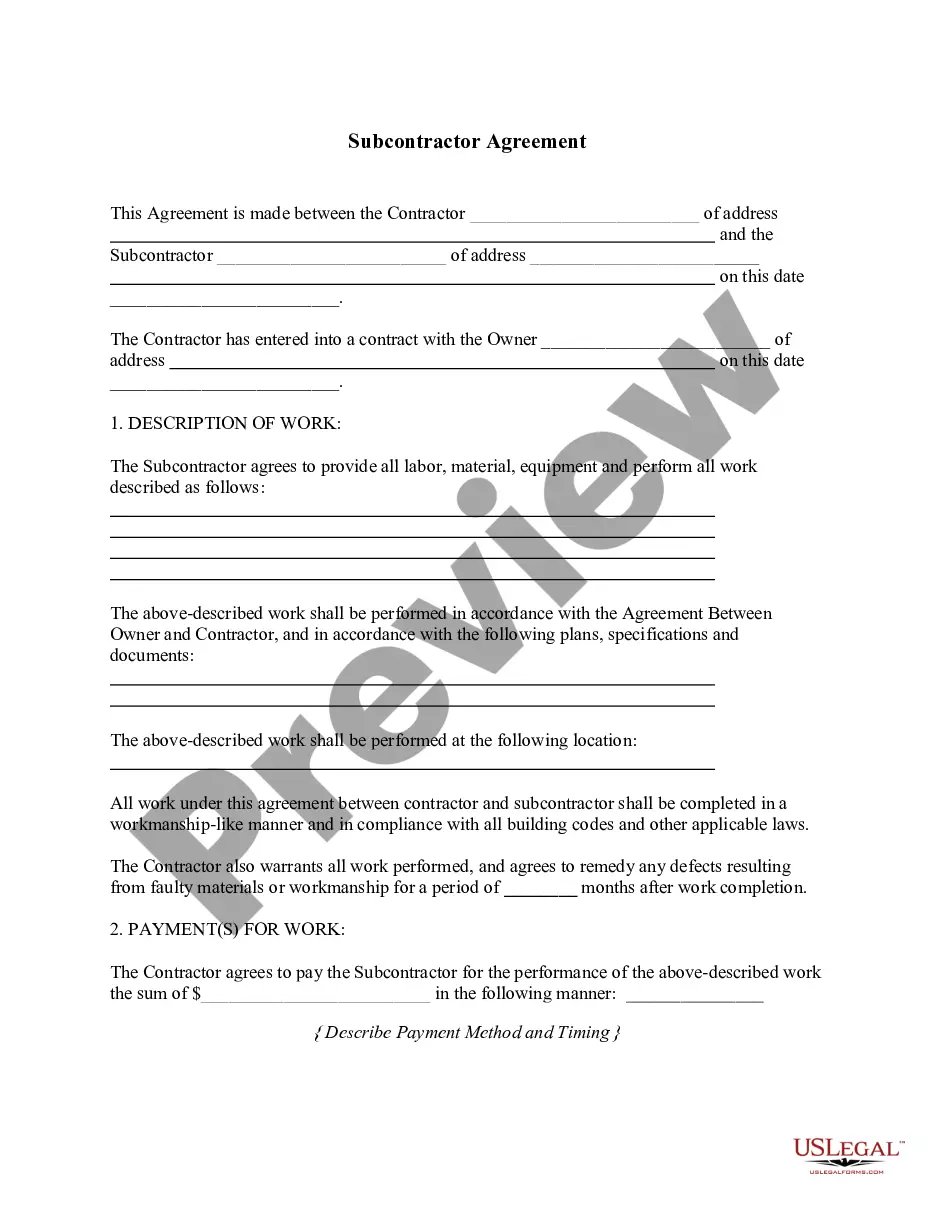
- Subcontractor's Agreement
- Contractor's Weekly Equipment Summary
- Contractor's Time and Materials Log
- Contractor's Bid Log
- Contractor's Bid Follow Up Letter
- Contractor's Summary of an Estimate
- Contractor's Final Punch List
- Construction Accident Report
- Construction Safety and Health Plan
- Change Order for Construction or Repairs by Contractor
- Certification of Completion by Contractor
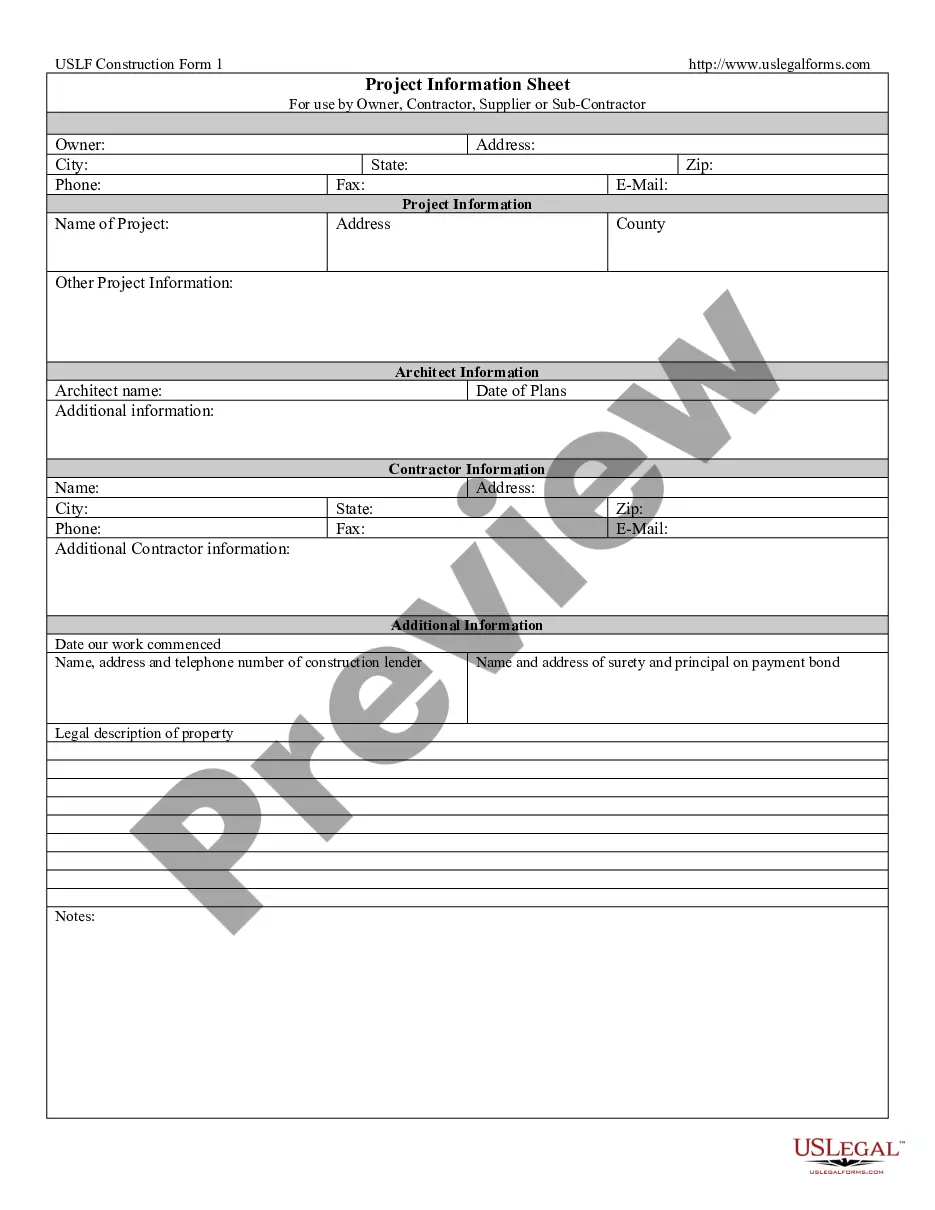
- Construction Project Information Sheet
Situations where these forms applies
This form package is useful in various scenarios, including:
- Beginning a new construction project as a subcontractor.
- Making changes to an existing contract with a client or contractor.
- Documenting equipment usage and labor hours for invoicing.
- Ensuring safety compliance on job sites.
- Finalizing project completion and filing necessary paperwork.
Who needs this form package
- Subcontractors in the construction industry working in Connecticut.
- Individuals entering into agreements with contractors or property owners.
- Construction professionals looking to document project details with legal forms.
- Anyone needing to comply with state-specific construction regulations.
Steps to complete these forms
- Review included forms to understand what is required.
- Gather necessary project information, including dates and parties involved.
- Complete the Subcontractor Agreement, ensuring compliance with state laws.
- Fill out additional forms like the Change Order Sheet and Weekly Equipment Summary as needed.
- Sign and date all completed forms, ensuring all parties do the same.
Notarization guidance for this package
Notarization is not commonly needed for forms in this package. However, if your state’s laws require it, our notarization service, powered by Notarize, allows you to finalize documents online 24/7 without in-person visits.
Get your form ready online
Our built-in tools help you complete, sign, share, and store your documents in one place.
Make edits, fill in missing information, and update formatting in US Legal Forms—just like you would in MS Word.
Download a copy, print it, send it by email, or mail it via USPS—whatever works best for your next step.
Sign and collect signatures with our SignNow integration. Send to multiple recipients, set reminders, and more. Go Premium to unlock E-Sign.
If this form requires notarization, complete it online through a secure video call—no need to meet a notary in person or wait for an appointment.
We protect your documents and personal data by following strict security and privacy standards.

Make edits, fill in missing information, and update formatting in US Legal Forms—just like you would in MS Word.

Download a copy, print it, send it by email, or mail it via USPS—whatever works best for your next step.

Sign and collect signatures with our SignNow integration. Send to multiple recipients, set reminders, and more. Go Premium to unlock E-Sign.

If this form requires notarization, complete it online through a secure video call—no need to meet a notary in person or wait for an appointment.

We protect your documents and personal data by following strict security and privacy standards.
Common mistakes
- Failing to complete all relevant forms for a project.
- Not reviewing the Subcontractor Agreement for state compliance.
- Omitting signatures or dates, rendering forms invalid.
- Neglecting to keep records of changes made during the project.
Why complete this package online
- Convenience of downloading and printing forms at any time.
- Editability allows for easy customization of forms to fit specific projects.
- Reliable, attorney-drafted documents ensure legal compliance.
- Access to a wide array of forms tailored specifically for subcontractors.
Looking for another form?

Form popularity
FAQ
Yes, there is a legal distinction between contractors and consultants. A contractor is directly responsible for project execution and may hire subcontractors, while a consultant typically provides advice and guidance without direct involvement in project implementation. Knowing these differences is crucial for legal clarity and effective project management, which can be aided by a Connecticut Subcontractors Package.
A sub agreement is a specific type of contract that outlines the terms between a contractor and a subcontractor. While all sub agreements are contracts, not all contracts are sub agreements. Understanding these differences can clarify your responsibilities and rights. Thus, using a Connecticut Subcontractors Package provides the right templates to avoid confusion.
Yes, an independent contractor can act as a subcontractor for a project. This often occurs when specialized skills are required that the main contractor doesn't possess. By hiring independent contractors as subcontractors, you can access a variety of expertise while using a flexible approach. A Connecticut Subcontractors Package can assist you in establishing clear agreements.
A contractor manages the overall construction process, while a subconsultant provides specialized expertise in areas such as design or engineering. This distinction is important because subconsultants often work under a contractor’s guidance to enhance project outcomes. Understanding these roles can help streamline your project, especially with the right Connecticut Subcontractors Package.
When hiring a subcontractor, ensure you have the right paperwork in place. You'll need a subcontractor agreement that outlines the work scope, payment terms, and timelines. Additionally, collecting W-9 forms and proof of insurance adds a level of protection. This helps create a solid foundation for a successful project, especially with a well outlined Connecticut Subcontractors Package.
No, a contractor and a subcontractor serve different roles in a construction project. A contractor oversees the entire project and directly manages the client, whereas a subcontractor specializes in specific tasks, such as plumbing or electrical work. Both are vital, but their responsibilities differ. To navigate these distinctions effectively, consider exploring a Connecticut Subcontractors Package.
General contractors often find subcontractors through recommendations, industry events, and online platforms. Utilizing a Connecticut Subcontractors Package can streamline the process by providing leads and facilitating connections. Building a strong online presence also helps showcase your skills and services, making it easier for general contractors to discover you. Networking within your local construction community can further enhance your visibility and opportunities.
The three main types of subcontractors include specialty subcontractors, who focus on specific trades, general subcontractors, who manage various aspects of the project, and professional service subcontractors, who offer expertise such as legal and financial services. Identifying your role as a subcontractor in the context of a Connecticut Subcontractors Package can enhance your effectiveness and ensure compliance with local regulations. Each type plays a crucial role in completing construction projects successfully.
To enter government subcontracting, start by understanding the bidding process for government contracts. Next, secure the necessary licenses and permits to operate legally in Connecticut. Consider investing in a Connecticut Subcontractors Package, which provides essential tools and resources for effective bidding and compliance. Additionally, networking with general contractors can open doors to potential subcontracting opportunities.
An example of a contractor is a general contractor who manages the construction of a new home. They may hire subcontractors for specific tasks such as electricians to handle wiring or plumbers for installing fixtures. Utilizing the Connecticut Subcontractors Package can help define and clarify these roles, protecting both contractors and subcontractors in the process.