Colorado Living Trust Property Record
What this document covers
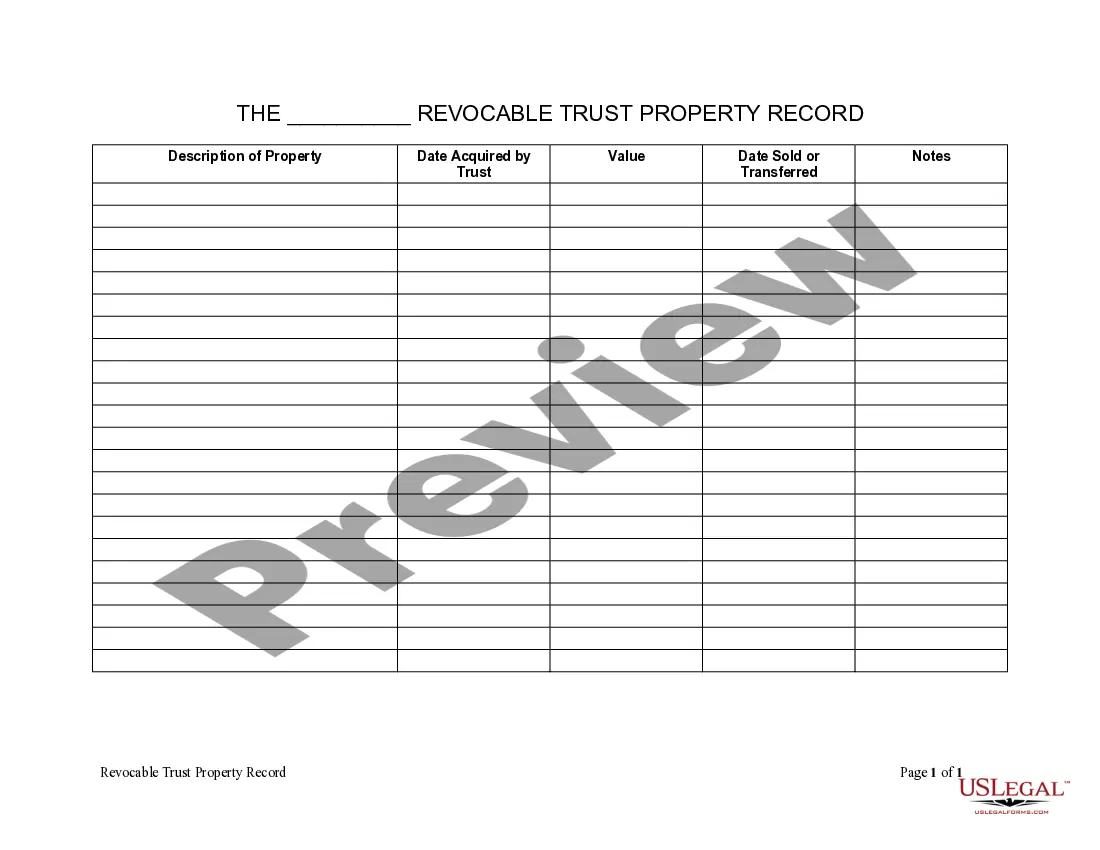
The Living Trust Property Record is a legal document that allows the Trustee to catalog the assets placed within a living trust. A living trust is a trust established during an individual's lifetime to manage their property, typically for estate planning purposes. This form is essential for accurately recording details about the property within the trust, including descriptions, acquisition dates, values, and any transfers or sales. Unlike other legal forms, this document specifically targets the inventory of trust property to ensure comprehensive record-keeping.
Key parts of this document
- Description of property: A detailed account of each asset, including any specific identifying information.
- Date acquired by trust: The date that each property was transferred into the trust.
- Value: The estimated worth of each property at the time it was added to the trust.
- Date sold or transferred: Information regarding any subsequent transactions involving the trust assets.

When this form is needed
This form is used when establishing a living trust or when updating the inventory of assets held within an existing trust. It is particularly important during estate planning to ensure that all assets are accurately recorded for management and distribution purposes. You may need this form when adding, selling, or transferring properties within the trust, or if you need to provide an accounting of the trust assets to beneficiaries.
Who can use this document
This form is suitable for:
- Trustees responsible for managing a living trust.
- Individuals setting up a living trust to manage their assets.
- Estate planners or attorneys assisting clients with trust documentation.
Instructions for completing this form
- Identify the properties to be included in the trust.
- Record each property's description clearly.
- Enter the date when the property was acquired by the trust.
- Specify an accurate value for each property at the time of trust funding.
- Document any transfer or sale of property by noting the date and details.
Does this document require notarization?
This form does not typically require notarization unless specified by local law. However, always check the specific requirements in your jurisdiction to ensure compliance.
Get your form ready online
Our built-in tools help you complete, sign, share, and store your documents in one place.
Make edits, fill in missing information, and update formatting in US Legal Forms—just like you would in MS Word.
Download a copy, print it, send it by email, or mail it via USPS—whatever works best for your next step.
Sign and collect signatures with our SignNow integration. Send to multiple recipients, set reminders, and more. Go Premium to unlock E-Sign.
If this form requires notarization, complete it online through a secure video call—no need to meet a notary in person or wait for an appointment.
We protect your documents and personal data by following strict security and privacy standards.

Make edits, fill in missing information, and update formatting in US Legal Forms—just like you would in MS Word.

Download a copy, print it, send it by email, or mail it via USPS—whatever works best for your next step.

Sign and collect signatures with our SignNow integration. Send to multiple recipients, set reminders, and more. Go Premium to unlock E-Sign.

If this form requires notarization, complete it online through a secure video call—no need to meet a notary in person or wait for an appointment.

We protect your documents and personal data by following strict security and privacy standards.
Mistakes to watch out for
- Failing to update the record when properties are sold or transferred.
- Providing vague property descriptions that lack specificity.
- Not including the date of acquisition, leading to incomplete records.
Why use this form online
- Convenience: Access and complete the form at any time from your home.
- Editability: Easily update property details as needed.
- Reliability: All forms are drafted by licensed attorneys, ensuring legal accuracy.
Looking for another form?
Form popularity
FAQ
Yes, property records in Colorado are public and can be accessed by anyone. These records provide information about property ownership, sales history, and tax status. If you are managing a Colorado Living Trust Property Record, it is crucial to understand how these public records work, as they can affect your estate planning and property management decisions.
Trusts do not need to register with the Colorado Secretary of State. While some business entities require registration, a living trust operates differently. Instead, focus on managing the assets within your trust, including your Colorado Living Trust Property Record, which allows for efficient asset distribution without probate.
Trusts in Colorado are generally not registered with any state entity, as Colorado law does not require trusts to be registered. However, certain documents, including the trust agreement, should be maintained for your records. While it may not be necessary to register a trust, properly handling a Colorado Living Trust Property Record can ensure clarity in property management and inheritance.
Yes, you can write your own living trust in Colorado. When crafting your living trust, ensure it outlines how your assets will be managed and distributed during your lifetime and after your death. Self-prepared trusts can save costs, but they also require careful attention to detail to comply with Colorado laws. Platforms like US Legal Forms provide templates and support, ensuring your Colorado Living Trust Property Record is both effective and valid.
Yes, you can write your own trust in Colorado, but it's essential to understand the requirements. For a trust to be valid, it must meet state law requirements, including proper documentation and signatures. Additionally, a well-drafted trust can protect your assets and simplify the transfer of property upon your passing. Consider using resources like US Legal Forms, which can guide you in creating a compliant Colorado Living Trust Property Record.
Trusts are not considered public records in Colorado. The Colorado Living Trust Property Record may provide some details related to asset ownership but keeps the specifics of the trust and its beneficiaries private. This confidentiality can protect the interests of those involved, making it an appealing option for many. If you need help understanding trust records, uslegalforms can provide resources and templates to ensure you comply with state laws.
Finding members of a trust can be challenging because the details are typically not public information. While the Colorado Living Trust Property Record may indicate the existence of a trust, it usually does not disclose personal information of the trust's members. If you need to find out about trust members for legal or personal reasons, working with a legal professional could be beneficial. They can assist you in navigating the complexities of trust privacy.
In Colorado, beneficiaries generally have a right to request a copy of the trust document. This right allows beneficiaries to understand their entitlements under the trust and how the Colorado Living Trust Property Record is managed. However, the specific terms of the trust also play a crucial role in determining what information beneficiaries can access. Consulting with legal experts can help clarify these rights and responsibilities.
Yes, a trust can hold title to real property in Colorado. When properly established, a Colorado Living Trust can own real estate, which helps in managing and distributing assets according to the terms of the trust. This arrangement often provides benefits such as avoiding probate and maintaining privacy. If you're considering this option, using a platform like uslegalforms can offer guidance on creating a trust that suits your needs.
While a living trust itself does not need to be recorded, any real property owned by the trust should be recorded for legal clarity. This prevents disputes and provides clear ownership records. Using a Colorado Living Trust Property Record can help you manage these assets effectively. It is beneficial to seek professional advice on how to best document your trust.