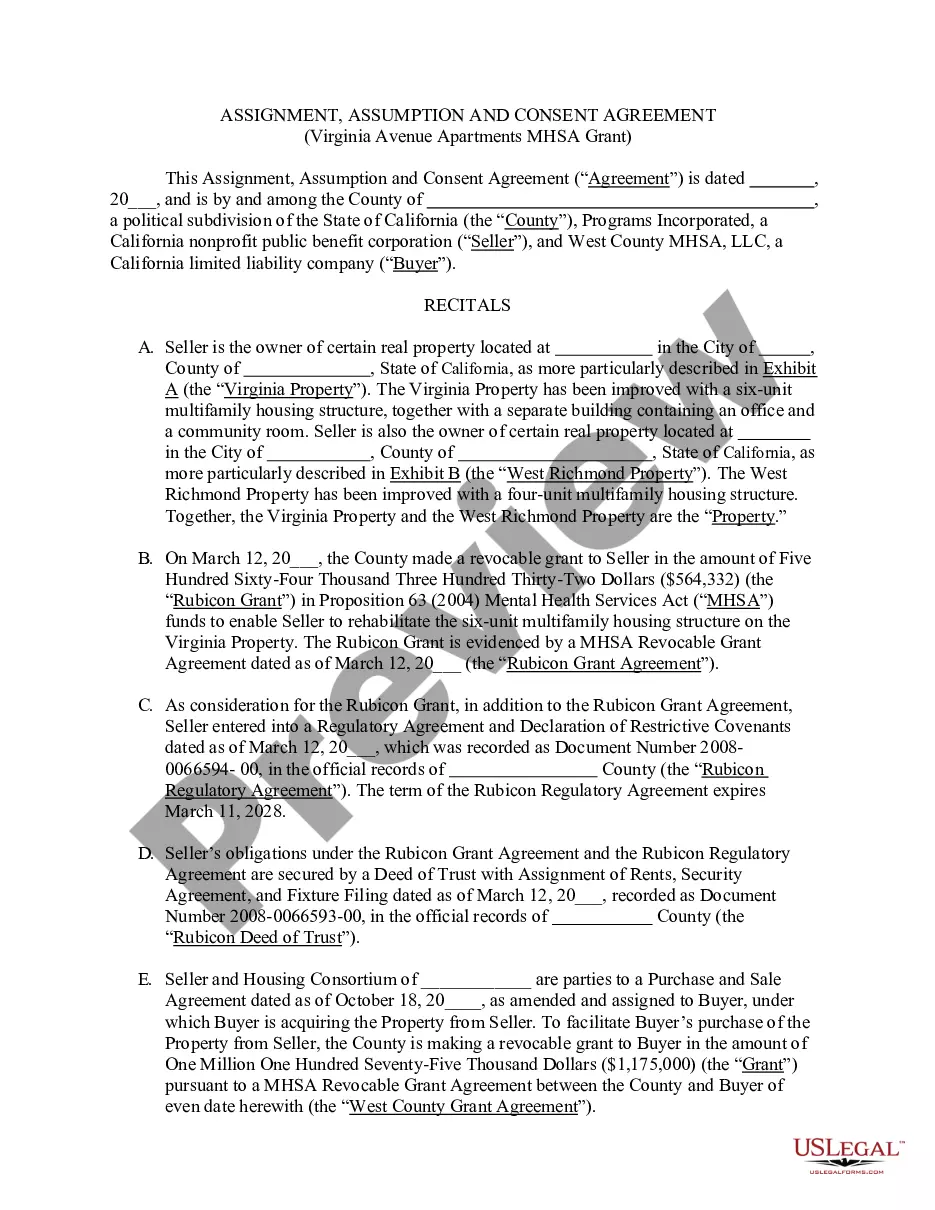
California Assignment, Assumption, and Consent Agreement involving a MHSA Grant
What this document covers
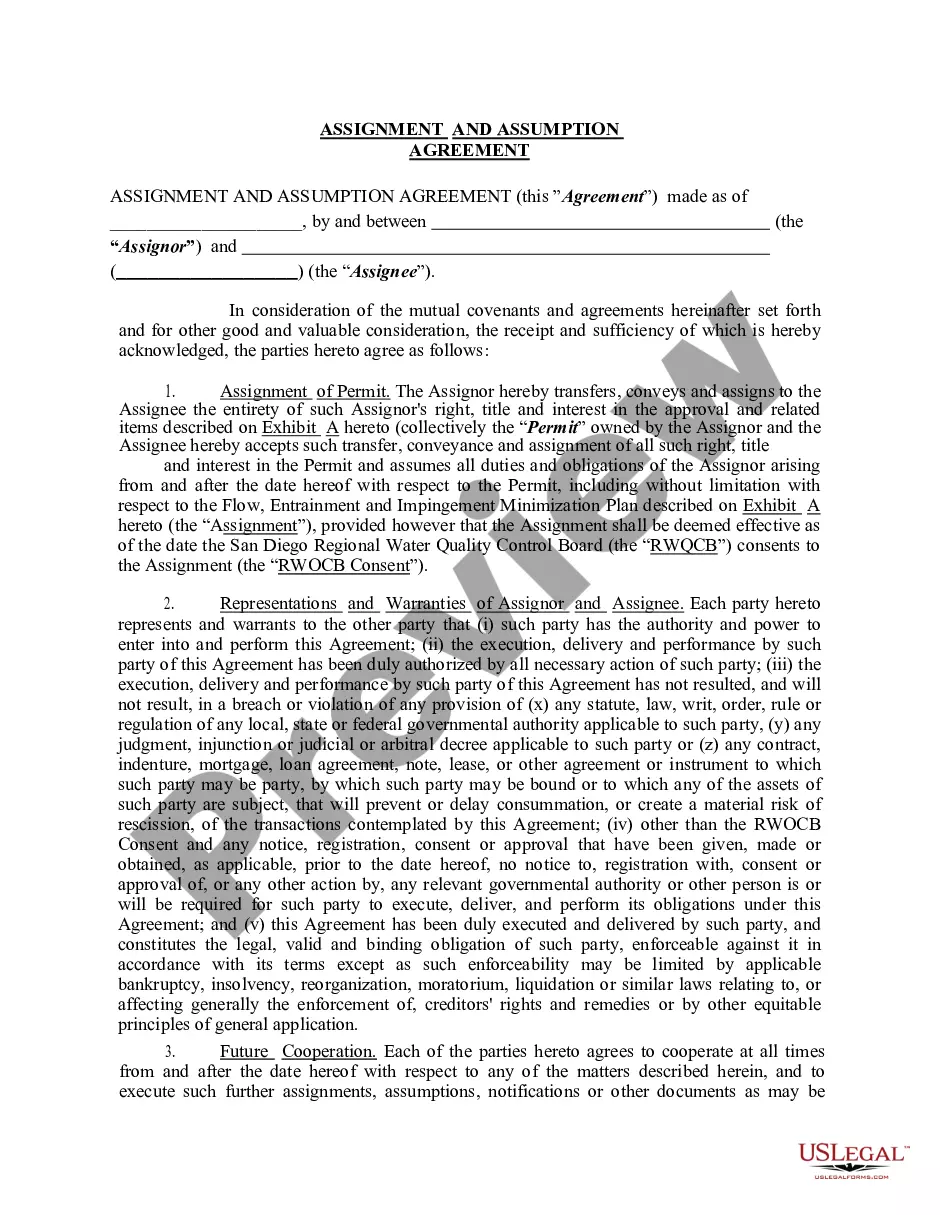
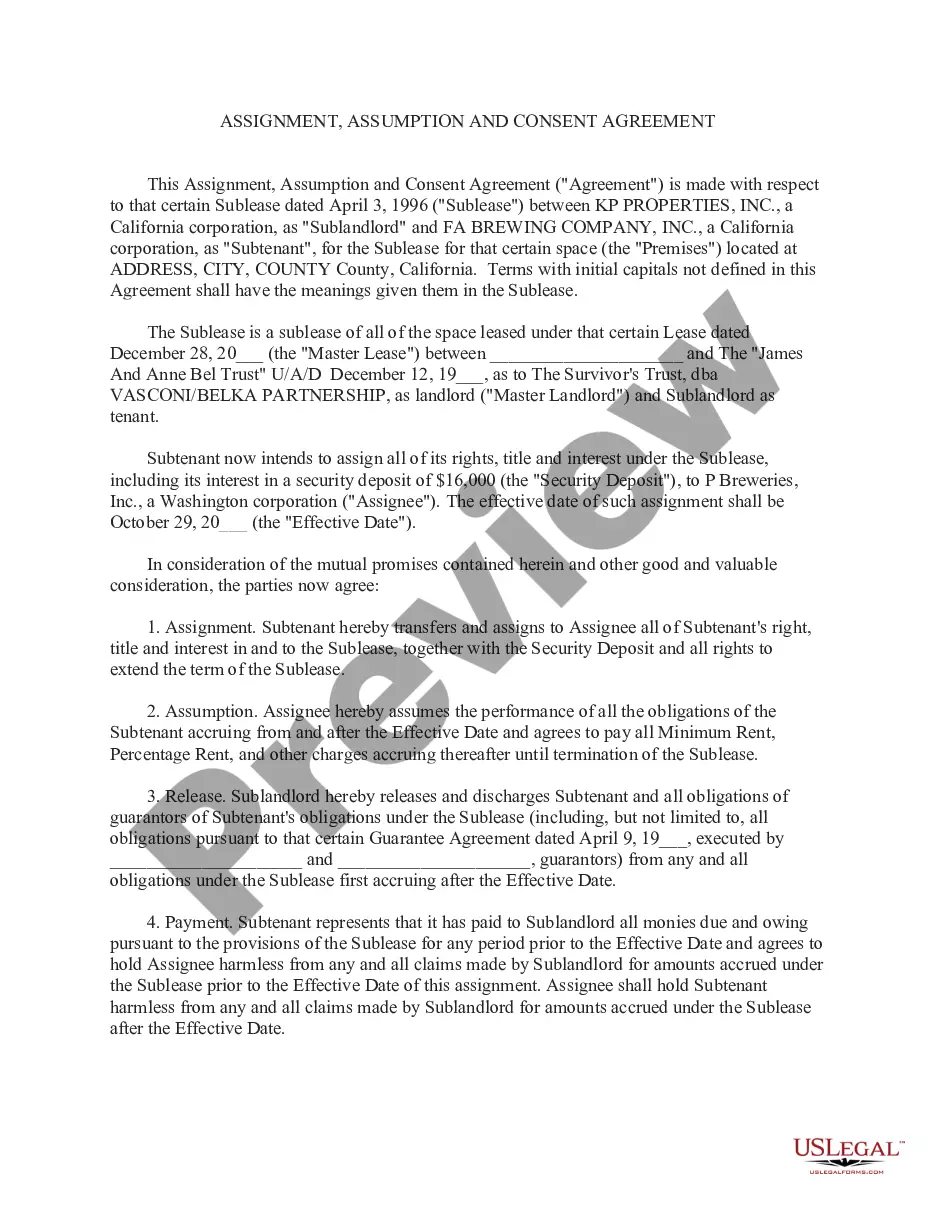
This Assignment, Assumption, and Consent Agreement involves a MHSA Grant is a legal document that facilitates the transfer of rights and obligations pertaining to a grant from one party to another. Specifically, this form allows the assignor, or original grant holder, to assign their rights under the Mental Health Services Act (MHSA) grant to a new party, known as the assignee. It ensures that the new party assumes the responsibilities associated with the grant, which is crucial for proper compliance with regulatory guidelines and funding requirements.
Key parts of this document
- Date of the agreement.
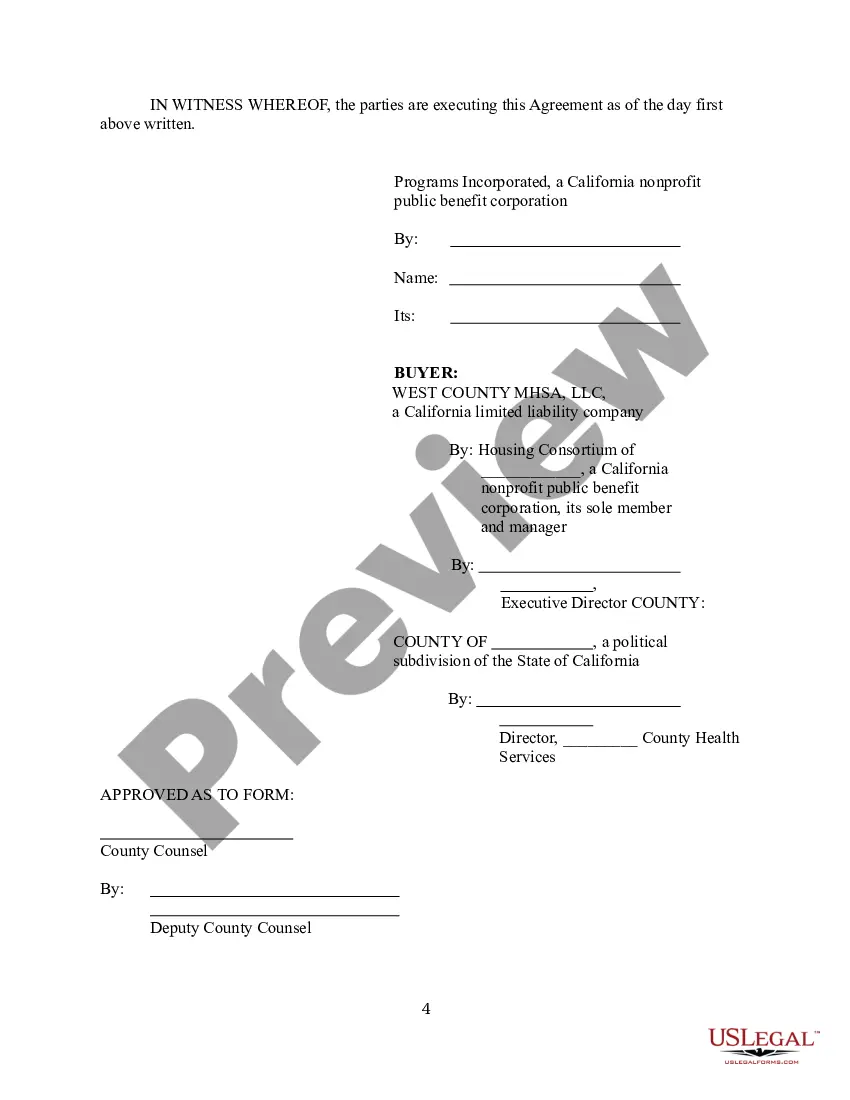
- Identification of the parties involved: assignor (Seller), assignee (Buyer), and the County.
- Recitals detailing the history of the grant and properties involved.
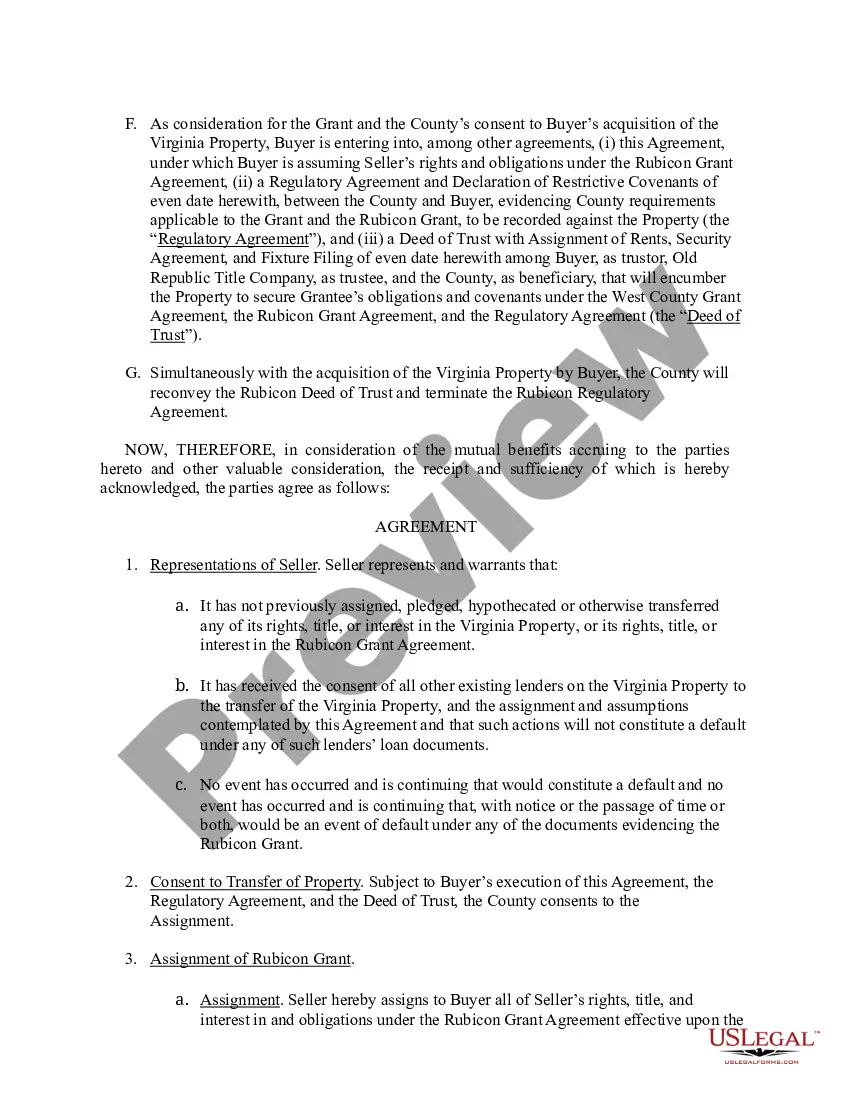
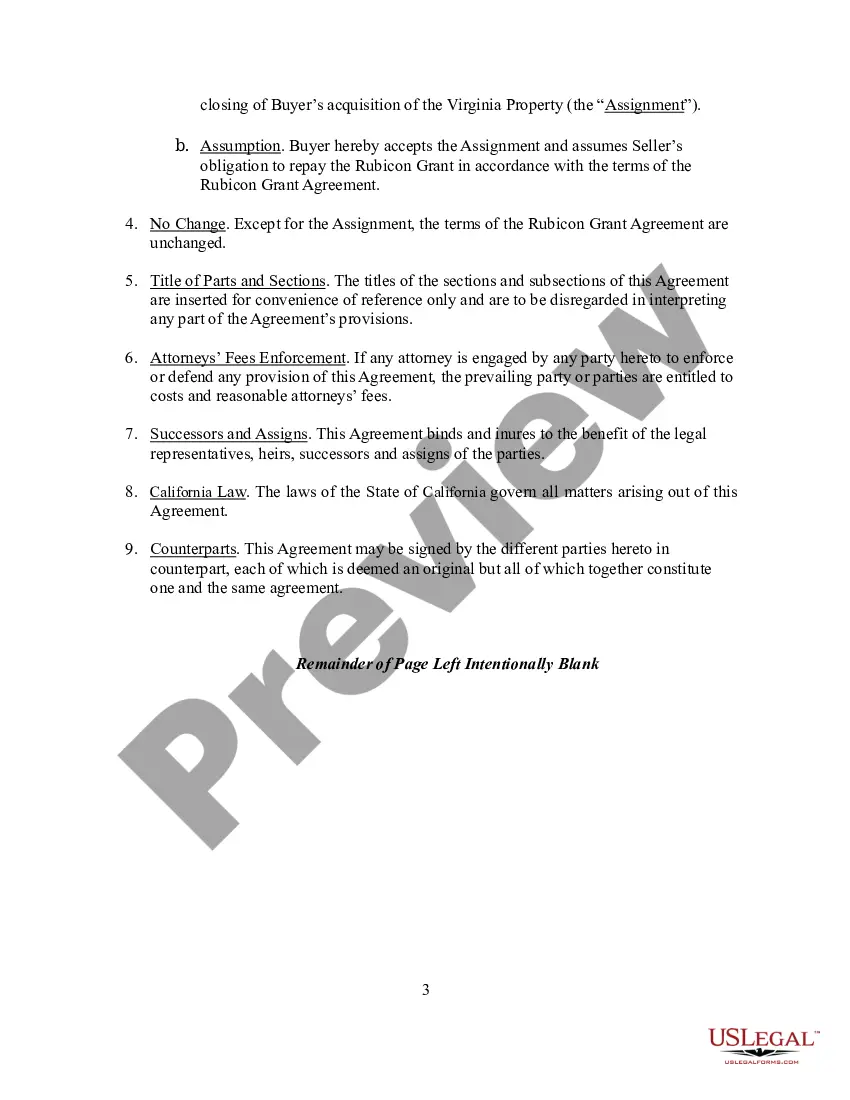
- Assignment and assumption of the grant rights and obligations.
- Representations and warranties made by the Seller regarding the property and grant.
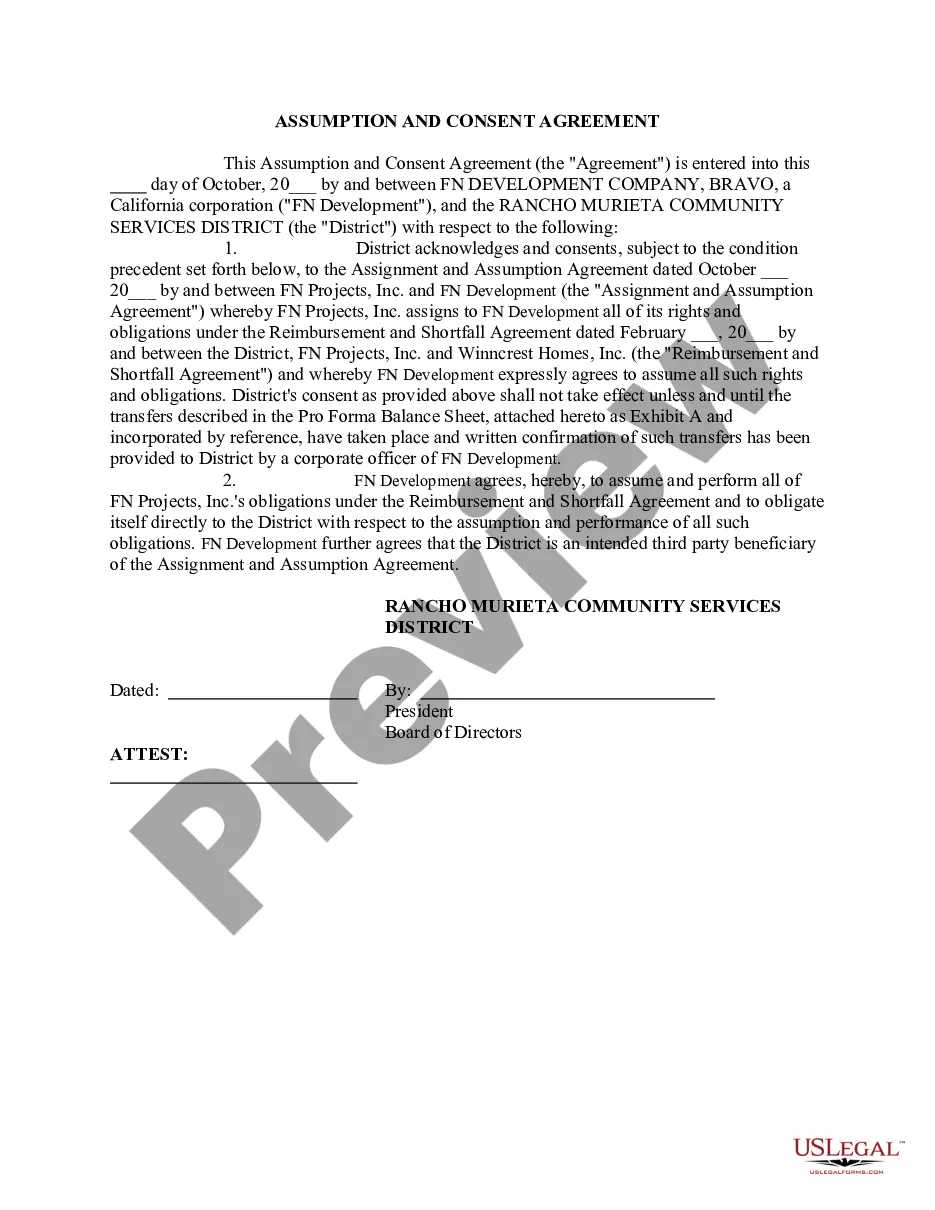
- Consent from the County for the assignment.
Common use cases
This form should be used when a party holding a MHSA grant wants to transfer their rights and obligations to another entity. This scenario typically arises during real estate transactions involving properties funded by MHSA grants, where the new buyer needs to assume responsibility for the grant terms. Using this form ensures that all parties are aware of their rights and obligations and formalizes the agreement to prevent future disputes.
Who this form is for
This form is intended for:
- Nonprofit organizations that have received MHSA grants and wish to transfer their obligations.
- Purchasers of properties funded by MHSA grants who need to assume responsibilities attached to the grant.
- Legal professionals assisting clients in real estate transactions involving MHSA grants.
How to prepare this document
- Identify the parties: Fill in the names of the assignor, assignee, and the County.
- Enter the date of the agreement.
- Provide the legal descriptions of the properties involved, including any necessary exhibits.
- Detail the obligations being transferred under the grant agreement.
- Ensure all parties involved review and sign the document.
- Retain copies for all parties for their records.
Does this form need to be notarized?
This form does not typically require notarization unless specified by local law. Always check local regulations to ensure compliance with any notarization requirements that might apply to your specific situation.
Get your form ready online
Our built-in tools help you complete, sign, share, and store your documents in one place.
Make edits, fill in missing information, and update formatting in US Legal Forms—just like you would in MS Word.
Download a copy, print it, send it by email, or mail it via USPS—whatever works best for your next step.
Sign and collect signatures with our SignNow integration. Send to multiple recipients, set reminders, and more. Go Premium to unlock E-Sign.
If this form requires notarization, complete it online through a secure video call—no need to meet a notary in person or wait for an appointment.
We protect your documents and personal data by following strict security and privacy standards.

Make edits, fill in missing information, and update formatting in US Legal Forms—just like you would in MS Word.

Download a copy, print it, send it by email, or mail it via USPS—whatever works best for your next step.

Sign and collect signatures with our SignNow integration. Send to multiple recipients, set reminders, and more. Go Premium to unlock E-Sign.

If this form requires notarization, complete it online through a secure video call—no need to meet a notary in person or wait for an appointment.

We protect your documents and personal data by following strict security and privacy standards.
Typical mistakes to avoid
- Failing to include complete and accurate property descriptions.
- Not obtaining necessary consents from lenders or regulatory bodies.
- Leaving forms unsigned by one or more parties.
- Neglecting to specify the effective date of the assignment.
Advantages of online completion
- Convenient access to legal templates tailored for California's requirements.
- Edit the form easily to meet the specific circumstances of your transaction.
- Downloadable for immediate use, saving time on paperwork.
- Ensures the inclusion of all necessary legal clauses to mitigate risks.
Legal use & context
- This form formalizes the transfer of grant rights and obligations, ensuring clarity in responsibilities among parties.
- Failure to use this form can result in disputes regarding the applicability of grant obligations and rights.
- The agreement helps satisfy regulatory compliance for MHSA grant stipulations.
What to keep in mind
- Essential for transferring MHSA grant obligations to a new party.
- Must include accurate information about the parties and properties involved.
- Consult local laws to ensure all requirements are met.
- Can prevent legal disputes by clearly outlining rights and obligations
Looking for another form?

Form popularity
FAQ
The MHSA Act stands for the Mental Health Services Act, which was passed to improve mental health services across California. It promotes a community-based approach to mental health care, encouraging collaboration among various stakeholders. If you are working on the California Assignment, Assumption, and Consent Agreement involving a MHSA Grant, understanding the MHSA Act is essential for aligning projects with available funding and resources.
Proposition 63, also known as the Mental Health Services Act, raised funding for mental health services through a tax on high-income earners. This initiative aims to transform California's mental health system by providing comprehensive care and reducing stigma. It relates directly to the California Assignment, Assumption, and Consent Agreement involving a MHSA Grant, as it provides crucial funding to ensure quality mental health services are accessible.
The 3 month rule in mental health refers to a standard assessment period where mental health services evaluate an individual's progress. This rule affects how funding and resources are allocated in California's mental health system. Knowledge of this rule is vital for those involved in the California Assignment, Assumption, and Consent Agreement involving a MHSA Grant, as it impacts the overall effectiveness of services provided.
The Mental Health Act 63 is a crucial piece of legislation in California that focuses on mental health policy and service improvements. It emphasizes the necessity for facilities to meet the needs of individuals facing mental health challenges. Understanding this act can help stakeholders navigate the California Assignment, Assumption, and Consent Agreement involving a MHSA Grant effectively, ensuring compliance and positive outcomes.
To assign an agreement, first check whether the original contract allows for assignments and if consent is required. Once confirmed, draft the California Assignment, Assumption, and Consent Agreement involving a MHSA Grant, ensuring it details the parties, rights transferred, and any obligations. Ultimately, sign the document to finalize the assignment and maintain a copy for your records.
Another example is when a contractor assigns their construction contract to a different subcontractor. In this situation, the original terms must remain intact, which aligns with the principles of a California Assignment, Assumption, and Consent Agreement involving a MHSA Grant. Proper documentation ensures all parties know their obligations moving forward.
An example of assignment of a contract is when a business sells its service contract to another company. This situation may involve a California Assignment, Assumption, and Consent Agreement involving a MHSA Grant to formalize the transfer. The original party maintains responsibility as long as the buyer does not default on the agreement.
Yes, in most cases, the seller must agree to the assignment of the contract unless the original agreement states otherwise. This is particularly crucial in the context of a California Assignment, Assumption, and Consent Agreement involving a MHSA Grant, as it protects the interests of all involved parties. Always seek written approval to avoid misunderstandings.
An example of a legal assignment is when a tenant transfers their lease to another individual. In this scenario, the landlord must consent to the change to align with the California Assignment, Assumption, and Consent Agreement involving a MHSA Grant. This ensures all parties acknowledge and accept the new arrangement, thereby maintaining legal clarity.
To create a valid assignment, ensure the original contract allows assignments, and obtain consent if required. Additionally, the assignment must be in writing, clearly specify the rights being assigned, and identify the parties involved. A California Assignment, Assumption, and Consent Agreement involving a MHSA Grant simplifies these requirements to meet legal standards.