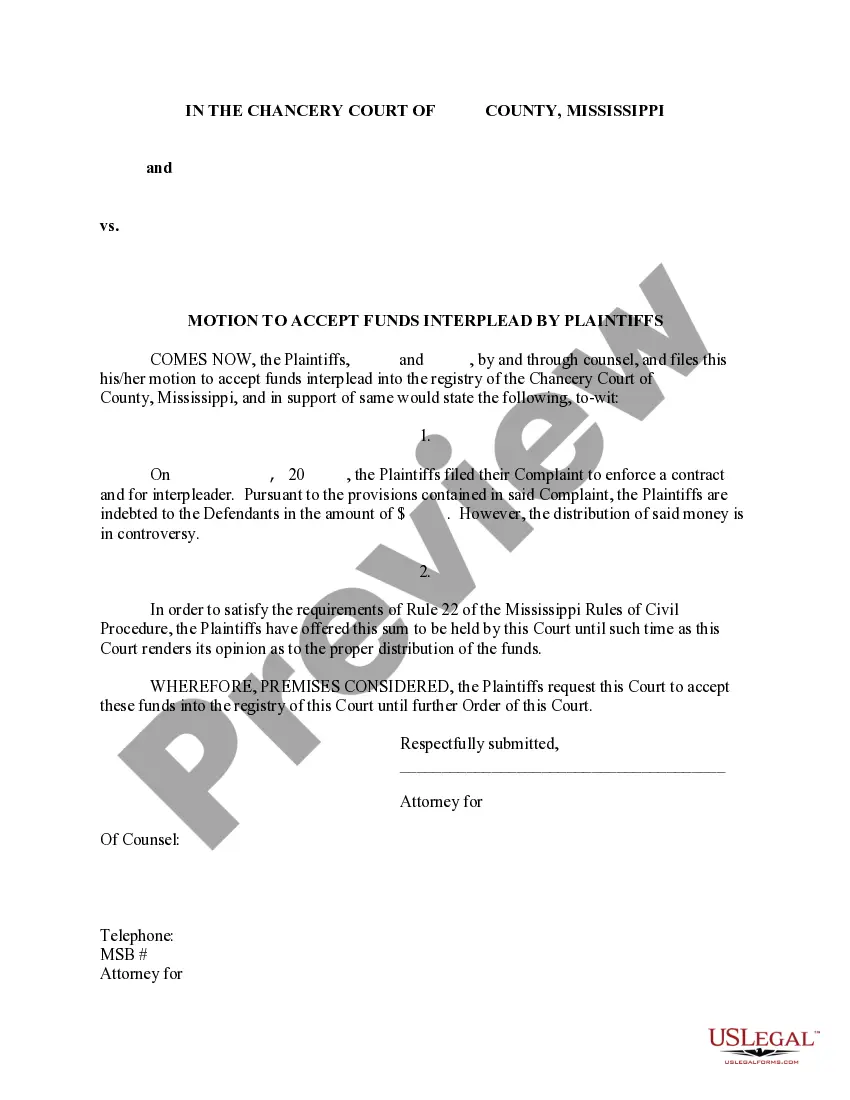
Mississippi Motion to Accept Funds Interplead by Plaintiffs
What is this form?
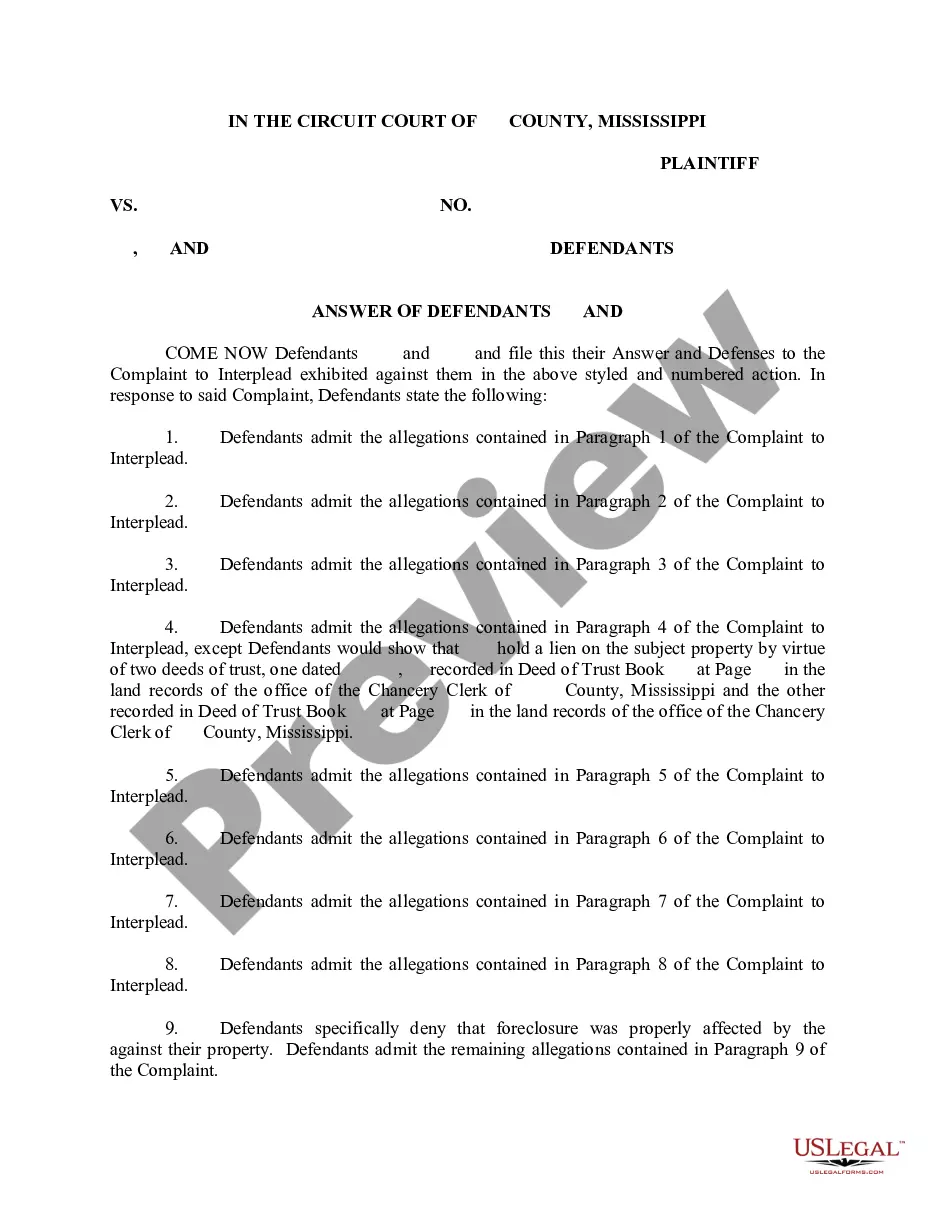
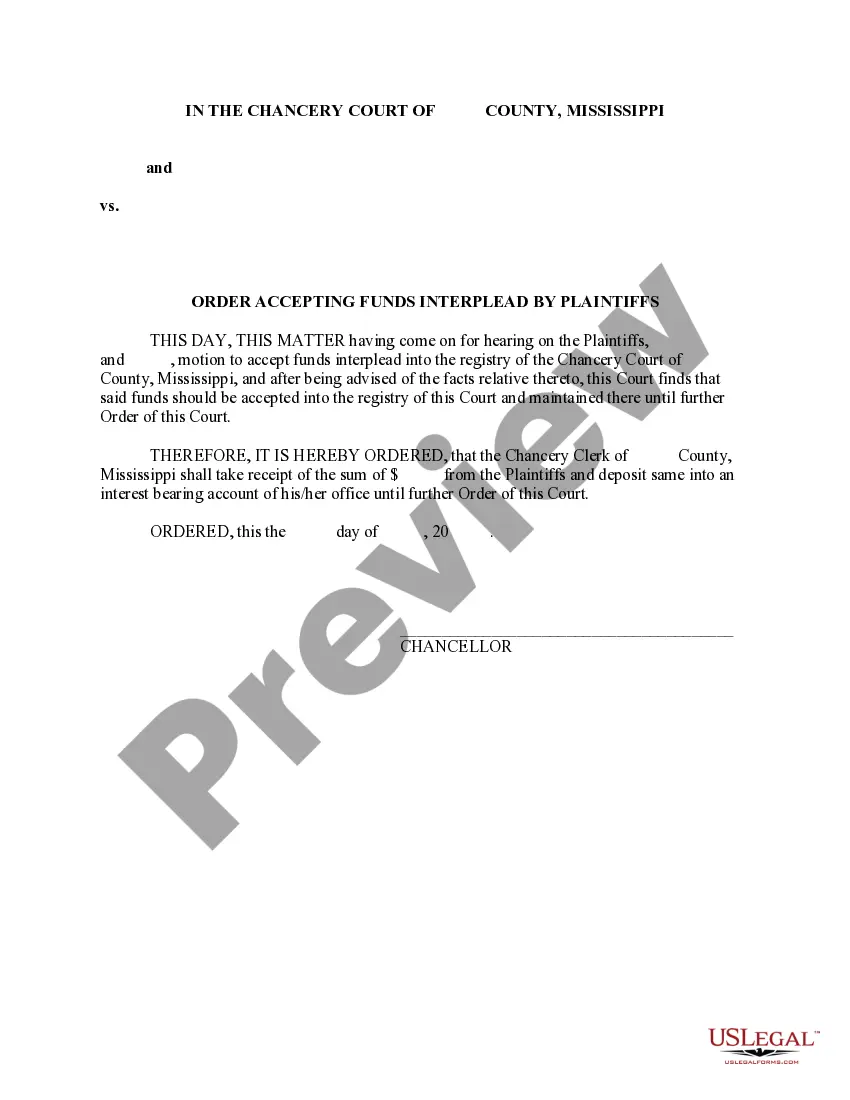
The Motion to Accept Funds Interplead by Plaintiffs is a formal request submitted to the court, asking for the acceptance of funds into the court's registry. This motion is essential for cases where multiple parties claim the right to funds, ensuring that the court oversees their distribution. This form helps distinguish it from other motions, as it specifically addresses the acceptance of interplead funds by plaintiffs.
What’s included in this form
- Parties involved: Identifies the plaintiffs making the request.
- Details of funds: Specifies the funds being interpleaded for the court to accept.
- Requested action: Clearly articulates the plaintiffs' request for the court to accept the funds.
- Signature: Requires the signature of the plaintiffs or their representatives to validate the motion.
- Prayer for relief: A formal request asking the court to grant the motion.
Common use cases
This form is used in legal situations where there are competing claims over particular funds. If you are a plaintiff in a legal case involving money or property that multiple parties assert a right to, you may need this motion to formally request the court to manage the funds during the proceedings. It is particularly useful in interpleader actions, where parties seek a resolution through judicial intervention.
Who should use this form
- Plaintiffs seeking to have the court accept interplead funds.
- Legal representatives acting on behalf of plaintiffs in a dispute over funds.
- Individuals involved in interpleader actions where the court's supervision of funds is required.
Instructions for completing this form
- Identify the plaintiffs and provide their names and contact information.
- Specify the details of the funds you are requesting the court to accept.
- Clearly articulate the action you are requesting from the court regarding these funds.
- Include the date and sign the form to validate the request.
- Submit the completed form to the appropriate court for filing.
Is notarization required?
Notarization is generally not required for this form. However, certain states or situations might demand it. You can complete notarization online through US Legal Forms, powered by Notarize, using a verified video call available anytime.
Get your form ready online
Our built-in tools help you complete, sign, share, and store your documents in one place.
Make edits, fill in missing information, and update formatting in US Legal Forms—just like you would in MS Word.
Download a copy, print it, send it by email, or mail it via USPS—whatever works best for your next step.
Sign and collect signatures with our SignNow integration. Send to multiple recipients, set reminders, and more. Go Premium to unlock E-Sign.
If this form requires notarization, complete it online through a secure video call—no need to meet a notary in person or wait for an appointment.
We protect your documents and personal data by following strict security and privacy standards.

Make edits, fill in missing information, and update formatting in US Legal Forms—just like you would in MS Word.

Download a copy, print it, send it by email, or mail it via USPS—whatever works best for your next step.

Sign and collect signatures with our SignNow integration. Send to multiple recipients, set reminders, and more. Go Premium to unlock E-Sign.

If this form requires notarization, complete it online through a secure video call—no need to meet a notary in person or wait for an appointment.

We protect your documents and personal data by following strict security and privacy standards.
Typical mistakes to avoid
- Failing to accurately identify all parties involved in the interpleader.
- Omitting essential details about the funds in question.
- Not signing the form, which can result in rejection by the court.
- Submitting the form to the wrong court or jurisdiction.
Why use this form online
- Convenience: Download and complete this form from anywhere at any time.
- Editability: Tailor the motion to fit your specific circumstances quickly.
- Reliability: Access expertly drafted forms that comply with legal standards.
Quick recap
- The Motion to Accept Funds Interplead by Plaintiffs is crucial for handling monetary disputes in a legal setting.
- Proper completion of the form ensures the safe management of funds during legal proceedings.
- Consult local court rules for specific requirements regarding submission and acceptance of motions.
Looking for another form?
Form popularity
FAQ
An interpleader action aims to determine the party who is entitled to receive money or property when a neutral third party is holding funds or property and is confronted with two or more claimants to the same money or property.
Introduction: In an interpleader action, a party who knows two or more other parties are making a claim on some asset controlled by the party can ask the court to decide who has what rights to the asset, deposit the asset into the custody of the court or a third party and remove itself from the litigation.
Interpleader is a kind of procedure whereby a person in possession of property not being his own, and being claimed from such person (possession) by two or more other persons (so called claimants), by which the matter can be brought to court for adjudication over ostensibly valid and enforceable competing claims over
N. the procedure when two parties are involved in a lawsuit over the right to collect a debt from a third party, who admits the money is owed but does not know which person to pay.
Interpleader suit in C.P.C is defined in section 88 with order no XXXV. An interpleader suit means if any person claims any property of her husband or her parents and in case the owner of the property is dead without transferring the property, then the second owner has to claim the property from the bank or authority.
A way for a holder of property to initiate a suit between two or more claimants to the property.Interpleader avoids the problem of A being sued separately by both B and C, and potentially losing the same piece of property twice.
You typically must initiate your interpleader action by filing your complaint with the clerk of the court in the county where the money or property at issue is located. Depending on the defendants and the amount of money at stake, federal court may be proper.
Interpleader is defined as an equitable remedy now governed by statute, whereby a holder of money such as an escrow deposits funds or property with the Court.