Arizona Statement of Wishes to Wills and Trusts
Overview of this form
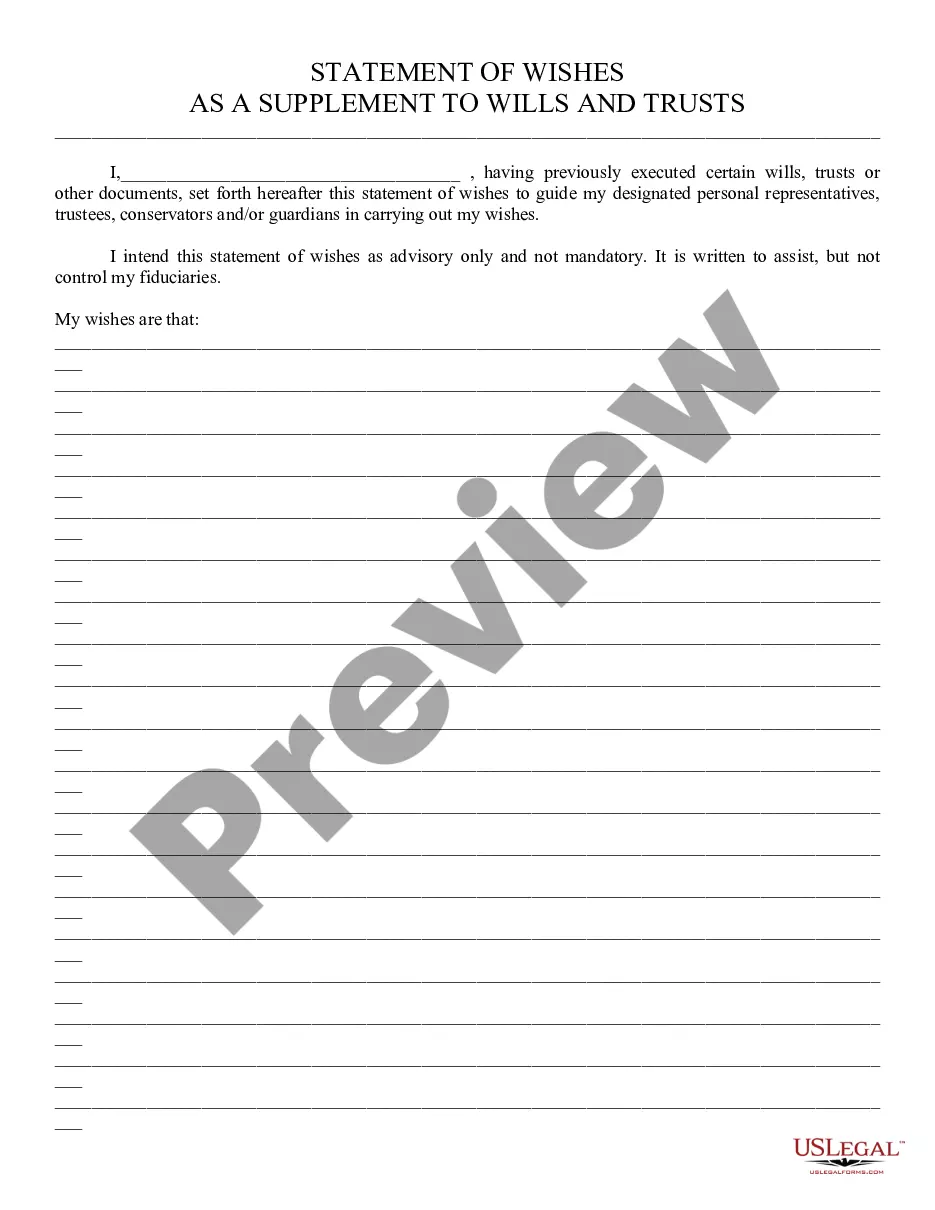
The Statement of Wishes to Wills and Trusts is a legal document that provides guidance to your personal representatives, trustees, or guardians regarding your preferences after your death. This form serves as an advisory tool to express your wishes without imposing them as mandatory requirements, allowing for flexibility in how your fiduciaries fulfill your intentions. It differs from a will or trust as it is not legally binding but serves to clarify your desires and ensure that your voice is heard in the management of your estate.
Key parts of this document
- Personal information section for the individual creating the statement.
- Clear declaration of intent indicating that the wishes are advisory.
- Space for detailing specific wishes and preferences.
- Signature and date fields to validate the document.
- Notary section to certify the statement if necessary.

Situations where this form applies
This form is useful when you want to communicate your preferences regarding your estate and care upon your passing. It can be used in conjunction with a will or a trust, providing additional guidance on how your desires should be interpreted and implemented. Ideal scenarios include when making arrangements for asset distribution, indicating preferences for funeral arrangements, or expressing wishes related to guardianship of minors or dependents.
Who this form is for
- Individuals preparing end-of-life documents.
- Those who have existing wills or trusts but want to provide further guidance.
- Anyone wishing to express personal preferences about how their affairs should be handled after death.
Steps to complete this form
- Fill in your personal information at the beginning of the document.
- Clearly state your wishes in the designated sections, keeping them concise and specific.
- Date the form accurately to establish when it was created.
- Sign the document in the presence of a notary public, if required.
- If needed, discuss your completed statement with your personal representatives to ensure understanding.
Is notarization required?
This form does not typically require notarization unless specified by local law. However, having it notarized can add an extra layer of credibility and may be advisable depending on your personal circumstances.
Get your form ready online
Our built-in tools help you complete, sign, share, and store your documents in one place.
Make edits, fill in missing information, and update formatting in US Legal Forms—just like you would in MS Word.
Download a copy, print it, send it by email, or mail it via USPS—whatever works best for your next step.
Sign and collect signatures with our SignNow integration. Send to multiple recipients, set reminders, and more. Go Premium to unlock E-Sign.
If this form requires notarization, complete it online through a secure video call—no need to meet a notary in person or wait for an appointment.
We protect your documents and personal data by following strict security and privacy standards.

Make edits, fill in missing information, and update formatting in US Legal Forms—just like you would in MS Word.

Download a copy, print it, send it by email, or mail it via USPS—whatever works best for your next step.

Sign and collect signatures with our SignNow integration. Send to multiple recipients, set reminders, and more. Go Premium to unlock E-Sign.

If this form requires notarization, complete it online through a secure video call—no need to meet a notary in person or wait for an appointment.

We protect your documents and personal data by following strict security and privacy standards.
Typical mistakes to avoid
- Not clearly specifying wishes, leading to confusion among fiduciaries.
- Failing to date the document, which can create ambiguity about the validity.
- Neglecting to discuss the statement with guardians or personal representatives.
- Not having the document notarized when required by local law.
Why complete this form online
- Convenient access from anywhere, allowing for quick updates as your wishes change.
- Editable digital formats (Word and Rich Text) for personalized details.
- Reliability in content created by licensed attorneys, ensuring legal validity.
Summary of main points
- The Statement of Wishes is not legally binding but offers essential guidance to executors and trustees.
- It is an important supplement to wills and trusts, helping to clarify your preferences.
- Providing detailed and clear instructions can help your loved ones make decisions in line with your desires.
Looking for another form?
Form popularity
FAQ
In Arizona, beneficiaries should expect to be notified shortly after the probate process begins. The executor is responsible for informing beneficiaries within a reasonable timeframe, usually within 30 days after filing the will for probate. A well-defined Arizona Statement of Wishes to Wills and Trusts can ensure that all parties are kept informed throughout the process.
A statement of will refers to a legal document where the testator communicates their final wishes regarding the distribution of their assets. It allows individuals in Arizona to outline their desires clearly, which can simplify the estate's administration process. Incorporating a statement of wishes into your estate planning can work hand-in-hand with wills and trusts.
Yes, in Arizona, an executor is required to provide an accounting to the beneficiaries of the estate. This includes detailed records of all transactions related to the estate's assets and liabilities. The Arizona Statement of Wishes to Wills and Trusts can help set clear expectations for communication between the executor and beneficiaries.
You can obtain a copy of a will by contacting the probate court where the will was filed. In many cases, they will offer a way to access these documents either in person or online. If you prefer a streamlined approach, check out US Legal Forms, which offers resources to help you acquire necessary legal documents.
Wills in Arizona do not need to be formally recorded unless they go through the probate process. However, recording the will can provide additional security and clarity regarding your wishes. Utilizing the Arizona Statement of Wishes to Wills and Trusts can help ensure your intentions are clearly communicated.
To obtain a copy of a will in Arizona, you typically need to request it from the court where the will was filed. If the will is part of an active probate case, you can visit the court's office and access it directly. For those looking for convenience, you can also turn to US Legal Forms for assistance with obtaining legal documents, including wills.
Yes, in Arizona, wills become public record after they enter probate. During this process, the court files and reviews the will, making it accessible to the public. This means anyone can request to view the will as part of the Arizona Statement of Wishes to Wills and Trusts.
To ensure your will is valid in Arizona, it must meet certain requirements. The document must be in writing, signed by the testator, and witnessed by at least two individuals who are present at the same time. Understanding the Arizona Statement of Wishes to Wills and Trusts can emphasize the importance of these requirements. Consider using uslegalforms for templates that guide you in fulfilling all necessary legal stipulations.
Yes, you can write your own will in Arizona and have it notarized. However, crafting a will that adheres to the legal standards is crucial. The Arizona Statement of Wishes to Wills and Trusts provides guidance on ensuring your wishes are honored. For those who prefer assistance, uslegalforms offers easy-to-use templates that help you create a legally sound document.
A letter of wishes is a non-binding document that provides guidance to trustees regarding your preferences and intentions for asset distribution. Although it does not have the legal weight of a will or trust, it serves as a helpful tool for ensuring your wishes are known and considered. This letter can align closely with your Arizona Statement of Wishes to Wills and Trusts, giving you peace of mind that your values and priorities will be respected. US Legal Forms can assist you in creating this important document.