Arizona Disclosure Statement Pursuant to Chapter 20 of Title 12
Understanding this form
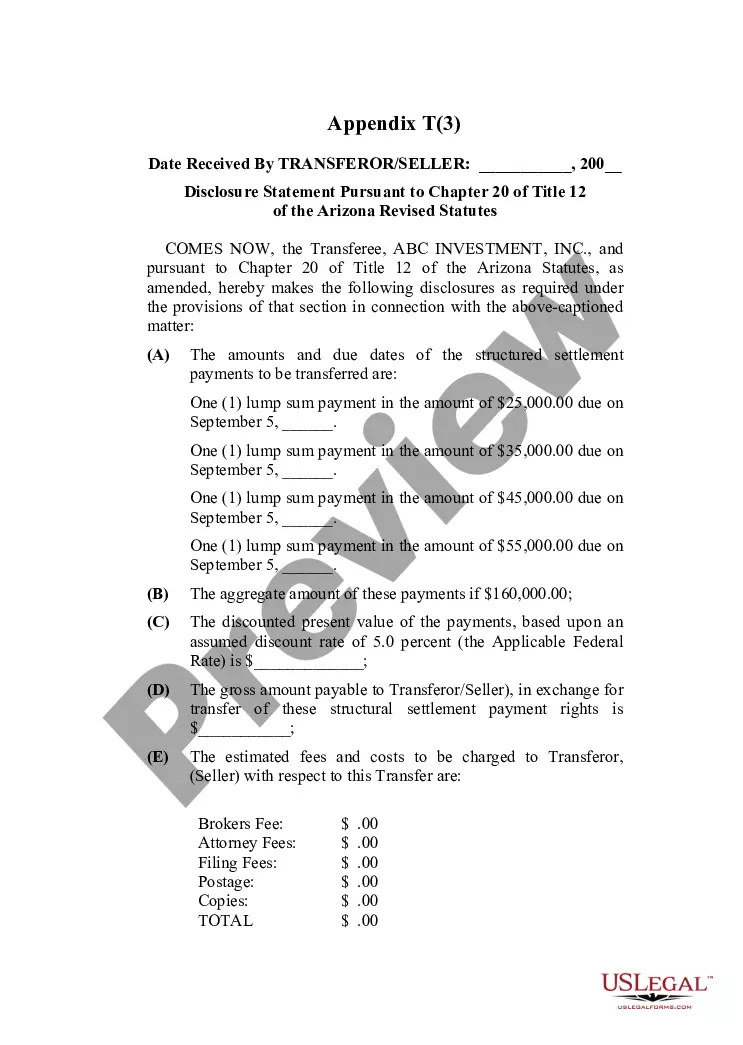
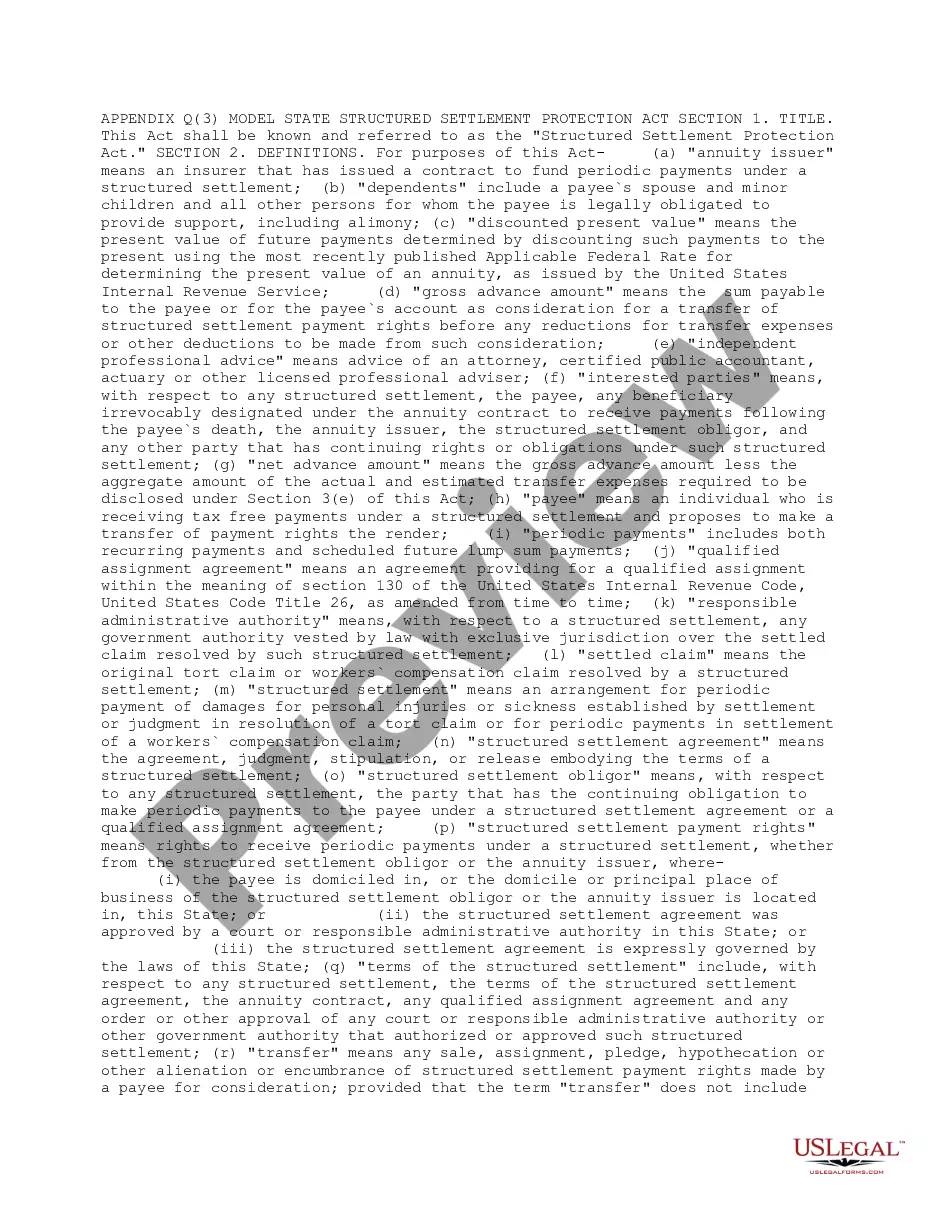
The Disclosure Statement Pursuant to Chapter 20 of Title 12 is a legal form used in Arizona for parties involved in the transfer, purchase, or sale of settlement payment rights. This form serves to disclose important financial information and details about the structured settlement payments being transferred, ensuring that parties understand the terms of the transaction and their respective obligations. It helps protect the interests of the Transferor/Seller through detailed disclosures required under Arizona law.
Main sections of this form
- Date received by Transferor/Seller
- Details of lump sum payments, including amounts and due dates
- Aggregate amount of structured settlement payments
- Discounted present value of payments based on an assumed discount rate
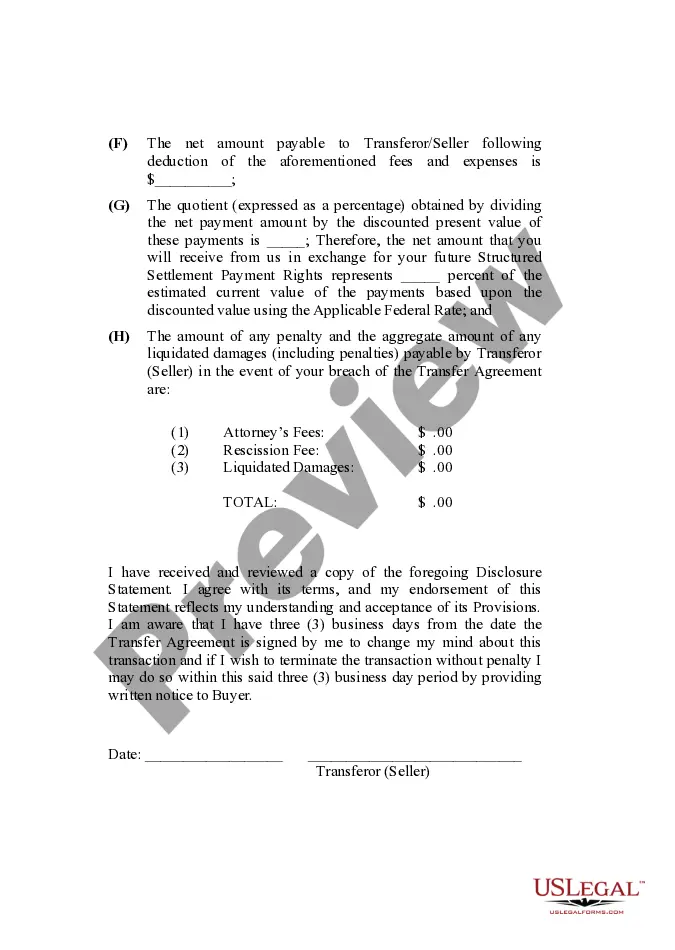
- Gross and net amounts payable to Transferor/Seller
- Estimated fees and costs associated with the transfer
- Liquidated damages and penalties for breach of transfer agreement
Common use cases
This form should be used when an individual or entity (the Transferor/Seller) intends to sell or transfer their rights to future structured settlement payments. It is applicable in situations where a structured settlement payment is being sold for a lump sum, which is often necessary for immediate financial needs, debt clearance, or significant expenses. It ensures that all parties understand the financial implications and terms involved in the transaction.
Who needs this form
- Individuals selling structured settlement payments for cash
- Investment companies or entities purchasing structured settlement rights
- Attorneys representing clients in settlement transfer transactions
- Financial advisors assisting clients in evaluating structured settlements
How to complete this form
- Enter the date received by the Transferor/Seller.
- List all lump sum payments, including amounts and due dates.
- Calculate and enter the aggregate amount of structured settlement payments.
- Determine the discounted present value of the payments and enter that amount.
- Provide an itemized list of any fees and expenses related to the transfer.
- Ensure all parties review and sign the statement to acknowledge their understanding and acceptance of the terms.
Does this form need to be notarized?
This form usually doesn’t need to be notarized. However, local laws or specific transactions may require it. Our online notarization service, powered by Notarize, lets you complete it remotely through a secure video session, available 24/7.
Get your form ready online
Our built-in tools help you complete, sign, share, and store your documents in one place.
Make edits, fill in missing information, and update formatting in US Legal Forms—just like you would in MS Word.
Download a copy, print it, send it by email, or mail it via USPS—whatever works best for your next step.
Sign and collect signatures with our SignNow integration. Send to multiple recipients, set reminders, and more. Go Premium to unlock E-Sign.
If this form requires notarization, complete it online through a secure video call—no need to meet a notary in person or wait for an appointment.
We protect your documents and personal data by following strict security and privacy standards.

Make edits, fill in missing information, and update formatting in US Legal Forms—just like you would in MS Word.

Download a copy, print it, send it by email, or mail it via USPS—whatever works best for your next step.

Sign and collect signatures with our SignNow integration. Send to multiple recipients, set reminders, and more. Go Premium to unlock E-Sign.

If this form requires notarization, complete it online through a secure video call—no need to meet a notary in person or wait for an appointment.

We protect your documents and personal data by following strict security and privacy standards.
Avoid these common issues
- Failing to disclose all fees associated with the transfer.
- Not providing accurate dates for payment schedules.
- Omitting required signatures or dates from the form.
- Not reviewing the terms of the transfer agreement thoroughly.
Benefits of completing this form online
- Convenient access to legally compliant and up-to-date forms.
- Ability to complete the form at your own pace, with clear guidance.
- Easy download and printing options for completed documents.
- Review by licensed attorneys to ensure accuracy and compliance with local laws.
Looking for another form?
Form popularity
FAQ
Writing a disclosure statement involves clearly outlining all relevant information that must be disclosed based on legal requirements. It should include specifics about the property, any existing debts, and any potential liabilities. You can simplify this process by using platforms like US Legal Forms, which provide templates tailored to the Arizona Disclosure Statement Pursuant to Chapter 20 of Title 12, ensuring that you cover all necessary details effectively.
In Arizona, the statute of limitations for credit card debt is typically six years. This means that creditors must file a lawsuit within six years of the last payment or acknowledgment of the debt. Knowing this timeframe can help you navigate financial decisions, especially when considering an Arizona Disclosure Statement Pursuant to Chapter 20 of Title 12 regarding debt disclosures.
The statute 12-550 in Arizona addresses the recording requirements and related legal obligations. This statute also plays a role in the necessary disclosures in real estate transactions, which are highlighted in the Arizona Disclosure Statement Pursuant to Chapter 20 of Title 12. Understanding this statute is crucial for both buyers and sellers to ensure compliance.
In Arizona, certain severe crimes have no statute of limitations, meaning they can be prosecuted at any time. These include serious offenses such as first-degree murder and various sexual offenses. Knowing these details is essential, especially when considering how an Arizona Disclosure Statement Pursuant to Chapter 20 of Title 12 may intersect with legal matters involving these crimes.
Rule 49 under Arizona family law focuses on the enforcement of legal and procedural requirements in family court. It emphasizes the significance of transparency in legal proceedings, particularly regarding the Arizona Disclosure Statement Pursuant to Chapter 20 of Title 12. By adhering to this rule, parties involved can ensure a fair and efficient resolution in family law matters.
The statute 12-553 in Arizona pertains to the regulations surrounding the Arizona Disclosure Statement Pursuant to Chapter 20 of Title 12. This statute outlines the necessary disclosures that individuals must provide regarding their legal obligations. Understanding this statute is crucial for compliance, especially in property sales and other legal transactions.
Article IX Section 20 of the Arizona Constitution discusses laws related to the regulation of property rights and management. This provision underscores the legal framework within which property regulations, including disclosures, are established. Understanding this section is important in relation to the Arizona Disclosure Statement Pursuant to Chapter 20 of Title 12, as it aligns with ensuring transparency in property transactions.
Rule 14 of the Arizona Rules of Civil Procedure allows for the joining of additional parties to a lawsuit. This rule can be advantageous in complex cases where multiple parties may be liable. Awareness of Rule 14 is beneficial, especially when it involves issues surrounding the Arizona Disclosure Statement Pursuant to Chapter 20 of Title 12 where multiple stakeholders could be involved.
Rule 5.1 in the Arizona Rules of Civil Procedure pertains to the service and filing of documents in civil cases. It specifies how attorneys and parties must handle their documents to ensure proper communication. Familiarity with Rule 5.1 is important, particularly in situations where the Arizona Disclosure Statement Pursuant to Chapter 20 of Title 12 needs to be filed as part of court documentation.
Arizona law 20-468 describes the responsibilities of sellers regarding disclosures about property condition and any known defects. This statute emphasizes the importance of the Arizona Disclosure Statement Pursuant to Chapter 20 of Title 12 as it mandates sellers to provide thorough and accurate disclosures to potential buyers. Understanding this law helps ensure compliance and protects the interests of all parties.