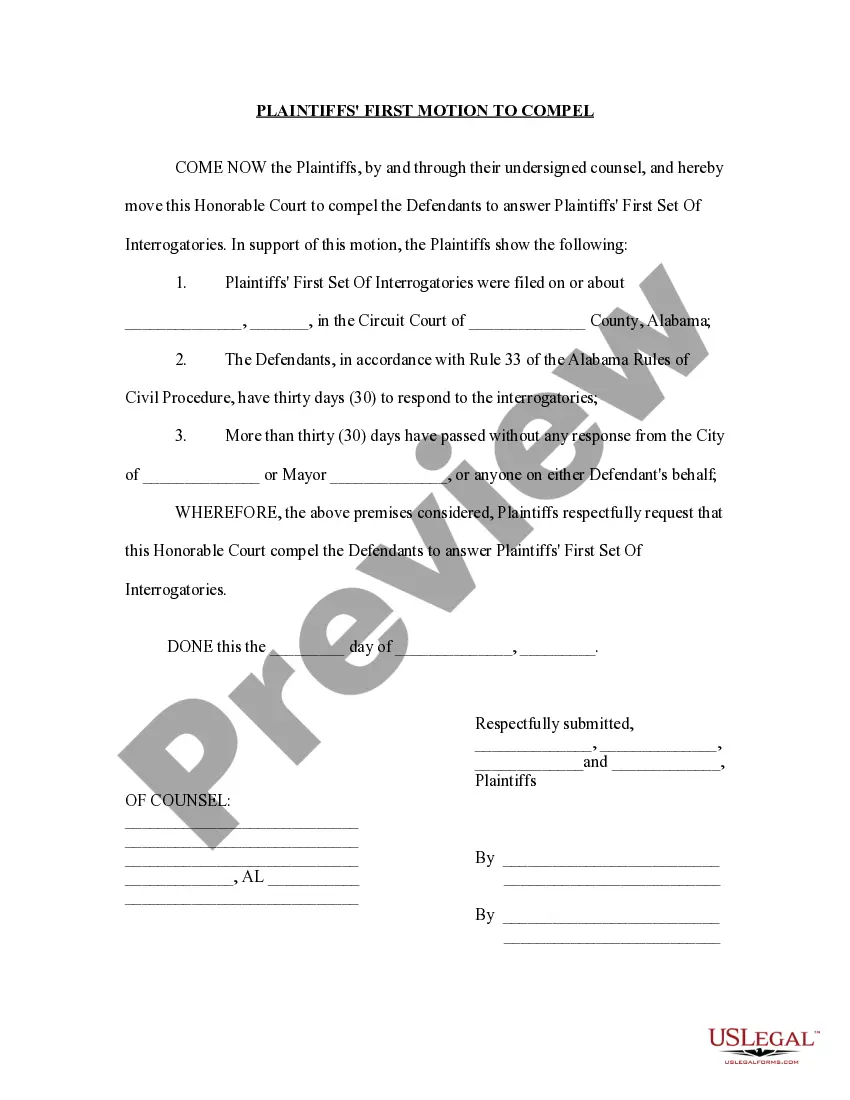
Alabama Motion to Compel when not answered
About this form
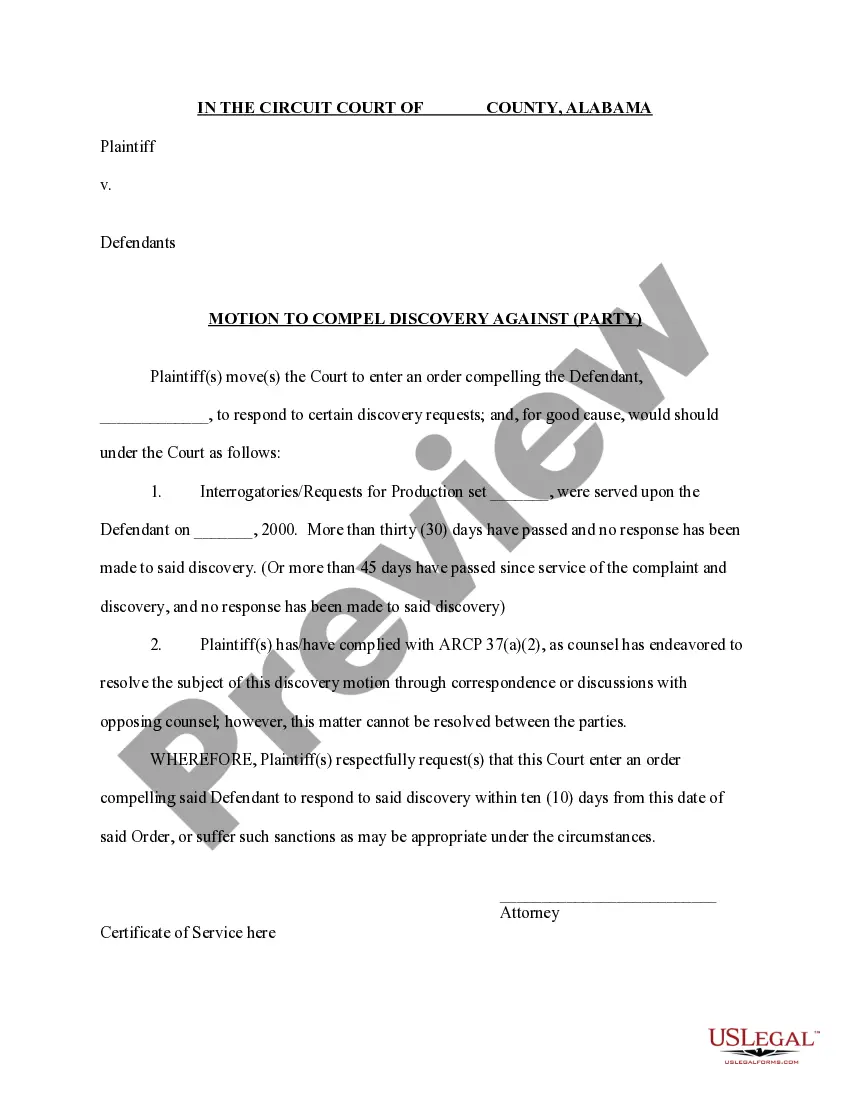
The Motion to Compel when not answered is a legal document used to request a court order compelling a party to respond to specific discovery requests. This form is essential when the opposing party fails to provide necessary information that could impact the outcome of a case, highlighting its role in facilitating the discovery process during litigation.
What’s included in this form
- Title and court information: Identifies the court and parties involved in the case.
- Motion request: Clearly states the request for the court to compel the opposing party to respond.
- Details of discovery requests: Specifies the interrogatories or requests that have not been answered.
- Affirmation of efforts: Confirms attempts to resolve the issue informally with opposing counsel.
- Request for timeline: Asks the court to set a deadline for the opposing party to respond.
- Certificate of service: Includes acknowledgment that the form has been served to other pertinent parties.
When this form is needed
This form is necessary when you have submitted discovery requests to the opposing party, but they have failed to provide answers within the required time frame. Specifically, it is used in scenarios where there has been a lack of cooperation in discovering pertinent facts or documents relevant to your case.
Intended users of this form
- Plaintiffs seeking to enforce their right to receive necessary information from defendants.
- Defendants who have issued discovery requests but have not received responses.
- Attorneys representing clients in civil litigation matters where discovery is vital.
- Individuals without legal representation who are navigating the discovery process themselves.
Completing this form step by step
- Identify the court and the parties involved in the case at the top of the form.
- Fill in the name of the party against whom the motion is directed.
- Specify the discovery requests that have not been answered, including relevant dates.
- Document correspondence or discussions with opposing counsel regarding the issues.
- Sign and date the form, along with including a certificate of service.
Does this form need to be notarized?
This form usually doesn’t need to be notarized. However, local laws or specific transactions may require it. Our online notarization service, powered by Notarize, lets you complete it remotely through a secure video session, available 24/7.
Get your form ready online
Our built-in tools help you complete, sign, share, and store your documents in one place.
Make edits, fill in missing information, and update formatting in US Legal Forms—just like you would in MS Word.
Download a copy, print it, send it by email, or mail it via USPS—whatever works best for your next step.
Sign and collect signatures with our SignNow integration. Send to multiple recipients, set reminders, and more. Go Premium to unlock E-Sign.
If this form requires notarization, complete it online through a secure video call—no need to meet a notary in person or wait for an appointment.
We protect your documents and personal data by following strict security and privacy standards.

Make edits, fill in missing information, and update formatting in US Legal Forms—just like you would in MS Word.

Download a copy, print it, send it by email, or mail it via USPS—whatever works best for your next step.

Sign and collect signatures with our SignNow integration. Send to multiple recipients, set reminders, and more. Go Premium to unlock E-Sign.

If this form requires notarization, complete it online through a secure video call—no need to meet a notary in person or wait for an appointment.

We protect your documents and personal data by following strict security and privacy standards.
Mistakes to watch out for
- Failing to specify the exact requests for which the response is sought.
- Not including the required timeline for the opposing party to respond.
- Omitting details about any attempts made to resolve the issue before filing the motion.
- Incorrectly assuming that this form does not need to be served on the opposing party.
Benefits of using this form online
- Convenience of downloading and completing the form from anywhere at any time.
- Editability allows for customization to fit your specific legal situation.
- Access to forms drafted by licensed attorneys, ensuring legal compliance.
- Streamlined process for filing and serving the motion as needed.
Summary of main points
- The Motion to Compel is essential for enforcing discovery compliance.
- Properly documenting efforts to resolve disputes can strengthen your motion.
- Filing this motion is a critical step if you encounter delays or non-responses in the discovery process.
Looking for another form?



Form popularity
FAQ
Hearing on Motion to Compel When a motion to compel is filed with the court, a hearing is scheduled. At the hearing, the party that filed the motion will need to tell the judge why the other party should be compelled to do something.Once that happens, that party will not be able to use the documents at trial.
Consequences of Refusing to Provide Evidence Requested in a Motion to Compel. If the court issues an order that compels your spouse to produce the discovery you are seeking but your spouse still refuses to provide evidence, the judge may impose further sanctions such as: A verdict in your favor.
Although it might be tempting to ignore a summons and complaint, ignoring a lawsuit does not make it go away. And it could result in the court awarding a money judgment against you by default. That can lead to your wages being garnished, your bank accounts attached, or your property being taken!
Motion for Sanctions If the court issues an order compelling discovery, and the party fails to comply with that order, then the court may sanction the party in numerous ways such as refusing to let in the party's evidence at trial, dismissing their lawsuit or striking their defense to a lawsuit, and imposing
If the plaintiff does not respond to the court order, then you can file a Motion to Dismiss and you may win your case. Send a final request. If they do not respond to the final request within 30 days you can send the court an application for entry of final judgment or dismissal.
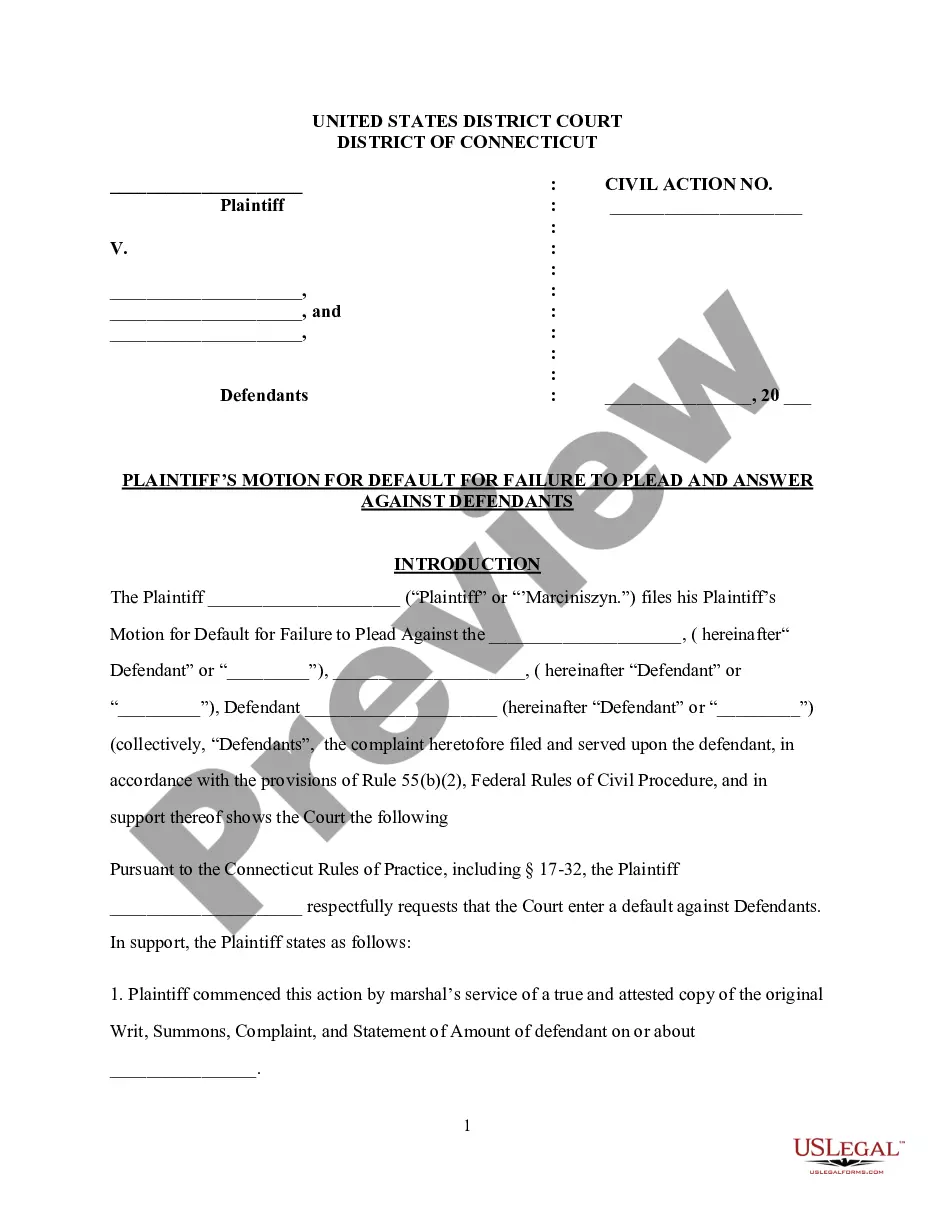
Failure to Respond: If a defendant fails to answer the complaint or file a motion to dismiss within the time limit set forth in the summons, the defendant is in default. The plaintiff can ask the court clerk to make a note of that fact in the file, a procedure called entry of default.
You need to give the court a reason to deny the other side's motion to compel. There are many different reasons you could give. Take out your Response to the discovery request. You should have identified reasons in your Response for why you weren't turning over certain information.
The motion to compel further responses has to be brought within 45 days of service of the response. (C.C.P.