Alabama Plaintiffs' First Motion to Compel Answer to Interrogatories - No Response Filed
Overview of this form
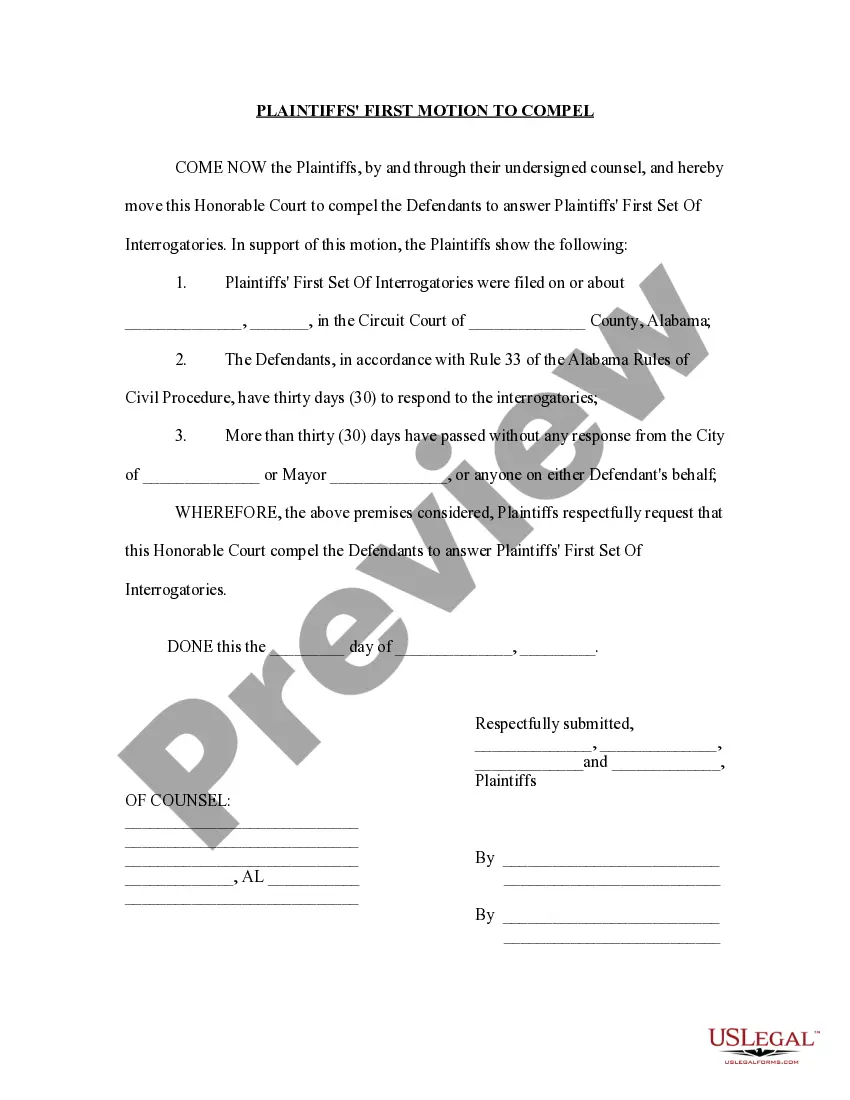
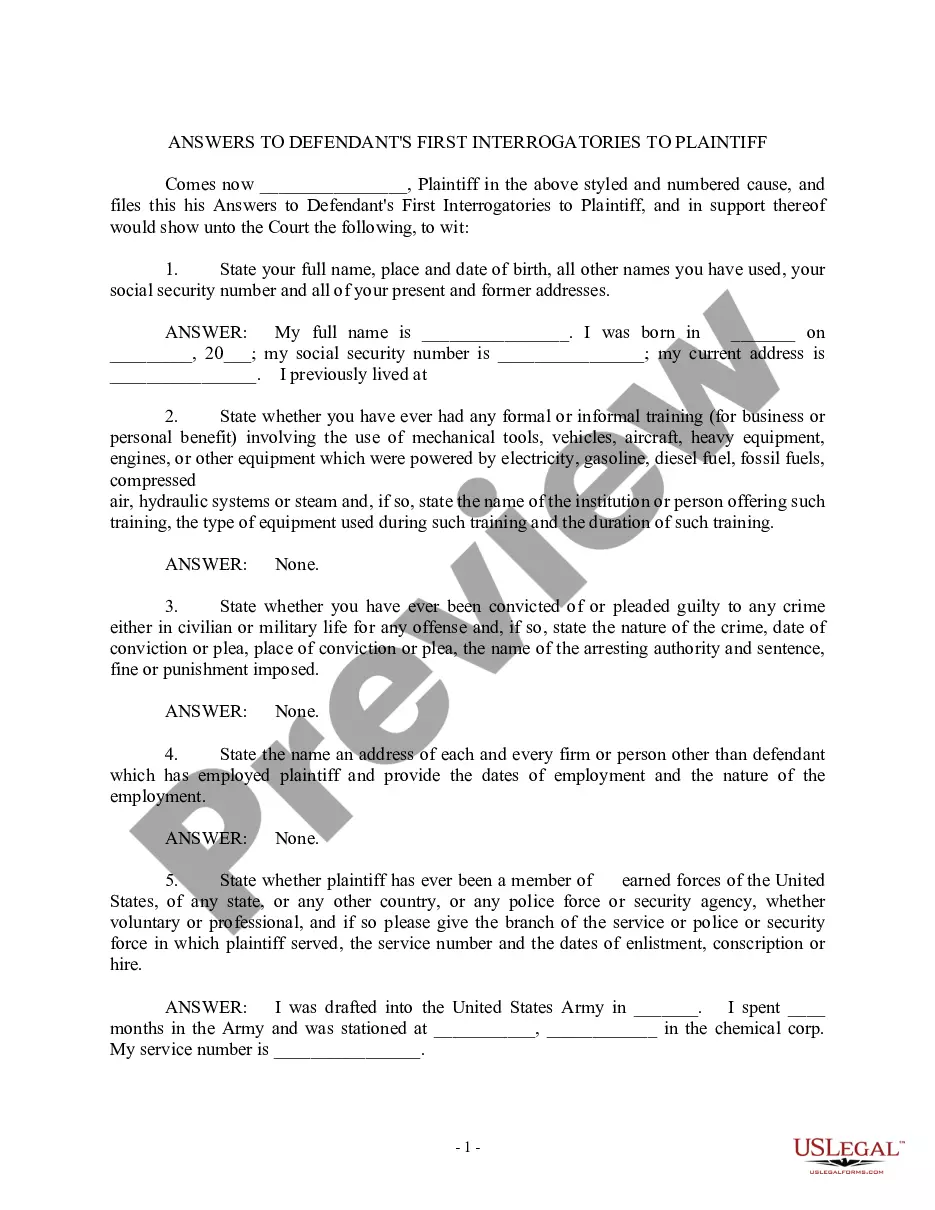
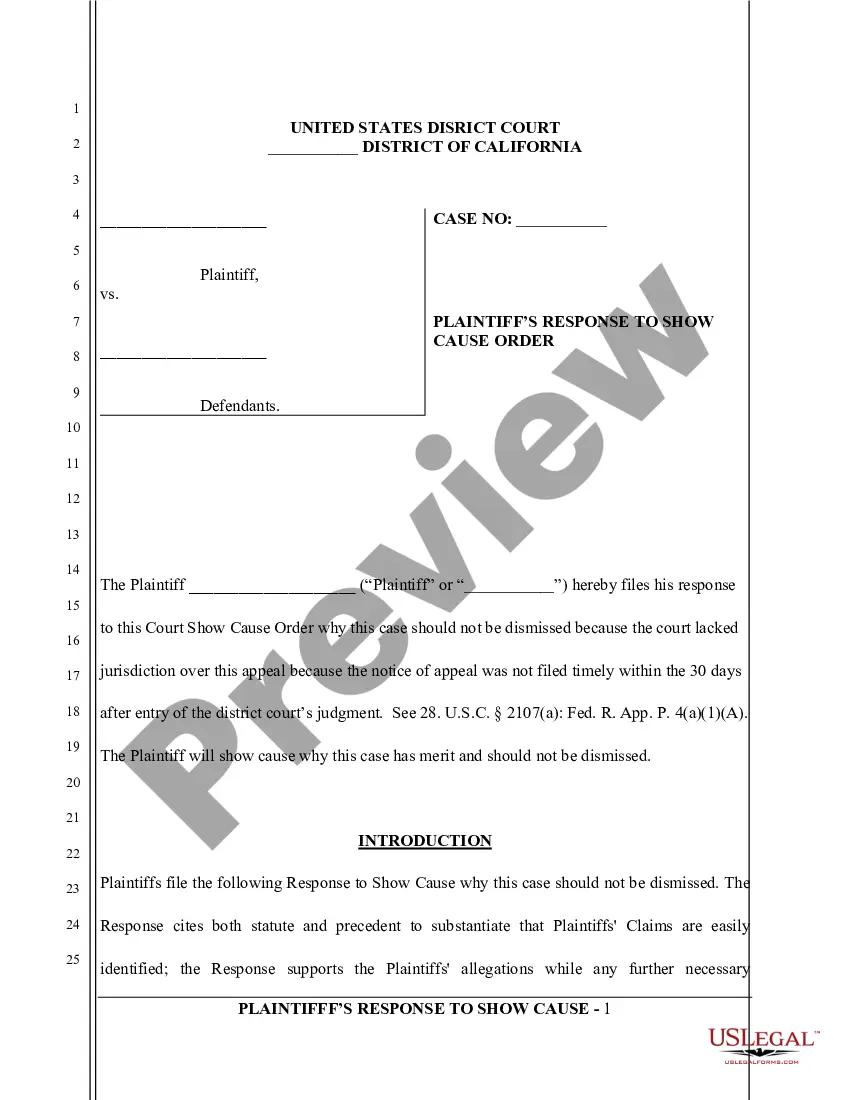
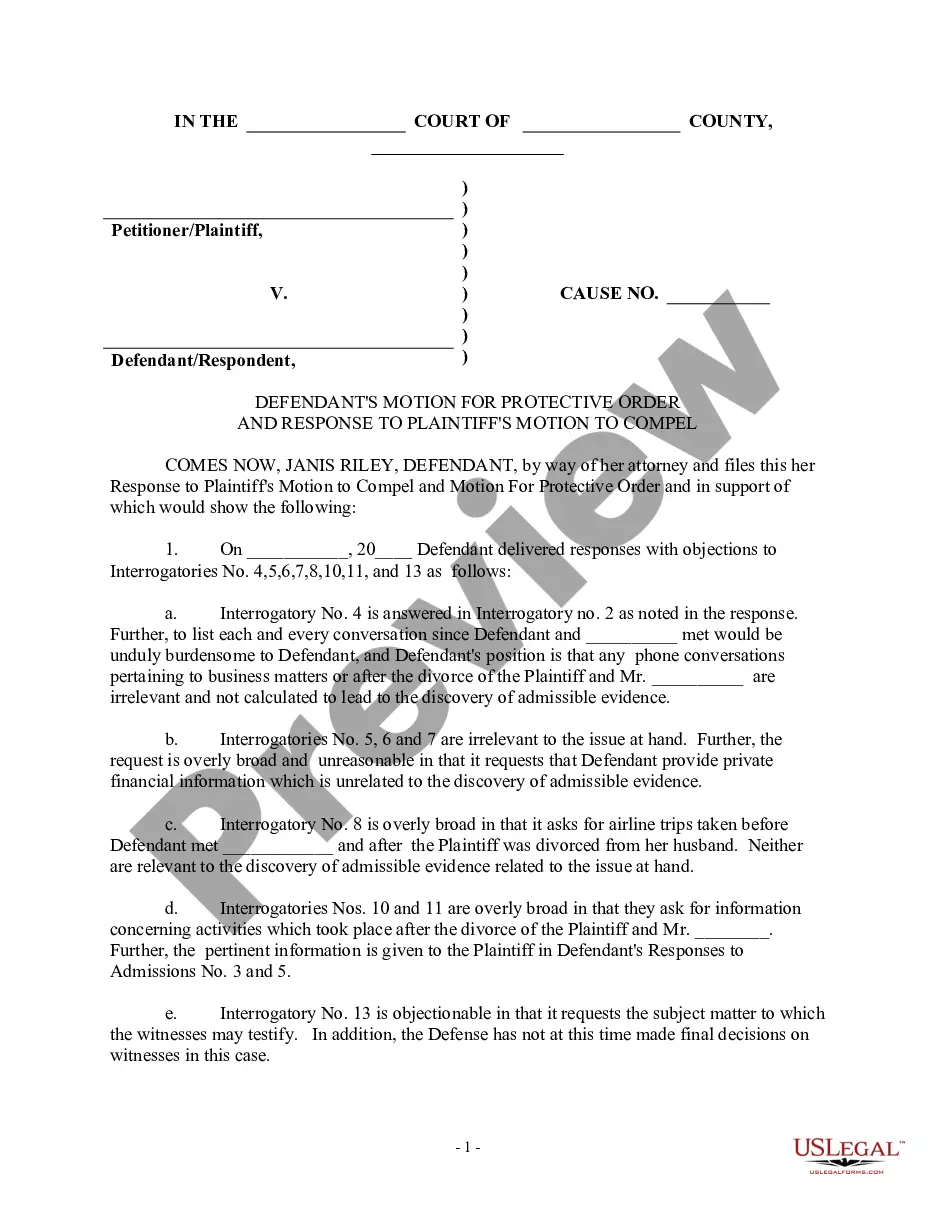
This document is a Plaintiffs' First Motion to Compel Answer to Interrogatories where the defendants have failed to respond. Its purpose is to request the court to compel the defendants to answer the interrogatories submitted by the plaintiffs. This form is essential when you have not received the required response from the other party in a legal case, distinguishing it from other motions that may address different legal issues or requests.
Form components explained
- Title of the motion stating it is a request to compel answer to interrogatories.
- Identification of the parties involved including plaintiffs and defendants.
- Details regarding when the interrogatories were filed.
- Assertion that the defendants have failed to respond within the required time frame.
- Request for the court to compel the defendants to respond to the interrogatories.
- Signatures of the plaintiffsâ counsel for submission.
Common use cases
You should use this form when you, as a plaintiff, have submitted interrogatories to the defendants and have not received any response within the stipulated timeframe, which is generally thirty days. This motion serves to prompt the court to action and may lead to a resolution of the discovery process, ensuring that you can proceed with your case effectively.
Who needs this form
- Plaintiffs in a civil lawsuit who have submitted interrogatories.
- Individuals or legal representatives needing to prompt a response from the defendants.
- Any party involved in a legal dispute requiring compliance with discovery rules.
Steps to complete this form
- Identify the parties involved by filling in the names of the plaintiffs and defendants in the designated sections.
- Enter the date on which the First Set of Interrogatories was filed.
- Specify that more than thirty days have passed since the interrogatories were submitted without a response.
- Clearly state your request for the court to compel the defendants to provide answers.
- Complete the signature section with the names of plaintiffs and their counsel, along with necessary dates and contact information.
Notarization guidance
This form does not typically require notarization to be legally valid. However, some jurisdictions or document types may still require it. US Legal Forms provides secure online notarization powered by Notarize, available 24/7 for added convenience.
Get your form ready online
Our built-in tools help you complete, sign, share, and store your documents in one place.
Make edits, fill in missing information, and update formatting in US Legal Forms—just like you would in MS Word.
Download a copy, print it, send it by email, or mail it via USPS—whatever works best for your next step.
Sign and collect signatures with our SignNow integration. Send to multiple recipients, set reminders, and more. Go Premium to unlock E-Sign.
If this form requires notarization, complete it online through a secure video call—no need to meet a notary in person or wait for an appointment.
We protect your documents and personal data by following strict security and privacy standards.

Make edits, fill in missing information, and update formatting in US Legal Forms—just like you would in MS Word.

Download a copy, print it, send it by email, or mail it via USPS—whatever works best for your next step.

Sign and collect signatures with our SignNow integration. Send to multiple recipients, set reminders, and more. Go Premium to unlock E-Sign.

If this form requires notarization, complete it online through a secure video call—no need to meet a notary in person or wait for an appointment.

We protect your documents and personal data by following strict security and privacy standards.
Avoid these common issues
- Failing to include all parties' names correctly.
- Not specifying the date when the interrogatories were filed.
- Overlooking to check local court rules that may require specific formats or additional documentation.
- Neglecting to sign the motion before submission.
- Missing details on why no response was received, which can weaken your motion.
Why use this form online
- Convenience of instant access and the ability to download the form immediately.
- Editable format allows you to customize the document to fit your specific case details.
- Reliability of forms drafted by licensed attorneys ensures legal accuracy.
Legal use & context
- This motion is legally valid as per the rules governing civil procedure in Alabama.
- It can help ensure compliance with discovery obligations, promoting fair and timely legal processes.
- If granted, the court may impose sanctions if the defendants continue to disregard their obligations.
Looking for another form?


Form popularity
FAQ
So, can you refuse to answer interrogatories? The answer is, no, you may not. You must answer a Rule 33 interrogatory within 30 days of being served with it. That answer must either permit inspection of the requested information or object to the production of the information for a specific reason.
Failure to Respond: If a defendant fails to answer the complaint or file a motion to dismiss within the time limit set forth in the summons, the defendant is in default. The plaintiff can ask the court clerk to make a note of that fact in the file, a procedure called entry of default.
You must answer each interrogatory separately and fully in writing under oath, unless you object to it. You must explain why you object. You must sign your answers and objections.
Motions to Compel If a party doesn't respond to interrogatories or requests for production, then the party seeking those answers must file a motion to compel with the court. If the court grants the motion to compel, then the party who objected or failed to answer must then do so.
If the plaintiff does not respond to the court order, then you can file a Motion to Dismiss and you may win your case. Send a final request. If they do not respond to the final request within 30 days you can send the court an application for entry of final judgment or dismissal.
You must answer each interrogatory separately and fully in writing under oath, unless you object to it. You must explain why you object. You must sign your answers and objections.
Consequences of Refusing to Provide Evidence Requested in a Motion to Compel. If the court issues an order that compels your spouse to produce the discovery you are seeking but your spouse still refuses to provide evidence, the judge may impose further sanctions such as: A verdict in your favor.
The motion to compel further responses has to be brought within 45 days of service of the response. (C.C.P.
Motion for Sanctions If the court issues an order compelling discovery, and the party fails to comply with that order, then the court may sanction the party in numerous ways such as refusing to let in the party's evidence at trial, dismissing their lawsuit or striking their defense to a lawsuit, and imposing