Alabama Corporate Satisfaction Mortgage
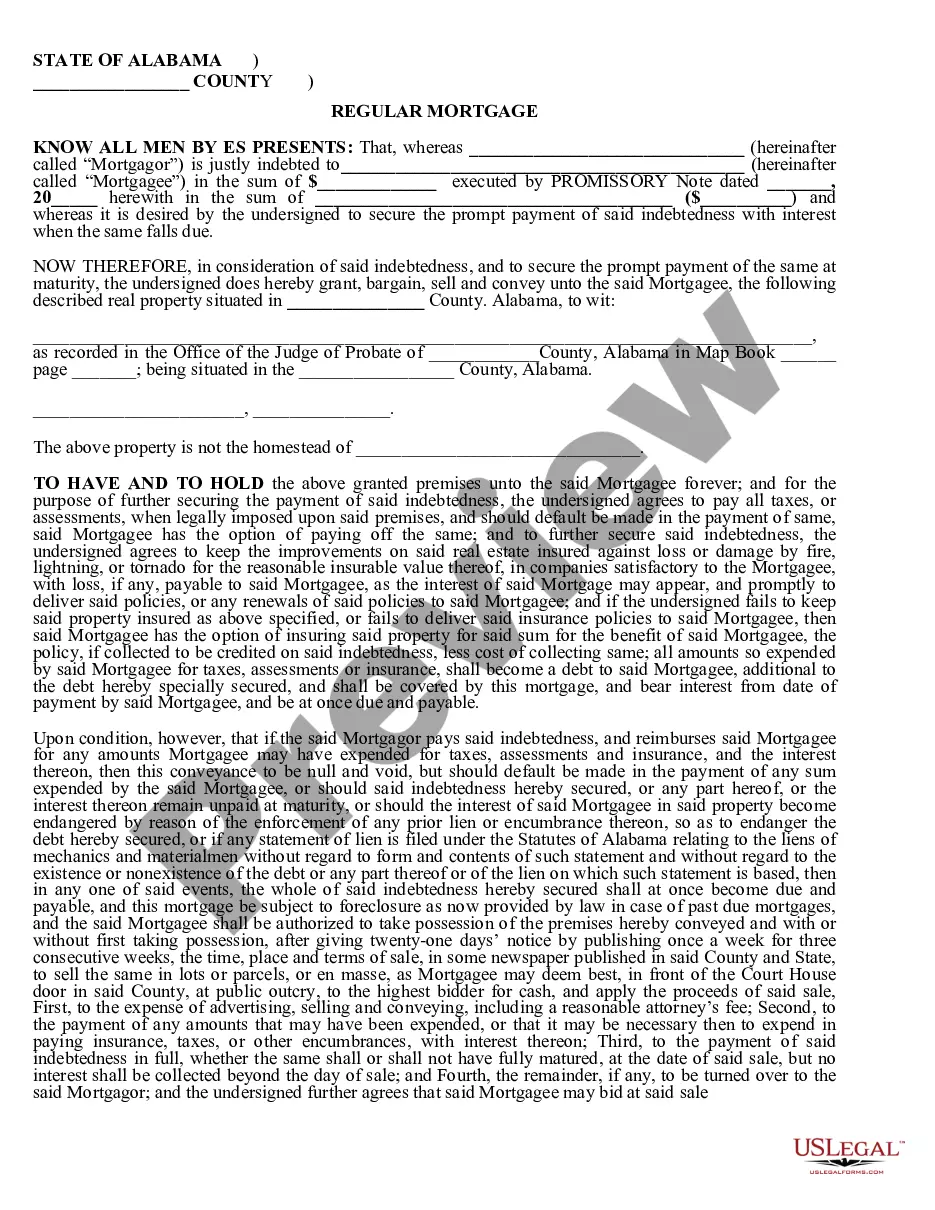
Overview of this form
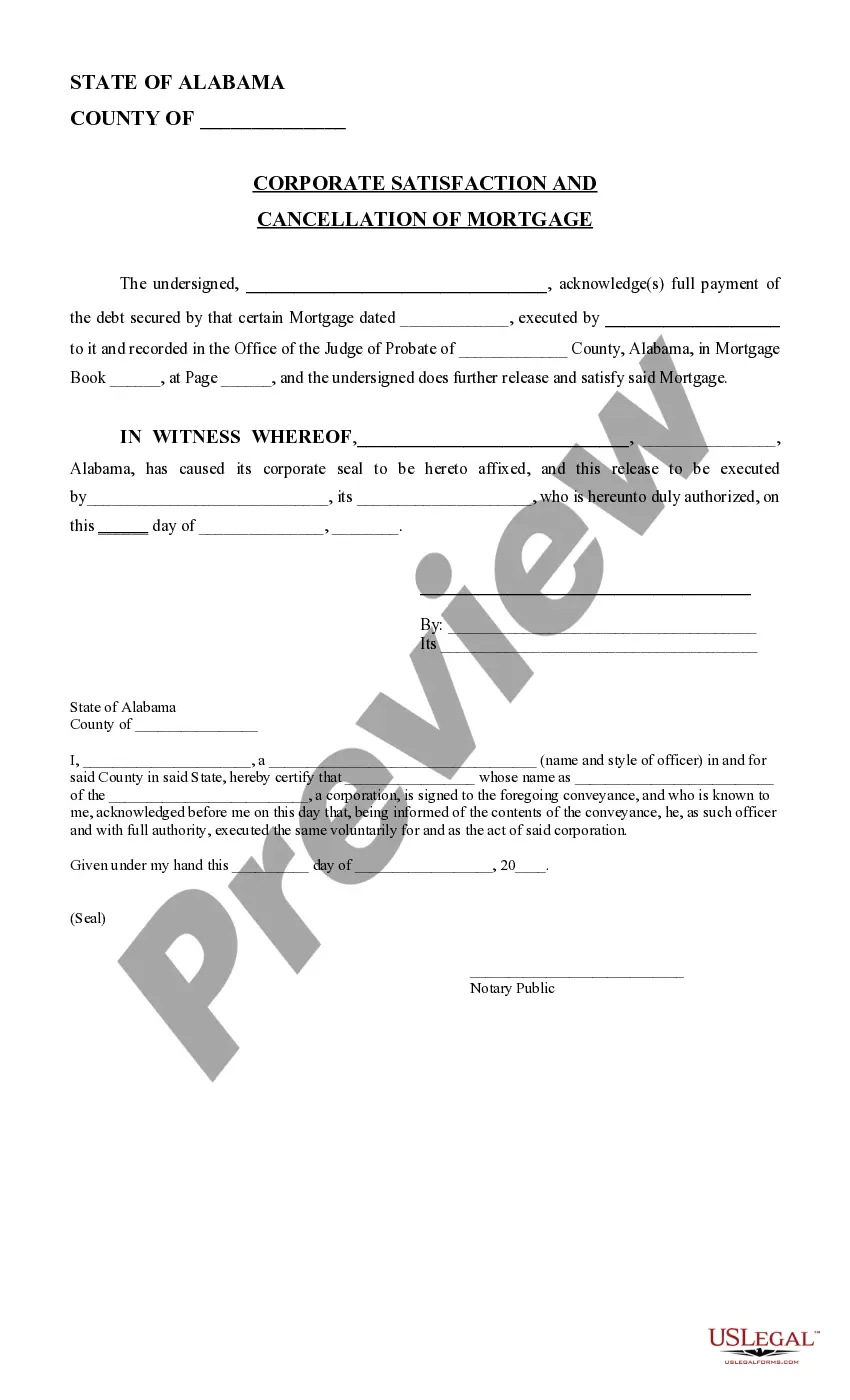
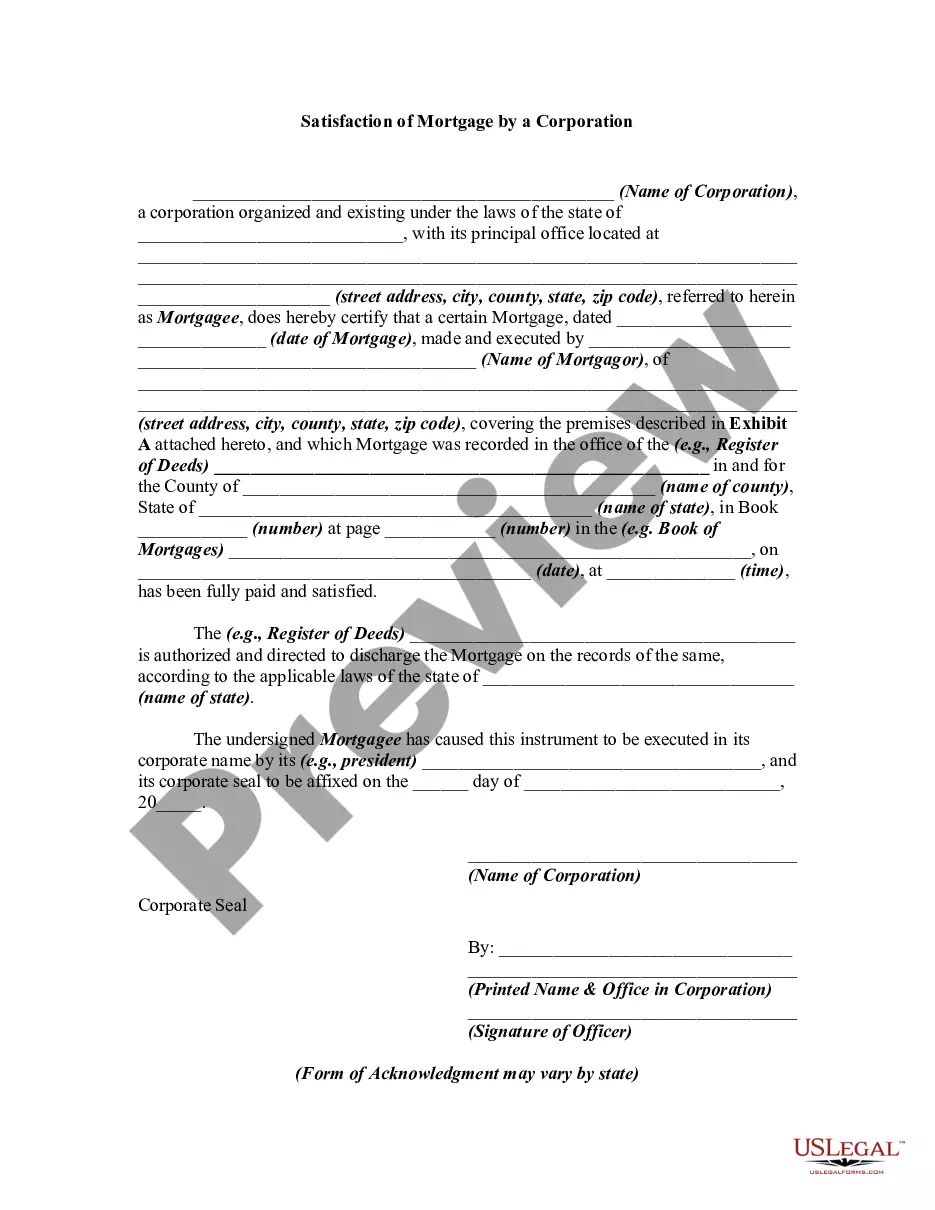
The Corporate Satisfaction Mortgage form is a legal document used to formally release a corporation from a mortgage after the debt secured by that mortgage has been fully paid. This essential form provides the necessary legal acknowledgment that the mortgage obligation has been satisfied, which protects the corporation's financial standing and clears the property title. It is distinct from other mortgage-related documents as it specifically focuses on the release of liability for a corporation once payments are complete.
Key parts of this document
- Identification of the corporation and the mortgage holder
- Details of the mortgage being satisfied, including dates and recording information
- Signature section for authorized representatives of the corporation
- Notary acknowledgment to validate the document
- Section for the corporate seal, if applicable
Situations where this form applies
This form should be used when a corporation has completed all mortgage payments and needs to legally confirm that the mortgage has been paid in full. It is particularly important during real estate transactions, refinancing, or when acquiring new financing, as it ensures that there are no outstanding mortgage obligations tied to the property.
Who can use this document
This form is designed for:
- Corporation executives or authorized representatives involved in the mortgage agreement
- Legal teams representing corporations needing to confirm satisfaction of debt
- Accounting or finance departments tasked with maintaining clear corporate records
Steps to complete this form
- Identify the corporation and the mortgage holder in the designated sections.
- Fill in the details of the mortgage, including the date of execution and the recording information from the probate office.
- Obtain signatures from the authorized representatives of the corporation.
- Affix the corporate seal in the specified area, if required.
- Ensure the form is notarized to validate the signatures and the document.
Does this document require notarization?
Yes, this form must be notarized to be legally valid. Notarization verifies the authenticity of the signatures and the willingness of the parties involved. US Legal Forms offers an integrated online notarization service that is available 24/7, ensuring a secure process without the need for physical travel.
Get your form ready online
Our built-in tools help you complete, sign, share, and store your documents in one place.
Make edits, fill in missing information, and update formatting in US Legal Forms—just like you would in MS Word.
Download a copy, print it, send it by email, or mail it via USPS—whatever works best for your next step.
Sign and collect signatures with our SignNow integration. Send to multiple recipients, set reminders, and more. Go Premium to unlock E-Sign.
If this form requires notarization, complete it online through a secure video call—no need to meet a notary in person or wait for an appointment.
We protect your documents and personal data by following strict security and privacy standards.

Make edits, fill in missing information, and update formatting in US Legal Forms—just like you would in MS Word.

Download a copy, print it, send it by email, or mail it via USPS—whatever works best for your next step.

Sign and collect signatures with our SignNow integration. Send to multiple recipients, set reminders, and more. Go Premium to unlock E-Sign.

If this form requires notarization, complete it online through a secure video call—no need to meet a notary in person or wait for an appointment.

We protect your documents and personal data by following strict security and privacy standards.
Mistakes to watch out for
- Failing to include all necessary details of the mortgage in the form.
- Not obtaining the required signatures from all authorized corporate officers.
- Neglecting to notarize the document, which can render it ineffective.
- Forgetting to include the corporate seal when it's necessary.
Why complete this form online
- Convenience of downloading and printing the form at any time.
- Editability allows for accurate entries without waiting for physical documents.
- Access to attorney-drafted templates ensures legal compliance.
- The ability to store and retrieve documents easily for future reference.
Legal use & context
- This form serves as formal evidence that a mortgage obligation has been satisfied.
- It provides protection for the corporation against future claims related to the mortgage.
- The notarization adds a layer of authenticity to the document, enhancing its enforceability.
What to keep in mind
- The Corporate Satisfaction Mortgage form is crucial for officially releasing a corporation from mortgage obligations.
- Proper completion and notarization enhance legal validity and clarity of records.
- This form is specifically tailored for use in Alabama and follows local legal requirements.
- Understanding the key components will aid in accurately filling out the form and preventing common mistakes.
Looking for another form?
Form popularity
FAQ
Lending institutions are responsible for preparing and filing the satisfaction of mortgage with the appropriate county recorder, land registry office, city registrar, or recorder of deeds. Some borrowers prepay their mortgages by making extra mortgage payments in an effort to pay off their mortgages faster.
Step 1 Identify the parties. The appropriate parties should be documented on the Satisfaction of Mortgage. Step 2 Fill and Sign. The Satisfaction of Mortgage should be signed by the mortgagee, after it has been issued. Step 3 File and Record the Form.
Key Takeaways. A satisfaction of mortgage is a signed document confirming that the borrower has paid off the mortgage in full and that the mortgage is no longer a lien on the property.
If a lender takes longer than 90 days to record it, they can be charged up to $1,500 in penalties. So, in theory, a satisfaction should be recorded within 30-90 days of payoff regardless of what state you work in.
In order to clear the title to the real property owned by the mortgagor, the Satisfaction of Mortgage document must be recorded with the County Recorder or Recorder of Deeds. If the mortgagee fails to record a satisfaction within the set time limits, the mortgagee may be responsible for damages set out by statute.
How do you get a Satisfaction of Mortgage? A Satisfaction of Mortgage is issued by the lender after they have received the final mortgage payment from the borrower. It's signed by the mortgagee (in the presence of a witness in some states and counties) and then notarized by a registered notary public.
A Mortgage Release is where you, the homeowner, voluntarily transfer the ownership of your property to the owner of your mortgage in exchange for a release from your mortgage loan and payments.Depending on your situation, you may be required to make a financial contribution to receive a mortgage release.