Jury Instruction - 1.9.2 Miscellaneous Issues Constructive Discharge
Overview of this form
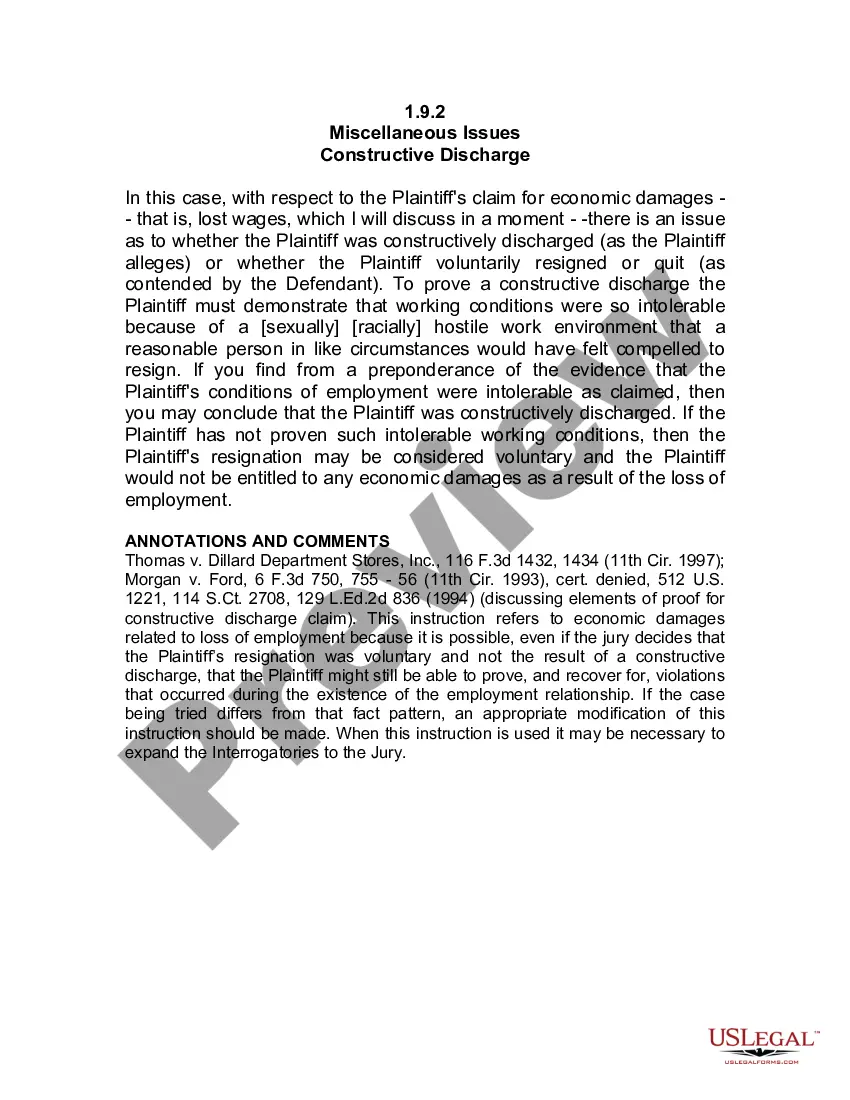
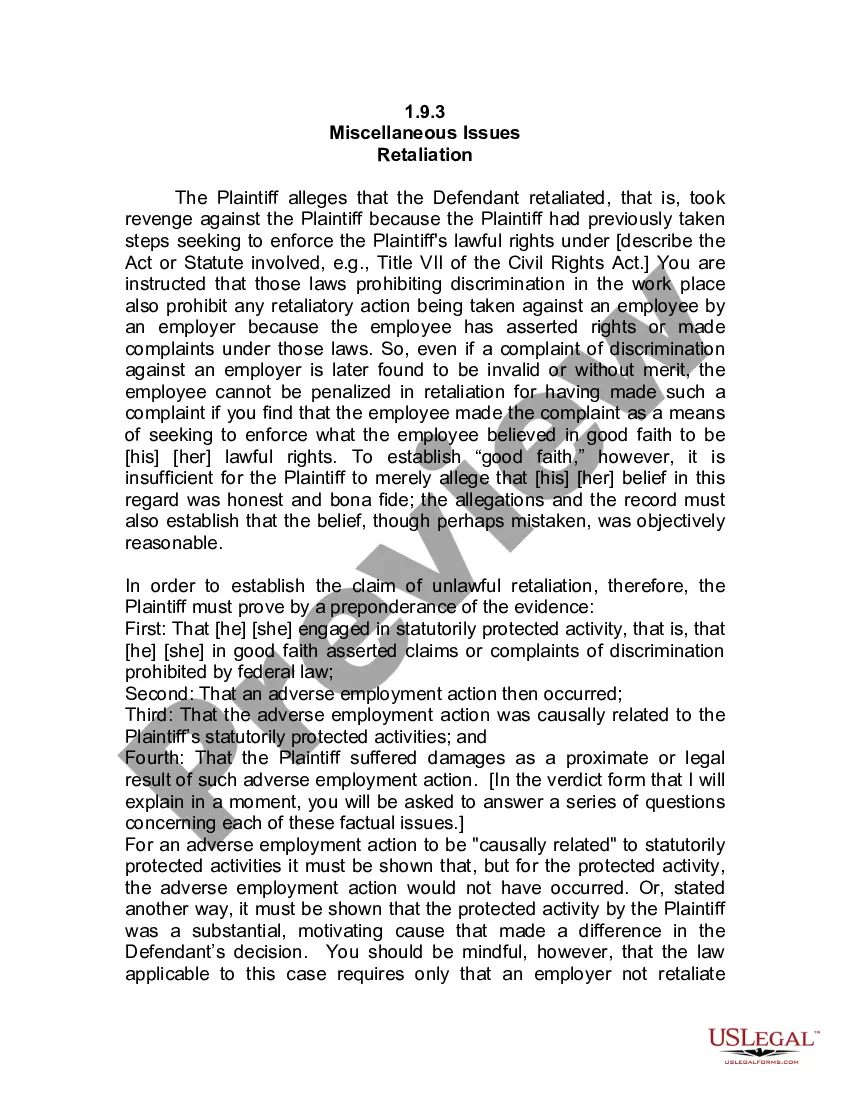
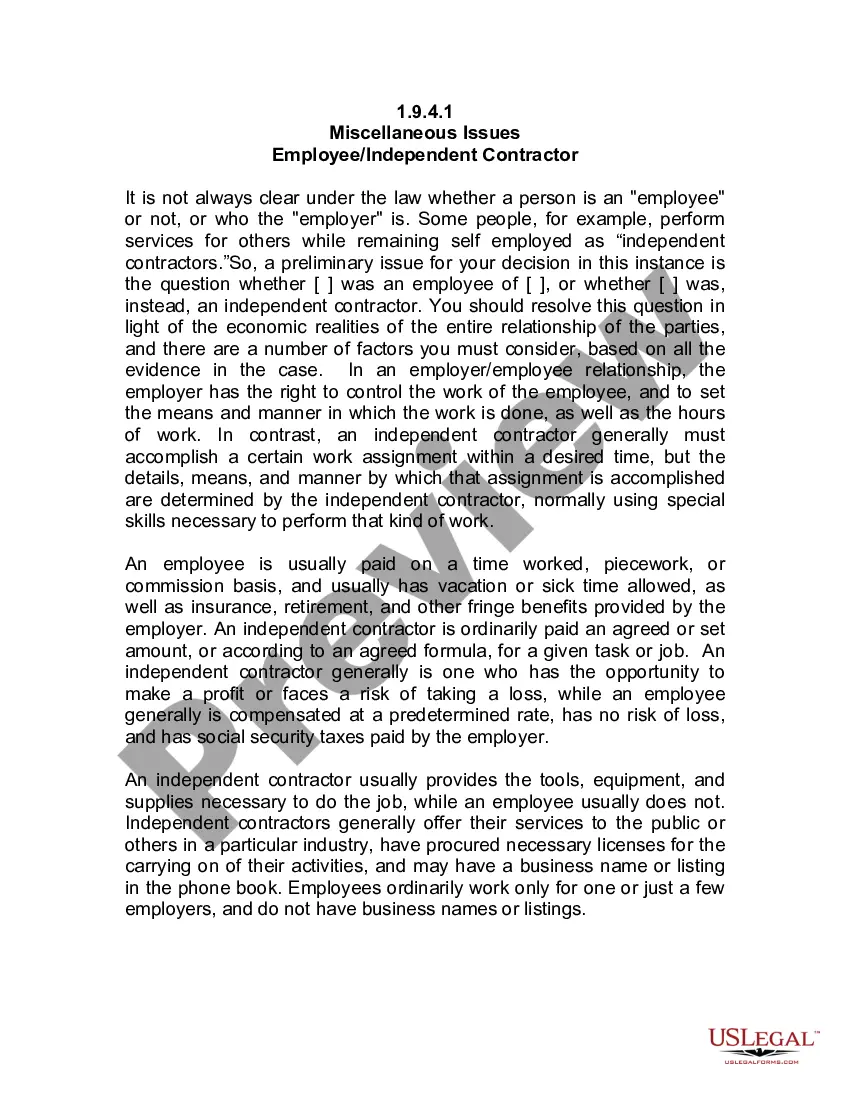
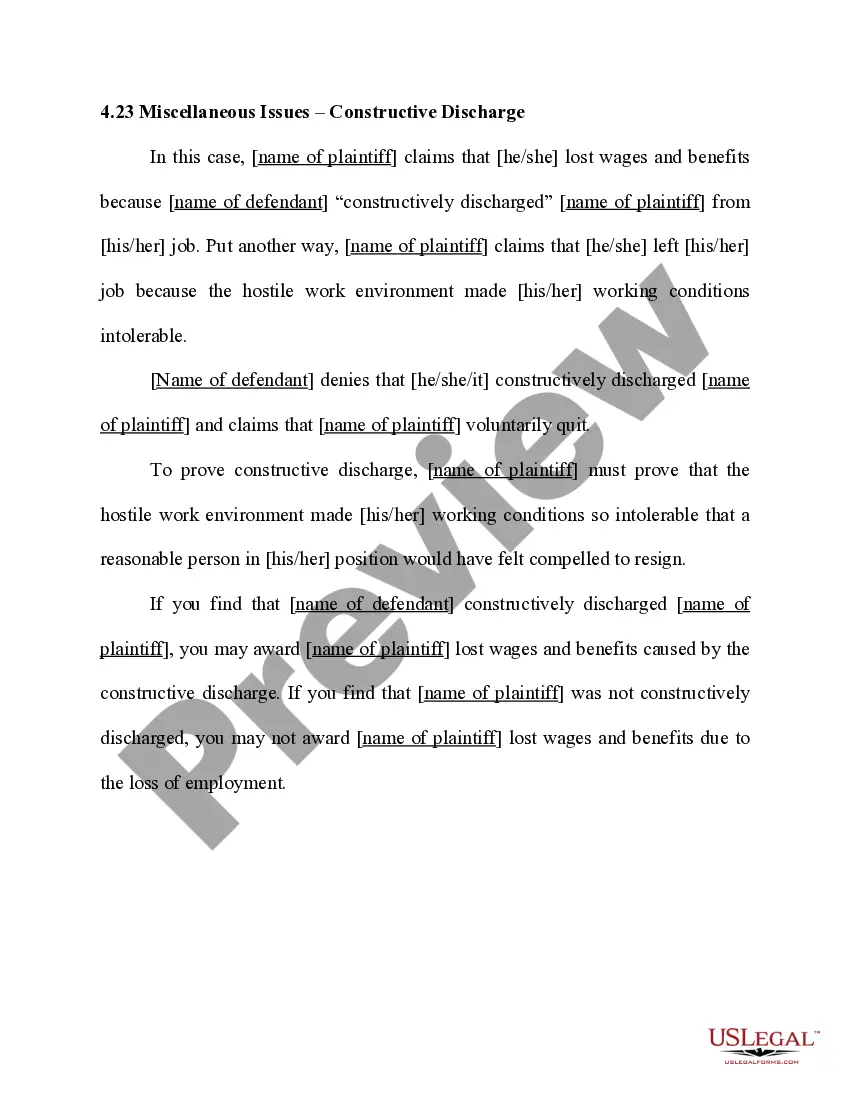
The Jury Instruction - 1.9.2 Miscellaneous Issues Constructive Discharge form provides sample jury instructions related to constructive discharge claims. This form is designed to guide juries in determining whether a plaintiff was constructively discharged due to intolerable working conditions or if the resignation was voluntary. It aims to clarify the legal standards necessary for establishing economic damages related to lost wages in employment cases.
What’s included in this form
- Definition of constructive discharge and its legal implications.
- Circumstances under which a resignation may be considered voluntary.
- Criteria a plaintiff must meet to prove intolerable working conditions.
- Discussion on economic damages related to loss of employment.
- Annotations referencing relevant case law for legal context.
When to use this form
This form is used in cases where an employee claims constructive discharge due to a hostile work environment. Itâs applicable in employment lawsuits where the employee alleges that the conditions were so severe that they had no choice but to resign, affecting their right to claim economic damages.
Who needs this form
Individuals who should consider using this form include:
- Plaintiffs in employment discrimination or wrongful termination cases.
- Attorneys representing employees facing constructive discharge claims.
- Employers seeking to understand jury instructions related to discharge cases.
How to prepare this document
Follow these steps to complete the form:
- Review the definition of constructive discharge to understand the legal standard.
- Determine the specific circumstances under which the plaintiff claims resignation.
- Identify evidence supporting claims of intolerable working conditions.
- Review relevant case law annotations to strengthen legal arguments.
- Prepare to adapt the instructions to fit the particular facts of your case.
Does this document require notarization?
Notarization is not commonly needed for this form. However, certain documents or local rules may make it necessary. Our notarization service, powered by Notarize, allows you to finalize it securely online anytime, day or night.
Get your form ready online
Our built-in tools help you complete, sign, share, and store your documents in one place.
Make edits, fill in missing information, and update formatting in US Legal Forms—just like you would in MS Word.
Download a copy, print it, send it by email, or mail it via USPS—whatever works best for your next step.
Sign and collect signatures with our SignNow integration. Send to multiple recipients, set reminders, and more. Go Premium to unlock E-Sign.
If this form requires notarization, complete it online through a secure video call—no need to meet a notary in person or wait for an appointment.
We protect your documents and personal data by following strict security and privacy standards.

Make edits, fill in missing information, and update formatting in US Legal Forms—just like you would in MS Word.

Download a copy, print it, send it by email, or mail it via USPS—whatever works best for your next step.

Sign and collect signatures with our SignNow integration. Send to multiple recipients, set reminders, and more. Go Premium to unlock E-Sign.

If this form requires notarization, complete it online through a secure video call—no need to meet a notary in person or wait for an appointment.

We protect your documents and personal data by following strict security and privacy standards.
Mistakes to watch out for
- Failing to adequately demonstrate the severity of working conditions.
- Misunderstanding the difference between constructive discharge and voluntary resignation.
- Neglecting to cite relevant case law that supports the claims.
Advantages of online completion
- Convenient access to ready-made legal templates.
- Form can be tailored to specific case facts and jurisdictional requirements.
- Drafted by licensed attorneys, ensuring legal validity.
Legal use & context
- Constructive discharge claims require substantial proof of intolerable conditions.
- The instructions emphasize the burden of proof placed on the plaintiff.
- Understanding the implications of voluntary versus involuntary resignation is crucial for jurors.
Key takeaways
- The form provides essential jury instructions for constructive discharge cases.
- Understanding the difference between constructive discharge and voluntary resignation is crucial.
- Evidence of intolerable working conditions is necessary for claiming economic damages.
Looking for another form?
Form popularity
FAQ
A constructive discharge occurs when an employer's actions make an employee's working conditions so intolerable that a reasonable person under the circumstances would feel compelled to resign. Labor and Employment Law.
It's important to remember that there is no separate legal claim for constructive discharge. Recognition that an employer can force an employee to resign allows employees to claim damages as if they had been fired, but employees must still prove that their treatment violated statutory or common law.
Constructive discharge is recognized and treated as an involuntary termination under various federal and state laws and can, for example, form the basis of the following claims: An adverse employment action under Title VII of the Civil Rights Act of 1964 (see Practice Note, Discrimination: Overview: Title VII).
Jury Instructions. instructions that are given by the trial judge that specifically state what the defendant can be found guilty of and what the prosecution or plaintiff has to prove in order for a guilty verdict.
What does California law say about wrongful constructive discharge? The law of wrongful constructive termination (also known as wrongful constructive discharge) in California provides that you can sue an employer for wrongful termination even if you resigned rather than being fired.
California law recognizes constructive termination (also called constructive discharge) as occurring when an employer intentionally creates or knowingly permits such intolerable working conditions for an employee, that the worker reasonably feels no choice but to resign.
Jury instructions, directions to the jury, or judge's charge are legal rules that jurors should follow when deciding a case.
These are civil or criminal jury instructions approved by a state court, bench committee, or bar association. They are commonly used by courts in the relevant jurisdiction, as they ease the process of drafting fair jury instructions and theoretically do not have errors.
Non-selection. Firing. Failure to promote. Demotion. Suspension. Undesirable reassignment. Denial of a leave request.