Alabama Order Approving Disbursements
About this form
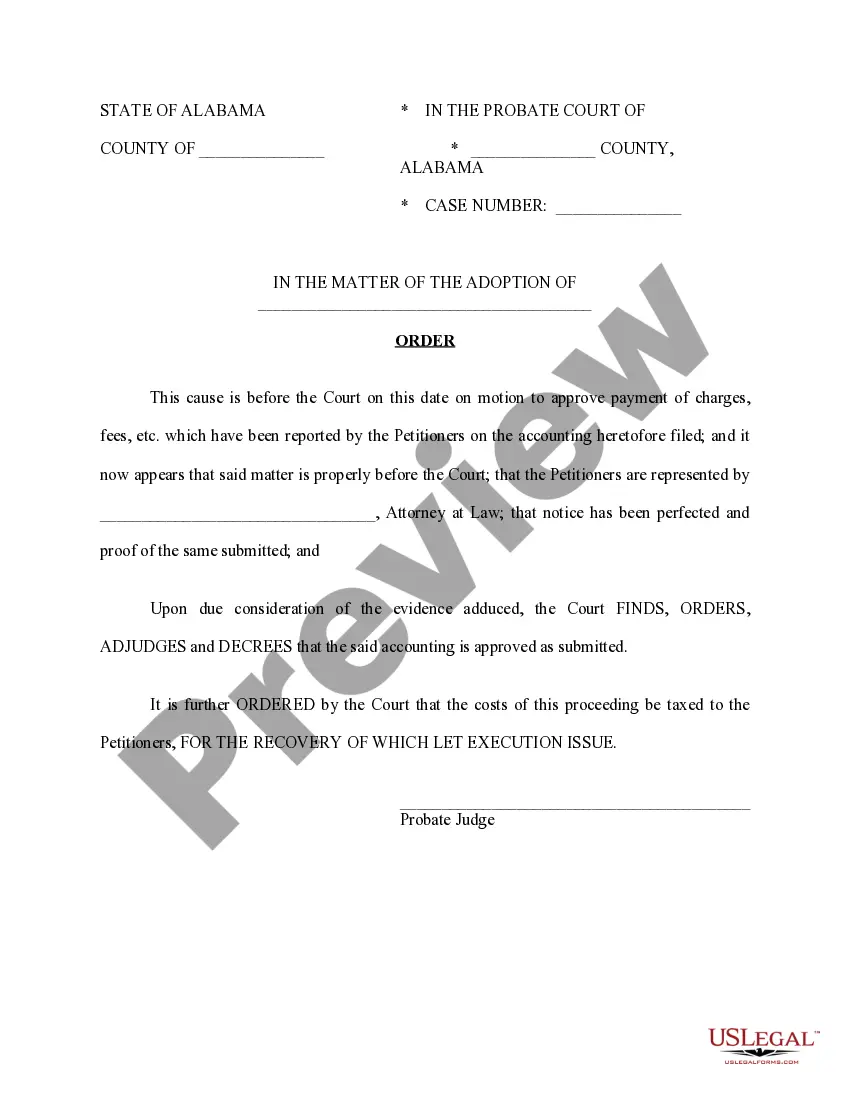
The Order Approving Disbursements is a legal document issued by a court that confirms the approval of an accounting submitted by petitioners. This form serves to provide a formal acknowledgment of the financial dealings reported by the petitioners, distinguishing it from other legal forms related to financial or estate matters. It is typically utilized in court proceedings to finalize the approval process for any disbursements outlined in the accounting.
Key components of this form
- Case number for identification and documentation.
- Name of the petitioners and their legal representation.
- Details of the accounting that is being approved.
- Court's findings and orders regarding the accounting.
- Signature of the probate judge or presiding officer.

When to use this document
This form is needed when a petitioner has submitted an accounting of financial transactions or expenses related to a court matter, such as an estate or trust. It is used in scenarios where approval is required from the court to proceed with disbursements or payments indicated in the accounting records.
Intended users of this form
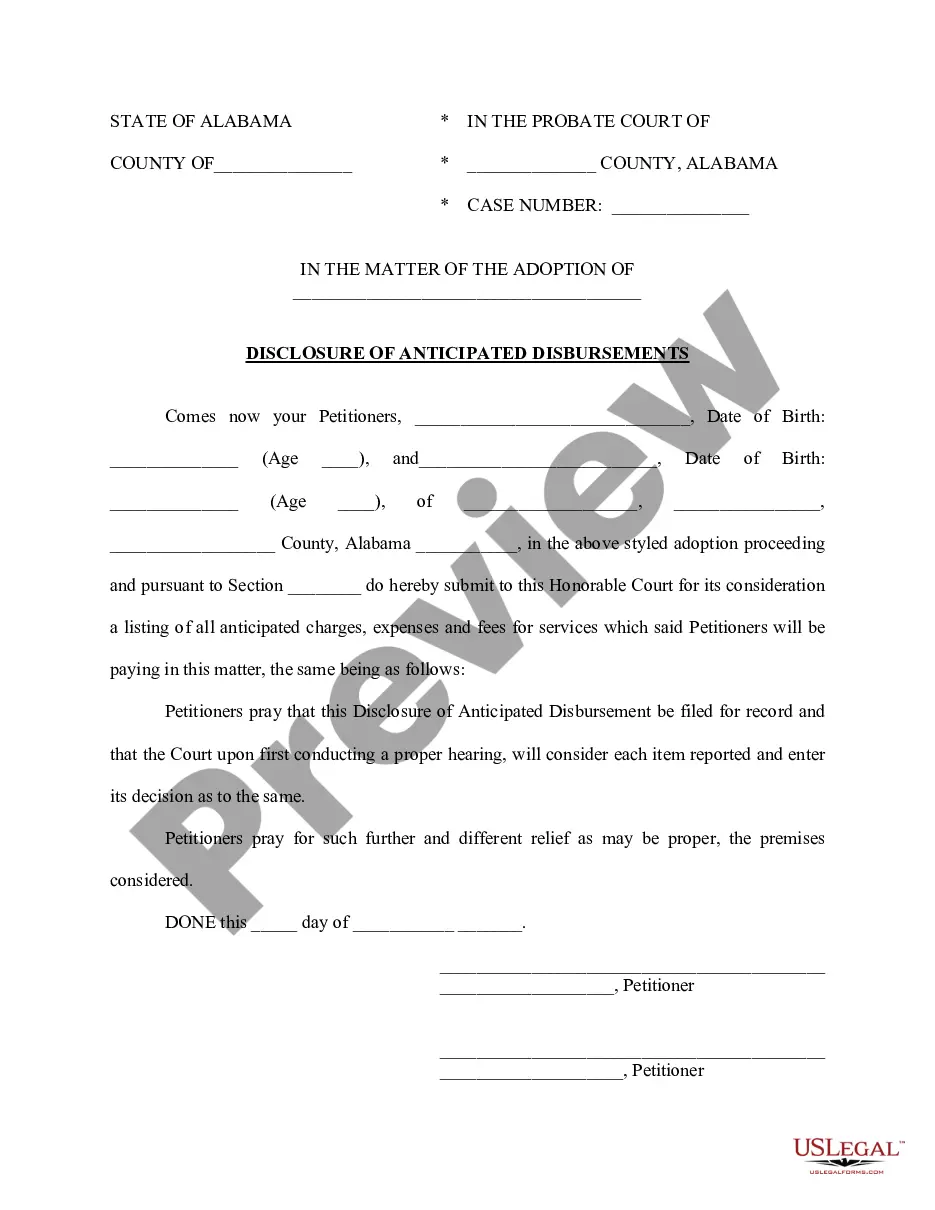
- Individuals acting as petitioners in adoption or probate cases.
- Trustees or executors handling estate affairs.
- Legal representatives overseeing the disbursement of funds in court matters.
How to complete this form
- Enter the state and county information at the top of the form.
- Fill in the case number if applicable.
- Name the party involved in the adoption or probate matter.
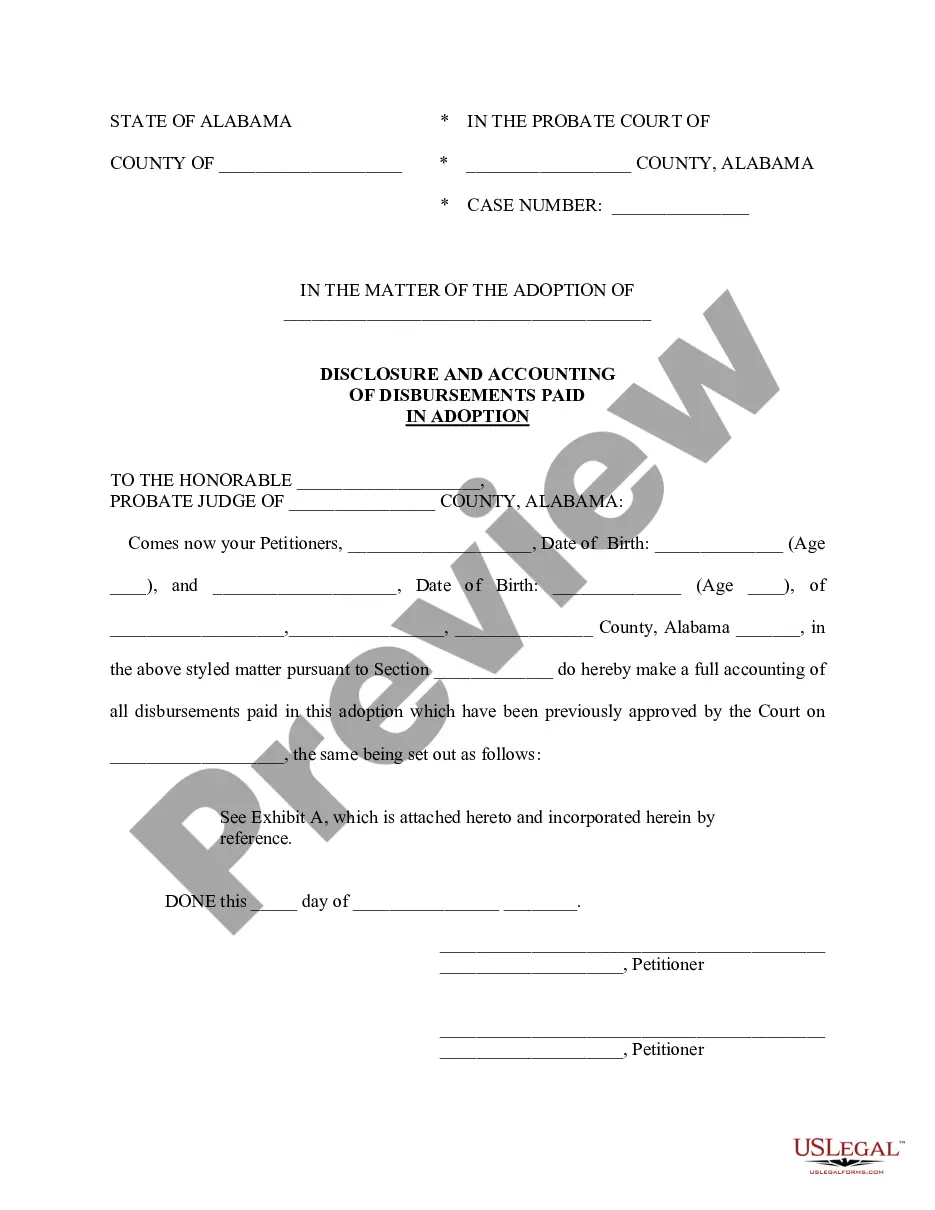
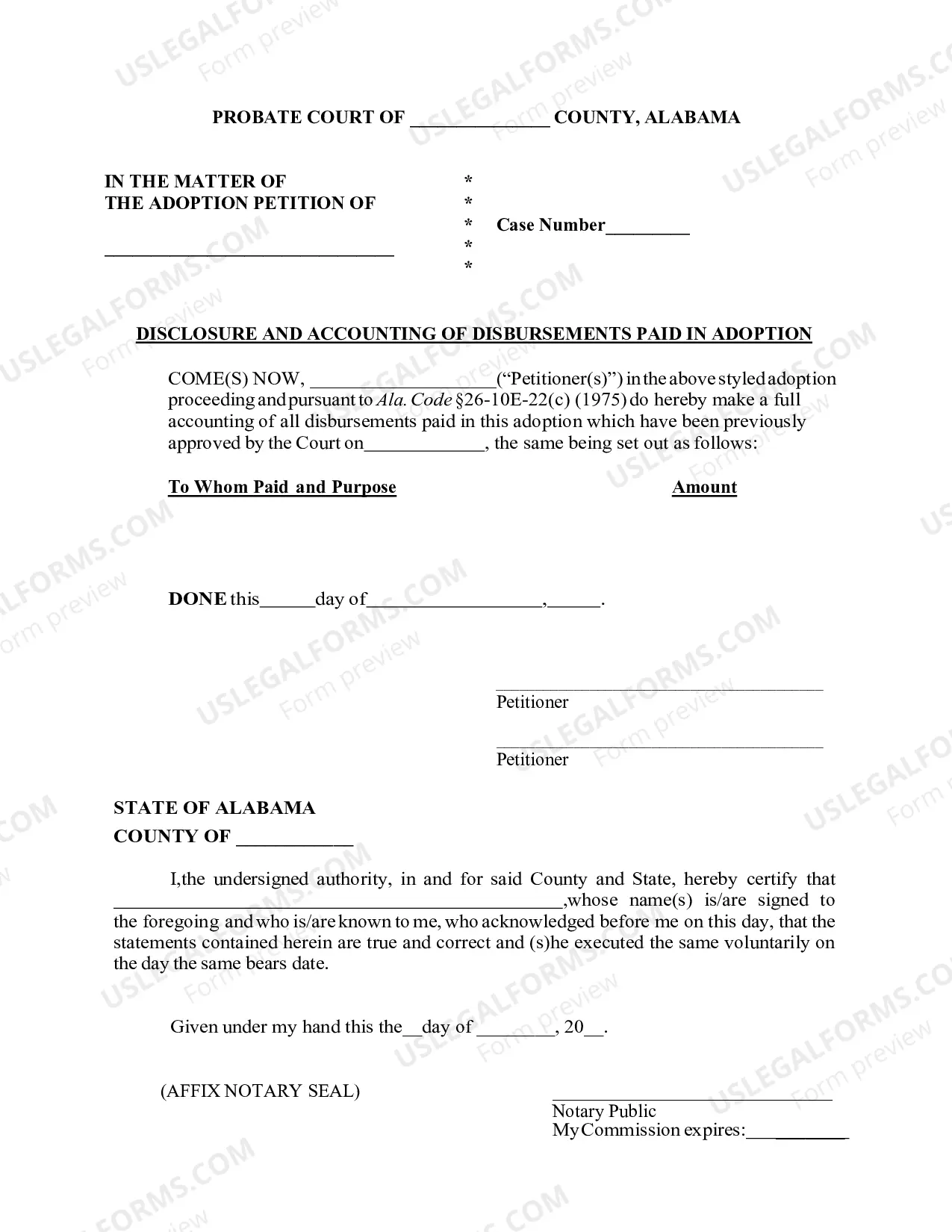
- Provide details of the accounting that needs approval.
- Obtain the signature of the probate judge at the designated section.
Does this form need to be notarized?
This document requires notarization to meet legal standards. US Legal Forms provides secure online notarization powered by Notarize, allowing you to complete the process through a verified video call, available 24/7.
Get your form ready online
Our built-in tools help you complete, sign, share, and store your documents in one place.
Make edits, fill in missing information, and update formatting in US Legal Forms—just like you would in MS Word.
Download a copy, print it, send it by email, or mail it via USPS—whatever works best for your next step.
Sign and collect signatures with our SignNow integration. Send to multiple recipients, set reminders, and more. Go Premium to unlock E-Sign.
If this form requires notarization, complete it online through a secure video call—no need to meet a notary in person or wait for an appointment.
We protect your documents and personal data by following strict security and privacy standards.

Make edits, fill in missing information, and update formatting in US Legal Forms—just like you would in MS Word.

Download a copy, print it, send it by email, or mail it via USPS—whatever works best for your next step.

Sign and collect signatures with our SignNow integration. Send to multiple recipients, set reminders, and more. Go Premium to unlock E-Sign.

If this form requires notarization, complete it online through a secure video call—no need to meet a notary in person or wait for an appointment.

We protect your documents and personal data by following strict security and privacy standards.
Common mistakes
- Not including the case number, which is essential for identification.
- Leaving sections blank, especially the name of the petitioners or attorney.
- Forgetting to have the probate judge sign the form.
Why use this form online
- Convenience of immediate access and download.
- Editability allows users to customize the form as needed.
- Reliability from attorney-drafted templates to ensure legal compliance.
Summary of main points
- The form is essential for obtaining court approval of financial disbursements.
- It is specifically tailored for use in Alabama probate and adoption cases.
- Accurate completion is crucial to avoid delays in the approval process.
Looking for another form?



Form popularity
FAQ
Disbursement means paying out money. The term disbursement may be used to describe money paid into a business' operating budget, the delivery of a loan amount to a borrower, or the payment of a dividend to shareholders.A disbursement is the actual delivery of funds from a bank account.
A payment made to suppliers on behalf of your customers is called a 'disbursement' if you pass the cost on to your customers when you invoice them.you pass on the exact amount of each cost to your customer when you invoice them. the goods and services you paid for are in addition to the cost of your own services.
Disbursement means paying out money. The term disbursement may be used to describe money paid into a business' operating budget, the delivery of a loan amount to a borrower, or the payment of a dividend to shareholders.A disbursement is the actual delivery of funds from a bank account.
Depending on the circumstances of the matter, disbursements may include expenses such as witness fees, court filing and hearing fees, interpreter's fees and fees for the service of court documents such as subpoenas. A legal aid grant may cover these fees.
Some examples of disbursements are payroll expenses, rent, taxes or insurance premiums. In organizational structures, the Finance Department is often the one that handles the disbursement program where all the company's financial commitments are scheduled to be paid at certain moment.
There is no absolute definition of disbursements, but are generally expenses a solicitor has to pay out on behalf of a client, for goods or services provided to the client, or on the client's behalf.The starting point for recoverability of any disbursement is whether it is covered in the contract.
When a business sends a disbursement on behalf of a client, the reimbursement is what the client pays to the company as a refund for the original payment.In general, the difference between a payment and disbursement is that one is the instance or process of disbursing while the other is the act of paying.
HMRC defines 'disbursements' as 'a payment made to suppliers on behalf of your customers'.you paid the supplier on your client's behalf and acted as the agent of your client. your client received, used or had the benefit of the goods or services you paid for on their behalf.
Disbursements, are out of pocket expenses which we incur on your behalf to a third party, whilst conducting your sale or purchase. Examples of disbursements are your search fees, your land registry fees and your CHAPS payment fees (same day electronic transfer of funds fees).