Alabama Disclosure of Disbursements
What this document covers
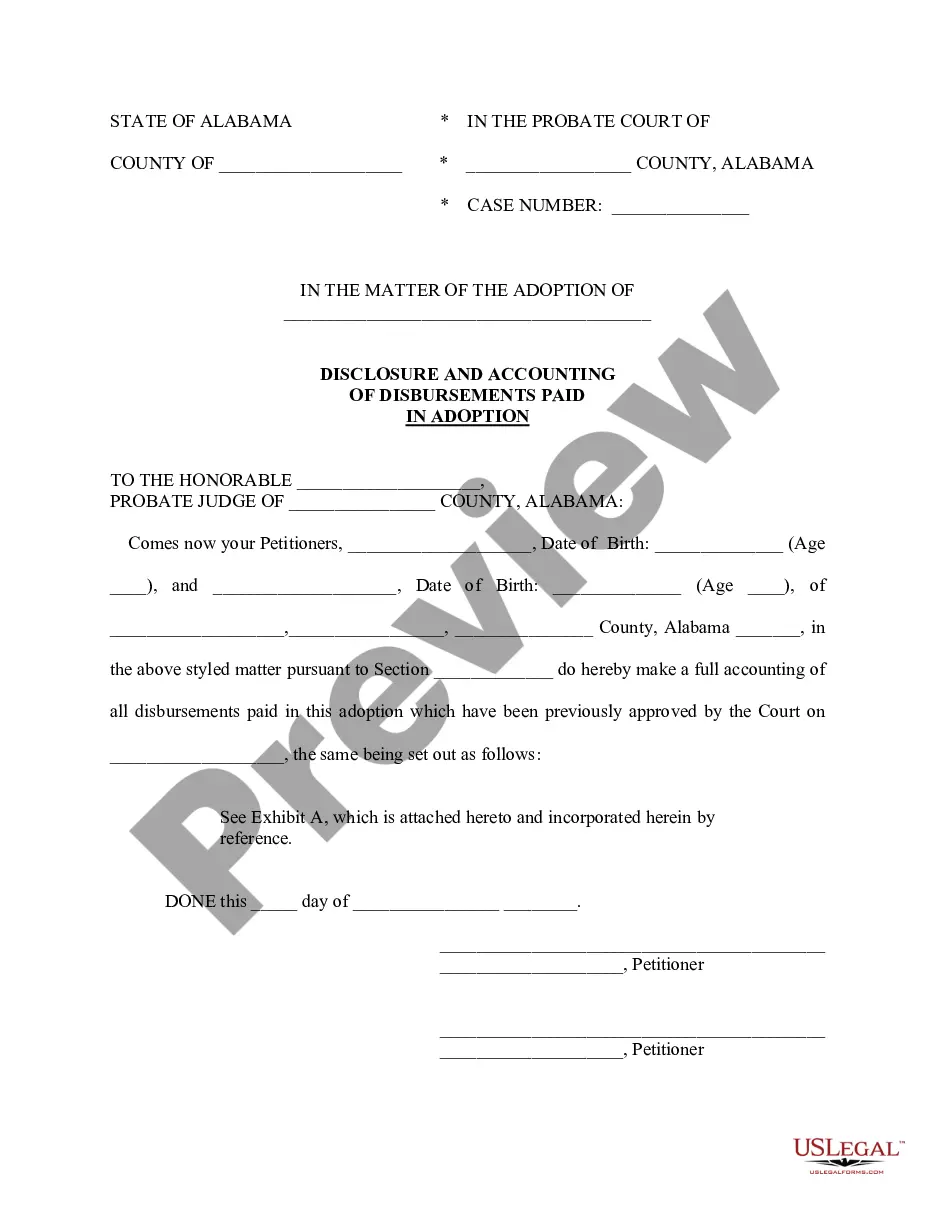
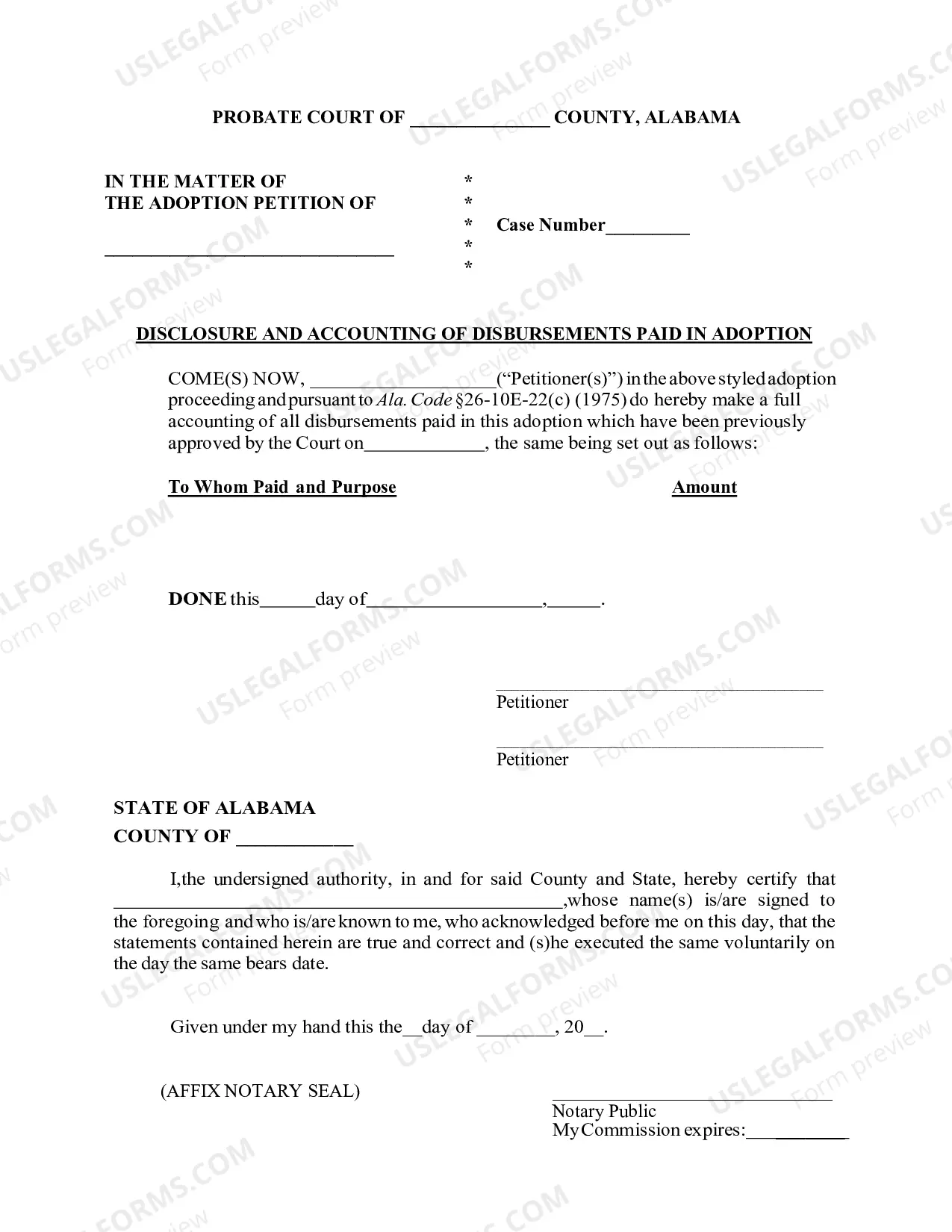
The Disclosure of Disbursements form is a legal document used by Petitioners to provide a comprehensive accounting of all financial disbursements made during an adoption proceeding. This form is essential for ensuring transparency and accountability in the adoption process. It is specifically designed to meet legal requirements, distinguishing it from general financial disclosure forms, and is available in both Word and Word Perfect formats for easy access and completion.
What’s included in this form
- Case number and adoption details to identify the specific proceeding.
- Petitioners' information, including names and dates of birth.
- A section for the full accounting of disbursements, along with an attachment reference for detailed expenses.
- Signature lines for both Petitioners to validate the accounting.
- Notary section to confirm the authenticity of the signatures and statements made.

When this form is needed
This form should be used during an adoption proceeding when Petitioners are required to disclose all financial disbursements that have been made as part of the adoption process. It is often necessary after the adoption has been approved by the court and provides a clear record of all the expenses incurred by the Petitioners throughout the adoption journey.
Intended users of this form
The following individuals should use the Disclosure of Disbursements form:
- Petitioners involved in adoption proceedings who need to account for their expenditures.
- Legal representatives assisting Petitioners with the adoption process.
- Adoption agencies that may require a detailed financial disclosure from Petitioners.
Instructions for completing this form
- Identify the parties involved, including the names and dates of birth of the Petitioners.
- Enter the case number and details of the adoption proceeding.
- Provide a complete accounting of all disbursements made, ensuring they align with the previously approved expenditures by the court.
- Include any necessary attachments, like Exhibit A, to provide detailed information about the expenses.
- Both Petitioners must sign and date the form, affirming their voluntary agreement and understanding.
- Have the form notarized to authenticate the signatures, if required by the local law or court specifications.
Notarization requirements for this form
To make this form legally binding, it must be notarized. Our online notarization service, powered by Notarize, lets you verify and sign documents remotely through an encrypted video session.
Get your form ready online
Our built-in tools help you complete, sign, share, and store your documents in one place.
Make edits, fill in missing information, and update formatting in US Legal Forms—just like you would in MS Word.
Download a copy, print it, send it by email, or mail it via USPS—whatever works best for your next step.
Sign and collect signatures with our SignNow integration. Send to multiple recipients, set reminders, and more. Go Premium to unlock E-Sign.
If this form requires notarization, complete it online through a secure video call—no need to meet a notary in person or wait for an appointment.
We protect your documents and personal data by following strict security and privacy standards.

Make edits, fill in missing information, and update formatting in US Legal Forms—just like you would in MS Word.

Download a copy, print it, send it by email, or mail it via USPS—whatever works best for your next step.

Sign and collect signatures with our SignNow integration. Send to multiple recipients, set reminders, and more. Go Premium to unlock E-Sign.

If this form requires notarization, complete it online through a secure video call—no need to meet a notary in person or wait for an appointment.

We protect your documents and personal data by following strict security and privacy standards.
Avoid these common issues
- Failing to include all required disbursements in the accounting.
- Neglecting to attach necessary supporting documents, such as Exhibit A.
- Forgetting to obtain notarization when required.
- Missing signatures from one or both Petitioners.
Benefits of using this form online
- Convenience of downloading and filling out the form at your own pace.
- Editability of the form allows for easy corrections and updates.
- Access to templates drafted by licensed attorneys ensures compliance with legal standards.
What to keep in mind
- The Disclosure of Disbursements form is critical for documenting adoption expenses.
- Carefully list all disbursements and ensure proper signatures and notarization.
- Users must adhere to specific Alabama state requirements when completing this form.
Looking for another form?
Form popularity
FAQ
Many adoption workers advise parents to introduce the word "adoption" as early as possible so that it becomes a comfortable part of a child's vocabulary and to tell a child, between the ages of 2 and 4 that he is adopted.
The certificate will normally include Full Adoption Name, Date of Birth, Sex, Place of Birth (where known), Adoptive Parent(s') name(s), their address and Occupation at time of adoption, Date of the Adoption Order and description of the court which made it; Date of entry into the Adopted Children Register.
Adoptions resulting from crimes such as abduction and sale of and trafficking in children, fraud in the declaration of adoptability, falsification of official documents or coercion, and any illicit activity or practice such as lack of proper consent by biological parents, improper financial gain by intermediaries and
Identified adoptions are also called designated adoptions. Identified adoptions combine elements of both independent adoptions and agency adoptions. In an identified adoption, the birth and adoptive families find each other, but an agency is used for the process.
There isn't a right time to tell your child that they are adopted but its best to tell them as early as possible. This is to avoid them learning about their adoption from anyone else, or feeling that their adoption is a bad thing.