Alaska Deed of Reconveyance (Corporation)
About this form
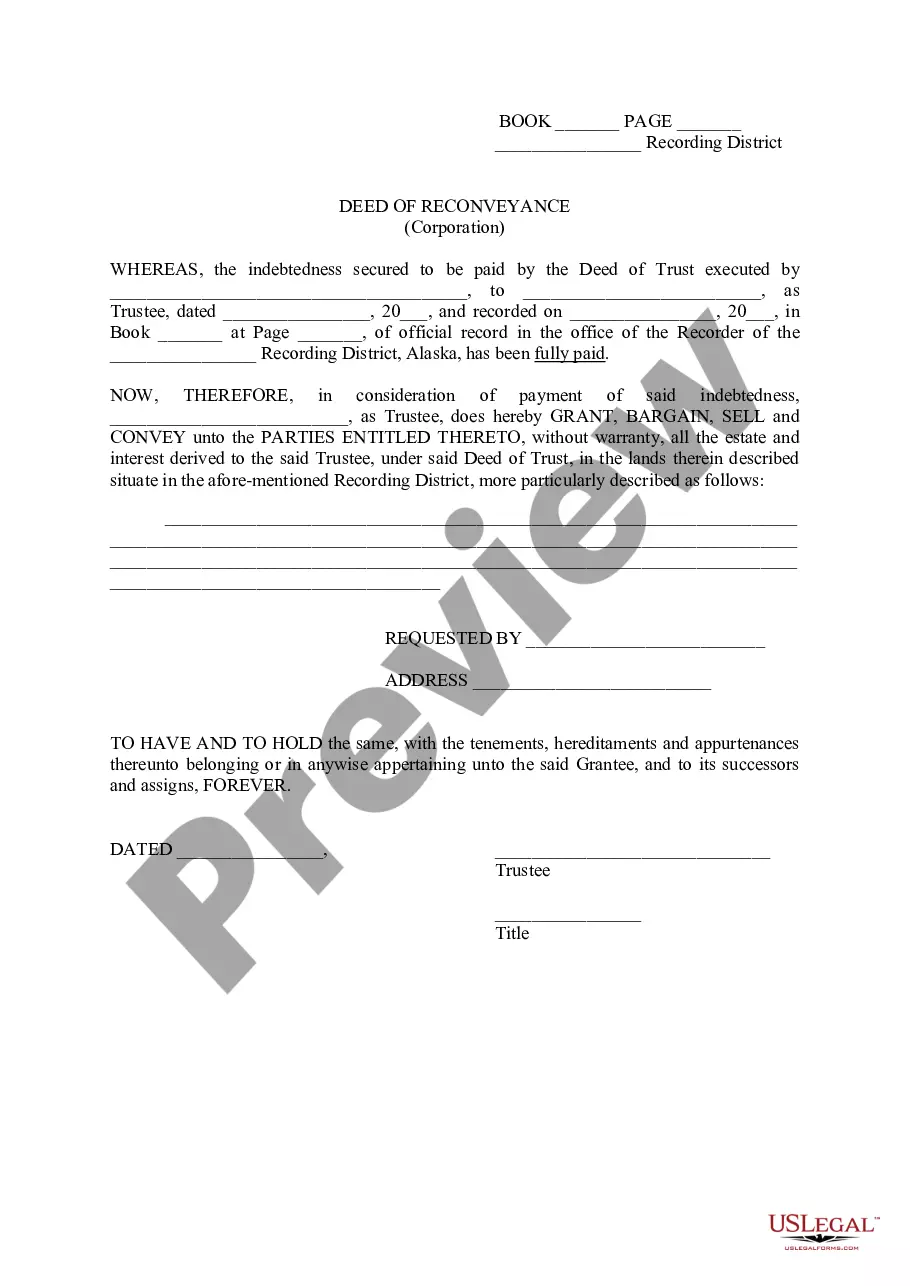
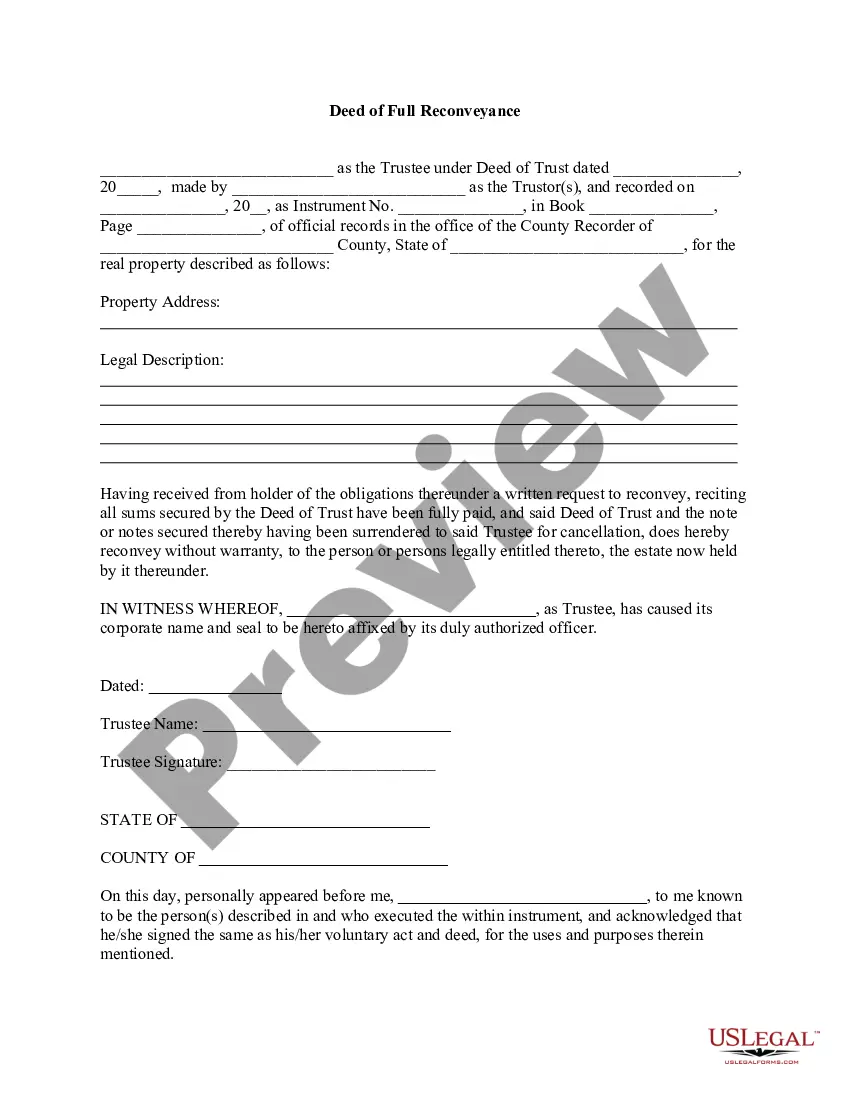
A Deed of Reconveyance is a legal document that transfers title of real property back to the borrower (Trustor) from the Trustee once the debt secured by a Deed of Trust has been fully paid. This form is specifically designed for corporations, making it distinct from individual reconveyance deeds. It serves to notify all parties involved that the lien on the property has been removed upon fulfilling the financial obligations of the Deed of Trust.
Main sections of this form
- Recording information: Includes the book and page number where the Deed of Trust is recorded.
- Trustee details: Information identifying the Trustee and the Trustor.
- Property description: A description of the property being reconveyed.
- Execution date: The date the Deed of Reconveyance is completed.
- Notary acknowledgment: Verification of the Trustee's signature by a Notary Public.

When to use this document
This form should be used when a corporation has repaid the debt associated with a Deed of Trust. If a corporation has taken out a loan secured by real property and has fully repaid that loan, the Trustee must execute a Deed of Reconveyance to formally transfer ownership back to the corporation. This document is necessary to clear the title and ensure that the property is free of any claims related to the debt.
Who this form is for
This form is intended for:
- Corporations or corporate entities that have obtained a loan secured by a real property.
- Trustees acting on behalf of the corporation who are responsible for managing the Deed of Trust.
- Legal representatives or attorneys who aid corporations in managing real estate transactions.
Steps to complete this form
- Identify the borrower (Trustor) and Trustee by filling in their names.
- Provide the date of the original Deed of Trust and the recording information (book and page number).
- Include a detailed description of the property being reconveyed.
- Specify the date that the Deed of Reconveyance is being executed.
- Obtain the signature of the Trustee and ensure that it is notarized.
Does this form need to be notarized?
Yes, this form must be notarized to be legally valid. The signature of the Trustee must be acknowledged by a Notary Public to ensure authenticity and compliance with legal requirements. US Legal Forms offers integrated online notarization services, providing a secure and convenient way to have your document notarized whenever you need it.
Get your form ready online
Our built-in tools help you complete, sign, share, and store your documents in one place.
Make edits, fill in missing information, and update formatting in US Legal Forms—just like you would in MS Word.
Download a copy, print it, send it by email, or mail it via USPS—whatever works best for your next step.
Sign and collect signatures with our SignNow integration. Send to multiple recipients, set reminders, and more. Go Premium to unlock E-Sign.
If this form requires notarization, complete it online through a secure video call—no need to meet a notary in person or wait for an appointment.
We protect your documents and personal data by following strict security and privacy standards.

Make edits, fill in missing information, and update formatting in US Legal Forms—just like you would in MS Word.

Download a copy, print it, send it by email, or mail it via USPS—whatever works best for your next step.

Sign and collect signatures with our SignNow integration. Send to multiple recipients, set reminders, and more. Go Premium to unlock E-Sign.

If this form requires notarization, complete it online through a secure video call—no need to meet a notary in person or wait for an appointment.

We protect your documents and personal data by following strict security and privacy standards.
Common mistakes to avoid
- Failing to accurately describe the property being reconveyed.
- Not providing correct recording information for the original Deed of Trust.
- Neglecting to have the Trusteeâs signature notarized.
- Leaving out the date of execution, which is essential for legal validity.
Benefits of completing this form online
- Convenience of downloading and filling out the form at your own pace.
- Editability to ensure all information is correct before finalizing.
- Access to reliable templates drafted by licensed attorneys, minimizing legal risks.
Looking for another form?


Form popularity
FAQ
The Alaska Deed of Reconveyance (Corporation) is a legal form used to record the release of a deed of trust lien when a loan secured by real property has been satisfied by a corporation. It documents that the trustee reconveys title back to the borrower corporate entity, clearing the lien from the property records and restoring unencumbered title.
Reconveyance of a deed of trust means the trustee releases the lien on the property by transferring title back to the borrower after full payment or fulfillment of obligations. In the Alaska Deed of Reconveyance (Corporation), this document formalizes that release for corporate borrowers.
The signer is typically the trustee or an authorized corporate representative, and the document should be recorded in the county where the property sits. For corporate use, ensure the signer has authority to bind the corporation. If in doubt, consult a licensed attorney about signatory authority and recording requirements.
It is typically used after a mortgage loan secured by a deed of trust has been fully paid, or otherwise satisfied, to trigger reconveyance by the trustee to the corporate borrower. It provides a formal mechanism to remove the lien from public records and confirm title free of encumbrances.
Yes. The reconveyance releases the lien by transferring the deed of trust back to the corporation, clearing the title. The form documents the release and is generally recorded to ensure the lien is legally extinguished and the property owner holds title free of that encumbrance.
This form is designed for corporate entities; the signing authority and terms presume a corporation as the principal. A non-corporate version would be used for individuals and might involve different signatories or procedural steps.