Alaska Tenant Welcome Letter
What this document covers
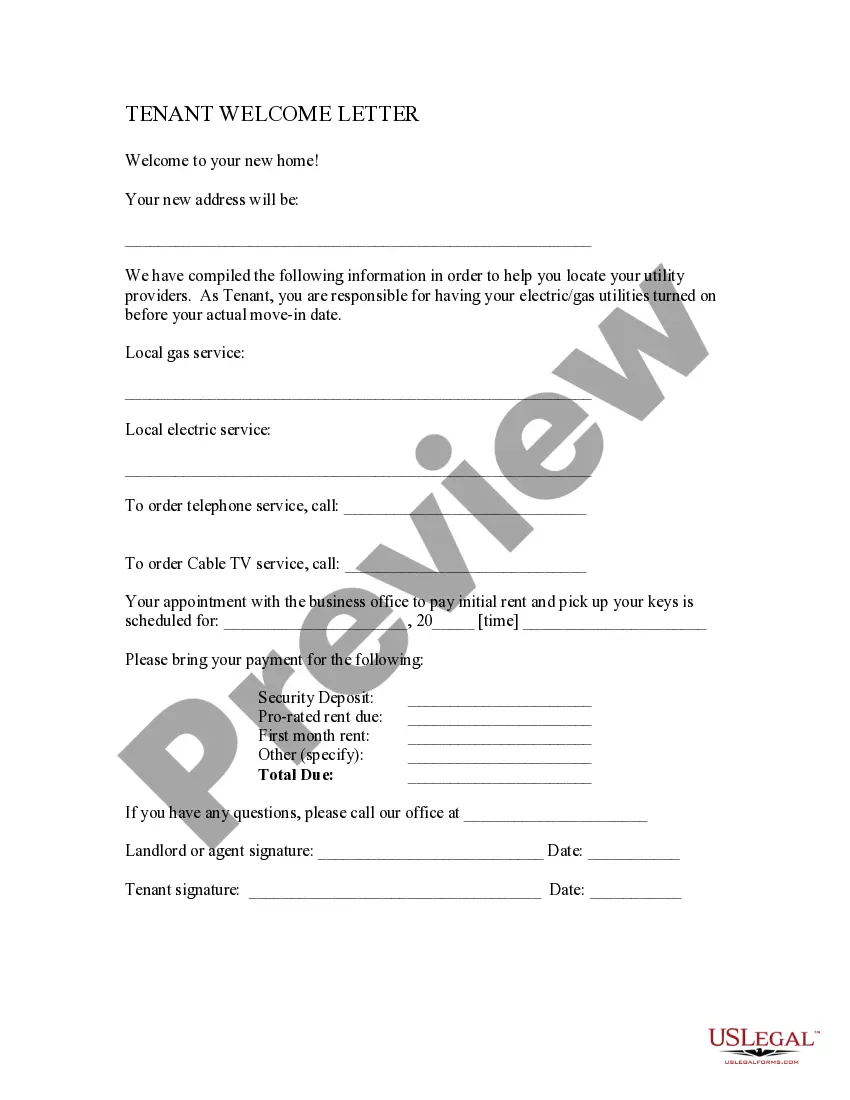
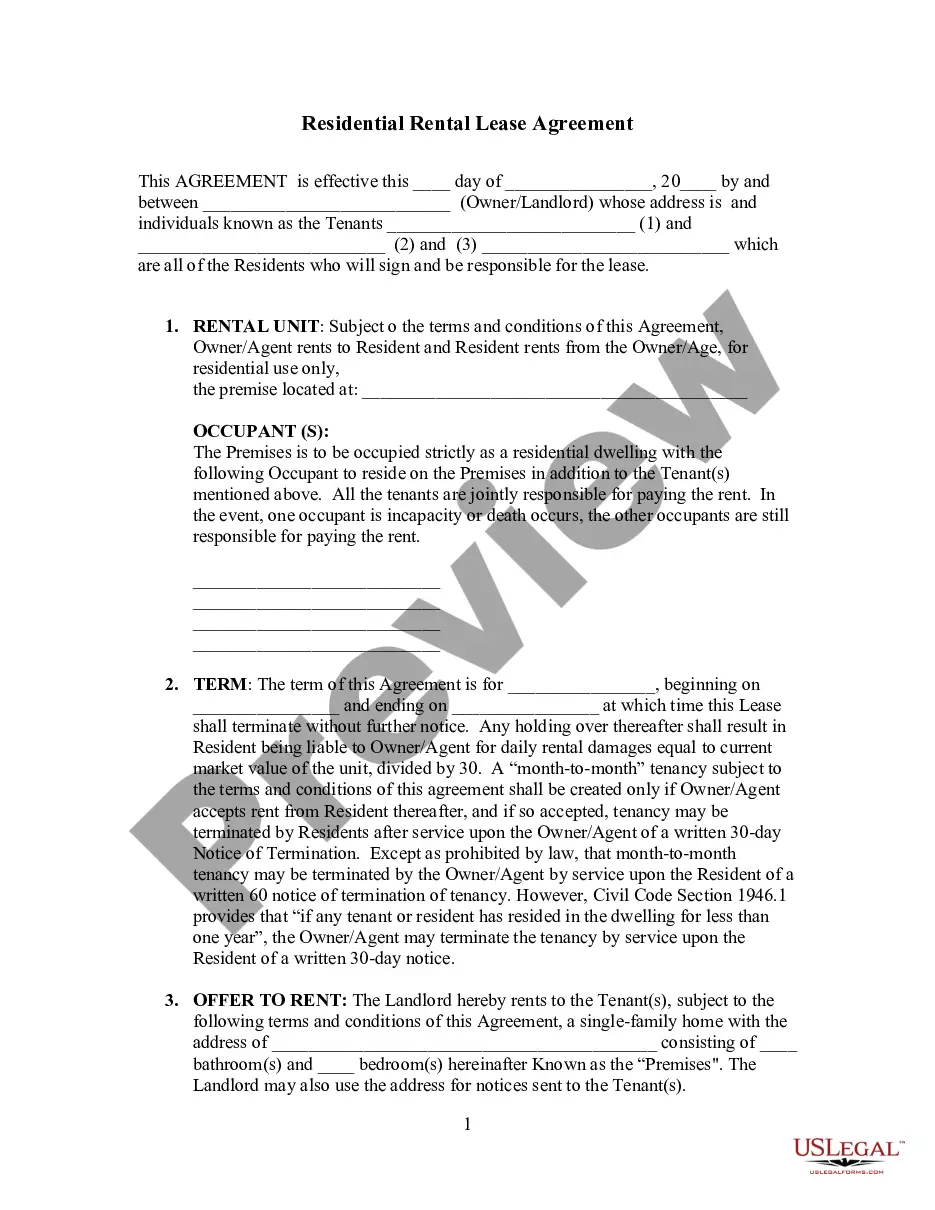
The Tenant Welcome Letter is a crucial document designed to provide essential information to new tenants. It serves as an introduction to the rental property and includes important contact details for utilities, along with reminders related to the lease agreement. This differs from other rental documents by focusing specifically on welcoming the tenant and ensuring they have all necessary information to settle in smoothly.
Form components explained
- Contact information for utility services.
- Details regarding the security deposit payment.
- Information about pro-rated rent due.
- First month's rent payment details.
- Space to specify any additional fees.
Situations where this form applies
This form should be used when a landlord wishes to formally welcome a new tenant to their rental property. It is ideally issued before or upon the tenant's move-in date to ensure they have all necessary information regarding payments and utilities, promoting a smooth transition into their new home.
Who needs this form
- Landlords or property managers welcoming new tenants.
- New tenants seeking clarity on their rental obligations.
- Anyone involved in residential leasing processes or property management.
Steps to complete this form
- Begin by entering the contact information for utility services.
- Specify the amount for the security deposit.
- Include the pro-rated rent amount that is due.
- Record the first month's rent amount.
- Add any additional fees, if applicable, and calculate the total due.
Notarization requirements for this form
Notarization is not commonly needed for this form. However, certain documents or local rules may make it necessary. Our notarization service, powered by Notarize, allows you to finalize it securely online anytime, day or night.
Get your form ready online
Our built-in tools help you complete, sign, share, and store your documents in one place.
Make edits, fill in missing information, and update formatting in US Legal Forms—just like you would in MS Word.
Download a copy, print it, send it by email, or mail it via USPS—whatever works best for your next step.
Sign and collect signatures with our SignNow integration. Send to multiple recipients, set reminders, and more. Go Premium to unlock E-Sign.
If this form requires notarization, complete it online through a secure video call—no need to meet a notary in person or wait for an appointment.
We protect your documents and personal data by following strict security and privacy standards.

Make edits, fill in missing information, and update formatting in US Legal Forms—just like you would in MS Word.

Download a copy, print it, send it by email, or mail it via USPS—whatever works best for your next step.

Sign and collect signatures with our SignNow integration. Send to multiple recipients, set reminders, and more. Go Premium to unlock E-Sign.

If this form requires notarization, complete it online through a secure video call—no need to meet a notary in person or wait for an appointment.

We protect your documents and personal data by following strict security and privacy standards.
Avoid these common issues
- Failing to provide accurate contact information for utilities.
- Omitting any additional fees or costs associated with the tenancy.
- Not clearly stating payment deadlines to the tenant.
Benefits of using this form online
- Easy to download and complete on any device.
- Editable templates allow for customization based on specific tenant needs.
- Access to a reliable source of legal forms drafted by licensed attorneys.
Main things to remember
- The Tenant Welcome Letter is essential for helping new tenants transition smoothly into their rental property.
- This form includes important information on payments and utilities.
- It is applicable across various states, ensuring relevance in most locations.
Looking for another form?

Form popularity
FAQ
The key difference between a guest and a tenant is that a tenant is on the lease, and a guest is not. The tenant will be held responsible for paying rent on time and preventing any damage to the property. A guest, however, can be a liability if they begin to act like a tenant when they are not.
Trouble is there is no way of knowing for sure which tenants are bad and which are good until you run a tenant background check. Don't be left in the dark. Make sure you verify all the information in the rental application, run a credit check, and speak with the references, including the previous landlords.
The tenant does indeed make the income that they claim to make (ideally no less than two-and-a-half times the rental price); The tenant has a good credit history; The tenant has a good rental history that can be verified by previous landlords.
When there is no lease agreement (like in the case of weekly rentals), you can instead use the Alaska Notice to Vacate to inform the other party in advance that you wish to end the tenancy agreement and vacate the premises.
Give the landlord/agent a written termination notice and vacate move out and return the keys according to your notice, and/or. apply to the NSW Civil & Administrative Tribunal (NCAT) for a termination order.
Fails to pay rent; Violates a clause in the lease or rental agreement; Violates a responsibility imposed by law.
In some circumstances, a tenant can break a fixed-term agreement early without penalty. A tenant can give 14 days' written notice to end an agreement early without penalty if: they have accepted an offer of social housing (e.g. from DCJ Housing)
Alaska state law limits how much a landlord can charge for a security deposit (two months' rent, unless the monthly rent exceeds $2,000), when it must be returned (within 14 days after a tenant moves if the tenant has given proper notice to end the tenancy or 30 days if the tenant has not), and sets other restrictions
As a landlord, you're not technically liable for nuisance tenants or occupiers of your property. However, you may be liable if you've allowed the tenants to cause the nuisance or if, when renting out your property, you were aware that nuisance was inevitable or almost certainly going to occur.