Jury Instruction - Presenting False Declaration Or Certification
Understanding this form
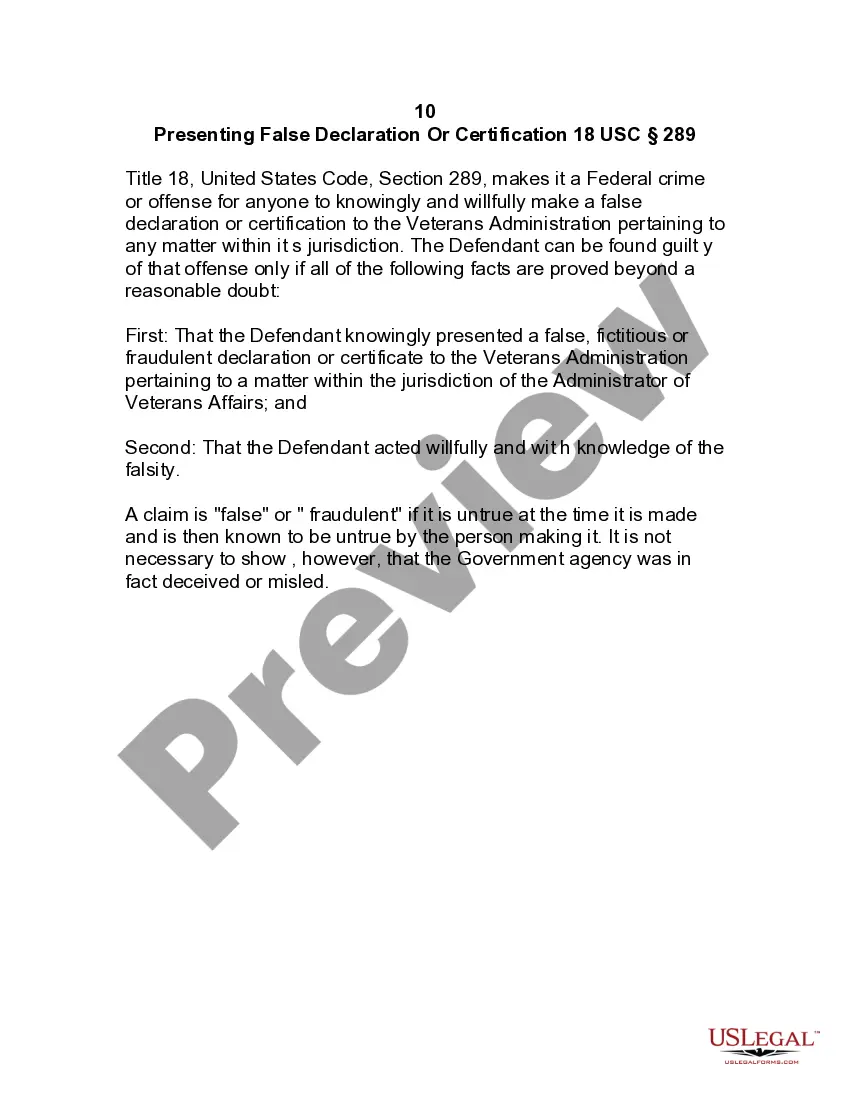
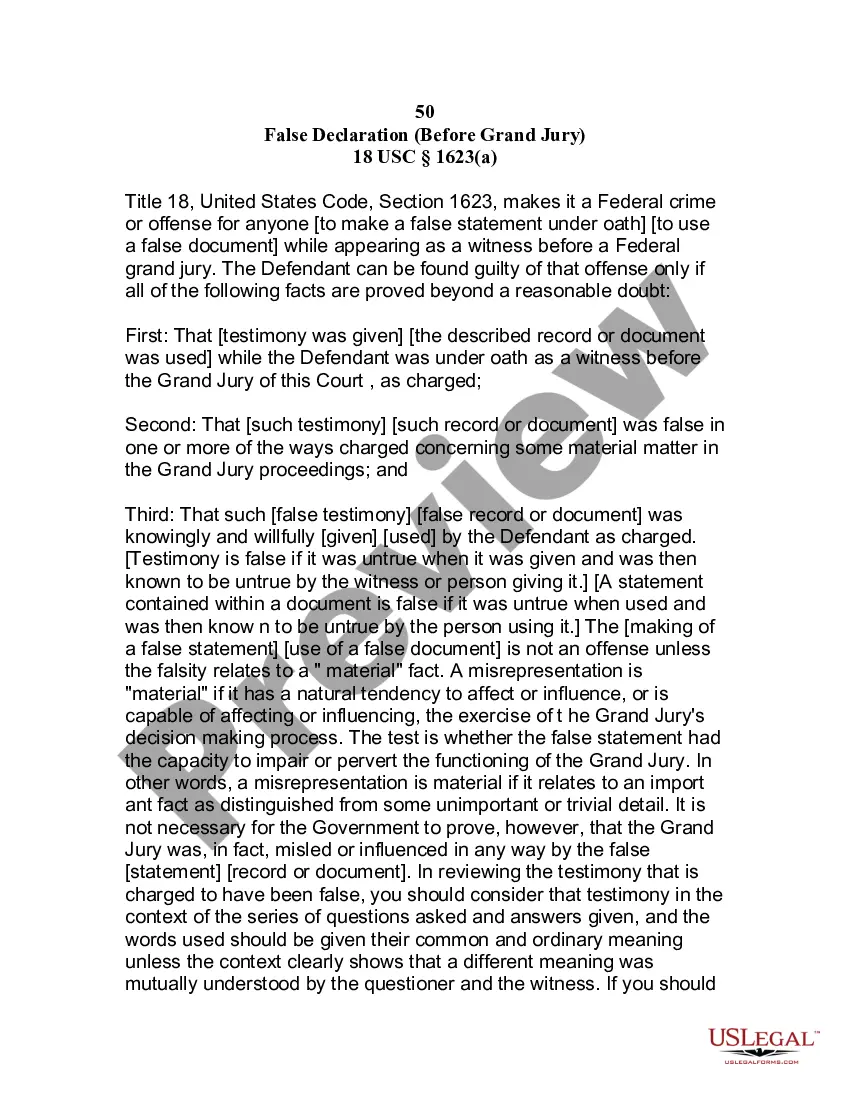
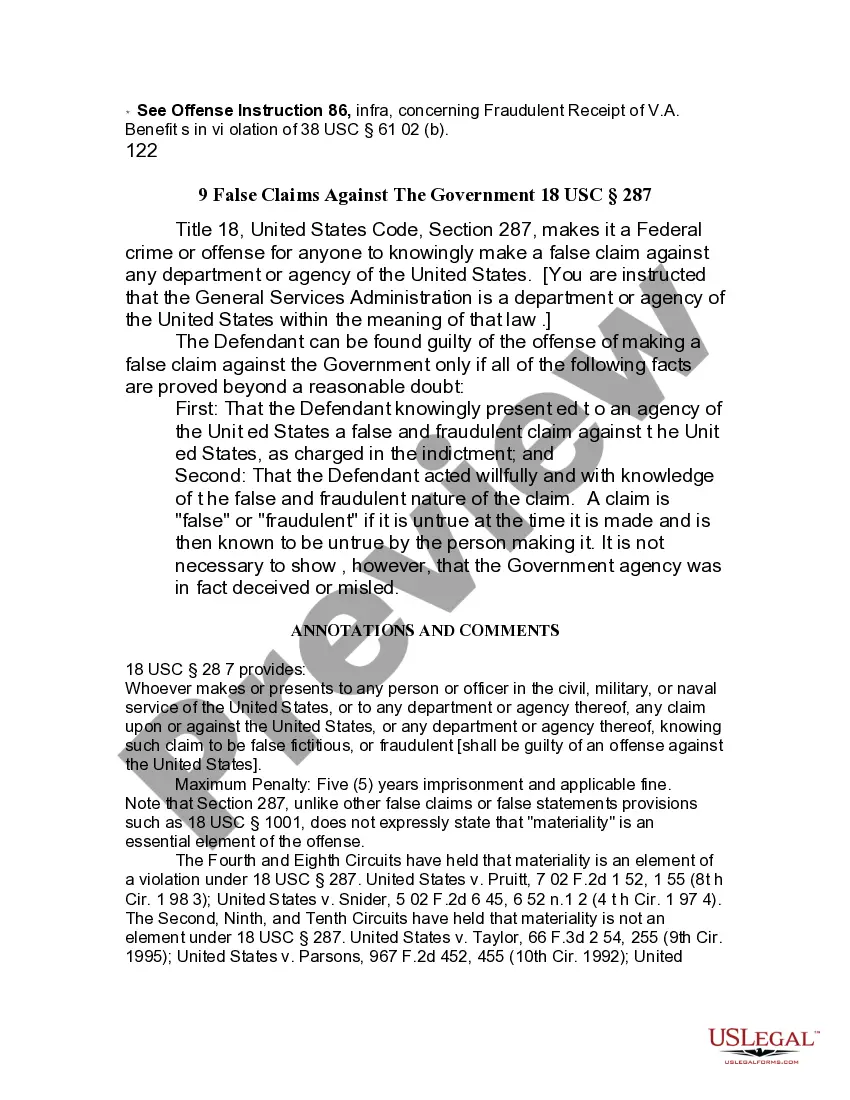
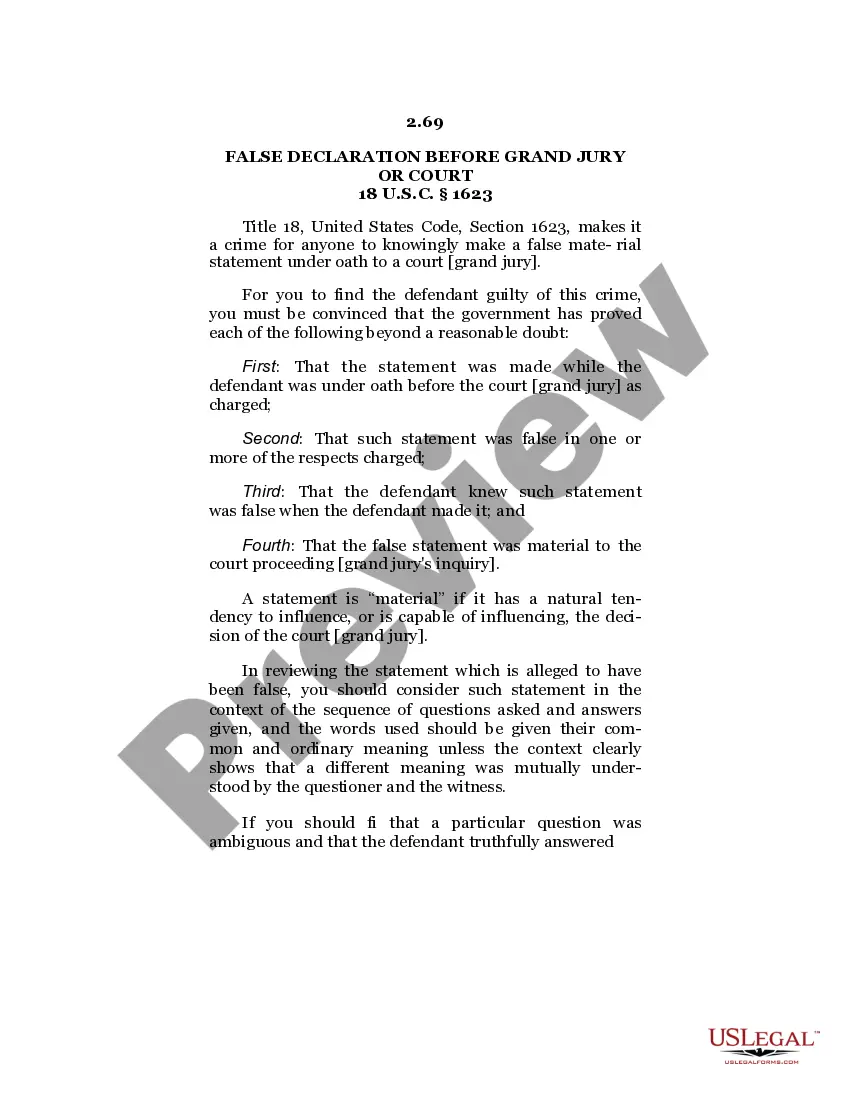
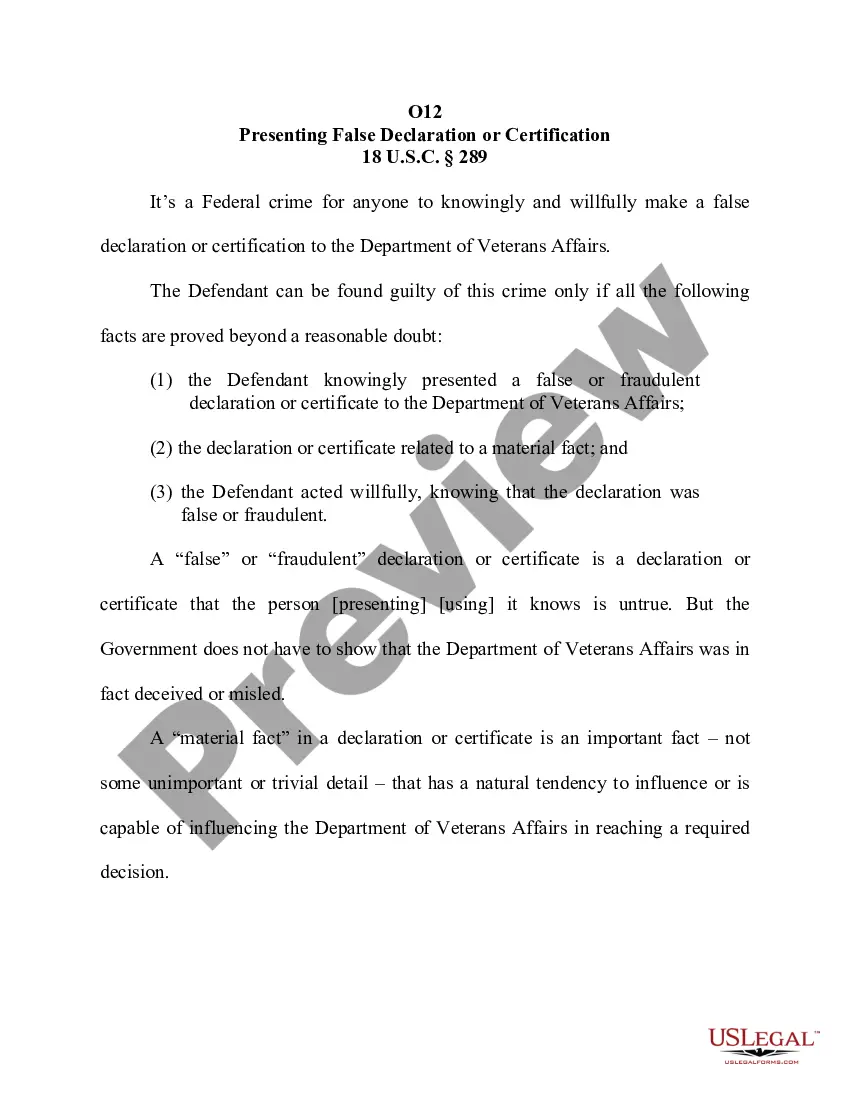
The Jury Instruction for Presenting False Declaration or Certification provides a framework for juries to understand the elements involved in prosecuting cases related to false declarations made to the Veterans Administration. This form specifies the legal standards that must be met for a conviction under 18 USC 289, differentiating it from other jury instructions that may address different forms of fraudulent behavior.
Key components of this form
- Matter of jurisdiction: Indicates the Veterans Administration as the agency involved.
- Elements of the offense: Details the necessary facts that must be proven beyond a reasonable doubt.
- Understanding falsity: Specifies that a declaration is false if it is known to be untrue at the time of submission.
- Willful action: Emphasizes the importance of the defendant's intent in making the false declaration.
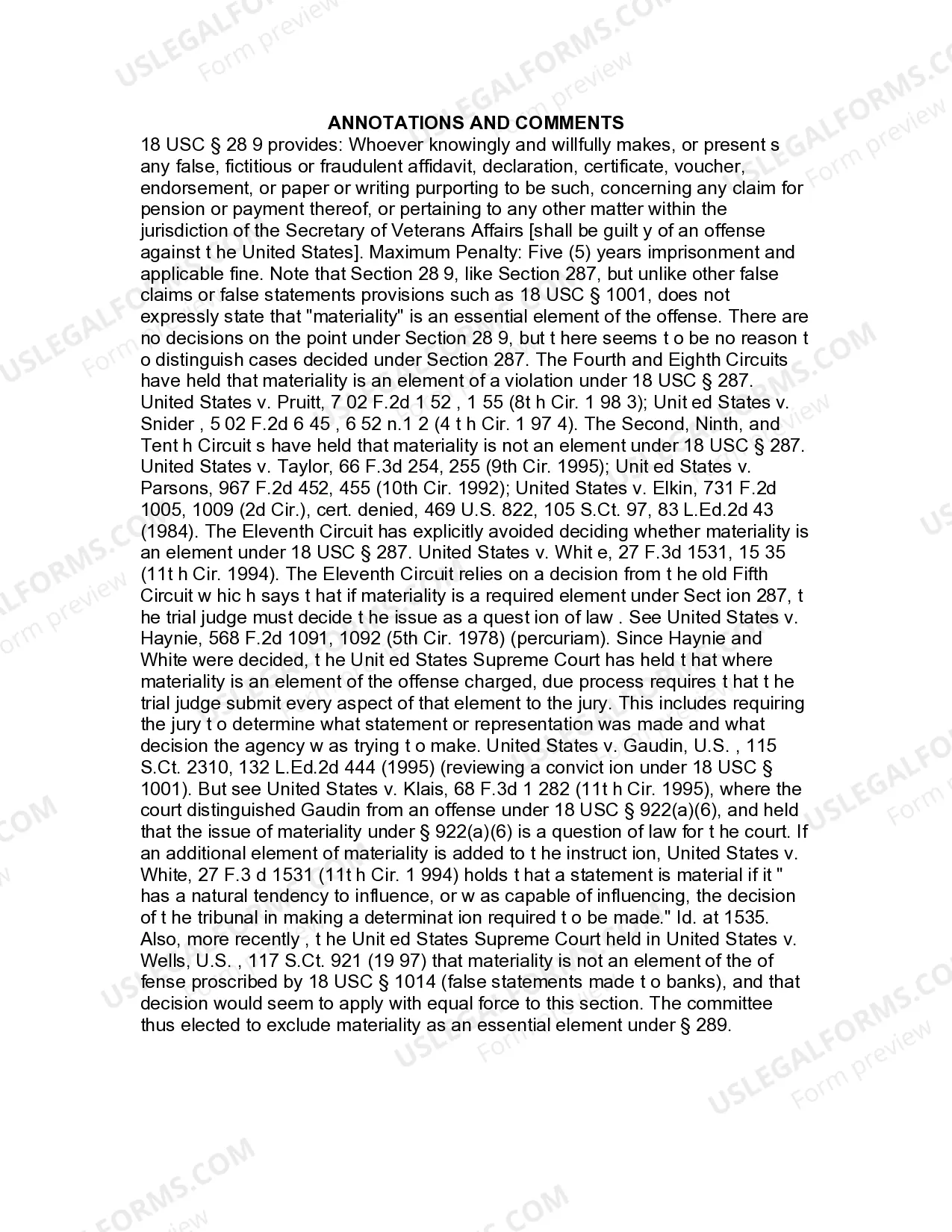
- Penalty information: Outlines potential penalties for making false declarations, including imprisonment and fines.
Common use cases
This form is used in legal cases where a defendant is charged with making false declarations or certifications to the Veterans Administration. It is particularly relevant in criminal cases where the government must prove that a person knowingly presented fraudulent information for benefits or claims.
Who this form is for
- Prosecutors working on cases involving false declarations to the Veterans Administration.
- Defense attorneys preparing for jury trials related to false certifications.
- Legal scholars and students studying criminal law related to fraud.
Instructions for completing this form
- Review the charges against the defendant carefully to understand the specific allegations.
- Identify the key elements that need to be proven beyond a reasonable doubt (knowledge, willfulness, and falsity).
- Prepare the jury instructions by tailoring the sample questions to fit the specifics of the case.
- Ensure that all relevant legal precedents and penalties are included in the instructions.
- Finalize the instructions to ensure clarity and thoroughness before presenting them to the jury.
Does this form need to be notarized?
In most cases, this form does not require notarization. However, some jurisdictions or signing circumstances might. US Legal Forms offers online notarization powered by Notarize, accessible 24/7 for a quick, remote process.
Get your form ready online
Our built-in tools help you complete, sign, share, and store your documents in one place.
Make edits, fill in missing information, and update formatting in US Legal Forms—just like you would in MS Word.
Download a copy, print it, send it by email, or mail it via USPS—whatever works best for your next step.
Sign and collect signatures with our SignNow integration. Send to multiple recipients, set reminders, and more. Go Premium to unlock E-Sign.
If this form requires notarization, complete it online through a secure video call—no need to meet a notary in person or wait for an appointment.
We protect your documents and personal data by following strict security and privacy standards.

Make edits, fill in missing information, and update formatting in US Legal Forms—just like you would in MS Word.

Download a copy, print it, send it by email, or mail it via USPS—whatever works best for your next step.

Sign and collect signatures with our SignNow integration. Send to multiple recipients, set reminders, and more. Go Premium to unlock E-Sign.

If this form requires notarization, complete it online through a secure video call—no need to meet a notary in person or wait for an appointment.

We protect your documents and personal data by following strict security and privacy standards.
Common mistakes
- Failing to clearly establish the necessary elements of the crime.
- Using vague language that could confuse the jury about the definitions of falsity and willfulness.
- Neglecting to address recent legal precedents that could affect the interpretation of the law.
Benefits of completing this form online
- Convenience of accessing the form from anywhere at any time.
- Editable format allows for customization based on case specifics.
- Reliability of having forms drafted by licensed attorneys, ensuring legal compliance.
Legal use & context
- This form is essential in ensuring that jurors understand the serious nature of making false declarations to government agencies.
- Understanding federal statutes like 18 USC 289 is critical for accurate legal proceedings in related cases.
- The absence of a materiality requirement under this statute requires careful consideration when presenting evidence.
Looking for another form?
Form popularity
FAQ
The judge instructs the jury about the relevant laws that should guide its deliberations. (In some jurisdictions, the court may instruct the jury at any time after the close of evidence.The judge reads the instructions to the jury. This is commonly referred to as the judge's charge to the jury.
These are civil or criminal jury instructions approved by a state court, bench committee, or bar association. They are commonly used by courts in the relevant jurisdiction, as they ease the process of drafting fair jury instructions and theoretically do not have errors.
False declaration means giving incorrect information on the value of a currency or bearer negotiable instruments being physically transferred across the border, or giving other incorrect related information required to be declared or provided through any other another means by the customs authorities.
A judgment notwithstanding the verdict (or JNOV) is an order by a judge after a jury has returned its verdict. The judge can overturn the jury's verdict if he or she feels it cannot reasonably be supported by the evidence or if it contradicts itself.
A jury instruction is a guideline given by the judge to the jury about the law they will have to apply to the facts they have found to be true. The purpose of the instructions is to help the jury arrive at a verdict that follows the law of that jurisdiction.
A person convicted of perjury under federal law may face up to five years in prison and fines. The punishment for perjury under state law varies from state to state, but perjury is a felony and carries a possible prison sentence of at least one year, plus fines and probation.
Jury instructions, directions to the jury, or judge's charge are legal rules that jurors should follow when deciding a case.
Penalties Upon Conviction Anyone convicted of making false statements in violation of federal statute faces a prison term of up to five years and a fine of up to $250,000. If the offense involves terrorism, anyone convicted of making false statements faces up to eight years in prison.