False Declaration Before Grand Jury or Court
What this document covers
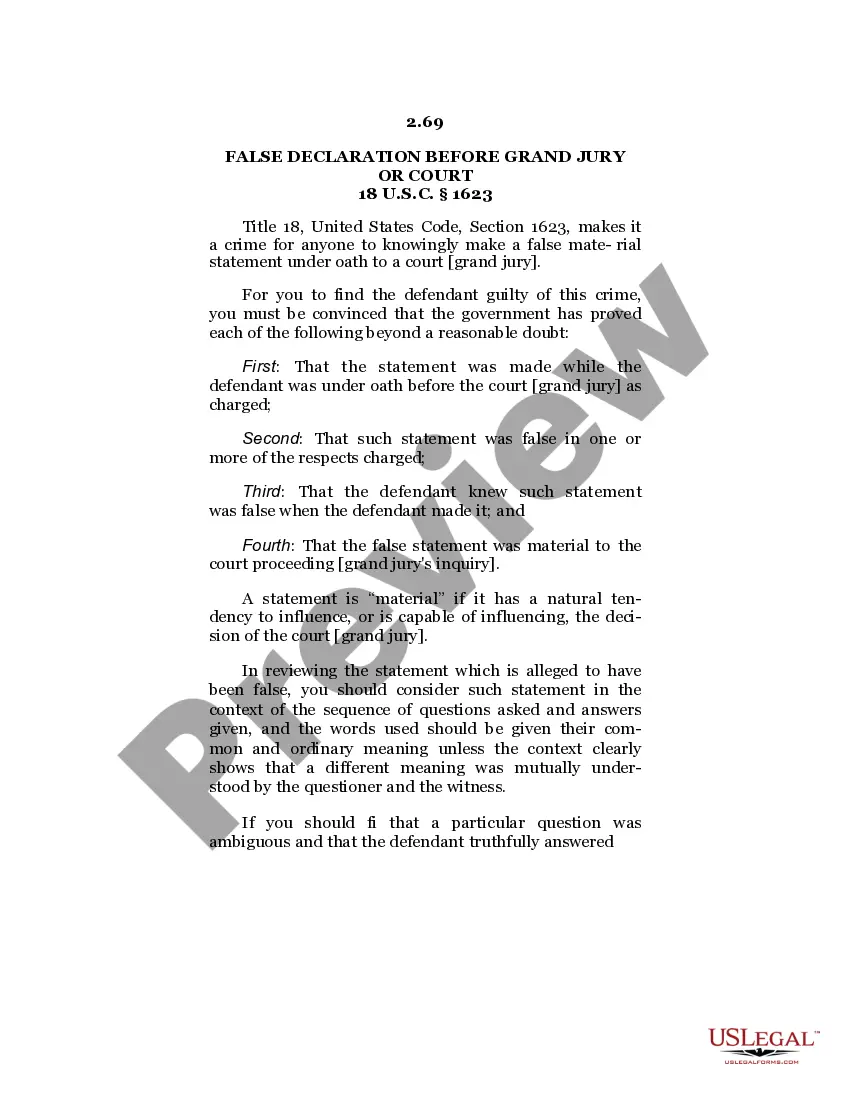
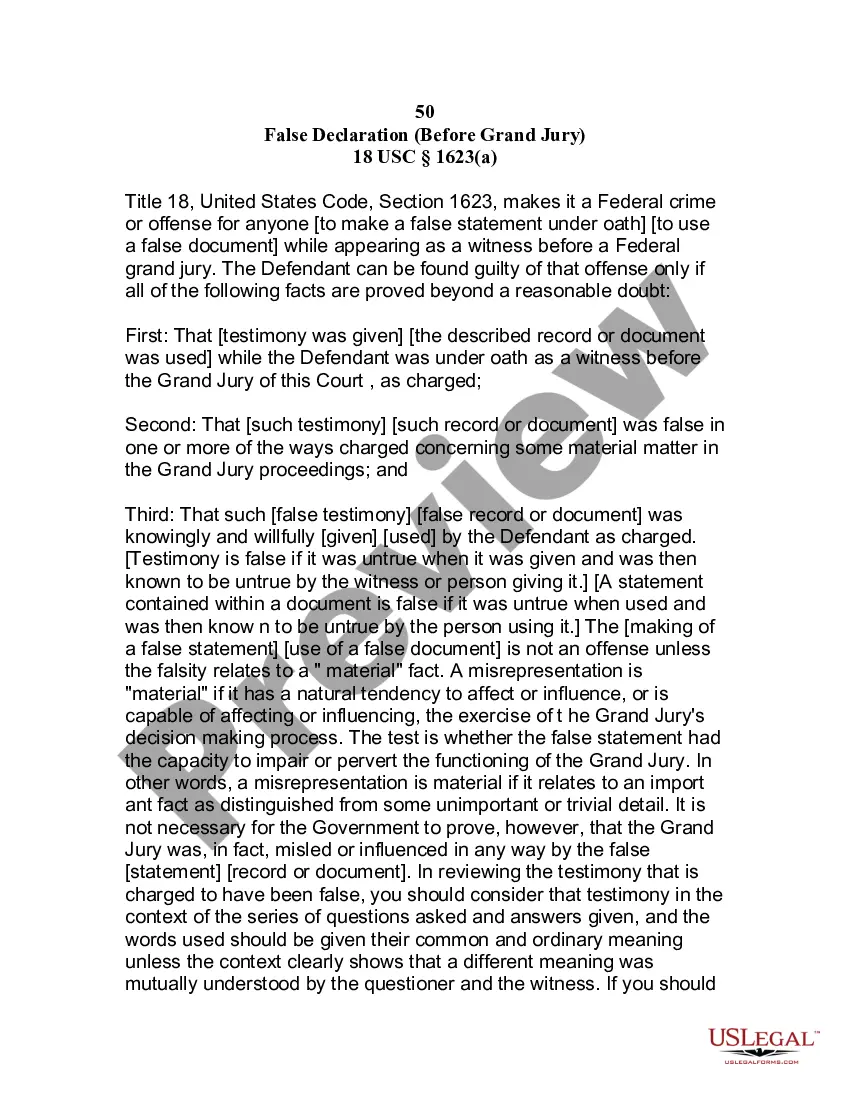
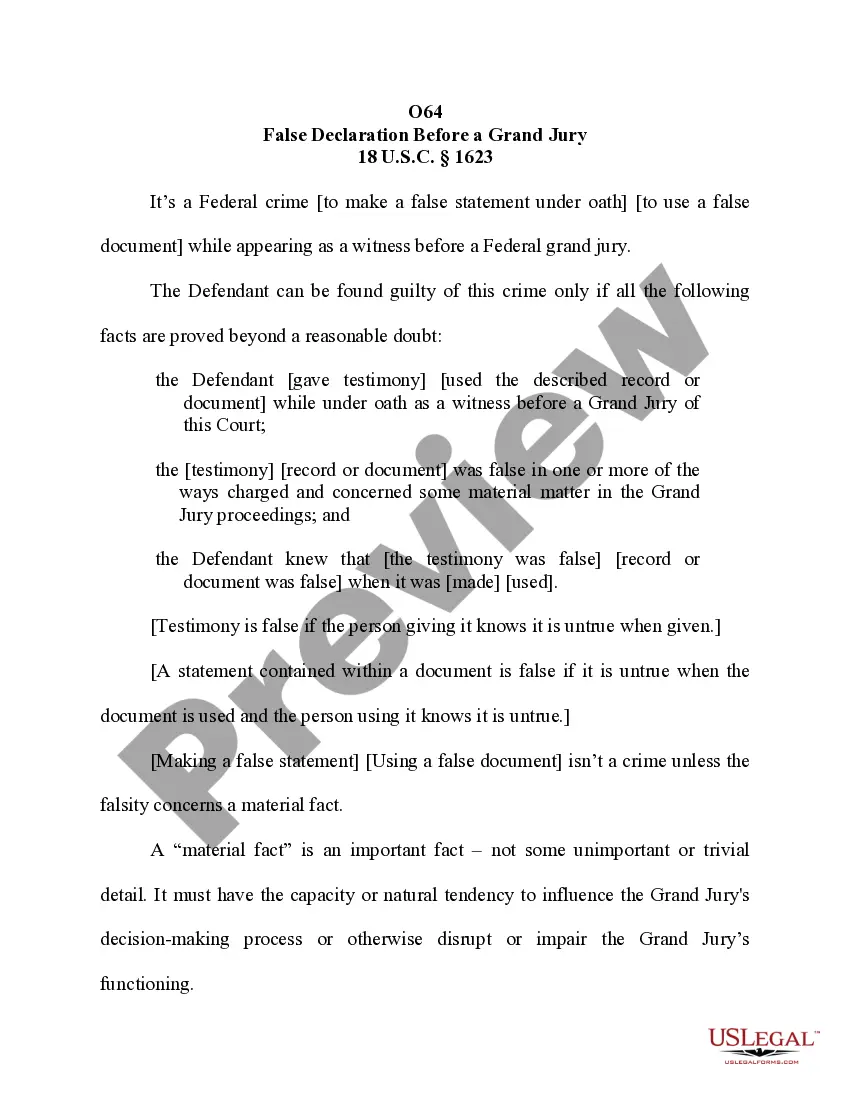
The False Declaration Before Grand Jury or Court form is a legal document used to address the consequences of making false statements under oath in a court or grand jury setting. It serves to inform individuals about the serious legal implications of providing false, material statements during legal proceedings, particularly under Title 18, Section 1623 of the U.S. Code. This form is crucial for those involved in the legal system to understand their responsibilities when testifying under oath.
Form components explained
- Identification of the defendant and the court or grand jury proceedings.
- Statement of the false declaration made under oath.
- Clarification of the materiality of the false statement to the case.
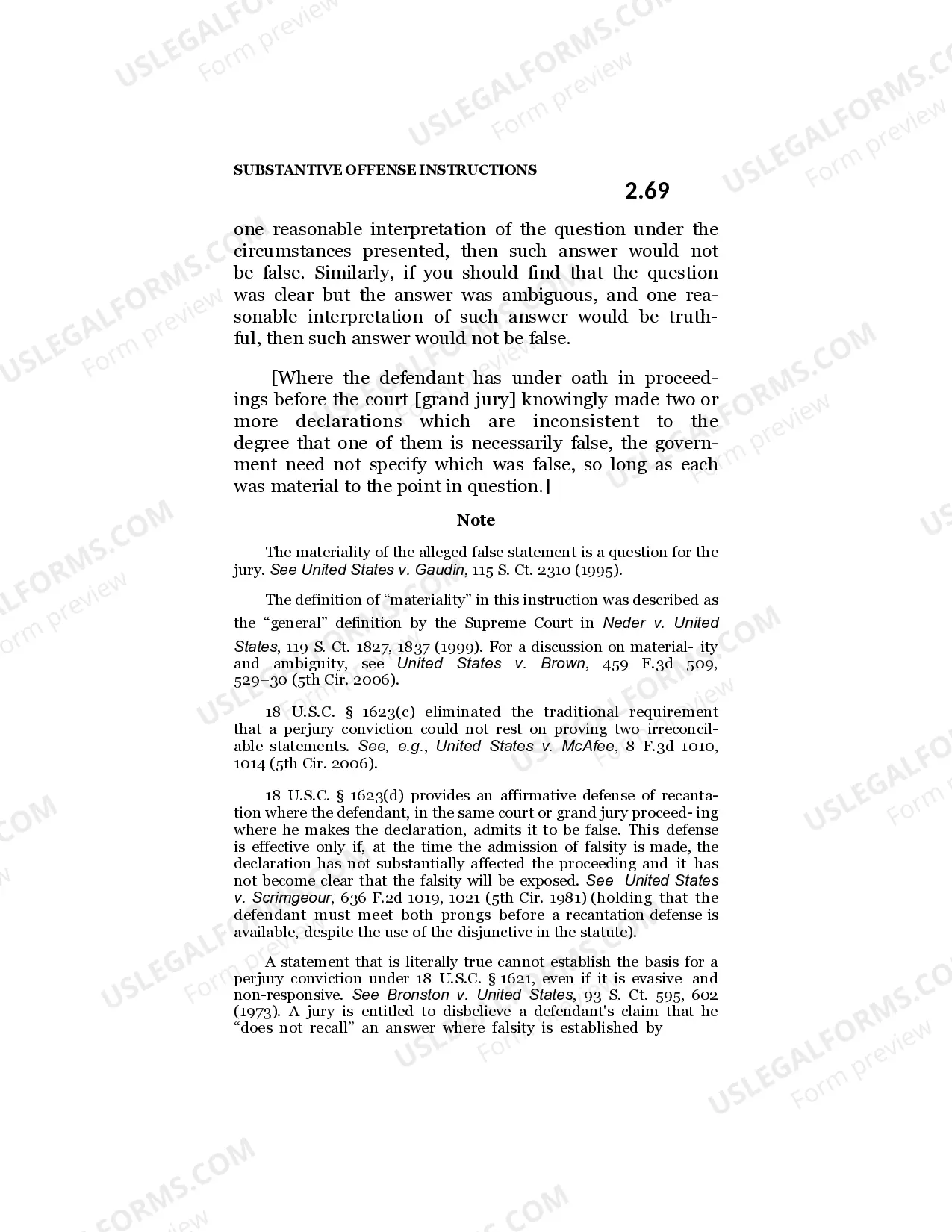
- Details regarding any affirmative defenses available to the defendant.
- Legal context and implications as defined by relevant statutes.

When to use this form
This form is needed in situations where an individual has testified under oath in a legal proceeding but has given false information. It is used to outline the potential legal repercussions and clarify the conditions under which the falsehood was made. Individuals who are preparing to address accusations of perjury or false statements in court may rely on this form as part of their legal documentation.
Who should use this form
- Individuals who have been summoned to testify before a grand jury or court.
- Defendants facing allegations of making false statements under oath.
- Individuals needing to understand their rights and obligations when providing sworn testimony.
- Legal counsel representing clients involved in grand jury proceedings or court cases.
Completing this form step by step
- Provide your full name and any relevant identifiers, such as case numbers.
- Clearly state the false declaration made during the oath-taking process.
- Indicate whether there are any defenses available, such as recantation.
- Consult legal counsel to review the completed form for accuracy and completeness.
- Submit the form to the appropriate court or authority as required.
Notarization requirements for this form
This form does not typically require notarization unless specified by local law. Ensure to check any specific jurisdictional requirements before submission.
Get your form ready online
Our built-in tools help you complete, sign, share, and store your documents in one place.
Make edits, fill in missing information, and update formatting in US Legal Forms—just like you would in MS Word.
Download a copy, print it, send it by email, or mail it via USPS—whatever works best for your next step.
Sign and collect signatures with our SignNow integration. Send to multiple recipients, set reminders, and more. Go Premium to unlock E-Sign.
If this form requires notarization, complete it online through a secure video call—no need to meet a notary in person or wait for an appointment.
We protect your documents and personal data by following strict security and privacy standards.

Make edits, fill in missing information, and update formatting in US Legal Forms—just like you would in MS Word.

Download a copy, print it, send it by email, or mail it via USPS—whatever works best for your next step.

Sign and collect signatures with our SignNow integration. Send to multiple recipients, set reminders, and more. Go Premium to unlock E-Sign.

If this form requires notarization, complete it online through a secure video call—no need to meet a notary in person or wait for an appointment.

We protect your documents and personal data by following strict security and privacy standards.
Typical mistakes to avoid
- Failing to provide a clear and concise statement of the false declaration.
- Not understanding the materiality of the statement and its implications.
- Overlooking the need for legal counsel before submission.
- Omitting relevant case information such as case numbers or court details.
Benefits of using this form online
- Convenience of downloading and completing the form at your own pace.
- Editability allows for easy updates and corrections before submission.
- Access to templates drafted by licensed attorneys ensures accuracy.
- Secure storage and easy retrieval for future reference.
Legal use & context
- This form serves legal documentation in proceedings to uphold the integrity of the judicial system.
- Failure to complete this form truthfully can result in significant legal penalties, including charges of perjury.
- The context and manner of responses are crucial; even truthful statements can be misleading if not articulated clearly.
Main things to remember
- Ensure all statements made under oath are truthful and clear.
- Understand the definition and implications of materiality when declaring statements.
- Consult legal professionals if facing allegations pertaining to false declarations.
- Review local laws for any specific requirements regarding the form.
Looking for another form?

Form popularity
FAQ
The offence of ?Perjury? is stating false testimony or furnishing false evidence by a person on oath. It can be done by stating wrong or incorrect or suppressed information in the affidavit submitted in the court proceedings.
The U.S. Code's Sections 1621 and 1623 of title 18 govern perjury before a federal court, tribunal, or grand jury. If you are facing this type of accusation, whether on its own or as part of other criminal allegations at the state and/or federal level, you could face severe penalties with lasting consequences.
Perjury (also known as foreswearing) is the intentional act of swearing a false oath or falsifying an affirmation to tell the truth, whether spoken or in writing, concerning matters material to an official proceeding.
A person convicted of perjury under federal law may face up to five years in prison and fines. (18 U.S.C. § 1621.) The punishment for perjury under state law varies from state to state but is typically a felony.
Section 1623(c) authorizes a person to be accused of having ?made two or more declarations, which are inconsistent to the degree that one of them is necessarily false,? and the government is not required to specify which declaration is false.
DIFFERENCES BETWEEN PERJURY & MAKING FALSE STATEMENTS And for perjury, the statement must be literally false and made with intent to deceive or mislead. In contrast, making false statements applies when people lie to the government regardless of whether it's under oath or not.
Generally any person can lodge complaint of an offence and set the law in motion. Exception to this rule is offences. Specified u/s 195 CrPC. Section 195 lays down rules to be followed by the court to take cognizance of an offence specified under it.
False declaration means the act of declaring assets, income and liabilities with an intention to conceal their disproportionate assets by providing incomplete or incorrect information.