Virginia Employment or Job Termination Package
What is this form package?
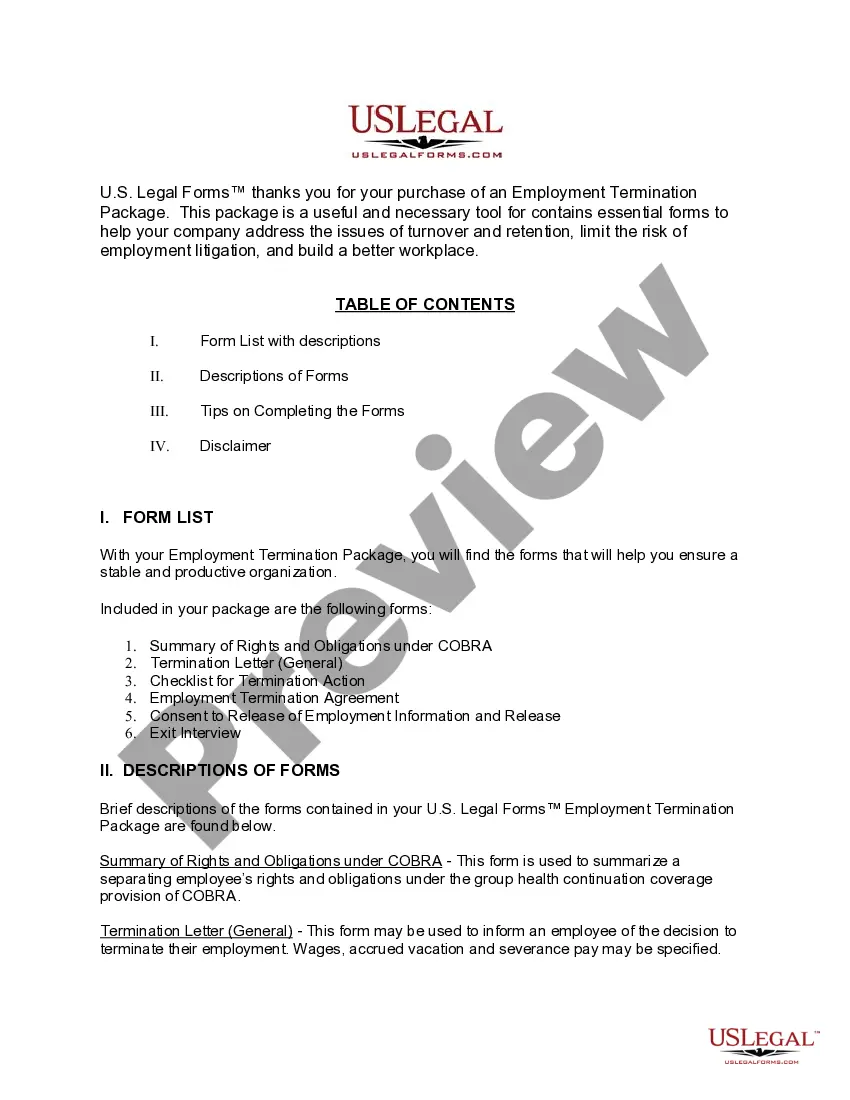
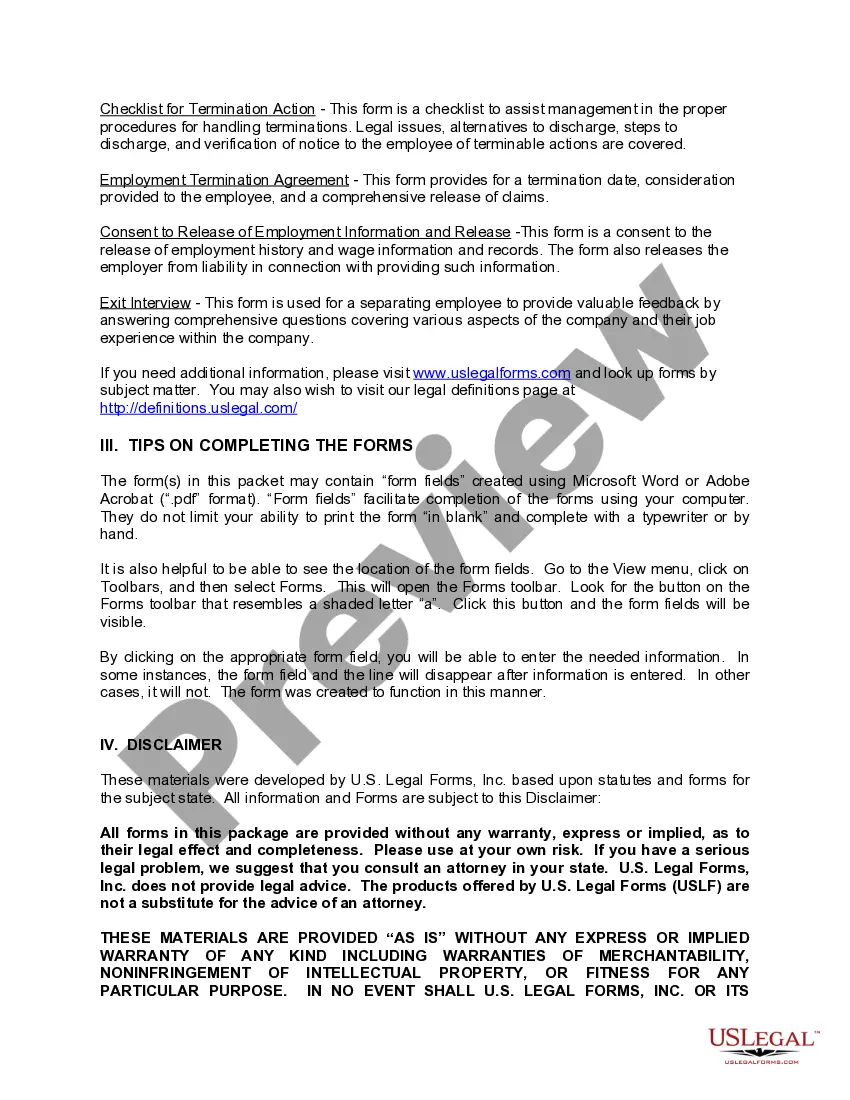
The Virginia Employment or Job Termination Package provides essential legal forms designed to assist employers in managing employee terminations effectively. This package streamlines the complexities of the termination process, ensuring compliance with legal requirements and minimizing the risk of potential disputes. Included forms cover important aspects such as termination notifications, employee rights under COBRA, and feedback through exit interviews, making it a comprehensive resource for any employer in Virginia.
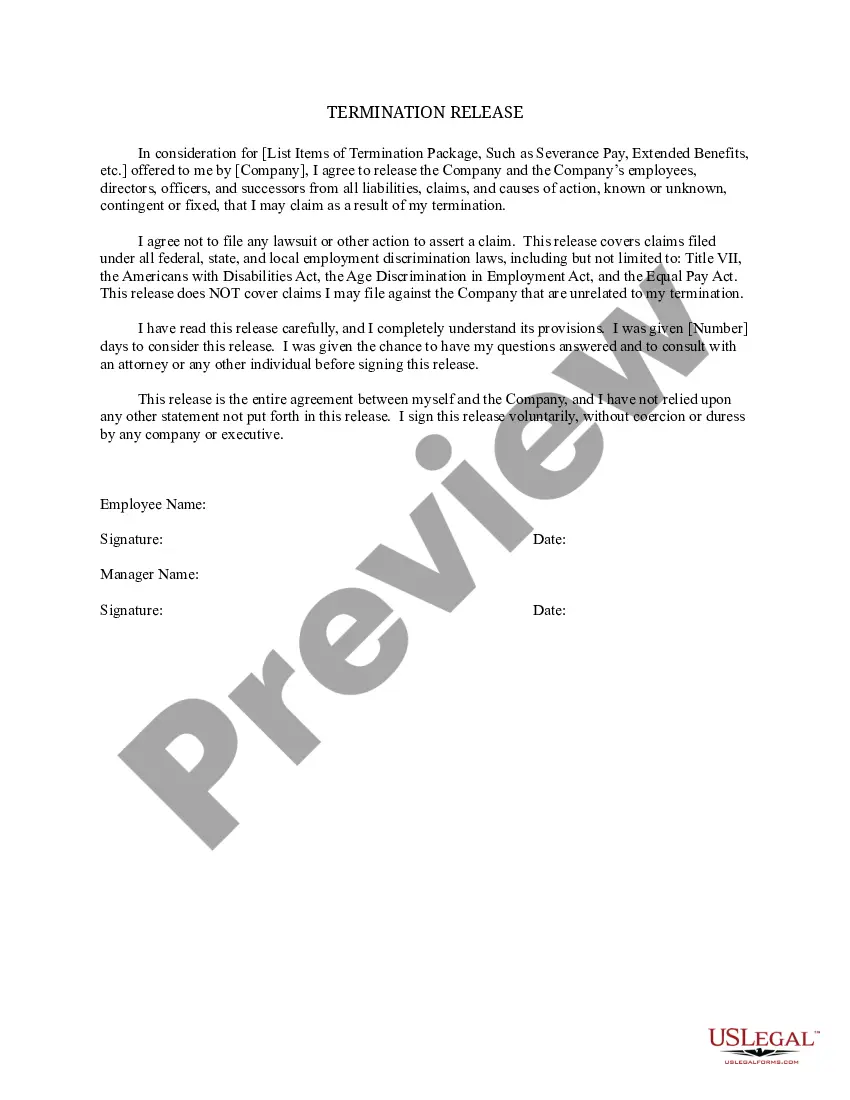
Forms included in this package

When to use this form package
This form package should be utilized when an employer needs to finalize an employee's termination. It is applicable in various scenarios, such as:
- When planning to terminate an employee for performance-related issues.
- When an employee resigns and needs a formal exit process.
- During organizational restructuring that affects employees.
- When addressing employee layoffs due to economic conditions.
Who should use this form package
- Employers or human resources personnel managing employee separations.
- Business owners who need to ensure compliance with employment laws.
- Managers responsible for handling exit processes within their teams.
- Organizations looking to standardize their termination procedures.
Steps to complete these forms
- Review included forms for your specific needs.
- Prepare any necessary employee information to complete the forms.
- Fill out the Termination Letter and Employment Termination Agreement with relevant details.
- Use the Checklist for Termination Action to ensure all steps are followed properly.
- Conduct an exit interview using the provided form to gather feedback.
Notarization details for included forms
Forms in this package typically do not require notarization unless required by local law. However, it is advisable to check the specific requirements based on your individual circumstances or legal advice.
Get your form ready online
Our built-in tools help you complete, sign, share, and store your documents in one place.
Make edits, fill in missing information, and update formatting in US Legal Forms—just like you would in MS Word.
Download a copy, print it, send it by email, or mail it via USPS—whatever works best for your next step.
Sign and collect signatures with our SignNow integration. Send to multiple recipients, set reminders, and more. Go Premium to unlock E-Sign.
If this form requires notarization, complete it online through a secure video call—no need to meet a notary in person or wait for an appointment.
We protect your documents and personal data by following strict security and privacy standards.

Make edits, fill in missing information, and update formatting in US Legal Forms—just like you would in MS Word.

Download a copy, print it, send it by email, or mail it via USPS—whatever works best for your next step.

Sign and collect signatures with our SignNow integration. Send to multiple recipients, set reminders, and more. Go Premium to unlock E-Sign.

If this form requires notarization, complete it online through a secure video call—no need to meet a notary in person or wait for an appointment.

We protect your documents and personal data by following strict security and privacy standards.
Avoid these common issues
- Failing to complete all required fields in the termination forms.
- Not adhering to the established termination checklist.
- Ignoring the need for a COBRA rights summary.
- Not allowing the employee an opportunity for an exit interview.
Why use this package online
- Immediate access to legally drafted forms ensures quick processing.
- Editable forms allow customization to fit specific employee situations.
- Reliability, as all forms are created by licensed attorneys.
- Convenient downloading and storage for future reference.
Looking for another form?
Form popularity
FAQ
Under California law, severance pay is not considered wages for unemployment purposes. Instead, it is considered a payment in recognition of your past service. Even if it is paid out in installments, as yours will be, it doesn't count against your unemployment.
You will be disqualified if the deputy determines that you quit your job without good cause, or you were fired from your job for misconduct in connection with your work. You and your employer have the right to appeal the deputy's determination if either of you disagrees with the results.
If severance pay does extend the employment relationship, however, unemployment benefits may not be available until the severance ends. For example, if you receive a lump sum amount of severance on your last day of work, you may apply for unemployment.
A: Currently the maximum weekly benefit amount is $378 and the minimum is $60. Individuals must have earned at least $18,900.01 in two quarters during the base period to qualify for the maximum weekly benefit amount. Benefit duration varies from 12 to 26 weeks, also depending on wages earned in the base period.
If an employer makes a lump sum severance payment at the time the worker is separated from a job but allocates the severance payment to a week or weeks other than the week in which the payment is made, then the worker's weekly unemployment benefits will be reduced in each claimed week to which the severance payment is
This means that, absent an employment contract, either the employer or the employee may terminate the employment arrangement at any time. Also, the termination may occur for any reason, or no reason at all, as long as the motivations for firing the worker are not illegal.
Like most states, Virginia maintains a common law rule that employees are at will, meaning that they can be terminated for any reason or no reason, and mutually, the employee may terminate his or her employment for any reason or no reason, unless the employee is under a contract otherwise.
In Virginia, in the absence of an employment contract, an employer usually has no obligation to provide an employee severance pay. If severance pay is offered, an employer will almost always provide the employee with a severance agreement.
If you are receiving severance pay, you will not receive benefits until the VEC contacts the employer about the severance payments. Severance pay may potentially block unemployment benefits for the period of time to which it is allocated by the employer.The VEC will contact the employer to obtain this information.