Virginia Notice of Assignment to Living Trust
What this document covers
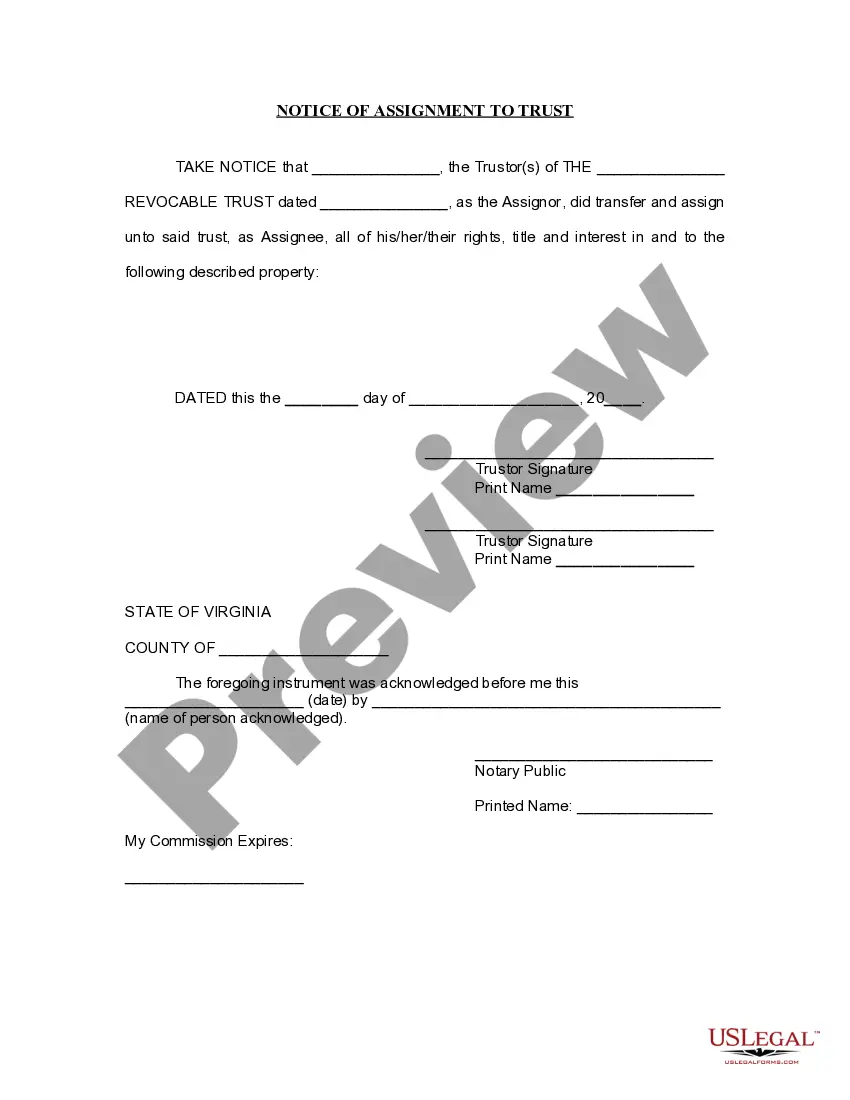
The Notice of Assignment to Living Trust is a legal document that announces the transfer of assets into a living trust established during the trustor's lifetime. This form serves the purpose of notifying interested parties that specific rights, titles, and interests in property have been assigned to the trust, distinguishing it from other estate planning documents such as wills or power of attorney forms.
What’s included in this form
- Identification of the trustor(s) who created the living trust.
- Details of the specific revocable trust being referenced, including the trust's date.
- Transfer statement indicating the rights, title, and interest being assigned to the trust.
- Signature line for the trustor, affirming the transfer.
- Notary acknowledgment section to provide legal verification of the transfer.
Situations where this form applies
This form should be used when a trustor wants to formally notify others about the assignment of property to their living trust. Common scenarios include transferring real estate, bank accounts, or other significant assets into the trust for better estate management and planning purposes. By using this form, the trustor can ensure that the transfer is legally recognized and properly documented.
Who can use this document
- Individuals who have established a living trust and wish to transfer property into it.
- Trustors seeking to provide clear notice of asset assignments to beneficiaries or interested parties.
- Anyone involved in estate planning who wants to manage assets effectively and avoid probate.
How to complete this form
- Identify the trustor(s) by writing their names at the start of the notice.
- Specify the name and date of the revocable trust being referenced.
- Clearly describe the property being transferred into the trust.
- Have the trustor sign the document to validate the transfer.
- Complete the notary acknowledgment section to meet legal requirements.
Is notarization required?
This form needs to be notarized to ensure legal validity. US Legal Forms provides secure online notarization powered by Notarize, allowing you to complete the process through a verified video call, available anytime.
Get your form ready online
Our built-in tools help you complete, sign, share, and store your documents in one place.
Make edits, fill in missing information, and update formatting in US Legal Forms—just like you would in MS Word.
Download a copy, print it, send it by email, or mail it via USPS—whatever works best for your next step.
Sign and collect signatures with our SignNow integration. Send to multiple recipients, set reminders, and more. Go Premium to unlock E-Sign.
If this form requires notarization, complete it online through a secure video call—no need to meet a notary in person or wait for an appointment.
We protect your documents and personal data by following strict security and privacy standards.

Make edits, fill in missing information, and update formatting in US Legal Forms—just like you would in MS Word.

Download a copy, print it, send it by email, or mail it via USPS—whatever works best for your next step.

Sign and collect signatures with our SignNow integration. Send to multiple recipients, set reminders, and more. Go Premium to unlock E-Sign.

If this form requires notarization, complete it online through a secure video call—no need to meet a notary in person or wait for an appointment.

We protect your documents and personal data by following strict security and privacy standards.
Common mistakes
- Failing to include detailed descriptions of the property being transferred.
- Not having the document notarized, if required by state law.
- Leaving out the trustor's signature or not obtaining it properly.
- Incorrectly naming the trust, which could lead to confusion during asset management.
Benefits of completing this form online
- Convenience of downloading and completing the form from anywhere at any time.
- Editability to customize the form according to specific needs and scenarios.
- Access to reliable templates drafted by licensed attorneys to ensure legal validity.
Summary of main points
- The Notice of Assignment to Living Trust is essential for legally transferring property to a living trust.
- It ensures clarity and documentation of asset assignments, supporting effective estate management.
- Notarization is an important step in the process to enhance legal enforceability.
Looking for another form?


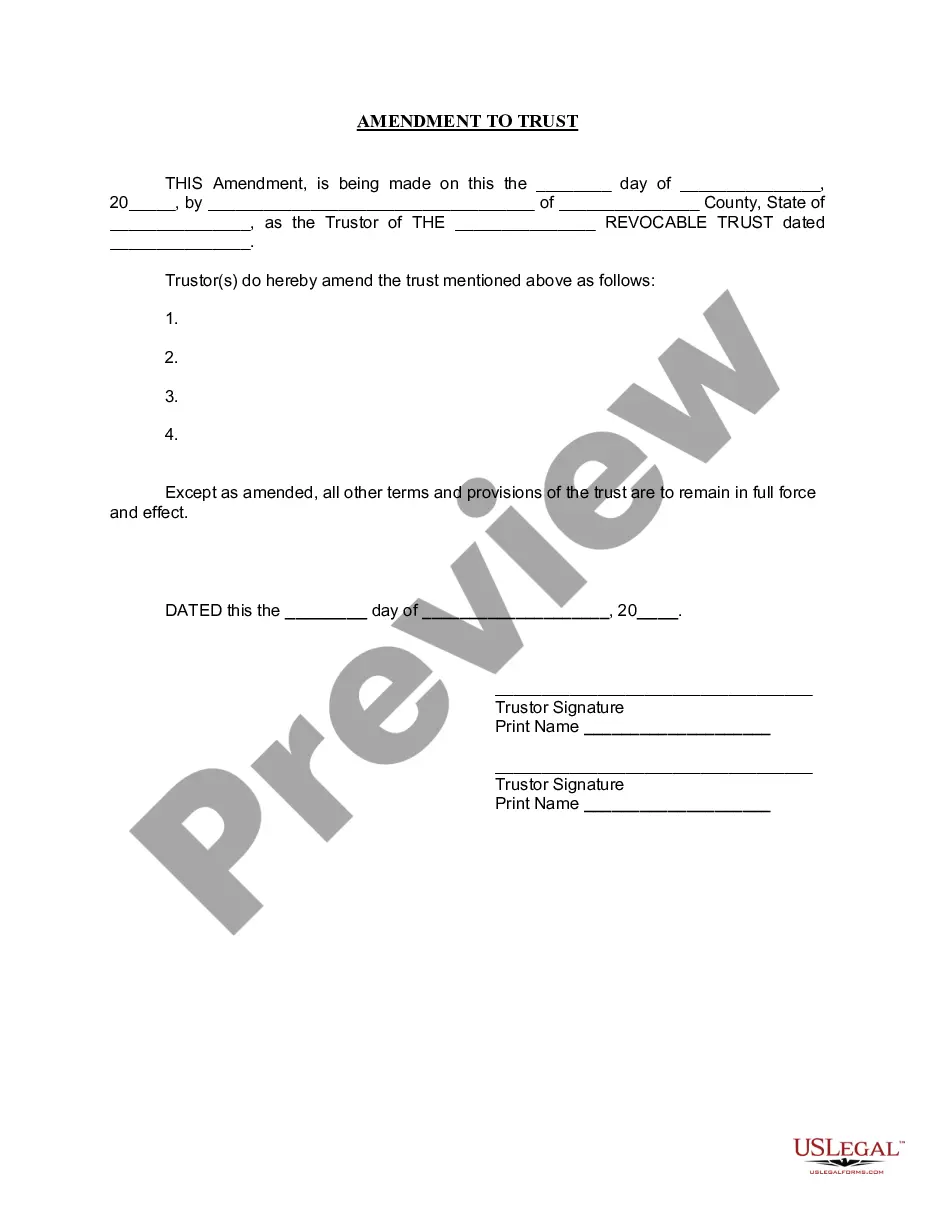

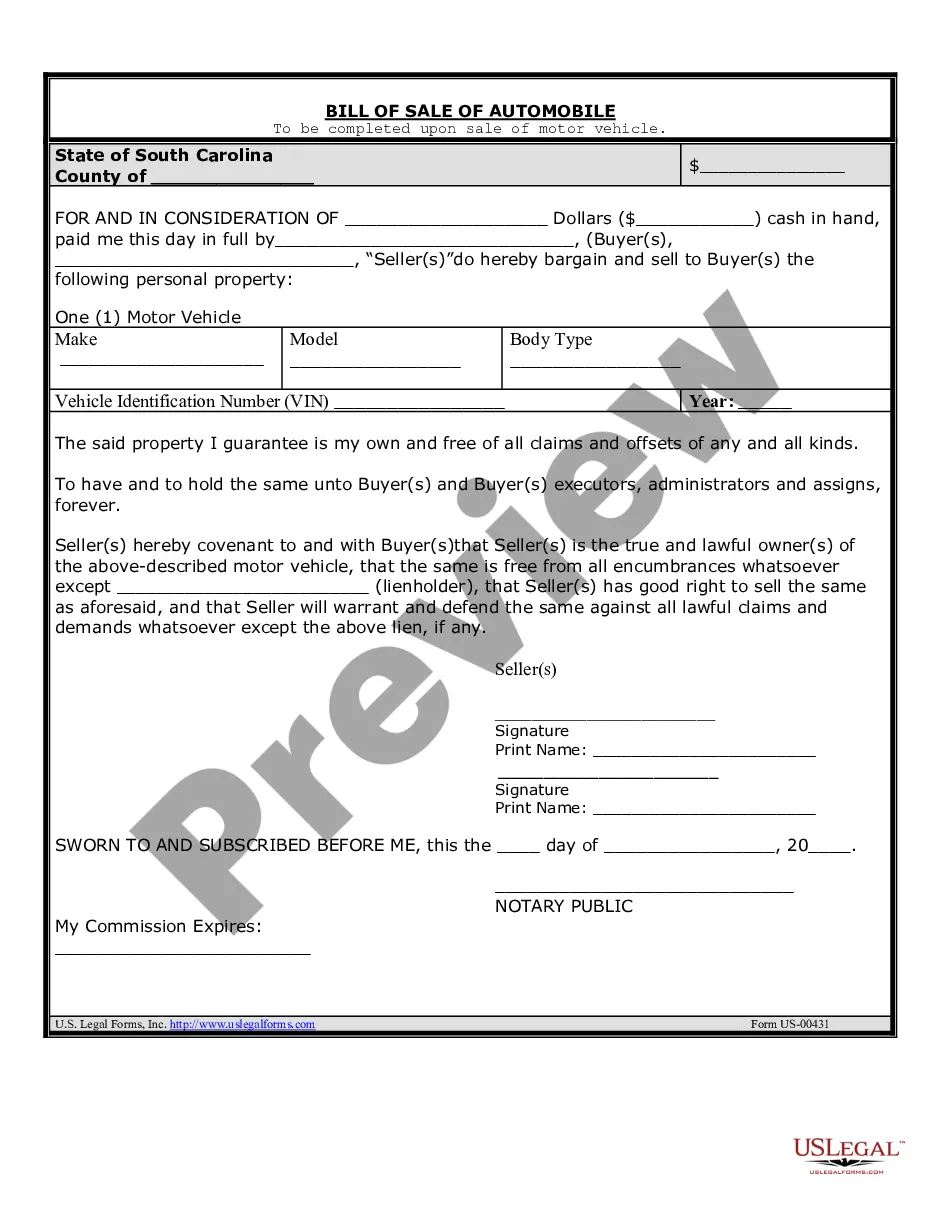
Form popularity
FAQ
The Virginia Notice of Assignment to Living Trust is a legal document used to notify interested parties that assets have been transferred into a living trust created during the trustor’s lifetime. It identifies the trustor, the revocable trust (with its date), and the property being moved, and it includes the trustor’s signature and a notary acknowledgment to formally document the transfer and distinguish it from a will or POA.
In Virginia, a living trust is created during the trustor’s lifetime, and assets can be transferred into the trust for management during life and distribution after death. The Virginia Notice of Assignment to Living Trust serves to notify that transfer to the trust and can help with ongoing asset management and probate avoidance.
The transfer statement should clearly describe the rights, title, and interest being assigned to the trust and reference the revocable trust by its date, while identifying the trustor(s). This ensures the specific assets are documented as belonging to the trust and that the notice matches the form’s included components.
The trustor must sign the Virginia Notice of Assignment to Living Trust, and the form includes a notary acknowledgment to verify the transfer. Notarization provides legal verification that the signer released rights and interests to the trust, helping to document the asset assignment.
This notice is appropriate when the trustor wants to move assets into the living trust, such as real estate, bank accounts, or other significant property. It formally informs interested parties and provides documentation that the asset transfer into the trust has occurred for estate planning purposes.
This Virginia-specific notice differs from a generic notice by tailoring the document to Virginia practice: it requires identifying the trustor and the exact revocable trust (including its date) and includes a notary acknowledgment. A generic notice may omit these state-specific details and notarization, potentially reducing evidentiary value.